The three- plate theory is a cognitive model about Ponzi proposed by Crypto Veto . This article explores the reasons for the three bull markets based on this theory: MEME currency is a mutual aid plate, DeFi is a dividend plate, and ICO is a split plate.
What is the three-disc theory?
Crypto Veda believes that one of the greatest values of Crypto is the democratization and tradability of Ponzi for the first time.
Everyone can hand out and trade plates. Putting aside external factors, every bull market in Crypto is driven by Ponzi’s fundamental innovation. If you study Ponzi, you can find the megatrend-level Alpha in the market based on the primacy required by Ponzi’s innovation.
Although Ponzi is dazzled, in the final analysis there are only three models: dividend plate, mutual aid plate and split plate. All Ponzi is a combination of these three models. Based on this logical analysis method, he called it the "Three Pan Model". The three markets can appear individually or in combination. Each has its own advantages and disadvantages, corresponding to the corresponding starting, trading and collapse logic.
- Dividend plate: invest a whole sum of money at one time and gain linear dividends over time;
- Mutual aid: A pays money to B, B pays money to C, and C pays money to A, resulting in a flow mismatch, and the income is settled on a per-transaction basis;
- Split plate: Continuously split an asset target into new targets. Attract incremental funds through new low-priced targets. Income is realized through underlying value appreciation
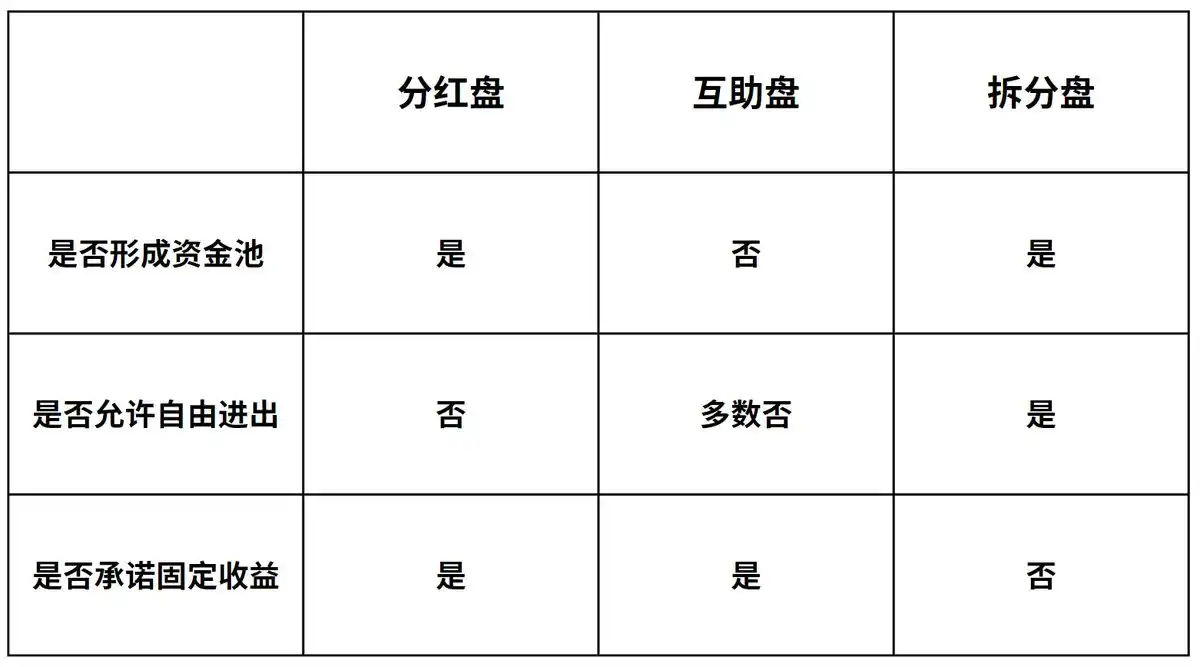
In terms of logical design, the characteristics of the three disks are as follows:
MEME is a mutual aid disk
The core of traditional mutual aid is the mismatch of capital flow. This model usually involves multiple participants transferring funds to each other sequentially, forming a funding loop. Generally speaking, a user receives more money from the next party than he gives to the previous party, thus earning more money than their original investment. Projects generally earn rewards through a commission on each transfer.
This Ponzi model is the most decentralized of the three models, because once the rules are formulated, there is no need for "management" to intervene, because pumping is essentially taxing.
The traditional mutual aid market is a mismatch of funds on a spatial scale, so it does not need to form a capital pool, and most of them cannot freely enter and exit funds, but they must promise high returns. So why is it said that MEME coin is a mutual aid disk?
We generally believe that MEME coins have two most important attributes:
- Fair Launch: everyone can participate (everyone can help each other);
- Full circulation: No reservation required by the project party;
- The so-called "cultural attributes" and "extremely large total amount" are not necessary.
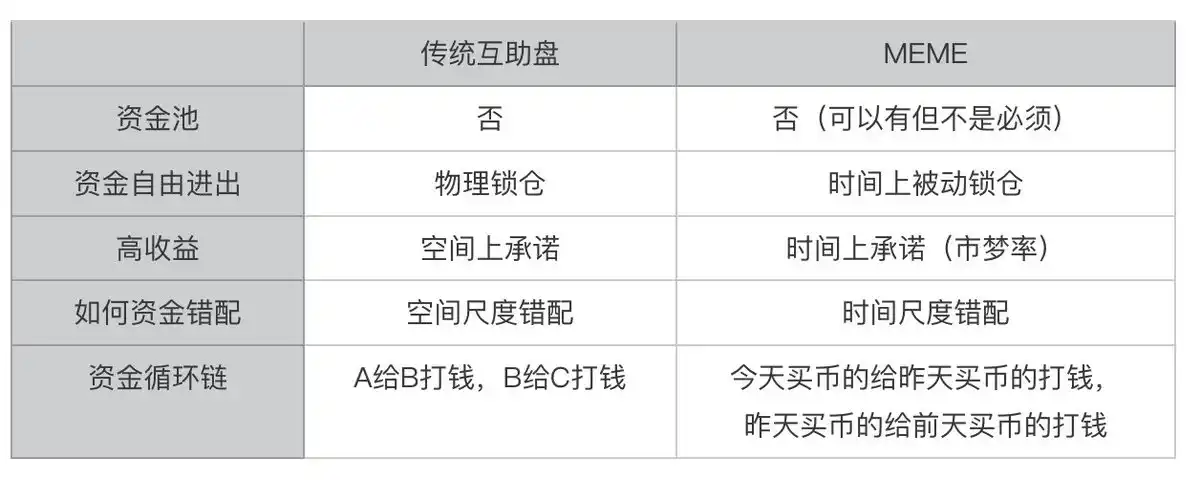
MEME coin is actually a mismatch of funds on a time scale. Let's assume that in a certain bull market context, a certain MEME currency has been rising strongly. In fact, those who bought the currency at a high price today will send money to those who bought the currency yesterday, and those who bought the currency yesterday will send money to those who bought the currency at the lowest price the day before yesterday. And because of the uniqueness of time itself, "passive lock-in" is formed (people cannot cross the same river forever). So we have the comparison below:
DeFi is a dividend payout
DeFi is the core narrative of the last bull market (2020). Technically, it means writing financial rules into smart contracts (a way to combine blockchain technology with a certain field). From the perspective of token economics, it is Distribute protocol tokens through liquidity mining: deposit money into the protocol to obtain Tokens.
For example, the two most important aspects in the financial field are trading and lending, then there are Uniswap and Compound. In Uniswap, users deposit token A and token B into the trading pair LP into the fund pool to obtain income. In Compound, users need to deposit loanable tokens into the fund pool to obtain income. Most of the income is protocol tokens, and a small amount is real money (stable currency).
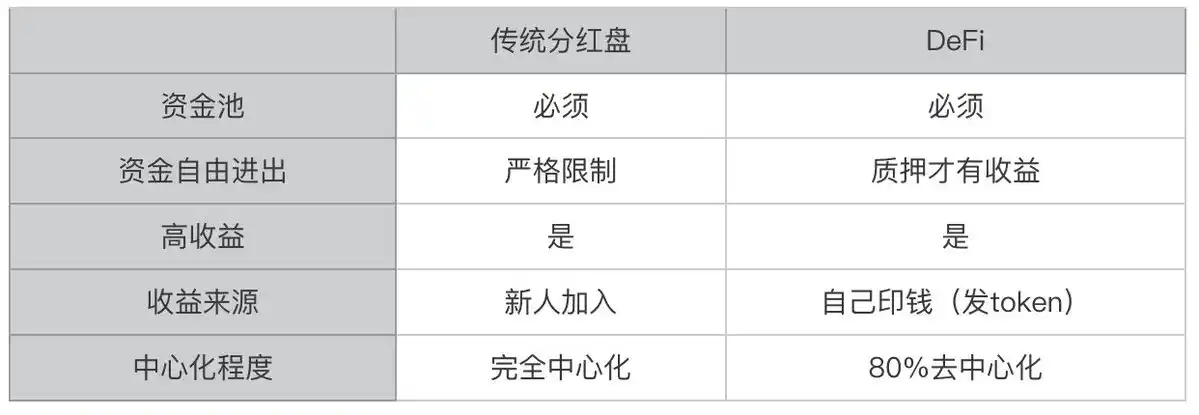
DeFi is a typical dividend plate, because the basic logic of the dividend plate is to "invest a whole amount of funds at one time and gain linear dividends over time." Is it exactly the same as the above approach? We also have the following comparison:
ICO is a split disk
ICO is the core narrative of the last bull market (2017). Its general gameplay is to write an idea in any field into a white paper, and then raise funds and issue tokens, so that most people mistakenly believe that the only application scenario of blockchain is It is "issuing coins" (another way to combine blockchain technology with a certain field). So during that cycle, many strange tokens appeared, such as "give a coin for environmental protection," "give a coin for computer work," "give a coin for charity," and so on.
We know that splitting is to continuously split an asset target into new targets. Attract incremental funds through new low-priced targets. Income is realized through the appreciation of the underlying value. Isn’t this the performance of ICO? If we regard the cryptocurrency track at that time as a fund market, the emergence of various ICOs is to split the asset target of cryptocurrency into new investment targets (new ICO tokens) through "new stories". currency) to attract incremental funds. So we still have a comparison chart:
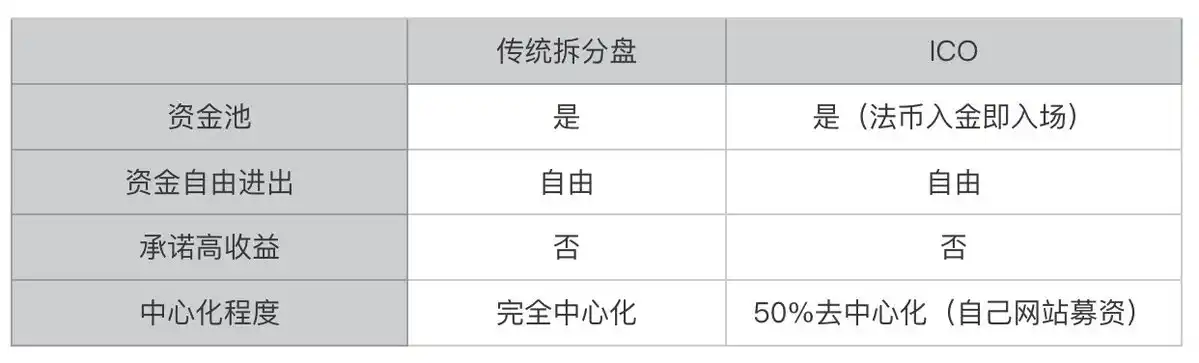
crypto is disk circle
If we ignore the specific technological evolution, just from the perspective of token economics, it seems that the past ten years have indeed represented the evolution of the Ponzi model. We can even regard Bitcoin mining as a form of dividends. Disk (the pledged mining machine generates BTC income).
Is that the order of evolution: dividend disk (BTC mining) – split disk (ICO) – dividend disk (DeFi) – mutual aid disk (MEME)? At the same time, projects are becoming more and more decentralized.
On the other hand, if you look at MEME as a track, the emergence of more and more MEME coins is actually a reflection of the split market. Then it can be considered that MEME is the combination of (mutual aid market + split market).
Mutual aid trading may be the real answer to the "no mutual support" in this bull market (Restaking is a dividend trading board, DePin is a dividend trading board, and Layer2 is a split trading board. Obviously retail investors only want to play mutual aid trading in this bull market).