It seems that AI will eliminate most humans. OpenAI CTO said in an interview that some creative jobs will disappear. Today, she once again published a long article to prove her point. And now, AI has really replaced a large number of employees in large companies.
In an interview a few days ago, OpenAI CTO bluntly stated that AI may kill some creative jobs that should not exist in the first place.
A recent report further confirmed this view.
Miller, the boss of a foreign technology media, replaced 60 employees with ChatGPT because AI is fully capable of writing and editing articles.
Even with the emergence of powerful AI tools such as ChatGPT and Claude, most people agree that they can only replace humans in formatted and repetitive tasks such as problem solving.
Now, we have to look at this issue with a completely new perspective.
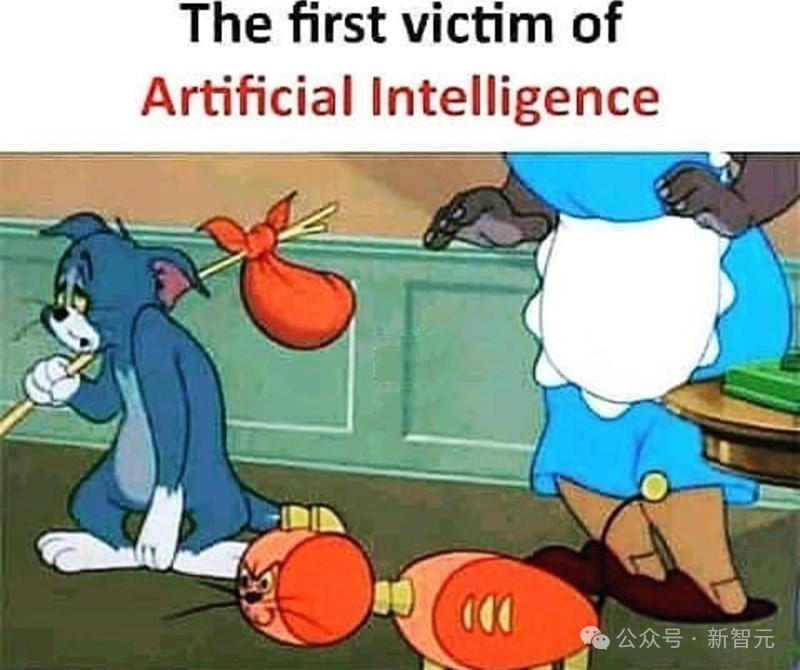
Is AI really going to eliminate those creative and imaginative humans?
Just now, Mira Murati published another long article, and even took out an article she wrote in 2022 to re-support this point of view.
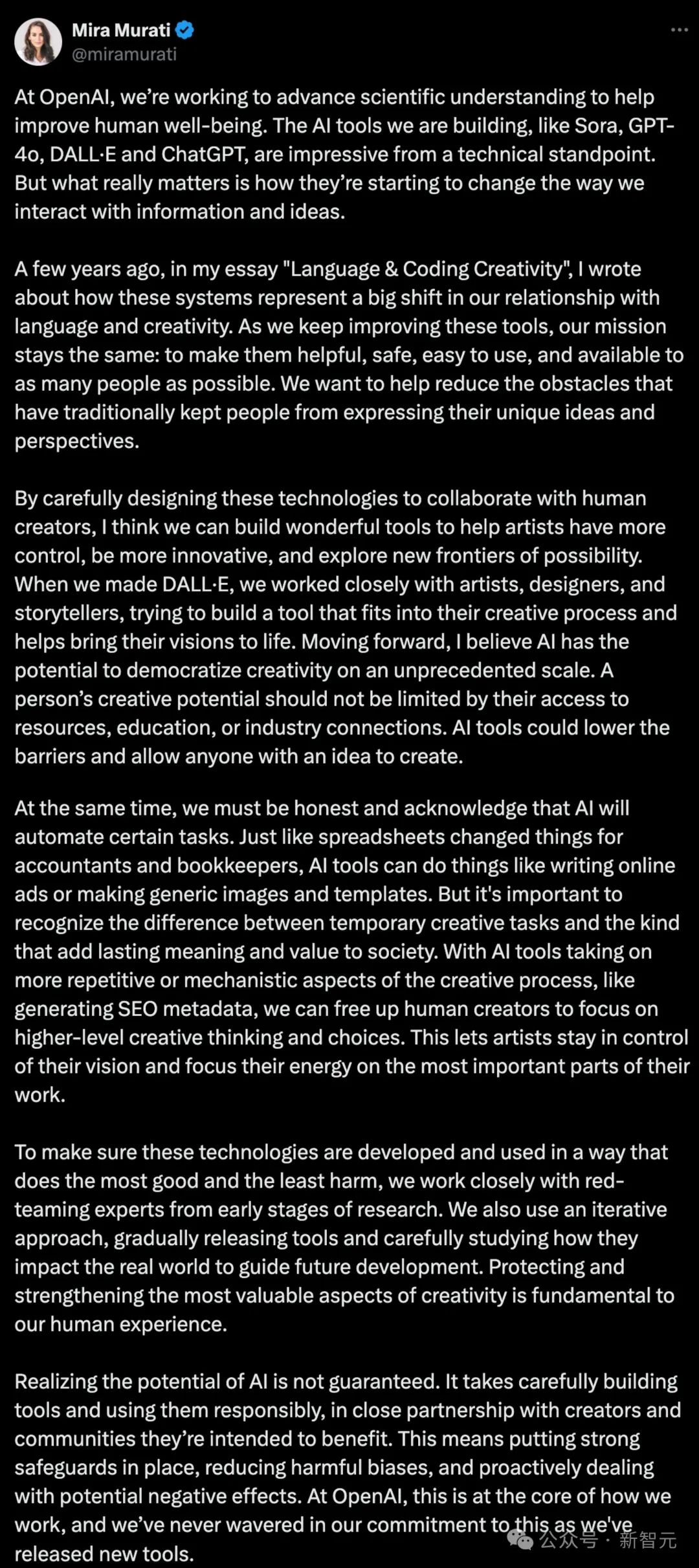
At OpenAI, we are committed to advancing scientific understanding to help improve human well-being. The AI tools we are developing, such as Sora, GPT-4o, DALL·E, and ChatGPT, are impressive from a technical perspective. But what is really important is that they are beginning to change the way we interact with information and ideas.
A few years ago, I wrote in Language and Coding Creativity that these systems represent a major shift in our relationship to language and creativity. As we continue to improve these tools, our mission remains the same: to make them useful, safe, easy to use, and accessible to as many people as possible. We hope to help reduce the barriers that have traditionally prevented people from expressing their unique ideas and perspectives.
By crafting these technologies to work with human creators, I think we can create amazing tools that help artists have more control, be more innovative, and explore new frontiers of possibility. When we were developing DALL·E, we worked closely with artists, designers, and storytellers to try to build a tool that fits their creative process and helps realize their vision. Looking ahead, I believe AI has the potential to democratize creativity on an unprecedented scale. A person’s creative potential shouldn’t be limited by resources, education, or industry connections. AI tools can lower the barrier to entry and allow anyone with an idea to create.
In response, netizens began to use Murati's recent interview remarks to play a meme - "I asked ChatGPT to summarize this post, which is to the effect that 'some creative jobs may disappear, but maybe they shouldn't exist in the first place'."

01 What the CTO said
In the long post, Mira Murati mentioned examples of how AI can perform some tasks and replace humans.
At the same time, we have to honestly acknowledge that AI will automate certain tasks.
Just as spreadsheets transformed the jobs of accountants and bookkeepers, AI tools can do things like write online ads or create generic images and templates.
But it is important to recognize the difference between temporary creative tasks and creative tasks that bring lasting meaning and value to society.
As AI tools take on more repetitive or mechanical creative processes, like generating SEO metadata, we can free up human creators to focus on higher-level creative thinking and choices.
Allowing artists to take control of their vision and focus on the most important parts of their work.
In 2022, Murati published this article "Language and Coding Creativity", which mainly discusses the question of how humans should get along with these increasingly "smart" AIs?

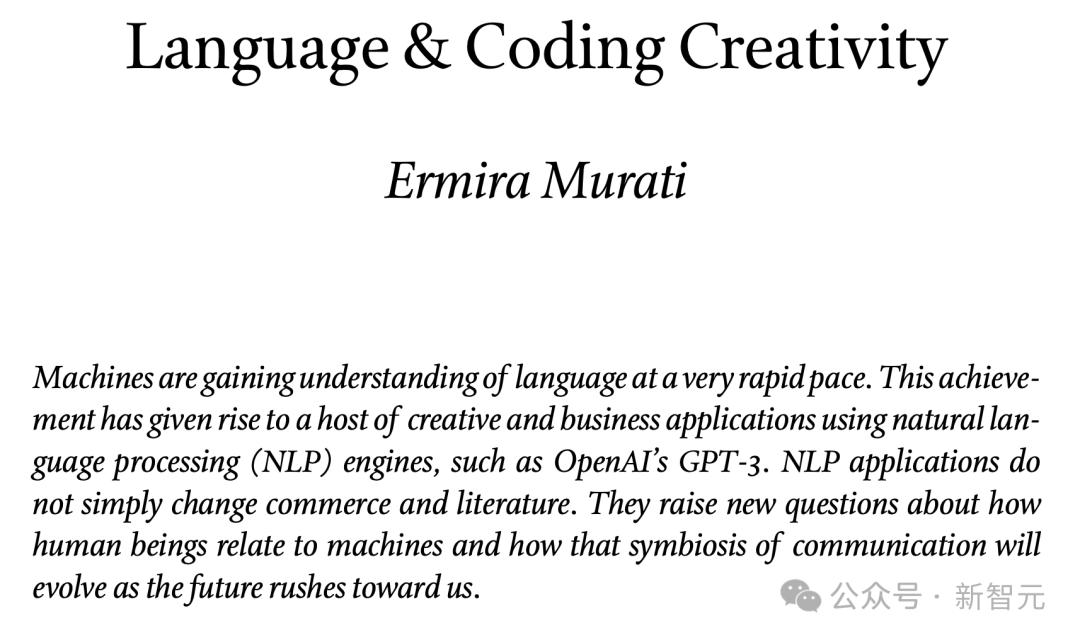
Address: https://www.amacad.org/sites/default/files/publication/downloads/Daedalus_Sp22_11_Murati.pdf
Netizens picked out a few representative opinions:
Every writer has his or her own unique aesthetic in the way he or she arranges words.
The nuances of language, or the writer’s “voice,” are one of the countless distinctive hallmarks of human creativity.
Unlocking the mysteries of this language faces a dual goal: AI must not only understand language at a human level, but also be able to generate human-level responses.
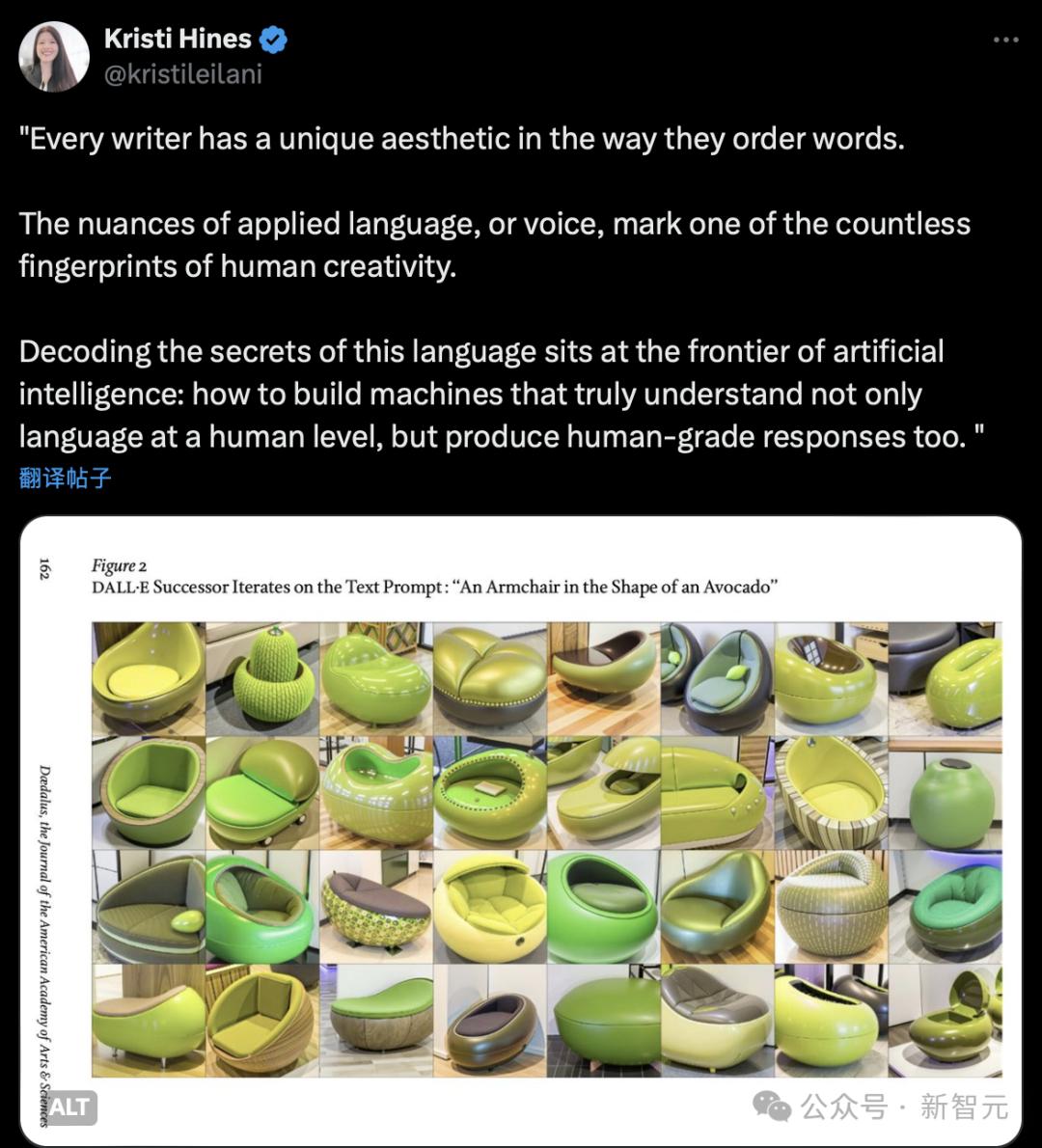
Murati also believes that AI tools could be used to do things like write online ads.

In addition to Murati, even the 25-year-old Anthropic Chief of Staff Avital Balwit previously wrote a long article saying, "I am 25 years old, and the next three years will be my last few years of work."
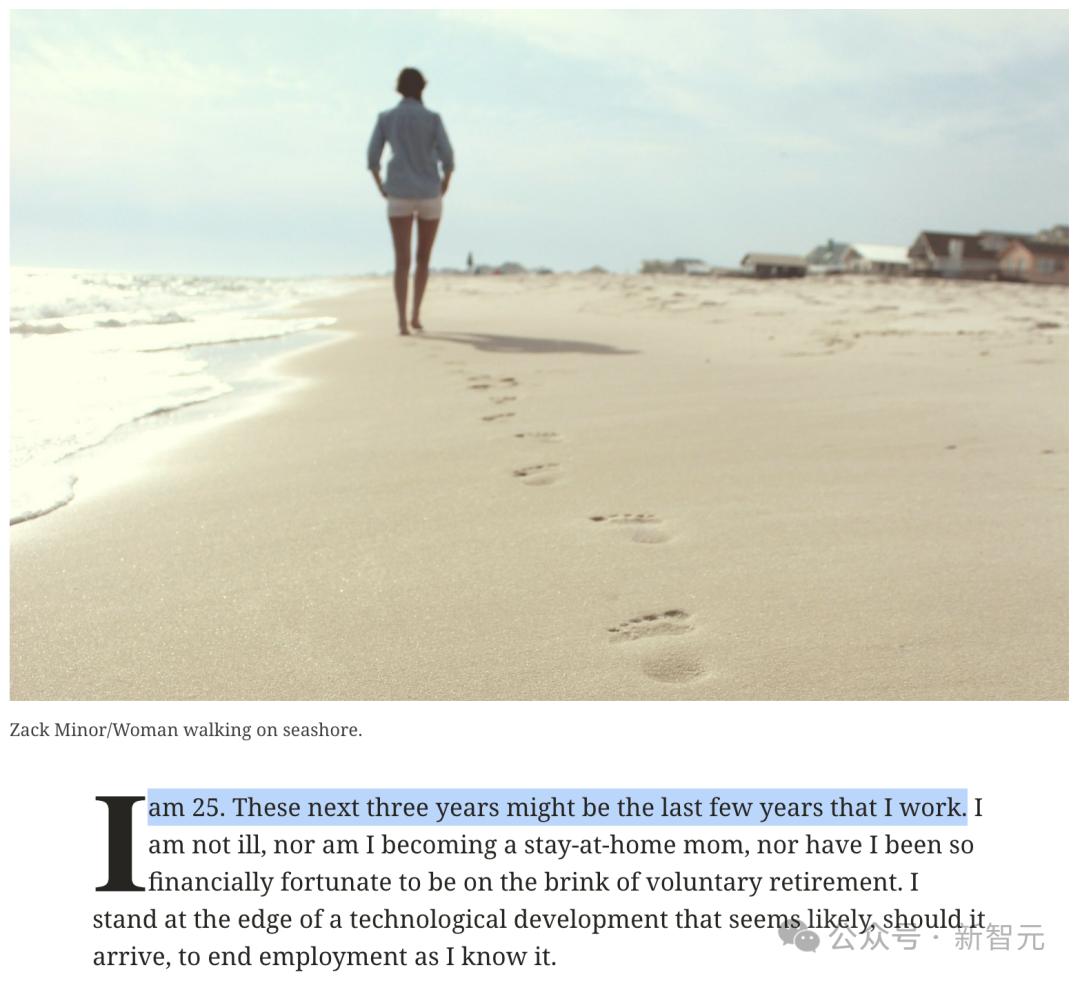
In the article, she mentioned that Claude 3 is able to handle different topics and generate coherent content. At the same time, its level of summarizing and analyzing texts is also quite good.
For Balwit, who once made a living as a freelance writer and prided himself on being able to churn out large amounts of content quickly, these developments are a bit disheartening.
She even said that basically anything that can be done by remote workers will be done better by AI.
Many tasks, including content writing, tax preparation, and customer service, are now or will soon be automated on a large scale.
Below are five real cases where AI is replacing human jobs.
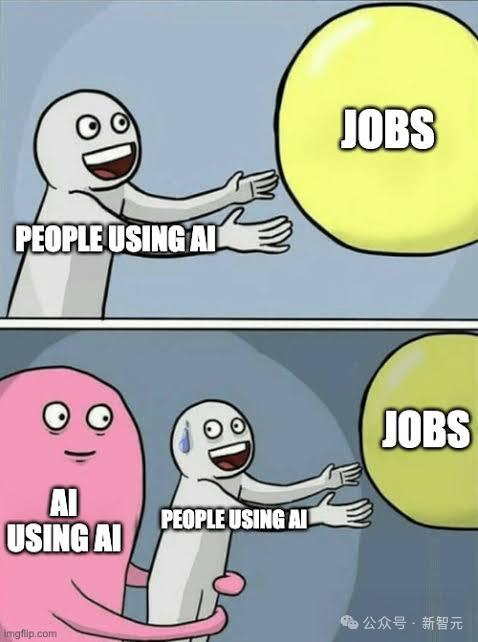
02 AI has begun to replace humans on a large scale
In February this year, Klarna, a Swedish buy now, pay later service company, said that it was building a customer service chatbot based on OpenAI and was doing the work of "700 customer service staff."
What’s more, these AIs do it faster and more accurately.
Klarna's CEO told WSJ that this greatly improved the company's efficiency, meaning more work could be done with fewer people.
Large financial services firms, such as Goldman Sachs and Morgan Stanley, are also introducing AI tools.
These tools could replace most entry-level white-collar jobs on Wall Street, such as preparing spreadsheets, creating presentations, and analyzing financial data.
While people may be less sympathetic toward Wall Street employees, it’s still a sign of the times.
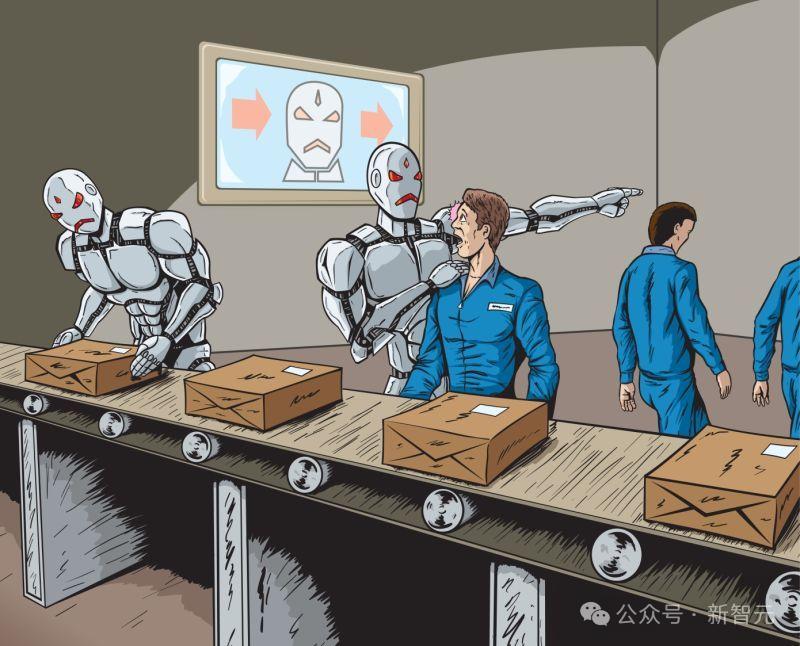
In addition, electronics retailer Best Buy has carried out large-scale layoffs, laying off many employees, including field workers in its Geek Squad.
At the same time, it has also launched a new AI project with Google to use GenAI to provide customers with a more personalized, industry-best technical support experience.
For some small businesses, the power of AI is gradually penetrating.
Little Beaver Brewery in Bloomington, Illinois, and Burning Rice, an Asian restaurant in the Dallas area, are using platforms like Slang.ai to automatically answer customer calls and reserve seats.
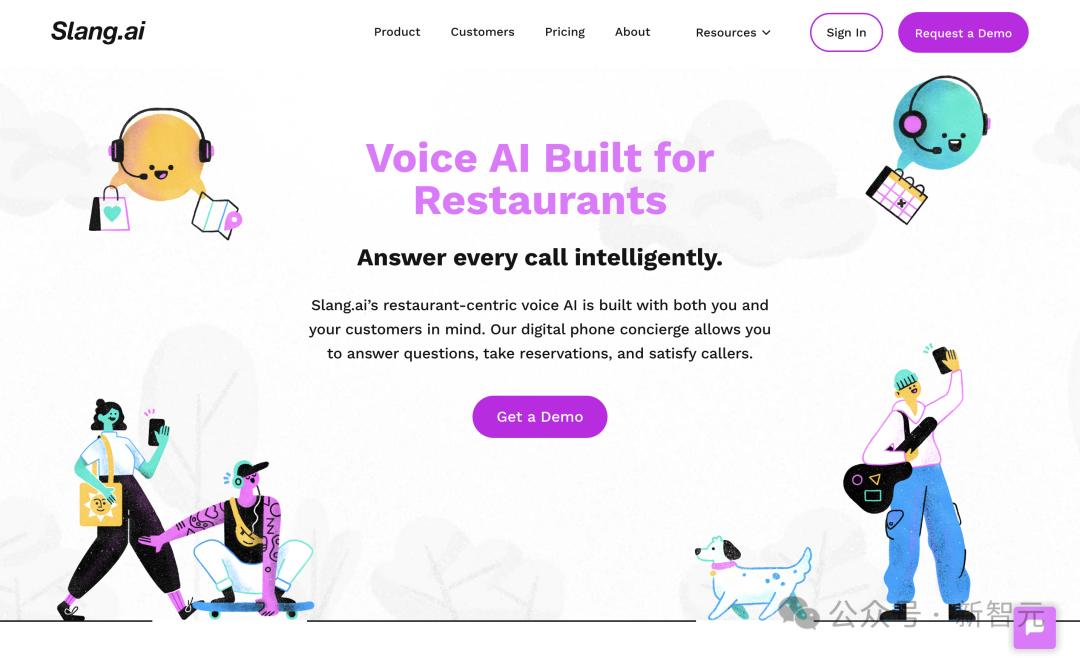
Slang.ai proudly declares on its website that “by 2030, we will save businesses and consumers 1 billion minutes of valuable time while transforming branded voice experiences into the preferred method of communication.”
This is equivalent to nearly 700,000 working days, which should have been done by humans but are now replaced by AI.
Even some local governments have begun to take action to incorporate AI into their workflows.
The Texas Education Agency is rolling out a new AI grading system that will replace most of the district’s human graders.
The agency expects the system to save $15 million to $20 million a year by reducing the need for temporary human raters, and plans to hire fewer than 2,000 raters this year, compared with 6,000 by 2023.
These are real cases that happened around us.
Goldman Sachs has also previously predicted that by 2030, up to 300 million people worldwide will be unemployed, which is actually not far away.
Throughout history, a large number of occupations and jobs have disappeared due to technological development.
For example, blacksmiths, typists, data entry clerks, telephone operators, elevator operators, bank tellers, these occupations no longer exist.
In the past 20 years alone, we've seen postal workers, video rental store clerks, and TV repairmen mostly replaced by technological advances.
In any case, artificial intelligence will replace more jobs.
03 Murati’s interview remarks sparked public outrage
A key glimpse into the potential for AI to replace human jobs can also be gained from a recent interview with Murati.
Murati received a bachelor's degree in mathematics and engineering from Dartmouth College, and the school just awarded her an honorary Doctor of Science title this month.
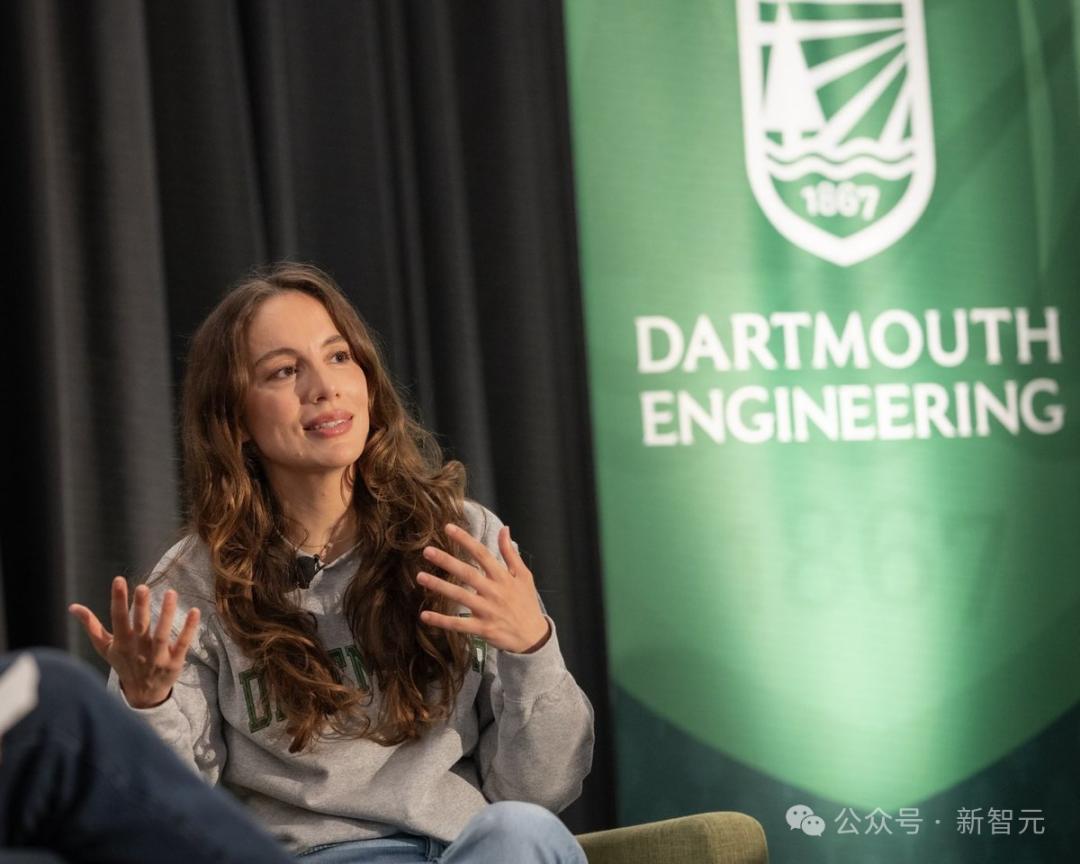
Murati, who returned to her alma mater for an interview, may have been too outspoken, causing many netizens who were already worried about AI to become even more angry, especially about how she viewed the job losses and social impacts caused by AI.
Murati said that AI systems have reached human levels in specific tasks. GPT-3 is similar to the intelligence of a baby, while GPT-4 has evolved to be more like a high school student.
She revealed that OpenAI will next focus on researching PhD-level intelligence on specific tasks, perhaps in just a year or a year and a half.
Previously, it was revealed that the internal code name of GPT-5 may be Gobi and Arrakis.
Microsoft CTO Kevin Scott also mentioned in an interview some time ago that GPT-5 has made significant improvements in reasoning and problem-solving, and can pass complex exams.
Artificial intelligence expert Alan D. Thompson created a comprehensive database of large-scale language models, and GPT-5 completed training as early as April.

Murati's metaphor for the level of AI intelligence is exactly the same as that of a former OpenAI employee who wrote an article predicting that ASI would be achieved in 2027.
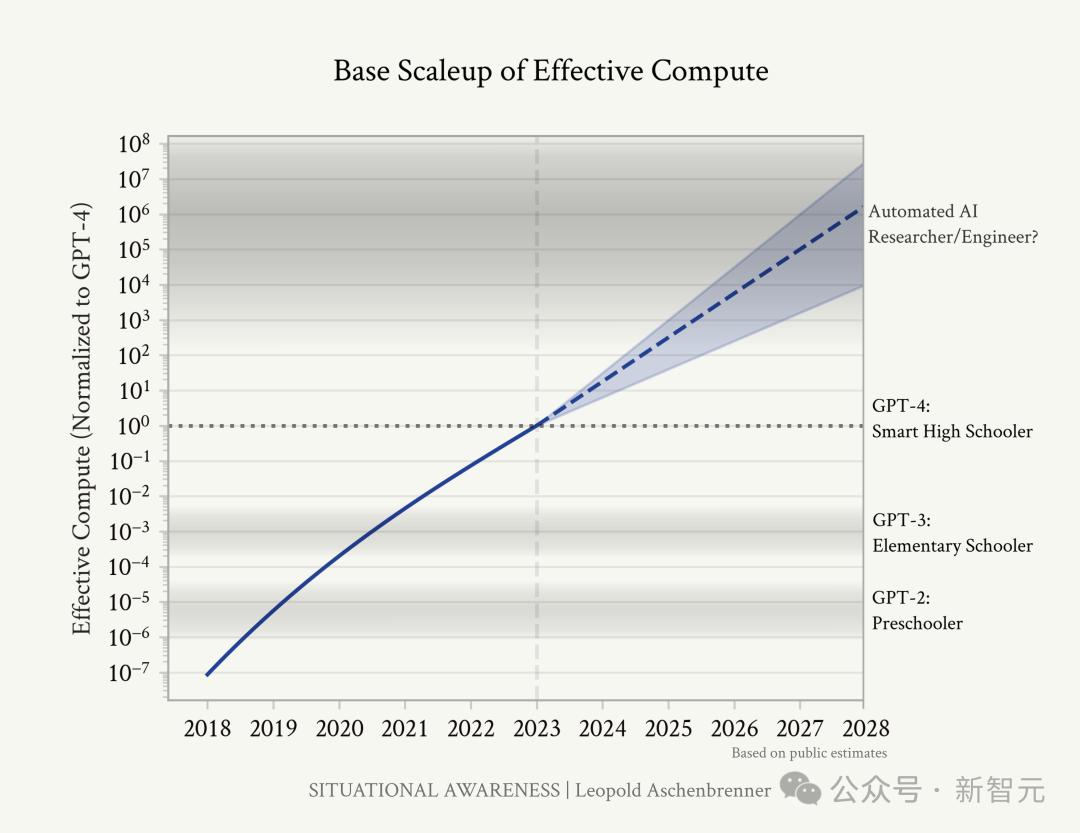
As a result, the topic naturally turned to the regulation, safety and social impact of AI. Compared with the advancement of technology, this seems to be the question that OpenAI executives are asked more often.
Murati's initial statement was quite abstract and vague. She said that AI has had an impact in finance, content, media, medicine and other fields. For example, the first version of design, coding, emails, articles, basically everything can be automatically generated by AI, which is also Murati's favorite way to use AI.
But which industry will be hit hardest in the future?
Probably all industries that involve cognitive work. It will take longer for AI to really enter the physical world, but until then, it will affect everything in the cognitive field.
Murati remains very positive and optimistic about this unknown impact.
In her eyes, AI is not "invading" or "plundering" the field of content creation that belongs to humans, but is completing boring, tedious and procedural work, allowing us to focus on creativity or the really difficult parts.
Therefore, Murati seems to have come to the conclusion that the role of AI is not "replacement" but "collaboration tool" to help humans liberate and expand their creativity and imagination to a greater extent.
From this perspective, the following statement seems to make sense:
“Humans will figure out how to make the creative part of their jobs better. Some creative jobs may disappear, but maybe they shouldn’t exist in the first place if the output is low-quality content.”
When asked by the host to further elaborate on the impact of AI on employment, Murati also frankly admitted that his company's understanding of this aspect was insufficient.
“The truth is, we don’t really understand what the impact of AI will be on jobs. I’m not an economist, but it’s a given that a lot of jobs are going to change, some jobs are going to disappear, and some jobs are going to increase.”
It’s conceivable that strictly repetitive tasks will be replaced, such as writing test code or answering questionnaires, but AI will also create jobs in many other places.
Can job losses and employment gains caused by AI offset each other? Murati said he doesn't know, and perhaps no one really knows, because we still lack reliable research in this regard.
AI will cause economic transformation and create value, so the key question is how to utilize this value.
In order to gradually build reliable cognition and prediction, we must first help people understand the capabilities of AI, integrate the system into the workflow, and then start predicting the impact. However, at present, people do not seem to realize the extent and scope of the use of these AI tools, and no one is conducting research in this regard.
Therefore, we should start with the current situation and understand what is happening now, as well as the nature of work and education, which will help predict how we should prepare for future work capabilities.
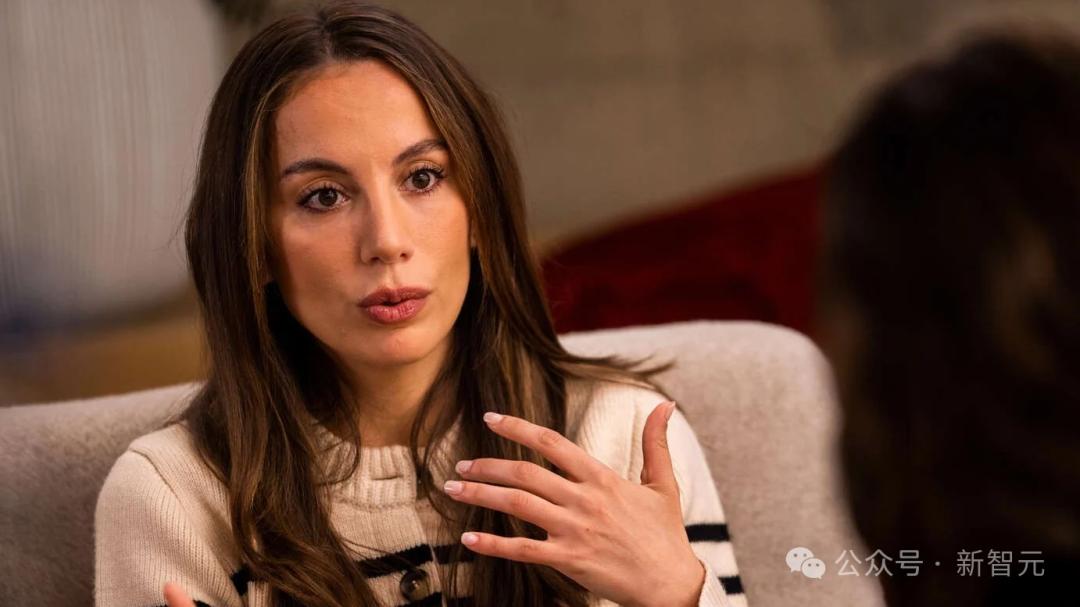
Although Murati's logical framework is very self-consistent and he does not deceive himself about the unknown issues but rather admits them generously, many netizens still do not buy it.
After all, who wouldn't be anxious about having their job replaced? Not everyone can be as calm as Anthropic's chief of staff.
The Reddit community had a particularly heated discussion on this matter, with some netizens expressing their anger and dissatisfaction with OpenAI's attitude, believing that this was naked bandit logic.
“If my new invention is going to take someone else’s job away, the last thing I’m going to say is, ‘Well, maybe that job shouldn’t have existed in the first place.’ What kind of bullshit is that?”
“Especially considering that OpenAI ‘stole’ millions of works of art as training data.”
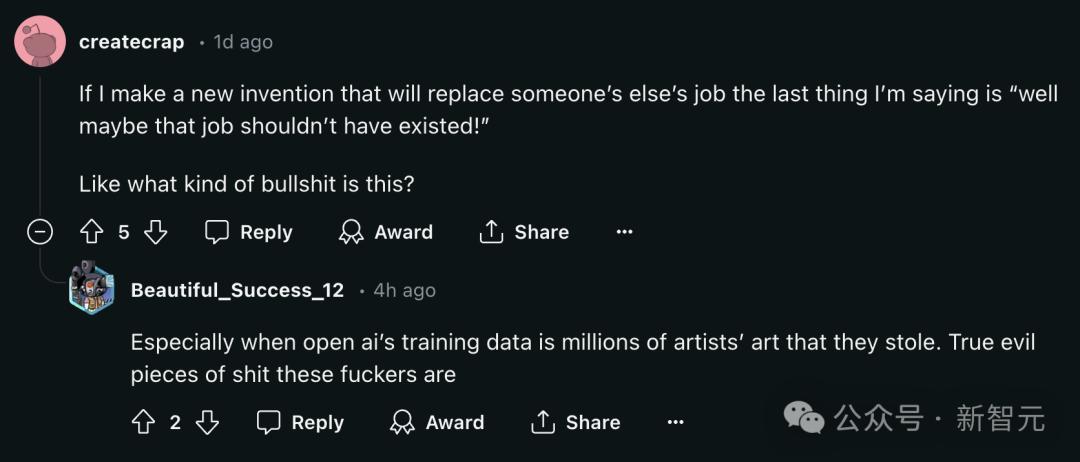
“If junior lawyers’ jobs are being automated, then they shouldn’t exist in the first place?”

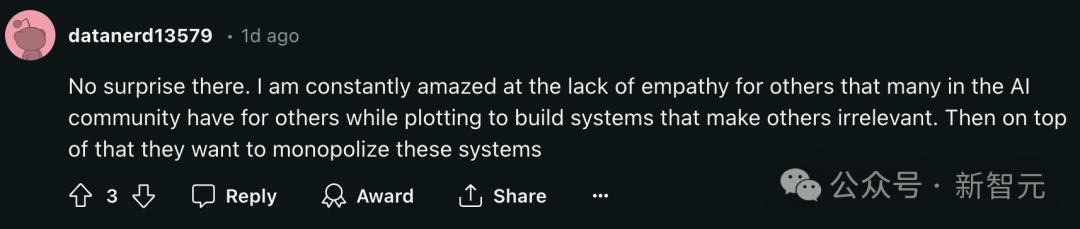
“Not surprisingly, I am continually amazed at the lack of empathy many in the AI community have for others, while they conspire to build systems that render them irrelevant. On top of that, they want to monopolize these systems.”
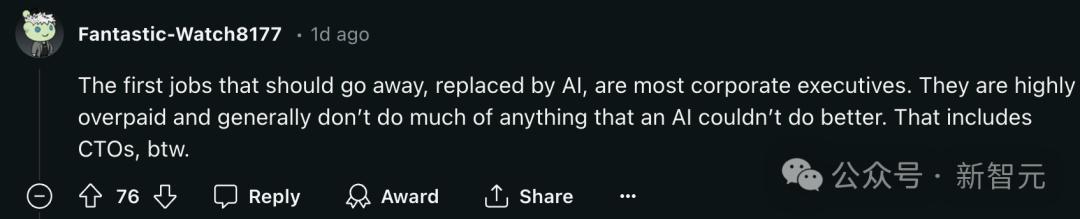
Some netizens’ counterattacks were sharp and humorous, which was amazing - "The first jobs that should be replaced by AI are most corporate executives. Their salaries are too high, and AI can do as well as they do. By the way, this also includes CTO (Murati’s position)."
Interestingly, last year edX actually published a survey result, which found that 49% of CEOs believed that most or even all of their work should be replaced by AI.

In addition, executives also believe that 47% of employees are not prepared for the future of work. However, in the eyes of employees themselves, only 20% believe that their roles can be replaced by AI.
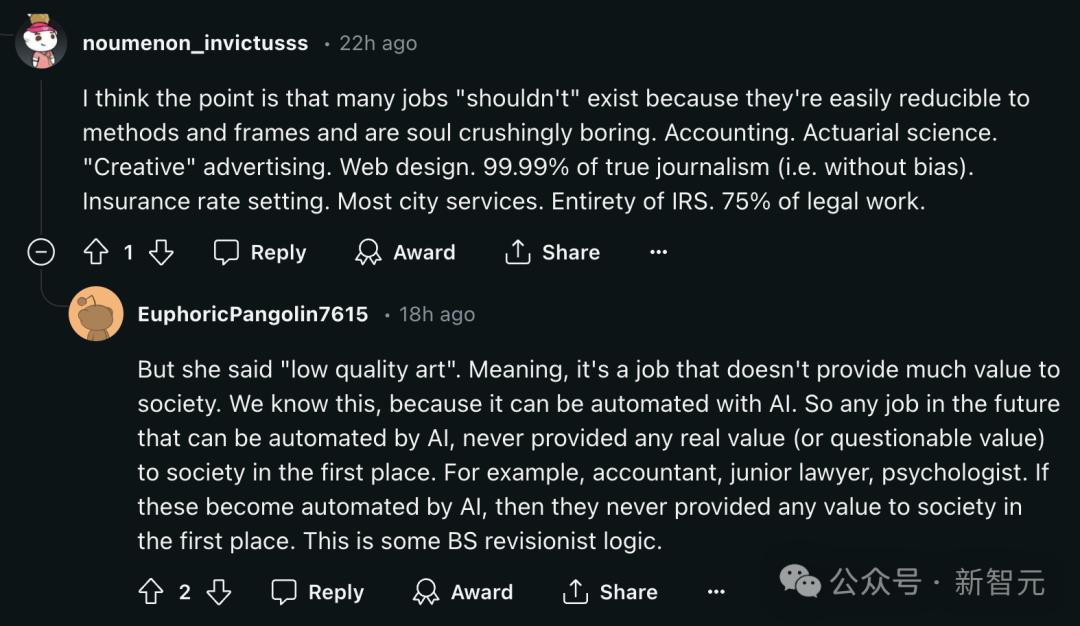
Some people also supported Murati online, saying that the "low-quality artworks" she described did not bring value to society, and that some work could be easily simplified into methods and frameworks, which were boring in themselves.
In addition, netizens went even further and said that accountants, actuaries, junior lawyers, psychologists, "creative" advertising, web design, 75% of legal work, and 99% of so-called real news reports (even if they are not biased) should be replaced.
References:
https://www.pcmag.com/news/openai-cto-mira-murati-ai-could-take-some-creative-jobs
https://www.chatgptguide.ai/2024/06/21/some-creative-jobs-maybe-will-go-away-but-maybe-they-shouldnt-have-been-there-in-the-first-place-mira-murati-openai-cto/
This article comes from the WeChat public account "New Intelligence" (ID: AI_era) , author: New Intelligence, and is authorized to be published by 36Kr.