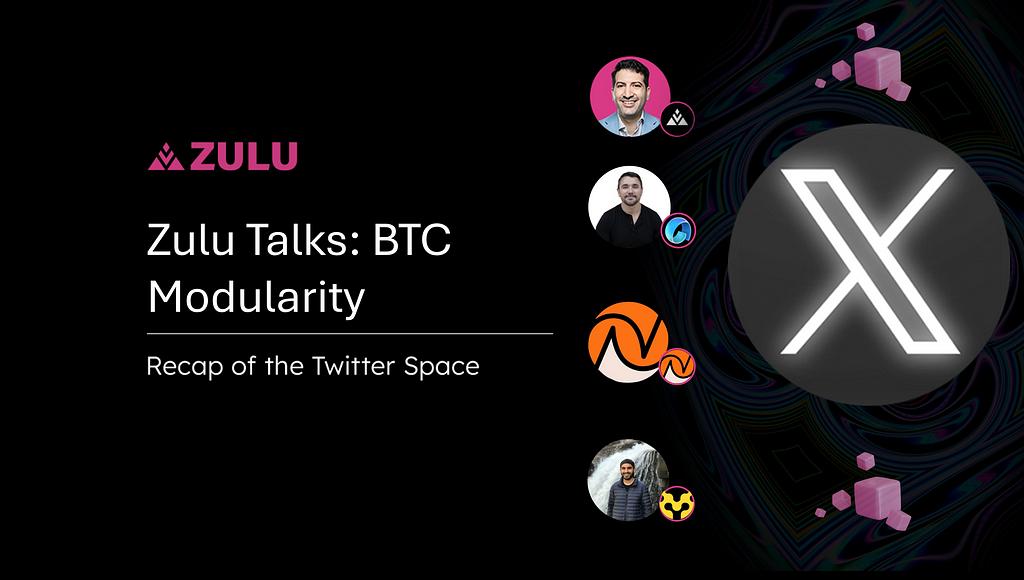
Zulu Co-founder Luke recently convened a panel with Kyle, head of Avail’s business team, Charlie, co-founder of Nexio, and Ali, Execution at Movement Labs.
Importance of Modularity
The BTC Modularity Panel delved into the evolving landscape of the Bitcoin ecosystem, emphasizing the importance of modularity, interoperability, and developer flexibility.
The discussion began with an exploration of how these elements are becoming increasingly critical, allowing Bitcoin to be utilized across different chains and ecosystems, thereby opening new doors for both developers and users.
Kyle from Avail highlighted the significance of extensive developer tooling, which has been a major factor in the success of the Ethereum ecosystem. He noted that similar tools are now becoming available for Bitcoin, which could accelerate innovation and increase the ecosystem’s robustness.
Luke from Zulu echoed this sentiment, pointing out that these new developments encourage growth in unexpected ways, enabling people with diverse ideas to contribute to the ecosystem.
The Potential of Bitcoin DeFi: BitFi vs ETH DeFi
The conversation then shifted to the emergence of DeFi on Bitcoin and how it compares to Ethereum.
Ali from Movement Labs suggested that while there are similarities, Bitcoin DeFi will likely demand more stringent security measures due to the higher value of Bitcoin compared to Ethereum. He pointed out that the higher stakes involved with Bitcoin could lead to more rigorous vetting processes for new projects.
Kyle added that the demographic differences between Bitcoin and Ethereum users could influence the types of DeFi applications that gain traction. He noted that Bitcoin users might be more conservative and risk-averse compared to their Ethereum counterparts.
Charlie emphasized that lessons learned from Ethereum’s DeFi could inform the development of more secure and efficient Bitcoin DeFi applications, potentially leading to a more mature and robust ecosystem.
The panelists also discussed what is required for a fully developed Bitcoin DeFi ecosystem.
Kyle emphasized the need for robust bridging solutions and thorough battle-testing to understand and mitigate risks. He stressed that effective bridging solutions are essential for connecting Bitcoin with other ecosystems, enabling seamless asset transfers and interactions.
Charlie highlighted the importance of OP_CAT for verifying proofs directly on Bitcoin and improving the user experience. He argued that native verification of proofs could enhance the security and efficiency of DeFi applications on Bitcoin.
Ali speculated that the user base might bifurcate into those seeking high-risk, high-reward opportunities and those preferring safer options, similar to the evolution seen in Ethereum. He suggested that this bifurcation could lead to a diverse range of DeFi products catering to different risk appetites.
Exciting Innovations in the Bitcoin Ecosystem
When asked about game-changing innovations, Charlie identified trustless bridges and better infrastructure as critical for increasing Bitcoin’s usability across different ecosystems. He argued that trustless bridges could eliminate the need for intermediaries, enhancing the security and efficiency of cross-chain transactions.
Ali mentioned the development of parallelized infrastructure to speed up Bitcoin transactions, making the network more efficient. He explained that parallelized infrastructure could reduce transaction times and increase throughput, addressing some of the scalability challenges faced by Bitcoin.
Kyle focused on chain abstraction and eliminating the need for traditional bridging, which could unify liquidity across various chains and reduce attack vectors. He envisioned a future where users can interact with multiple chains seamlessly, without needing to worry about the underlying technical complexities.
Updates on Movement Labs, Avail, Nexio
The panelists then shared updates on their respective projects.
Ali spoke about Movement Labs’ work on app chains, offering modular solutions for different consensus layers and sequencers, as well as their upcoming competition called Battle of Olympus. He explained that app chains could provide tailored solutions for specific use cases, enhancing the flexibility and scalability of the Bitcoin ecosystem.
Kyle provided a roadmap for Avail, including upcoming mainnet launches and Bitcoin integration. He highlighted Avail’s focus on data availability and modularity, aiming to provide robust solutions for the growing Bitcoin DeFi ecosystem.
Charlie hinted at exciting developments in parallelization on Bitcoin, urging the audience to stay tuned for more updates on Nexio. He emphasized the potential of parallelization to transform the Bitcoin network, making it more efficient and scalable.
Final Remarks
In their closing remarks, the panelists expressed optimism about the future of Bitcoin and encouraged continued innovation and community engagement.
They thanked the host, Luke from Zulu, for organizing the discussion and emphasized the collaborative spirit driving the ecosystem forward.
Kyle expressed gratitude for the opportunity to share insights and highlighted the importance of community involvement in driving innovation.
Ali thanked the audience for their engagement and encouraged developers to explore the new tools and opportunities emerging in the Bitcoin ecosystem.
Charlie emphasized the potential for collaboration and innovation, urging the community to stay involved and contribute to the ecosystem’s growth.
The guests of the panel all shared a common sense of commitment to advancing the state of Bitcoin and DeFi.
The panelists underscored the transformative potential of these innovations, offering a glimpse into a future where Bitcoin can interact seamlessly with other ecosystems, providing diverse and secure DeFi solutions for a wide range of users.
Attendees were left with a clear message: the future of Bitcoin is bright, and continuous innovation and community engagement are key to unlocking its full potential.

About Zulu Network
⛓️ Zulu Network is the first Bitcoin Layer 2 with Bitcoin-level security using BitVM2, enabling developers to seamlessly deploy dApps on both EVM liquidity & UTXO innovation layers.
🌉 Zulu is a recognized key contributor to BitVM, poised to launch the first trust-minimized Bitcoin bridge. Join their 720k+ users and start earning and shaping the future on Bitcoin with Zulu.
🏦 Leading Investors: CGV, Web3.com Ventures, BlueRun Ventures (CN), Ledger Capital, among others.
👥 Community Metrics: 120k+ Twitter, 68k+ Telegram, 82k+ Discord.
Twitter | Telegram | Discord | Blog
Website | Whitepaper | GitHub
Let’s move Bitcoin forward.ZuluScan: https://testnet.zuluscan.io/
Lwazi Testnet Marketing Campaign: Lwazi Points System⏫⭐
Bridge: https://testnet.zulunetwork.io/bridge/
Bridge Guide: Zulu Bridge Testnet Guide ⏫🌉