Today, the development of information technology has brought about an explosive growth of information. Hundreds of millions of pieces of information are generated on the Internet every day. If we want to find the information we want from this vast ocean of data, search engines are undoubtedly the best helpers.
Over the past two decades, as the world's largest search engine, Google Search has been a bridge for many people to understand the Internet world. But now this bridge seems to have changed.
01
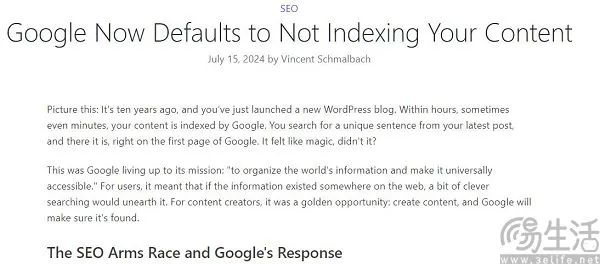
Recently, Vincent Schmalbach, a technology blogger focusing on SEO (search engine optimization), pointed out a surprising change: Google no longer attempts to index the entire web, but has become extremely selective and refuses to index most content. According to the author of the relevant article, Google search now seems to be operating on a "default no index" basis, and content will only be included in its index when the search engine perceives a real need.
The author gave an example that in the past, when a new domain name was created, even if there were no external links, the new domain name would be indexed by Google search within an hour or faster. Indeed, before the concept of SEO emerged, Google search was as greedy as gluttony for content, and a new blog or new website would be indexed soon after it was created. However, with the prevalence of SEO, the cat-and-mouse game between Google and SEOers has also reached its climax. Google hopes to index high-quality content to meet user needs, while SEOers want to make more web pages appear at the top of Google search rankings to obtain more advertising revenue.

Google continues to update its search engine algorithm in order to filter out valuable content from the vast ocean of data, while SEOers have been trying to crack the "black box" of Google search and find out the secrets in the algorithm. Fighting without breaking is undoubtedly the main theme of the confrontation between Google and SEOers, and both sides are conducting offense and defense under the framework of Google Search Console. Obviously, if Google search really starts to conduct selective indexing, it will not be because of SEO.
It should be noted that such a drastic change in Google Search has not yet been officially confirmed. However, Google Search did fail to index new content on the Internet in August 2019. At that time, Google explained that it was a bug, so it is not ruled out that Google Search has a bug again this time. In addition, Google has been continuously reviewing content indexes to reduce useless content in searches, which also leads to the frequent de-indexing of some websites.

02
Of course, most SEOers believe that this time Google search has become extremely selective and refused to index most content is not a bug, because the Internet environment in 2019 is very different from today, that is, AIGC has emerged. AIGC technology represented by ChatGPT has taken the lead in achieving breakthroughs in the field of graphics and text. With the support of multimodal large language models, it has become increasingly difficult to distinguish between AI-generated content and human-created content.
Before 2022, AI painting was characterized by "not being able to draw hands", and many painters believed that the impact of AI on painting was just a fantasy. However, with the emergence of Midjourney V5, AI painting tools have been flawless in details, and what happened next was that game artists and commissioned painters were largely unemployed. Since painting has been reshaped by AI, let alone writing.
From ChatGPT to Wenxinyiyan, from Gemini to Kimi, the texts output by the AI big model may lack literary grace and personal style, but the sentences are definitely fluent and logical.
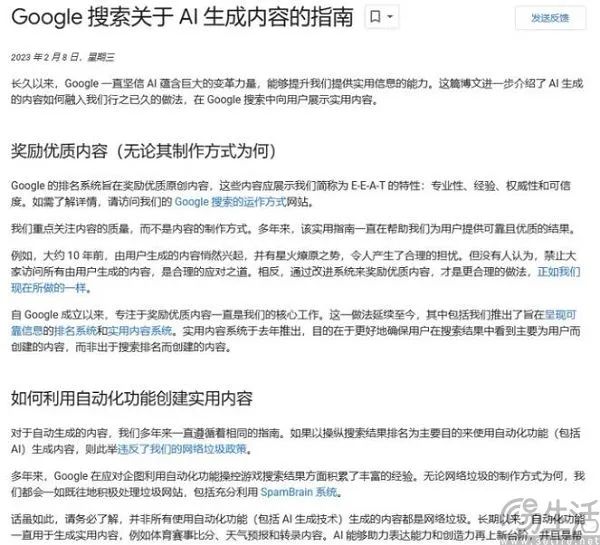
In short, the articles generated by Kimi and GPT-4 may not make people feel the beauty and power of words, and lack the "human touch", but they are already worth reading. Otherwise, Character.AI and other products focusing on virtual role-playing would not be popular all over the world today, and scientists would not use AI to process data, write code, and help them write papers.
03
Then the question arises, AI is just a tool. Some people use it to make the world a better place, and naturally there will be people who use it to do evil.
Long before the emergence of AIGC technology, content farms and social media bots based on automated scripts had already flooded the Internet. However, due to technical limitations at the time, there were still flaws in the writing and logic, and ordinary people could see that something was wrong at a glance, such as "What is going on with XX? XX is believed to be shocking to everyone. Let me show you how to understand it."
Earlier, the scripts of content farms could only do simple content splicing and reorganization, which seemed dull and boring compared to the texts of human creators that condensed the sparks of wisdom. From scripts to AI big models, the ability of machines to edit pictures and texts has made a qualitative leap. At this time, some "smart" SEOers discovered that "content is king" has another way to achieve it, so using AIGC to generate content has become a trend in the webmaster circle since 2023.
A report issued by NewsGuard, a news website rating company, last summer showed that fake news websites using AI-generated content are growing exponentially. Some SEOers are obviously not building websites filled with AI-generated content for fun, but to make money. Based on the online advertising network established by Google itself, SEOers only need to add a piece of Google Adsense code to a designated location on their website page to join the advertising alliance, and then use advertising to monetize the website's traffic.

That’s right, the reason why SEOers optimize for Google Search is that Google not only controls the power of traffic distribution, but also has the switch to monetize traffic. AIGC is like an efficiency amplifier for SEOers, so of course there will be people who continue to try to use AI-generated content to win the favor of Google Search. Unfortunately, even though the current AIGC has made historic progress in generating content, it is still inferior to the average content creator, and under the influence of illusion defects, it will become a rumor maker, so there is a saying that "AI is polluting the Internet."
04
In response to this, domestic content platforms such as WeChat, Douyin, Zhihu, and Weibo require creators to add the label "Content generated by AI" when creating content. But creators use AI to mass-produce content just to earn traffic money, so why would they actively label the content "AI" and cause the content to be restricted? The situation in overseas markets is similar. Before the technology for identifying AI-generated content matures, Google Search has almost no way to deal with AI-generated content.
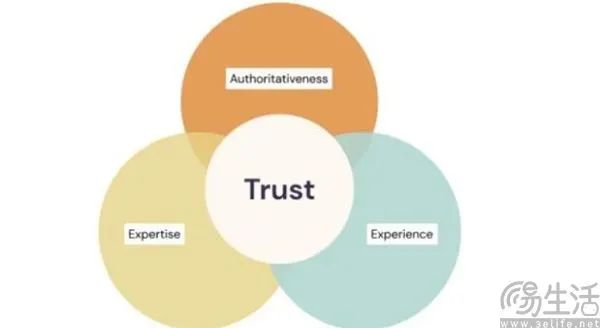
The "one-size-fits-all" approach is certainly unreasonable, but for a monopolistic Internet infrastructure like Google Search, apart from promoting the EEAT (Experience, Expertise, Authoritativeness, Trustworthiness) system and improving the weight of well-known websites, the only thing left is to default to not indexing new web pages. So Google may be treating all newly generated web pages as AI-generated.
The original Google search may have been a blacklist mechanism, but the future Google search may have to use a whitelist, but this is not friendly to new players at all.
This article comes from the WeChat public account "Sanyi Life" , author: Sanyi Jun, and is authorized to be published by 36Kr.