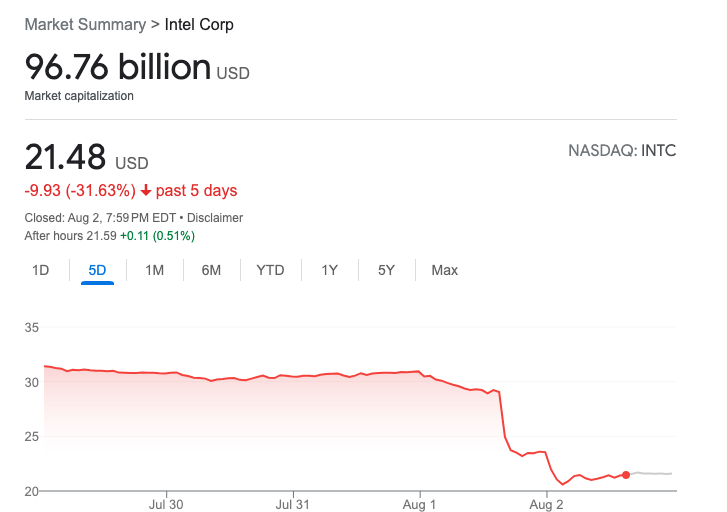
It delivered a dismal second-quarter financial report yesterday (2nd), with plans to lay off more than 15,000 people and suspend dividends. The stock price plummeted by more than 30% in the past two days. It rained all night because of the leak, and yesterday there were rumors that there might be another class action lawsuit due to the major damage to the 13th and 14th generation Core desktop processors.
According to reports from " Tom's Hardware " and " PC MAG ", Abington Cole + Ellery, an international law firm specializing in class actions and intellectual property rights, has begun investigating instability issues plaguing Intel's 13th and 14th generation CPUs and has called on affected parties on its official website Users have come forward as representatives of a class action lawsuit to hold Intel accountable.
Extended reading: Is Intel going to be sued? The United States calls for class-action lawsuits from affected households with 13th and 14th generation Intel processors
Intel refuses to insure disaster-stricken CPUs, and the community shouts: Join a class action lawsuit
As the Intel 13th and 14th generation CPU disaster continues to spread, Intel announced on the 1st that it will extend the 2-year warranty for the boxed version of the 13th/14th generation desktop processors, in addition to the original 3-year warranty. Warranty period, the overall warranty will be extended to 5 years.
However, netizen jerubedo posted on Reddit yesterday that Intel refused to return his two 14900K CPUs for return authorization (RMA), and said that if the netizen continues the warranty process, Intel will confiscate or destroy his CPUs. Many people also said When I encountered this situation, I left a message saying that Intel has become extremely strict in issuing insurance policies in recent years, and I often face difficulties. For example, one of Intel's reasons for rejection was that opening the cover violated the warranty, but netizens believed that there was too much residual thermal paste color, and unprofessional Intel customer service mistakenly judged it as the adhesive on the upper cover that was exposed after opening the cover. However, many consumers who have gone through RMA in the past also added in the article that in the past, Intel's warranty was quite "Asha Li". This kind of situation would not have happened four or five years ago, and they also sarcastically said, "Perhaps every RMA photo needs to be taken by a photographer." .
Although most of these subsequent situations have been resolved by large sellers Amazon and Microcenter, and some have fully refunded the victims, this is equivalent to absorbing costs on behalf of Intel, and many netizens believe that these two companies should not bear it Intel's responsibilities and costs, and today's large-scale 13/14 generation desktop processor cases have also caused trouble for dealers and consumers.
As soon as the article came out, it immediately triggered extensive discussions among Reddit netizens. Some netizens said: "Ironically, Intel has just announced that it will extend the warranty for two years," "Boycott Intel products," and "Calling Gamer Nexus to criticize Intel." In addition, some netizens said that they can provide information to the class action investigation. This comment also caused many affected netizens to ask how to join the class action lawsuit.
Intel 13th and 14th generation CPUs cause disaster
Dongzhong has previously reported that well-known e-sports Youtuber Gamer Nexus released a video on July 20, criticizing the 13th and 14th generation CPU models produced by Intel for having major problems , which aroused great concern in the community.
Against the background of increasing pressure, Intel finally announced on the 23rd that it had found the root cause of the crash problem of its 13th and 14th generation processors.
Intel said in the Reddit community that through extensive analysis of unstable 13th and 14th generation processors returned by customers, it was confirmed that the problem lies in a specific algorithm of the processor microcode, which causes the processor's voltage request to be inaccurate. , thereby increasing the operating voltage of the processor, causing some consumers to experience program crashes, freezes, burned out CPUs, and other disasters when using their computers.
Community dissatisfied with Intel compensation plan
Although Intel has stated that it will "provide comprehensive compensation" and expects to provide microcode update files to relevant motherboard partners in mid-August to allow affected users to update themselves, users who were previously damaged due to excessive voltage have been unable to save, and Intel promises to provide Affected users are provided with a Return Merchandise Authorization (RMA) and any affected users can contact Intel.
However, the company's insistence on not recalling and discontinuing sales of the 13th and 14th generation Core desktop processors still makes the majority of users quite dissatisfied.
In the past, the market value was far higher than that of TSMC, but now it is only 1/8 of TSMC.
Looking back on the past, Intel's market capitalization exceeded US$300 billion in 2000, when it was the leader in the technology industry. At that time, the "Wintel" alliance formed by Intel and Microsoft set off a wave of global PC era. In comparison, semiconductor peer TSMC at the time had a market value of only US$50 billion, and Nvidia had a market value of only US$5 billion.
However, as the dot-com bubble burst, the technology industry suffered a heavy setback, and Intel's market value also plummeted by 80%, but this did not affect Intel's leading position in semiconductors. However, from 2010 to 2020s, many semiconductor companies began to exert their efforts. Nvidia and AMD rose rapidly. TSMC's market value even overtook Intel in 2017, which shocked the entire financial world at the time. Many people believe that the future may be one of multiple leading companies carving up the semiconductor market, and Intel will definitely have a place in it.
Going back to the present, Huida, which had a market value of only US$5 billion at the time, relied on the AI craze to once soar to US$3 trillion, becoming the world's most valuable company; TSMC, which had a market value of only US$50 billion at the time, relied on its semiconductor industry With a market value of US$758.59 billion, it has become the tenth largest company in the world by market value. In contrast, Intel, whose market value exceeded US$300 billion that year, now has a market value of only US$96.76 billion, only 1/8 of TSMC, which is very disappointing.
Intel’s transformation failed after Biden took office
Regarding the decline of the former technology leader, the community believes that the culprit may be the current US President Biden. Yik Lim, a Facebook user on the social platform, posted that the Biden administration’s chip bill subsidies should be the biggest curse that prevents Intel from smoothly transforming:
Because of receiving this subsidy, Intel must give priority to building factories in the United States, and any penny spent will be watched closely by members of Congress from both parties. But in fact, Intel's best-run factory is not in the United States but in Ireland. Even the average level of human resources in Israel is better than that in the United States. As a result, in order to raise money to continue building factories in the United States, Intel actually has to dispose of its assets in Ireland and terminate its expansion of operations in Israel. This is the same approach as working hard to sell blood just to collect money to take a tonic. This tonic is still forced by the U.S. government food….
At the same time, Yik Lim also added that Intel is an overly bloated company, with as many as 120,000 employees:
Intel still maintains a company size of nearly 120,000 people. You must know that even TSMC has only 80,000 employees worldwide. Fabless companies such as Huida and AMD have about 30,000 employees. So No matter how you look at it, you will think that Intel is an overly bloated company...