Navigation Directory
1 Introduction
2. Opportunity to enter the Web3 field
3. Motivation and process of creating Sonic
4. The impact of experience in different fields and projects on entrepreneurship
5. Mirror World’s development history and direction changes
6. Comparison of Solana Scaling and Ethereum Scaling
7. Sonic's expansion solution Hypergrid
8. Challenges of Layer 2 Scaling on Solana
9. Future prospects of Web3 game track
01. Introduction
Welcome to Ryze Up, brought to you by Ryze Labs. Ryze Labs is a bridge between the East and the West. We want to accelerate the development of Web3 in emerging markets and impact the global Web3 world. Local Insights, Global Impact, let’s start together. Time to Ryze Up.
This episode's host
Fred, Ryze Labs Researcher, focuses on expanding the fund’s impact in the Chinese-speaking community and providing ideas and advice to the fund’s portfolio companies.
Special Guest
Chris started his career at ByteDance. Before entering the Web3 field, he accumulated rich experience in consumer entertainment and SaaS market research during his time at ByteDance. Subsequently, Chris joined the RCT AI team, which focuses on the intersection of AI and Web3, and explored the combination of AI and NFT, AI and Crypto. These new business models sparked his interest in Web3. After founding Mirror World and paying attention to the issuance of game assets, he discovered the variability of market demand and worked with the Solana Foundation to develop Sonic, a proprietary chain dedicated to game services, to solve the expansion problem in the Solana ecosystem. With his rich experience and deep understanding of technology, Chris has become an important promoter of the Web3 game ecosystem.
02. Opportunity to enter the Web3 field
After leaving ByteDance in the second half of 2021, Chris began to get involved in the Web3 field. During his time at ByteDance, he participated in research on the consumer entertainment industry and the SaaS market, and then joined the RCT AI team that focuses on the intersection of AI and Web3. This team conducted in-depth research on the combination of AI and NFT, and AI and Crypto. These studies and new business models based on the concept of decentralization deeply attracted Chris, prompting him to decide to enter the Web3 field.
03. The motivation and process of creating Sonic
In the process of creating Sonic, Chris experienced the transition from Mirror World to Sonic and identified three core issues during the process:
1. Game asset diversity and user diversity: In the early days of Mirror World, Chris's team focused on issuing assets through NFT collections to serve multiple game projects. Over time, they found that the demand for game asset issuance was higher in the market up cycle, but in the bear market or down cycle, project parties were more inclined to build and solve core problems. The asset diversity of games can directly lead to user diversity, however, on the Solana chain, the number of assets for consumer applications, games, and social applications is relatively small.
2. Computing resources and congestion issues on the Solana chain: It was observed that a single project took up a lot of computing resources on the chain, causing congestion on the Solana mainnet. Although Solana's TPS is already very high and the cost is very low, it will still face congestion problems when more applications put logic on the chain. Therefore, Chris and the team considered sharing computing resources through side chains or proprietary chains to avoid overloading the mainnet.
3. Insufficient game distribution capabilities: Solana itself does not have the ability to distribute games. This is not only a technical issue, but also involves aspects such as organizational structure and team background. Chris believes that the game industry needs proprietary resources and professional distribution agencies to support content development and distribution. Therefore, they discussed with the Solana Foundation to develop a game-specific chain for game services through the SVM framework to solve these problems.
Based on the above three core issues, Chris's team cooperated with the Solana Foundation and proposed a solution to develop a game-specific chain Sonic based on Solana, making full use of their R&D capabilities and resources in Mirror World and successfully turning to the game SVM track.
04. The impact of experience in different fields and projects on entrepreneurship
Chris's career experience covers multiple fields, from ByteDance to RCT AI, to Mirror World and Sonic, and each step has provided him with valuable experience. During his time at ByteDance, he learned corporate management concepts and efficiency management methods in a fast-growing environment, and these experiences played an important role in his future entrepreneurship. At RCT AI, Chris joined a young and international team, which allowed him to further train in managing enterprises and recruiting talents, and laid a solid foundation for his subsequent entrepreneurship.
These experiences became particularly important after Chris entered the Crypto field. He realized that the Crypto field is highly cyclical and volatile, and the inflow of funds has a clear time window, which is different from the sustainable growth of SaaS products. Therefore, Chris adopted a more flexible and adaptive strategy when managing the Sonic team. He emphasized keeping the core members of the team lean and expanding quickly when market demand is high to cope with the rapid changes in the industry. This flexible management style helps Sonic stay competitive in a turbulent market environment.
05. Mirror World’s development history and direction change
Mirror World initially served game projects by issuing NFT assets. However, over time, Chris and his team found that simple asset issuance could not meet the long-term needs of the market. Especially in the down cycle of the market, the project party is more eager to solve infrastructure problems, such as fiat currency deposit liquidity and cross-chain exchange. Therefore, the team cooperated with the Solana Foundation in early 2022 to start developing in-game wallets, markets, deposits, and swap tools. This shift has enabled Mirror World to go beyond asset issuance and begin to provide broader infrastructure support.
In 2023, with the outbreak of the FTX incident, the number of projects in the entire ecosystem dropped sharply. Chris and the team realized that existing solutions alone could not meet new market challenges. They had in-depth discussions with the Solana Foundation and finally decided to develop an SVM extension chain Sonic specifically for gaming. This new direction not only leverages their R&D experience in Mirror World, but also helps game projects run better on the chain by solving Solana's expansion problem.
06. Comparison between Solana and Ethereum scaling
When discussing the expansion of Solana and Ethereum, Chris pointed out that the purposes and characteristics of the two are very different. Ethereum's expansion is mainly to solve the mainnet speed and cost issues, and to increase transaction speed and reduce transaction fees through Layer 2 solutions. Solana's TPS is already very high and the transaction cost is also very low. The purpose of its expansion is more to meet the specific needs of different fields.
Solana's expansion is to provide dedicated chains for different fields to ensure that each field has its own independent economic effects and computing resources. This expansion method can not only share the load of the mainnet, but also provide more professional and efficient services for each field. For example, in the field of games, by developing a dedicated game chain, it can better support the on-chain operation of game logic and assets and improve the overall operating efficiency.
07. Sonic’s expansion solution Hypergrid
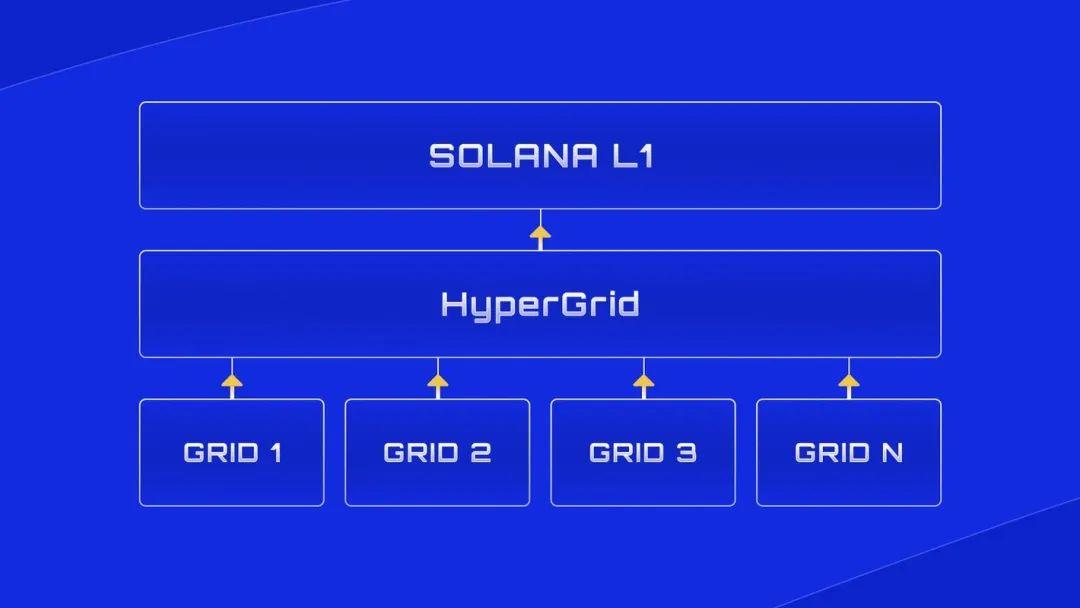
Sonic's expansion solution on Solana, Hypergrid, is a framework designed to create an SVM environment dedicated to gaming. Through Hypergrid, Sonic became the first project to apply the framework. The design concept of Hypergrid is to solve the expansion problem in specific fields by providing proprietary chains for different fields through horizontal expansion. Chris predicts that in the future, there will be proprietary chains in other fields such as DeFi and AI, not just in the gaming field. In this way, each field can enjoy customized expansion services.
The core of Hypergrid lies in its flexibility and adaptability. Through horizontal expansion, each field can develop independently while maintaining a connection with the Solana mainnet. This approach not only improves the professionalism and efficiency of each field, but also improves the performance and scalability of the Solana ecosystem as a whole.
08. Challenges of Layer 2 Scaling on Solana
Solana faces multiple challenges in terms of Layer 2 expansion. The first is to evaluate which areas really need independent SVM expansion chains. Although independent expansion chains can improve efficiency in some cases, not all areas need such a solution. Chris mentioned that Ethereum also faced similar problems in its early days and eventually determined which areas were suitable for Layer 2 expansion and which areas could run directly on the mainnet.
Secondly, there are technical challenges in the process of continuous splitting and maintenance of Solana's code base. For example, the code split of Solana's client and runtime environment was only recently completed, and the ecosystem is still gradually adapting to this change. In the process of rapid development, how to ensure the stability and compatibility of the code is an important issue that the team needs to solve.
Finally, the rapid development of the Solana ecosystem requires constant resolution of new problems. Chris pointed out that Solana is more like a fast-moving startup that is constantly adjusting and optimizing during its development. Therefore, the team also needs to remain flexible and respond to new challenges and changes at any time during the development of Sonic.
09. Future prospects of Web3 game track
Chris is confident about the future of Web3 games. He believes that the current game content quality and payment point tool set have been significantly improved compared to the previous cycle. Although the current price performance of Web3 games is not ideal, he feels that the current game quality and user willingness to pay have reached a fairly high level. For example, games like Big Time have been growing in both monthly active users and overall revenue scale, which shows that Web3 games have great potential in both user base and economic effects.
In the future, game design will put more logic on the chain. When the technical cost and speed reach a certain level, full-chain games will become possible. Sonic is also working in this direction in technical development. Although 80% of the focus is still on games with assets on the chain, more attention will be paid to the development of full-chain games in the future. He believes that with the advancement of technology and the maturity of the market, Web3 games will achieve breakthroughs in gameplay and asset innovation, and may even become the first full-chain hit game.