There are indeed some trends in the market towards AppChains, but the needs and solutions of DApps are diverse, and not all applications are suitable to become independent chains.
Original text: Is everything really moving towards AppChains? (X)
Author: paramonoww
Compiled by: Vernacular Blockchain
Cover: Photo by Jigar Panchal on Unsplash

Is everything in the market really moving towards AppChains? Yes, but not entirely.
The main reason DApps migrate to independent chains is that they believe they are being "plundered". This statement is actually not wrong, because most dApps are not profitable. You can refer to the recent example of @zkxprotocol closing, and the past cases of @utopialabs_, @yield, @FujiFinance and many other applications.
But is it really the business model that is deeply flawed, or are these protocols actually being “ripped off”? The main (and often only) source of revenue for DApps is transaction fees. Users pay transaction fees because they directly benefit from them.
However, users are not the only actors who benefit from the use of DApps. In the transaction supply chain, there are several roles that can benefit from it, mainly block proposers, even though they are the last to see the transaction. On L2, these roles are sequencers.
While not all MEV (maximum extractable value) extraction is a bad thing, the value created by dApps is being deprived and they are not getting the full value they deserve.
There are currently three solutions:
1) Become an application chain.
2) Choose an L1/L2 that returns value.
3) Implement application-specific sorting mechanisms.
Like everything in crypto, every solution has its trade-offs.
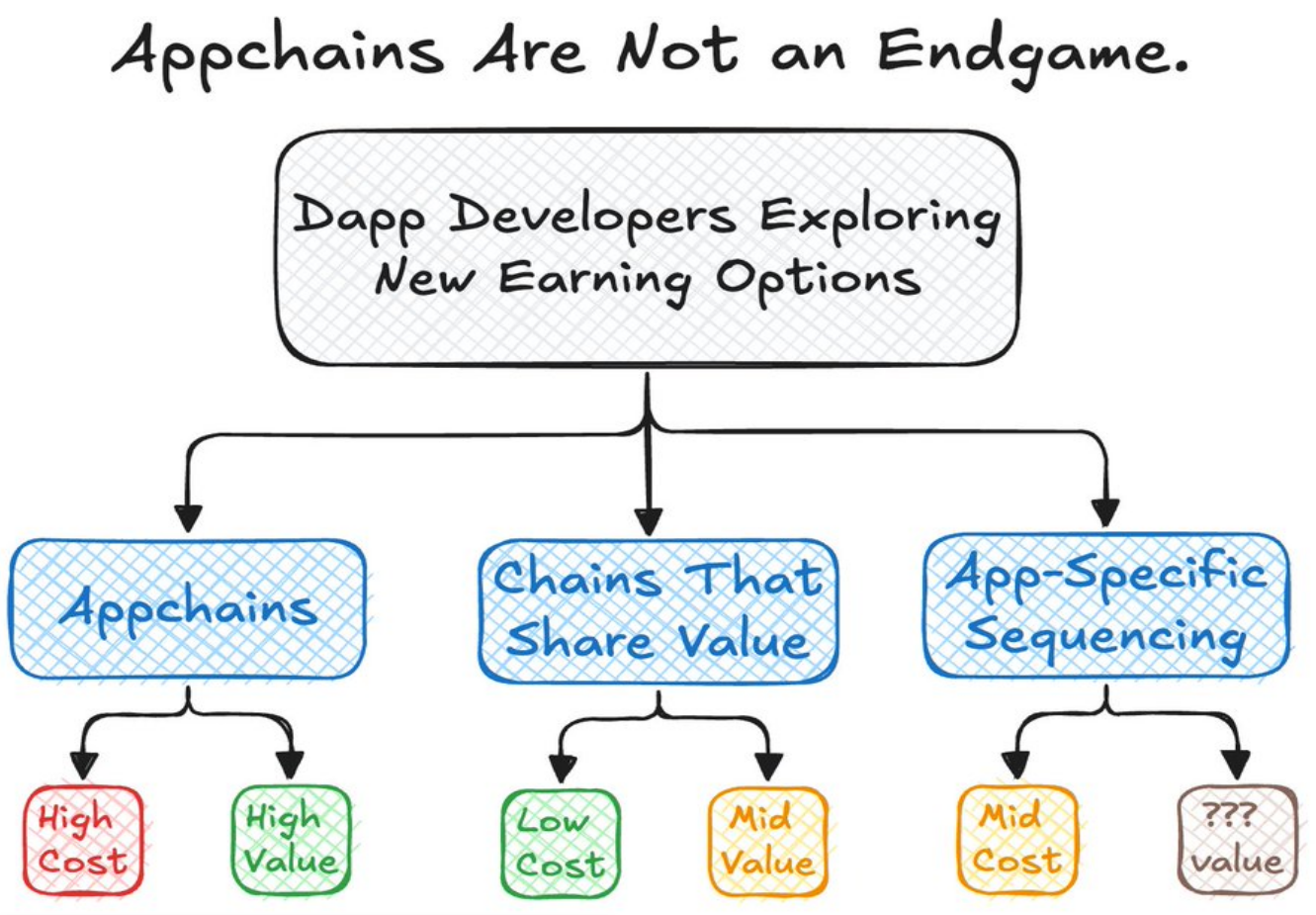
1. Becoming an application chain: high cost + high value
You get countless benefits: the ability to extract value at will, control your own network (if you are L2), easier scaling, avoid competition for block space, and more.
The downside is: it’s really, really expensive. It’s also more difficult because you need to build both the app and the blockchain.
This is true even if you want to build an L2 and use a solution like @alt_layer .
The idea that every application will eventually become an application chain is not entirely valid for three reasons:
- Not every dApp is large enough to require migration to Lisk.
- Some dApps can directly benefit from the architecture of the underlying chain.
- There are also some dApps that are already very comfortable on other chains.
2. L1/L2 that can return value: low cost + medium value
It’s much cheaper to deploy an application on a rollup or L1 because you don’t need to implement new rules for validation, inclusion, consensus, transaction flow, etc.
For rollups: It’s generally very easy to migrate your app from Ethereum to rollups, as rollups are either EVM-compatible (e.g. @arbitrum) or EVM-equivalent (e.g. @taikoxyz).
You still need to consider the architecture of the underlying chain, but you don’t need to build it from scratch.
Maybe in the future we will have true chain abstraction and developers only need to focus on their dApps and not worry about anything else, but that’s another topic…
The rewards developers receive are of medium value because, while not the highest (you don’t own the chain’s economy), they are not low either (you get some value in addition to the transaction fees).
Currently, there are few implementations of this approach as sharing MEV with dApps is still a complex process and we need more R&D.
3. Application-specific ranking: medium cost + uncertain value
The concept of application-specific ordering is fairly new and many people often confuse it with appchains, but the difference is simple:
- Appchain focuses on sequencing and execution.
- Self-sorting DApps only care about sorting and "outsource" the execution to L1/L2.
This is a medium-cost option because in addition to building a dApp, you also need to consider the ordering of transactions, and its value is uncertain because the concept is relatively new and has various problems.
First, you are still dependent on the proposer, because in the inclusion game: you can send any transaction package you want, but it is up to the proposer to include your package in the block.
If you extract all the MEV, then there is no obvious incentive for the proposer to include your package in the block.
This opens up another incentive market for proposers. DApps and proposers should cooperate, otherwise neither party can gain any value or power.
Another reason for its uncertainty is that we cannot yet determine whether the value distributed by L1/L2 will exceed the value that the DApp creates for itself by ordering transactions.
4. Summary
Any chain is a dark forest (not just Ethereum!). So back to the original question: Is everything really moving towards application chains?
1) Yes (some dApps benefit from having their own chain rather than staying on an existing chain).
- Not exactly (there are other solutions that are better suited to dApp needs).
The forest is large enough to explore all options.
Every landscape in the world (crypto) has its diversity, so choose the one that best suits your needs, or build your own solution!
Disclaimer: As a blockchain information platform, the articles published on this site only represent the personal opinions of the author and guests, and have nothing to do with the position of Web3Caff. The information in the article is for reference only and does not constitute any investment advice or offer. Please comply with the relevant laws and regulations of your country or region.
Welcome to join the Web3Caff official community : X (Twitter) account | WeChat reader group | WeChat public account | Telegram subscription group | Telegram exchange group