Société Générale
Issuing Tokenized Bonds on Ethereum: As one of the major banks in France, Société Générale has taken an important step in asset tokenization by issuing tokenized bonds on the Ethereum blockchain. This initiative is noteworthy as it represents traditional financial institutions embracing blockchain technology to innovate core financial products.
Embracing New Technology: By utilizing the Ethereum blockchain, Société Générale is moving away from traditional financial methods and exploring the potential of blockchain in providing faster and more transparent financial transactions. The use of Ethereum smart contracts allows for automated processes, thereby improving efficiency and reducing operational risks.
Impact on the Financial Industry: Société Générale's actions strongly endorse the capabilities of blockchain, highlighting its potential in revolutionizing the establishment, management, and trading of financial products. Their efforts also contribute to the widespread adoption and application of blockchain technology in the financial industry.
Securitize
Simplifying Digital Token Issuance: Securitize focuses on simplifying the process of issuing digital Tokens, while ensuring compliance with regulatory requirements. Their platform helps enterprises achieve asset tokenization and provides efficient processes for establishing and managing these digital securities.
Compliance: One of Securitize's core strengths is its emphasis on regulatory compliance for securities. The services they provide ensure that tokenized assets adhere to legal standards, which is crucial for maintaining investor confidence and ensuring market integrity.
Enhancing Market Liquidity: By offering a platform for the issuance and trading of compliant digital Tokens, Securitize has enhanced market liquidity and accessibility. Their technology supports the secondary trading of tokenized assets, allowing investors to safely buy, sell, and trade these digital securities.
Tokeny
Supporting Blockchain Integration: Luxembourg-based Tokeny assists institutions in migrating their assets to the blockchain. They focus on ensuring the tokenization process meets security standards and regulatory requirements, which is crucial for institutional adoption.
Platform Capabilities: Tokeny's platform provides solutions for the creation and management of tokenized assets, with a focus on security and compliance. They offer tools for the secure issuance of Tokens, investor onboarding, and asset management, helping organizations seamlessly and efficiently enter the tokenization space.
Building Trust and Reliability: By prioritizing security and regulatory compliance, Tokeny helps to enhance trust in tokenized assets, encouraging institutions to explore blockchain technology. Their efforts are driving the widespread acceptance and normalization of asset tokenization in traditional financial markets.
2. What are the latest trends in RWA tokenization?
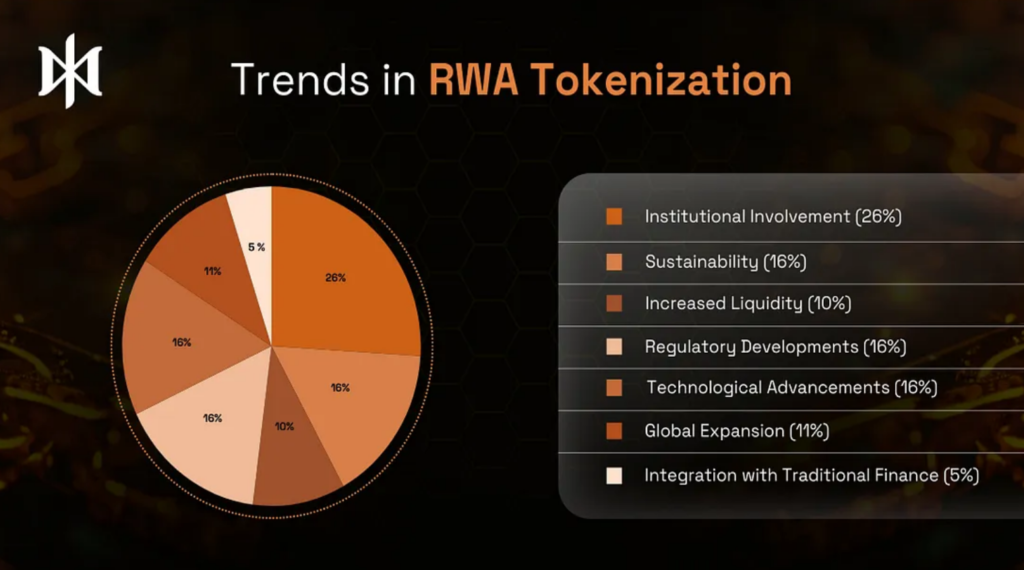
Institutional Involvement: Major financial institutions, including Blackstone, Goldman Sachs, and Fidelity, are increasingly entering the tokenization space, enhancing the credibility and impact of this market.
Sustainability: The tokenization of sustainable assets, such as carbon credits and renewable energy projects, is on the rise, driving investment into environmental projects while providing financial returns.
Improved Liquidity: Tokenization enhances the liquidity of previously illiquid or hard-to-access assets by allowing for fractional ownership and more convenient trading.
Regulatory Developments: Evolving regulations and frameworks are shaping the tokenization landscape, with governments and regulatory bodies working to address legal and compliance issues.
Technological Advancements: Innovations in blockchain technology, such as smart contracts and decentralized finance (DeFi) protocols, are improving the efficiency and functionality of tokenization platforms.
Global Expansion: Tokenization is gaining widespread attention across multiple regions, with significant adoption trends observed in financial hubs like the United States, Europe, and Asia.
Integration with Traditional Finance: The integration of tokenized assets with traditional financial systems is deepening, including partnerships between blockchain platforms and traditional financial institutions.
Market Segmentation: Tokenization is expanding beyond traditional asset classes, extending to niche markets and industries, such as art, collectibles, and intellectual property.
Increased Transparency and Security: The use of blockchain technology has brought higher transparency, traceability, and security to tokenization, addressing common issues in asset management.
Innovative Investment Tools: Through tokenization, new investment products and instruments are emerging, such as tokenized real estate funds and commodity-backed Tokens, providing investors with diversified investment opportunities.
3. KALP Tokenization: A Local Story with Global Potential
Back in India, an innovative project called KALP is making waves. They have launched the BIMTECH CBDC, a digital currency for transactions within the academic environment. Students, suppliers, and administrators have all become part of this tokenized ecosystem.
Over 1,300 transactions have been completed so far, demonstrating how tokenization can be applied in real-world scenarios. KALP's GINIToken serves as the transaction fee, allowing the entire system to operate efficiently and proving that even small ecosystems can benefit from tokenization.
Tokenization of Commodities
The tokenization of commodities, such as gold and oil, has become a significant trend. Companies like Paxos and Tether Gold allow investors to hold Tokens backed by physical gold reserves. This enables investors to easily trade or invest in commodities without the complexity of handling the actual assets.
Democratizing Real Estate
Real estate is one of the most exciting areas of tokenization. Platforms like RealT and tZERO allow people to purchase fractional ownership of properties. This means you can invest in real estate without having to buy an entire property. This opens up real estate investment to a wider audience, no longer limited to the wealthy.
4. Navigating the Regulatory Environment
Governments around the world are starting to recognize the potential of tokenization and are supporting this trend through regulatory measures. For example, the European Union's Markets in Crypto-Assets (MiCA) regulation and the increasing focus of the U.S. Securities and Exchange Commission (SEC) on tokenized securities are paving the way for widespread tokenization adoption. As these regulations become clearer, institutions and individuals will find it easier to safely and legally engage in asset tokenization.
In summary, the adoption of tokenization of global RWA (Real World Assets) is accelerating, which will change our perception of asset ownership and transactions. Whether it's a giant like JPMorgan Chase or an innovative local project like KALP, tokenization is gradually integrating into our daily financial lives. With the rise of trends such as sustainability and fractional ownership, we are moving towards a more inclusive and efficient financial world.