Having a large active user base across multiple social media platforms allows games to keep players constantly informed, actively engaged, and eager for upcoming features and developments. The recent growth in fan numbers also indicates that these games have been able to effectively capture user attention in the short term.
Quantitative Indicator Comparison
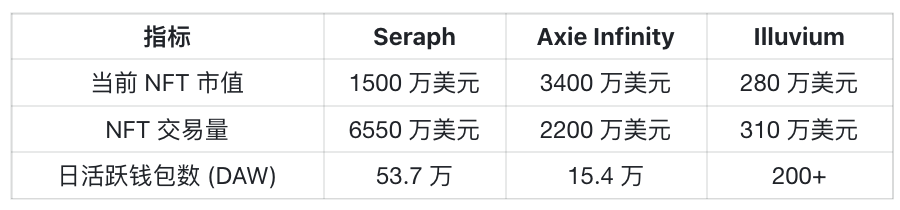
Although the overall crypto market is facing challenges, the daily transaction volume of blockchain games grew by 8.94% in August 2024. If we look at the performance of individual games this year, we can see that Seraph is far ahead in terms of Daily Active Wallets (DAW) with 537K, significantly surpassing Illuvium's 200+ and Axie Infinity's 154K. However, Axie Infinity dominates the current NFT market capitalization at $34 million, followed by Seraph at $15 million and Illuvium at $2.8 million. In terms of NFT trading volume, Seraph leads significantly with $65.5 million, far exceeding Axie Infinity's $22 million and Illuvium's $3.1 million. A key driver for Seraph's high DAW may be its 7-day retention rate of 66% during the pre-season, indicating that many new users have maintained sustained engagement.
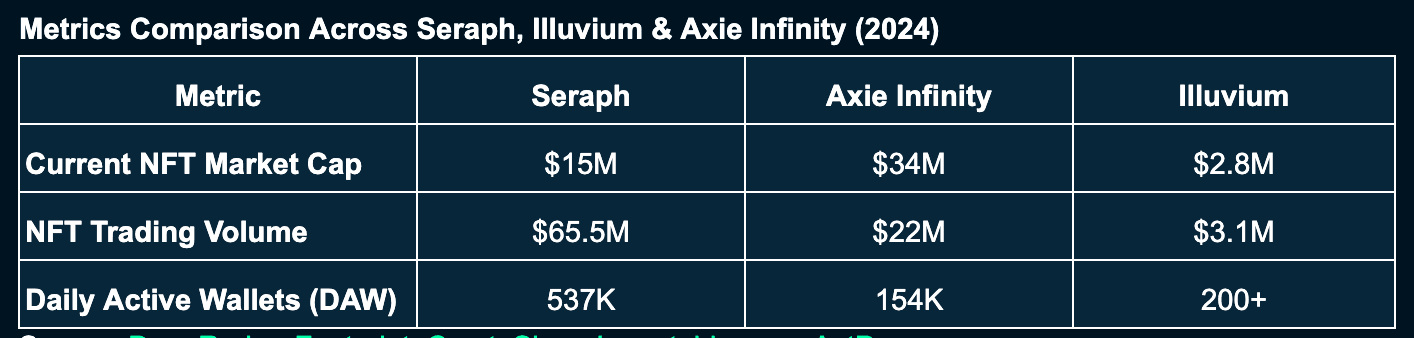
Source: Comparison of Seraph, Illuvium, and Axie Infinity metrics (2024)
Source: DappRadar, Footprint, CryptoSlam, Immutable.com, ActPass
Comparison of Top GameFi Chains
When evaluating the performance of leading GameFi chains such as opBNB, Ronin, Polygon, and Immutable X, key factors to consider include gas fees, transactions per second (TPS), and scalability. These metrics are particularly important for the Non-Fungible Token (NFT) gaming ecosystem, as supporting high transaction volumes requires fast and cost-effective transactions.
Source: Key metrics for top gaming chains opBNB, Ronin, Polygon PoS, and Immutable X
Here are the key findings:
Gas Fees: In the GameFi ecosystem, gas fees are crucial as frequent micro-transactions and NFT trades are at its core. opBNB provides the lowest median gas fee among the major chains at $0.0001, making it highly cost-effective for gaming applications. Ronin closely follows with a median fee of $0.00179, while Polygon PoS charges $0.00293. Immutable X stands out by not charging gas fees for Non-Fungible Token (NFT) minting and transfers.
Theoretical Transactions Per Second (TPS): High TPS is critical for handling the large transaction volumes required for real-time multiplayer games and frequent asset trades. As of October 2024, Ronin leads with 100,000 TPS, surpassing Immutable X's 9,000 TPS and Polygon PoS's 7,200 TPS. opBNB also ranks among the top chains with 10,000 TPS, ensuring scalability for large-scale Non-Fungible Token (NFT) transactions.
Average TPS: While the theoretical maximum TPS can reflect the network's potential capacity, actual usage often differs. Currently, opBNB processes an average of 97 TPS, far below its theoretical limit of 10,000. Ronin averages 20 TPS, Polygon PoS handles 33 TPS, and Immutable X is the lowest at 0.02 TPS. As the average TPS figures are significantly lower than the theoretical maximums, scalability is not an immediate concern at the moment. However, as the gaming industry expands and Account Abstraction (AA) adoption increases, especially in complex gaming ecosystems, having high TPS will be crucial to manage the growing load and ensure a seamless user experience.
Fast transaction speeds, low gas fees, and good scalability remain key for GameFi chains to support the growing demand of the Non-Fungible Token (NFT) gaming economy. opBNB's highest average TPS of 97 (2024) demonstrates its ability to handle large transaction volumes. As GameFi continues to expand, these chains will play a critical role in shaping the future of blockchain gaming.
Key Factors for GameFi Blockchains
To assess the success of blockchain networks in the gaming industry, several key performance indicators need to be considered, such as Daily Active Wallets (DAW), Total Value Locked (TVL), and the number of games hosted on each chain. Comparing opBNB, Ronin, Polygon, and Immutable X reveals how these metrics reflect the vitality of the ecosystem, user engagement, and platform liquidity. Additionally, security remains a crucial factor, as major chain vulnerabilities could undermine user trust in GameFi.
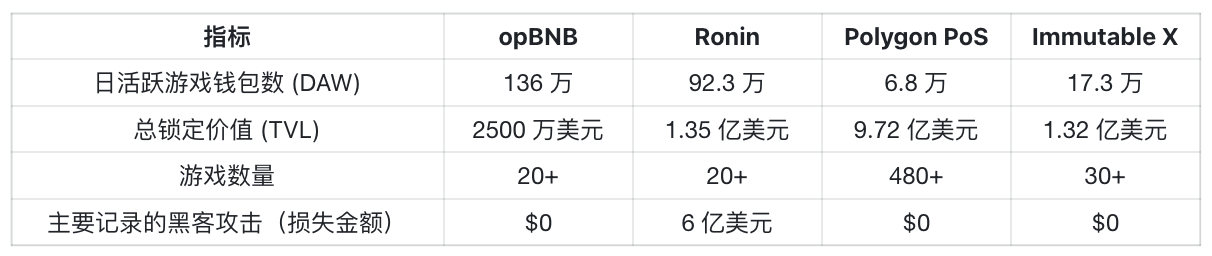
Source: Game-specific metrics for opBNB, Ronin, Polygon PoS, and Immutable X
Source: DappRadar, Footprint, defillama, Crypto Briefing, CNN
Here are our key findings:
Daily Active Game Wallets: As of October 2024, opBNB achieved a 72% month-over-month growth in DAW, reaching 1.36 million active daily players, highlighting its scalability and superior performance in the gaming domain. In comparison, although Polygon is a widely-used platform, its DAW is only 68,000, indicating a decline in its gaming user base. Ronin and Immutable X have 923,000 and 173,000 DAW, respectively, demonstrating stable user engagement within their ecosystems.
Total Value Locked (TVL): Polygon leads with a TVL of $972 million, solidifying its importance in the gaming space. Ronin and Immutable X follow closely with $135 million and $132 million, respectively. Meanwhile, as a newer Layer 2 solution, opBNB is rapidly rising with a TVL of $25 million.
Number of Games: Polygon hosts over 480 games, establishing its position as a developer hub. opBNB closely follows with over 20 games, indicating its rapid expansion in the GameFi domain. Ronin and Immutable X have over 20 and 30 games, respectively, focusing on specific gaming verticals, such as Axie Infinity on Ronin and Non-Fungible Token (NFT)-driven games on Immutable X.
Recorded major hacking incidents (loss amount): opBNB and Immutable X have not had any recorded hacking incidents so far, maintaining a good security record. Polygon previously faced potential vulnerabilities, but they were discovered and reported to the team by a white hat hacker in a timely manner. In contrast, Ronin faced the most severe security challenge, with a $600 million hacking incident that allowed the attackers to use private keys to validate network transactions. After this incident, Ronin has undergone security upgrades, including increasing the number of validators and introducing Hardware Security Modules (HSM) to prevent future security vulnerabilities.
Conclusion
In summary, the GameFi ecosystem is in an important expansion phase, with the market value expected to reach $301.5 billion by the end of 2030. This rapid growth is driven by the decentralized ownership of in-game assets (such as Non-Fungible Tokens and Tokens), which provide real-world value and unique financial incentives, something that traditional gaming ecosystems cannot achieve. Despite broader market challenges, the number of active wallets grew by 8.94% in August 2024, further demonstrating the resilience of the current GameFi landscape.
As blockchain infrastructure continues to improve - providing higher transaction capacity, lower gas fees, and better scalability - GameFi projects, particularly those driven by Non-Fungible Token-based economies and with significant social impact, will be in a favorable growth position. Leading chains like opBNB, Ronin, and Immutable X, with their advantages in speed, low cost, and scalability, are attracting the attention of many developers and players.
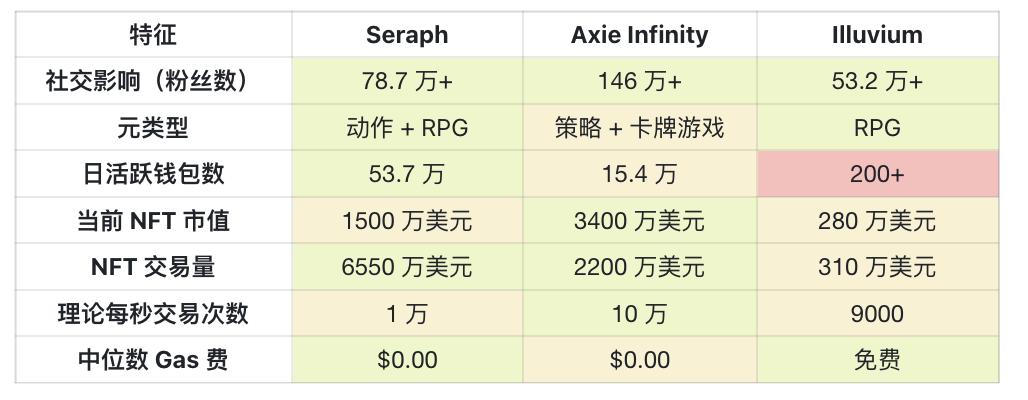
Color coding: Green indicates good, yellow indicates average, and red indicates below average
Source: Key feature comparison matrix: Seraph, Axie Infinity, and Illuvium
Disclaimer: Nansen and Slice Analytics have prepared the following report under an existing service contract with Seraph ("the Client"). While the Client has the right to review and provide feedback on the report, Nansen maintains full editorial control over the publication of this report. The views expressed herein are the independent opinions of the Nansen research analysts (the authors mentioned in this report). This report is for informational purposes only and does not constitute investment, financial, professional, or other advice. For more information, please refer to the disclaimer at the end of this report as well as our terms of service.