The status and regulation of crypto assets have undergone phased changes in the Texas legislation, and there are constantly new issues and new perspectives being raised.
The status and regulation of crypto assets have undergone phased changes in the Texas legislation, and there are constantly new issues and new perspectives being raised.
Author: TaxDAO
1. Introduction to Texas
The State of Texas, commonly known as Texas, is the second largest state in the United States in terms of land area and population (approximately 690,000 square kilometers, second only to Alaska; population of about 30 million, second only to California), located in the south-central region of the United States. It is known as the "Lone Star State" because it was once an independent republic.
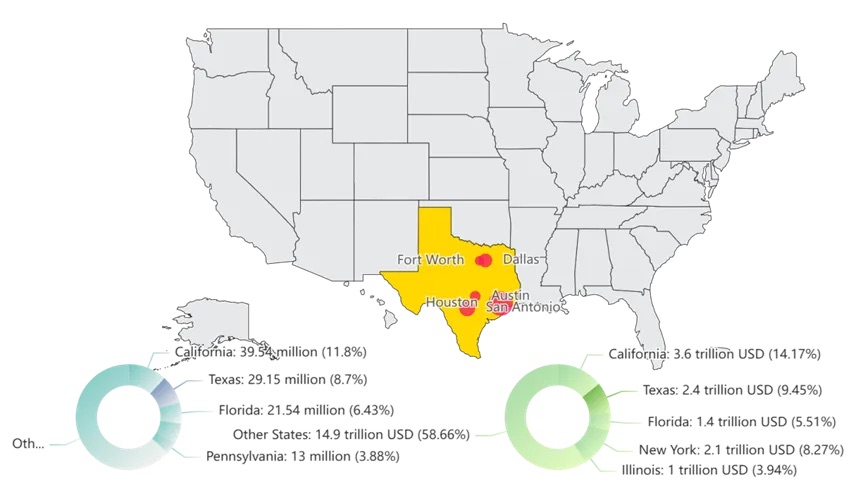
Self-made image, data source: Wikipedia US GDP and population
Texas' total economic output in 2022 was $2.4 trillion, accounting for 9.4% of US GDP. Its main industries include energy, agriculture, high-tech manufacturing, and financial services. The state is very rich in natural resources, with oil and natural gas being Texas' main minerals, with known oil reserves exceeding 8 billion barrels, accounting for about 1/3 of the known US supply. Many major international oil companies have their headquarters in Texas, including ExxonMobil and BP. Texas is also one of the main hubs in the US for the development of computer components and systems as well as software. Austin, Dallas, and Houston are the main centers of this industry in Texas, with the Austin area often referred to as "Silicon Hills". Texas has an average electricity price of about $0.105 per kilowatt-hour, with a national share of 25.5%, making it the land of electricity freedom.
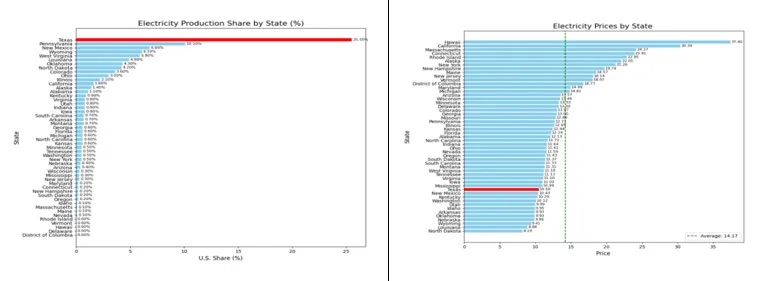
Self-made image, data source: EIA, electricity price and share
2. Texas' Basic Tax System
When investors venture into the US to invest and start businesses, the investment environment, market size, and operating costs are the main considerations. In January of this year, Wall Street released a report on the best and worst states for startups in 2023, evaluating the 50 US states based on key startup indicators such as financing, affordability, and tax rates. The results show that Texas, due to its favorable employment environment, friendly regulatory policies, and relatively low state taxes, was ranked the third best state for startups in the US.
The Texas government advocates a low-tax rate and a lax management model that avoids excessive intervention. A survey on the friendliness of US states to small and medium-sized enterprises shows that in terms of overall friendliness, talent welfare, and government regulations, Texas meets the A-level standard in terms of ease of entrepreneurship, employment of labor talents, and taxation.
Texas is known for its low taxes, but the reality is much more complex. Texas does not have a state income tax (but federal income tax still applies to all residents), and to make up for this, Texas relies more heavily on other forms of taxation, such as sales tax and property tax. A 2020 report by Ernst & Young pointed out that the total state and local taxes paid by individuals in Texas account for 3.5% of their income, far below the national average of 5.8%; relative to economic output, the effective tax rate levied by Texas on businesses is 5.6%, higher than the national average of 4.7%, ranking 11th among the states.
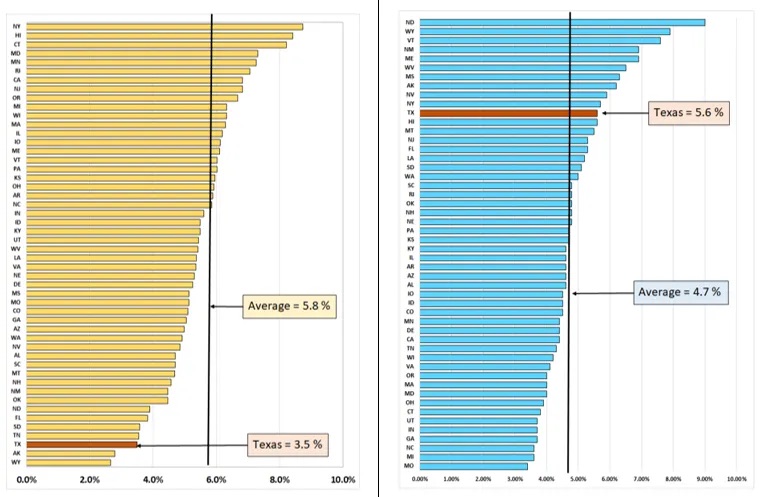
Source: TTARA Team Research Report June20
2.1 Tax Types and Rates
According to the official website, Texas currently has 29 major tax categories, including sales tax, franchise tax, and property tax.
Sales and Use Tax: Texas imposes a 6.25% state sales and use tax on most retail, lease, and rental of goods and taxable services. Local tax jurisdictions (cities, counties, special purpose districts, and transportation authorities) can also levy up to 2% in sales and use taxes, for a maximum combined rate of 8.25%. Sales tax applies to most goods and services, with some food groceries (such as flour, sugar, milk, eggs, etc.) and prescription drugs being exempt. In addition, Texas also imposes sales tax on digital goods (such as online subscription services).
Property Tax: Texas does not have a state-level property tax, and property tax is levied by local governments. Tax rates may vary by region, ranging from 1.5% to 3%, with an average of 1.65%. Texas' property tax mainly applies to real estate, including residential and commercial buildings and land owned by individuals and businesses.
Franchise Tax: Every taxable entity established or doing business in Texas must file and pay the franchise tax. These entities include: corporations; limited liability companies (LLCs), banks; national banking associations; savings and loan associations; partnerships, etc. Sole proprietorships (except single-member LLCs), general partnerships, etc. do not file or pay the franchise tax. Depending on the type of business, the tax rate is 0.375% for retail and wholesale industries, and 0.75% for other industries.
Vehicle Fuel Tax: $0.20 per gallon for diesel and gasoline, $0.15 per gallon for liquefied natural gas.
There are also hotel occupancy tax, tobacco tax, etc.
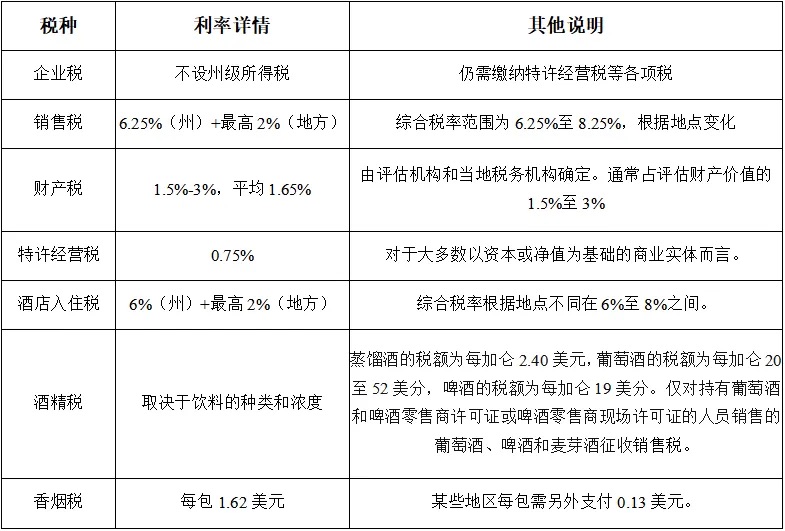
Self-made table, content: Texas tax details
2.2 Taxpayers
Under Texas' tax system, taxpayers include individuals, businesses, and other legal entities. The specific tax burden is concentrated in several areas.
Individuals do not need to pay state personal income tax, but they need to pay sales tax in their daily consumption, with a state rate of 6.25%, and local governments can add up to 2% in additional tax, making the total sales tax rate in some areas reach 8.25%. In addition, individuals who own real estate (such as houses, land, etc.) need to pay the property tax levied by local governments, with an average property tax rate in Texas of about 1.63% in 2023. Property tax revenue is mainly used for local public services such as education and infrastructure construction.
For businesses, Texas does not levy a traditional corporate income tax, but all businesses operating in Texas must pay the franchise tax, which is based on the company's total revenue or profits, with the tax rate varying by industry type, 0.375% for retail and wholesale industries, and 0.75% for other industries. Even tax-exempt businesses still need to submit an annual tax return. In addition, businesses need to collect and remit the sales tax on the taxable goods and services they sell, which applies to most goods and some digital goods such as software and media subscriptions.
2.3 Taxable Objects
Taxable objects refer to the specific behaviors, properties, or transaction types that tax laws are based on, which form the basis of government tax revenue. In Texas' tax system, various behaviors, properties, and transactions have corresponding tax types. In general, they include goods, services, real estate, business revenue, and specific consumer goods.
2.4 Major Tax Incentives and Policies
Texas has been ranked the "Best State for Business" by CEOs for 20 consecutive years, with its unique economic incentives and tax relief policies.
Texas does not levy corporate income tax or personal income tax, making it one of the states with the lowest tax burden in the US. The state also provides many tax incentives for businesses, including exemption from sales tax on manufacturing machinery and equipment, research and development-related materials, software and equipment, as well as exemption from franchise tax for solar equipment manufacturers, sellers or installers. The state also offers property tax relief, license fee relief, local cash grants, and local funding to help businesses relocate or expand in the state. The Texas Enterprise Zone Program (EZP) is a state sales and use tax refund program aimed at encouraging private investment and job creation in economically distressed areas of the state.
The economic development incentives in the state of Texas are powerful and extensive. It is constantly committed to diversifying industrial development to maintain the thriving business enterprises. For example, the Texas Enterprise Fund (TEF) is one of the largest "deal-closing" funds of its kind in the United States, which is a performance-based incentive program. There are also additional rewards for major event sponsorship, university research programs, job creation, new product development, skills training, and relocation of employees and their families. The incentives are aimed at rewarding companies that make substantial capital investments and create employment opportunities for the state's economy.
Companies relocating or expanding in Texas may be eligible for asset-backed loans, leverage loans, or tax-exempt bonds. These include the Texas Industrial Revenue Bond Program and the Texas Military Value Reinvestment Fund. Texas communities, certain Texas higher education institutions, and businesses can also receive various types of grants.
In recent years, Texas has attracted a large number of cryptocurrency-related businesses and projects. Large cryptocurrency mining companies such as Riot Blockchain and Argo Blockchain have set up mining farms in Texas. Blockchain technology companies like Blockcap have also moved their headquarters to Austin, Texas. So why is Texas so favored by cryptocurrency companies? Next, we will analyze the cryptocurrency companies in more detail from the perspective of taxation and regulation.
3. Texas Cryptocurrency Asset Tax System
The status and regulation of cryptocurrency assets have undergone phased changes in Texas legislation, and new issues and perspectives are constantly emerging. To date, there are no specific laws in Texas on how cryptocurrency assets should be taxed. The taxation of cryptocurrency assets is mainly based on the existing tax system, with different tax rates levied according to their characteristics as assets, usage, and scenarios. This also allows cryptocurrency assets to enjoy the unique tax system advantages of Texas.
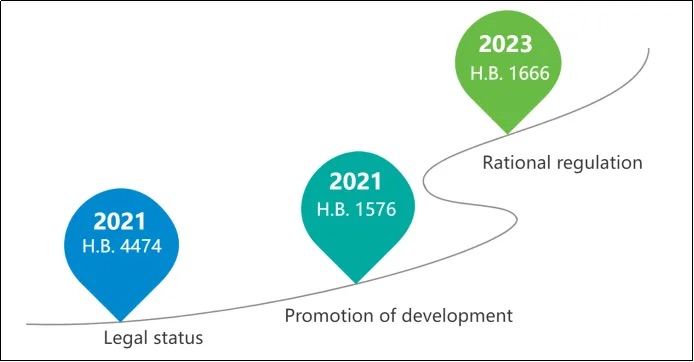
Image created by the author, content: Evolution of cryptocurrency legislation in Texas
3.1 Definition and Characterization of Cryptocurrency Assets
The legal definition of cryptocurrency in Texas is primarily established through the H.B. 4474 Act passed in 2021. This Act clarifies the legal status of cryptocurrency, defining it as "a representation of value in electronic form that is intended to function as a medium of exchange, a unit of account, or a store of value." The Act amends the Texas Uniform Commercial Code (UCC) to recognize cryptocurrency as a type of digital asset, similar to other financial assets. This definition ensures that cryptocurrency can be used for legitimate commercial transactions and provides a legal framework for regulation.
Furthermore, H.B. 4474 also stipulates the concept of "control" of cryptocurrency, granting the holder exclusive rights to use, transfer, and possess their cryptocurrency, ensuring the legal status of digital asset holders in transactions. Through this framework, Texas has laid the foundation for the legitimate application of cryptocurrency in the commercial and financial fields, and provided legal protection for businesses and individuals.
3.2 Texas Cryptocurrency Asset-Related Taxes
The IRS classifies cryptocurrency and other "virtual currencies" as property. Any cryptocurrency received must be reported as "income," and "capital gains" must be paid when sold. Cryptocurrency and cryptocurrency-related activities in Texas must be carefully reported on the U.S. Individual Income Tax Return Form 1040 (f1040) to accurately record cryptocurrency transactions for the tax year.
While federal taxes still need to be paid, Texas residents can enjoy state-level income exemptions. However, it should be noted that other forms of taxation, such as sales tax and property tax, still apply to cryptocurrency. If cryptocurrency or other capital assets are sold in Texas at a price higher than the acquisition cost, capital gains tax (federal rate, no state-level) must be paid. If capital losses are incurred, federal regulations allow these losses to be offset against gains. In Texas, inheriting cryptocurrency assets is not subject to estate tax. However, large estates may still be subject to federal estate tax. If goods and services purchased with cryptocurrency are taxable, sales tax will be levied. In this case, the tax rate depends on the goods or services purchased, not on the use of cryptocurrency. In Texas, property purchased with cryptocurrency is also subject to taxation. There is no state property tax, but properties purchased in the state are subject to county and city taxes.
Texas does not have a state-level corporate income tax, which means that businesses do not need to pay income tax on their cryptocurrency transaction profits at the state level, which is undoubtedly a huge attraction for cryptocurrency companies and miners. However, Texas imposes a Margin Tax, which is a tax based on total revenue rather than traditional net profit. Any business with annual revenue exceeding about $1.2 million may be required to pay the Margin Tax, with rates ranging from 0.375% to 0.75% depending on the type and size of the business. This may pose a certain tax burden for cryptocurrency companies, especially miners, with high revenue but low profits.
Cryptocurrency miners need to pay special attention to Texas property taxes. Cryptocurrency mining typically requires a large number of mining rigs and power facilities, which are considered "tangible personal property" in Texas and therefore subject to local property taxes. Texas property taxes are relatively high, typically ranging from 1.8% to 2.3%, varying by county and city. When investing in hardware equipment, the cost of these taxes must be taken into account. At the same time, the mining activity itself is considered income creation at the federal level. Therefore, the market value of the cryptocurrency mined at the time of creation must be reported as income on the federal tax return. This means that even though Texas does not levy a state income tax, miners still need to pay federal income tax on their mining income. If miners subsequently sell these cryptocurrencies and realize price appreciation, the appreciation portion will be treated as capital gains and subject to federal capital gains tax.
For businesses engaged in cryptocurrency transactions or providing related services, sales tax also needs to be considered. While the transactions of virtual currencies themselves are not subject to sales tax (as virtual currencies are considered intangible assets), sales of cryptocurrency-related hardware, technical support services, and other cryptocurrency-related sales activities may trigger sales tax obligations. For example, companies selling mining rigs or providing mining hosting services need to pay sales tax at the base rate of 6.25%, plus local additional taxes, with a maximum actual rate of 8.25% depending on the type of product or service sold.
Furthermore, federal tax compliance is also crucial. While Texas' tax system is relatively lenient, federal tax laws require accurate reporting of income, capital gains and losses. Specifically, the IRS requires businesses to strictly report cryptocurrency transactions, mining income, and any sales of cryptocurrency assets. This means that not only the electricity and hardware costs of mining itself need to be considered, but also how to accurately estimate the market value of the mined cryptocurrency and correctly report it on the federal tax return.
3.3 Cryptocurrency Tax Incentives
Currently, there are no provisions that directly establish specific tax incentives or preferential policies for cryptocurrency transactions, investments, or mining in Texas. The main tax incentive policies are concentrated in traditional industries and renewable energy, manufacturing, and other sectors. However, based on the legal provisions, corresponding measures can be taken to obtain tax incentives for cryptocurrency:
- Hold the asset for more than a year before selling. Long-term capital gains are taxed at 25%, while short-term capital gains are taxed at 32%.
- Recoup tax losses. By selling at a loss, the loss can be realized and used to offset other capital gains or up to $3,000 of ordinary income per year. Losses can also be carried forward to future years.
- Sell in low-income years. Low income also means low tax rates.
In addition, the specific actions of cryptocurrency miners and related companies may also meet some existing tax incentives and incentive measures in Texas. Although these incentives are not specifically designed for the cryptocurrency industry, miners and companies can fully utilize the existing tax policies through the following actions:
Building large data centers or mining facilities: Cryptocurrency miners typically need to build or expand large-scale data centers to support their mining operations. Under Chapter 312 of the Texas Local Government Code, companies can sign agreements with local governments to obtain property tax exemptions for up to 10 years. This policy applies to capital-intensive facilities such as newly built or expanded data centers, helping companies reduce long-term operating costs.
Energy-intensive mining activities: Cryptocurrency mining is an energy-intensive activity, and Texas's electricity policies provide flexible electricity pricing options for such high-energy industries. The Electric Reliability Council of Texas (ERCOT) electricity market allows miners to negotiate long-term electricity contracts with power suppliers to obtain preferential electricity prices. In addition, if the mining site chooses to use renewable energy sources such as solar or wind, it can also enjoy further energy incentives.
Research and development of new mining technologies or blockchain applications: For cryptocurrency companies that invest in research and development of mining technologies or blockchain applications, the research and development tax credit (R&D Tax Credit) policies at the state and federal levels in Texas apply. These companies can use their R&D expenditures for tax credits, reducing their overall tax burden.
Purchase or lease commercial real estate for mining: Cryptocurrency miners typically need to purchase or lease large-scale industrial land or warehouses as mining facilities. Texas provides property tax exemption policies, and under Chapter 312 of the Texas Local Government Code, companies can negotiate with local governments to obtain property tax exemptions, especially when the investment is for the expansion of commercial use. In addition, when companies import and store mining equipment, they can also use the Freeport Tax Exemption to be exempt from property tax on the inventory equipment.Cryptocurrency wallet service providers, investment funds, and cryptocurrency ATM operators are also subject to regulation, but there is still no strict system in place. Wallet service providers need to ensure the security of the stored cryptocurrency assets, prevent hacker attacks, and comply with KYC and AML requirements. Cryptocurrency funds and investment institutions need to comply with securities laws, especially when involving tokenized assets or investments, and the TSSB will regulate them to ensure adequate information disclosure for investors. Cryptocurrency ATM operators must strictly comply with AML and KYC regulations to prevent illegal money laundering activities through ATMs.
5. Summary and Outlook
Considering various factors such as state-level systems, market environment, and operational capabilities, more and more cryptocurrency companies (not limited to cryptocurrency mining companies) are settling in Texas. Texas has abundant economic and natural resources, a unique tax environment, and a leading regulatory framework. The rich energy resources, relatively high power generation, and low power costs in the state provide favorable conditions for cryptocurrency mining. In addition, the advantage of no state-level income tax further enhances the profitability of enterprises. Furthermore, Texas is at the forefront of legislation and regulation in the United States, with continuously advancing regulations that safeguard asset security while preserving innovation opportunities.
Looking to the future, as cryptocurrency and blockchain technology continue to develop, Texas is expected to further consolidate its global leading position in the field of cryptocurrency assets and may introduce more innovative regulations to promote the standardized development of the industry.