So far, the 2024 cycle has witnessed the dominance of Solana, with the main narrative of this cycle - Memecoins - all being generated on Solana. In terms of price, Solana has also been the best performing L1 blockchain, up around 680% year-to-date.
While memecoins and Solana are deeply intertwined, since the recovery in 2023, Solana as an ecosystem has generally sparked people's interest, with its ecosystem thriving, with protocols like Drift (Perp-DEX), Jito (Liquid Stake), Jupiter (DEX-Aggregator) all having multi-billion dollar token valuations, and Solana's active addresses and daily transactions exceeding all other chains.
Raydium, the premier DEX in the Solana ecosystem, is at the core of this thriving ecosystem. The old saying "in the gold rush, sell shovels" perfectly encapsulates Raydium's position: powering the liquidity and trading of the memecoin frenzy.
Benefiting from the trading volume of memecoins and the broader DeFi activity, Raydium has solidified its position as a critical infrastructure within the Solana ecosystem.
This article aims to use a data-driven approach, using first principles to unpack Raydium's position within the Solana ecosystem.
Raydium Introduction
Launched in 2021, Raydium is a Solana-based Automated Market Maker (AMM) that enables permissionless pool creation, lightning-fast transactions, and yield farming. Raydium's key distinction lies in its structure: Raydium was the first AMM on Solana and introduced the first hybrid AMM compatible with order books in DeFi.
When Raydium launched, it adopted a hybrid AMM model, allowing idle pool liquidity to be shared with central limit order books, whereas typical DEXes at the time could only access liquidity within their own pools. This meant Raydium's liquidity also created a market for OpenBook, which could be traded on any OpenBook DEX GUI.
While this was the key early differentiation, this feature has since been turned off. Raydium currently offers three different pool types:
- Standard AMM Pools (AMM v4), officially called Hybrid AMM
- Constant Product Market Maker Pools (CPMM), supporting Token 2022
- Concentrated Liquidity Market Maker Pools (CLMM)
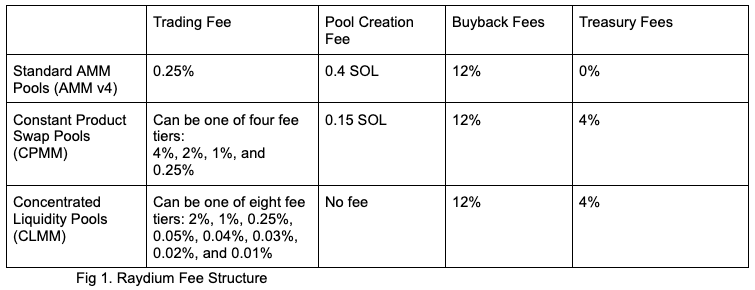
For each swap that occurs on Raydium, a small fee is charged based on the specific pool type and fee tier. This fee is split into two parts, one to incentivize liquidity providers, and the other for RAY buyback and the treasury.
The following records the trading fees, pool creation fees, and protocol fees on different Raydium pools. Here's a brief explanation of each term and their respective fee levels:
- Trading Fees: Fees charged to traders for Swap transactions
- Buyback Fees: Percentage of trading fees used to buyback Raydium tokens
- Treasury Fees: Percentage of trading fees allocated to the treasury
- Pool Creation Fees: Fees charged when creating a pool, intended to prevent pool spam. Pool creation fees are controlled by the protocol multi-sig and retained for protocol infrastructure costs.
Solana Ecosystem DEX Overview
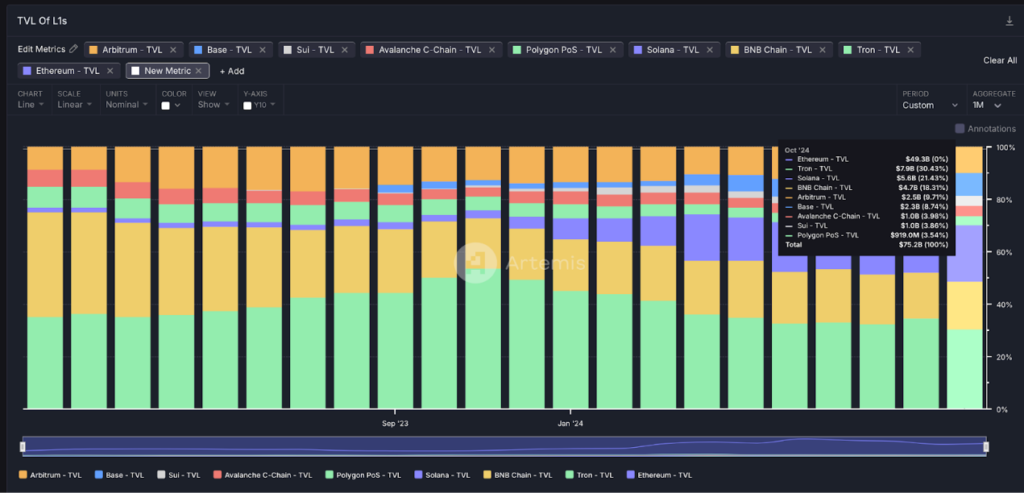
Figure 2: Solana's TVL in DEXes
The above primarily analyzed Raydium's mechanics, now let's evaluate Raydium's position in the Solana DEX landscape. Undoubtedly, Solana has successfully ascended to the top L1s in the 2024 cycle. Solana's TVL ranks third, behind only TRON (second) and Ethereum (first).
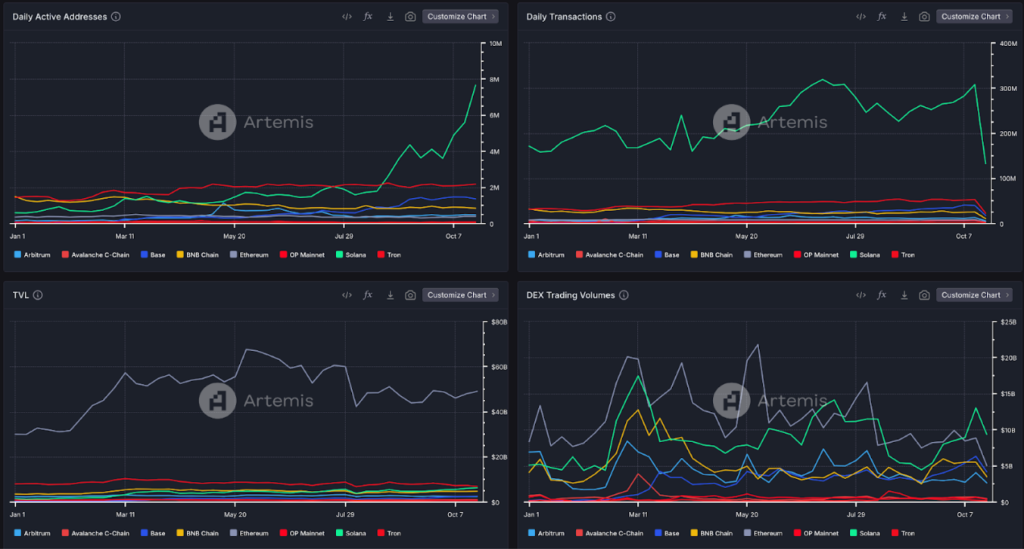
Figure 3: Daily Active Addresses, Daily Transactions, TVL and DEX Volumes
Solana continues to dominate in user activity metrics, such as daily active addresses, daily transactions, and DEX volumes. The increased activity and token liquidity on Solana can be attributed to several factors: the memecoin frenzy on Solana.
Solana's fast and low-cost settlement, combined with the smooth user experience of DApps, has driven the growth and thriving of on-chain transactions. As tokens like $BONK and $WIF reach multi-billion dollar market caps, and the emergence of Pump.fun.
As a platform for the release of memecoins, Solana has effectively become the headquarters for memecoin trading.
Currently, Solana has been the most utilized L1 in this cycle and continues to dominate in transaction activity. As a direct beneficiary of the increased activity, this means Solana's DEXes are performing exceptionally well - more traders mean more fees, which also means more protocol revenue.
However, even within DEXes, Raydium has successfully captured a significant market share, as shown in the following charts:
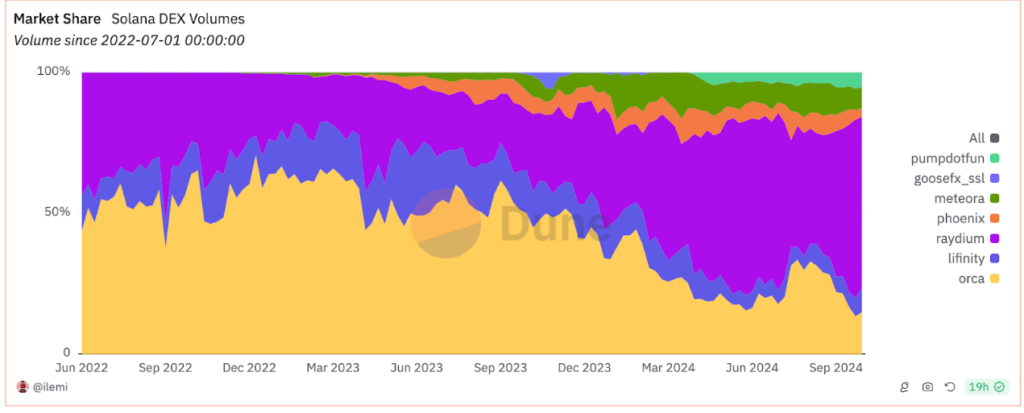
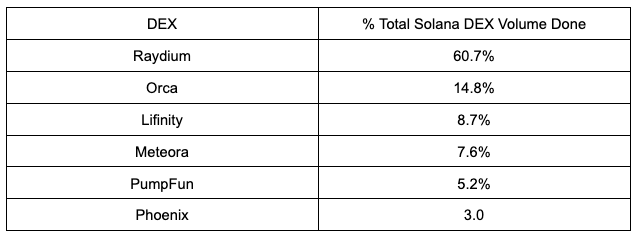
Figure 4: Solana Ecosystem DEX Volume Market Share
Raydium ranks first in the Solana DEX, with the highest trading volume among all Solana DEXs, accounting for 60.7% of the total Solana DEX trading volume. This is because Raydium allows for a variety of activities on its platform - from memecoins to stablecoins.
One way Raydium achieves this is by providing pool builders and liquidity providers with multiple options when establishing new markets.
Users can choose to do price discovery in a fixed product pool at initial release, or they can choose a narrower range in a concentrated liquidity pool (LP): allowing for initial price discovery on Raydium, while still remaining competitive on SOL-USDC, stablecoins, LST, and other markets.
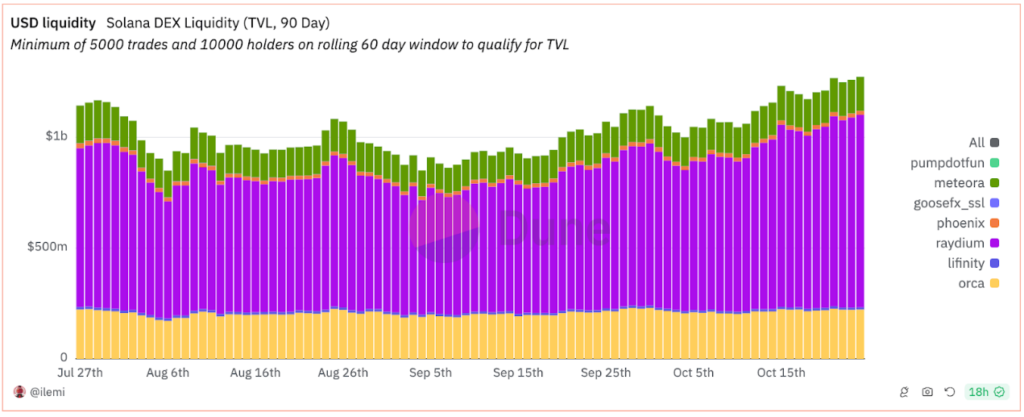
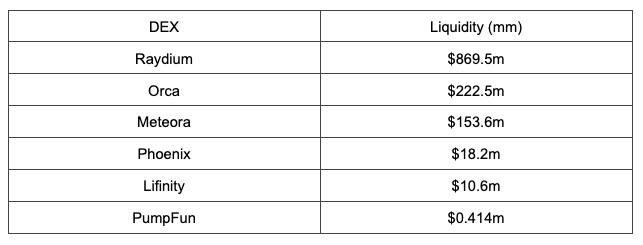
Figure 5: Solana DEX Liquidity
Most importantly, Raydium remains the most liquid DEX. It's worth noting that trading is often an issue of economies of scale, as traders flock to the exchange with the most liquidity to avoid slippage.
Liquidity begets liquidity: As the largest DEX captures the most traders, it becomes a positive flywheel, attracting LPs who can earn from the fees, which in turn attracts more traders seeking to avoid slippage.
When comparing DEXs, liquidity is often an overlooked factor, but it is crucial when evaluating the best-performing DEX (especially considering Solana traders are trading memecoins). Fragmentation of liquidity between different DEXs can lead to a poor user experience, and having to purchase different memecoins on different DEXs can be frustrating.
The Relationship Between Memecoins and Raydium
Raydium's popularity can also be attributed to the resurgence of memecoins on Solana, particularly Pump.fun, a memecoins launch platform that has generated over $100 million in fees since its inception earlier this year.
Pump.fun memecoins have a direct connection to Raydium, as when tokens launched on Pump.fun reach a $69,000 market cap, Pump.fun automatically deposits $12,000 worth of liquidity into Raydium. Continuing the earlier point about liquidity, this means Raydium is effectively the most liquid platform for trading memecoins.
It's a virtuous cycle: Pump.fun integrates with Raydium -> memecoins are issued there -> people trade there -> liquidity is gained -> more memecoins are issued there -> more liquidity is gained, and the cycle continues.

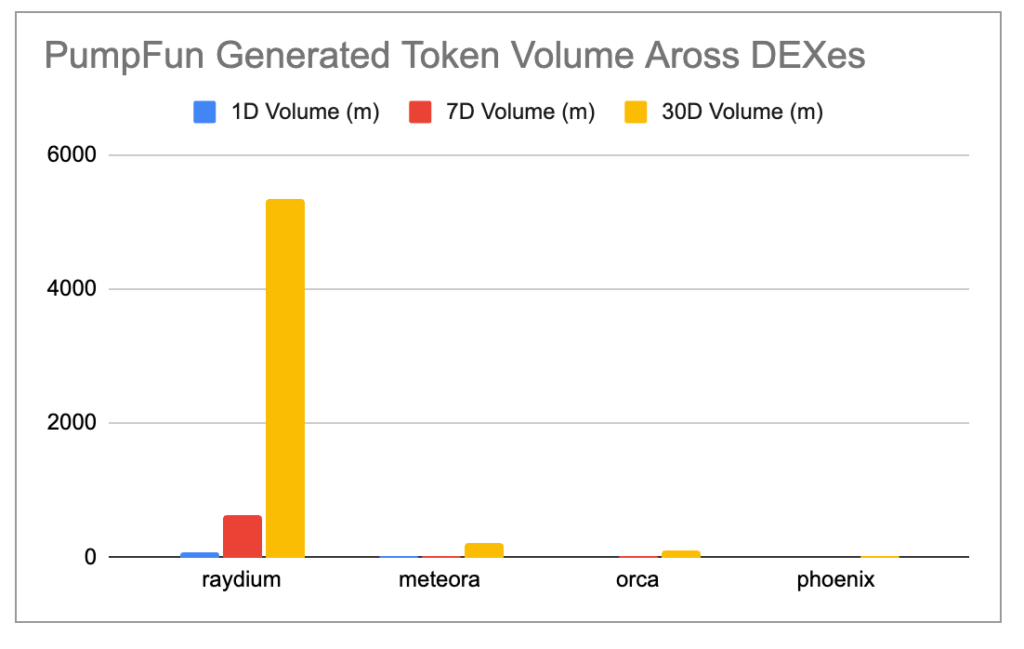
Figure 6: Tokens Generated by Pump.Fun on DEXs
So Pump.fun is attributable to Raydium, with over 90% of the memecoins generated by Pump.fun being traded on Raydium. Just like a shopping mall in a city, Raydium is the largest "shopping mall" on Solana, where most people go to "shop", and most "businesses" (tokens) want to "set up shop".
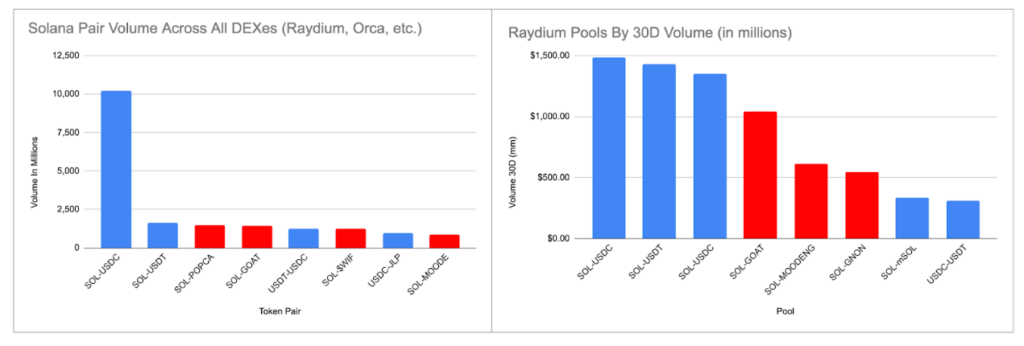
Figure 7. Token Pair Trading Volume on Solana DEXs vs. Raydium
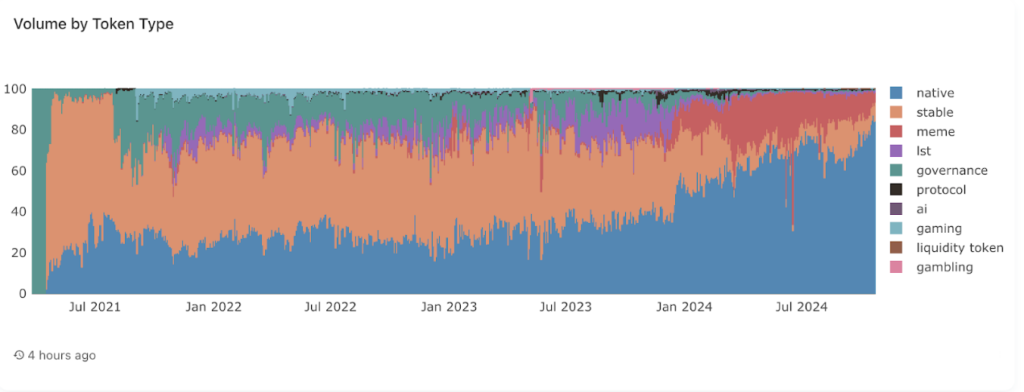
Figure 8: Raydium Trading Volume (by Token Type)
It's worth noting that while Pump.fun relies on Raydium, the reverse is not true - Raydium does not solely rely on memecoins. In fact, according to Figure 8, the top 3 token pairs by trading volume in the past 30 days are SOL-USDT/USDC, accounting for over 50% of the total trading volume. (Note: the two SOL-USDC pairs are two different pools with different fee structures).
Figures 7 and 9 also confirm this, with Figure 7 showing that SOL-USDC far outpaces all other DEX pairs in trading volume. Figure 7 represents the trading volume of all DEXs, and it still indicates that the overall ecosystem's trading volume is not necessarily driven solely by memecoins.
Figure 9 further shows Raydium's trading volume by token type. It can be seen that "native" tokens occupy the largest market share, over 70%. So while memecoins are an important component of Raydium, they are not the whole story.
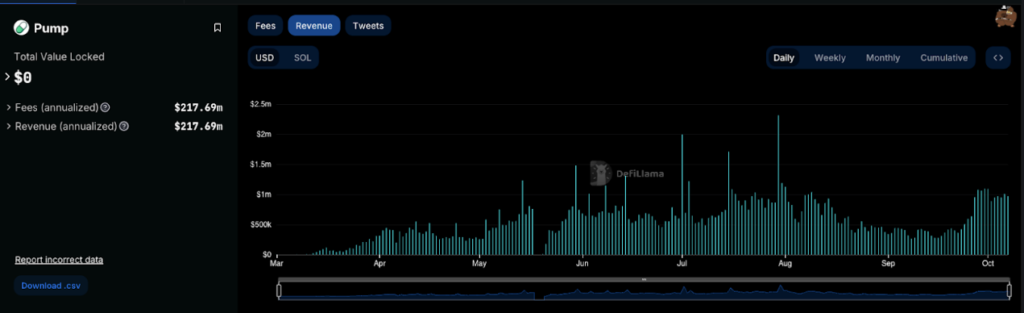
Figure 9: PumpFun Revenue
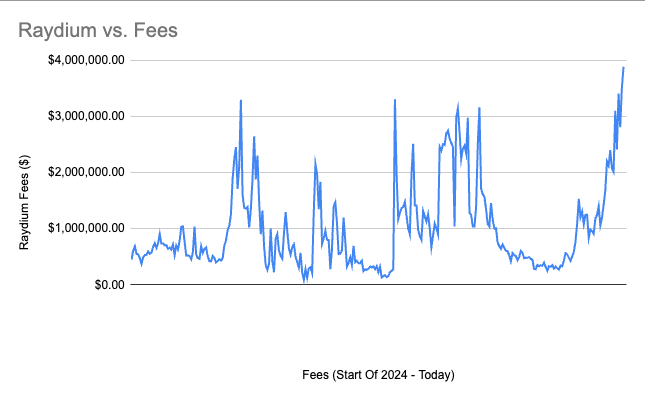
Figure 10: Raydium Revenue
That said, memecoins have high volatility, and pools with high volatility typically charge higher fees. So while memecoins may not contribute as much to trading volume as Solana pools, they contribute significantly to Raydium's revenue and fees.
This can be seen in the situation from September, as memecoins are cyclical assets, and their performance often drops significantly below expectations when risk appetite wanes during "bad market" times.
Subsequently, Pump.Fun's revenue dropped 67% from an average of $800,000 per day in July/August to around $350,000 in September; Raydium's fees also declined during this period.
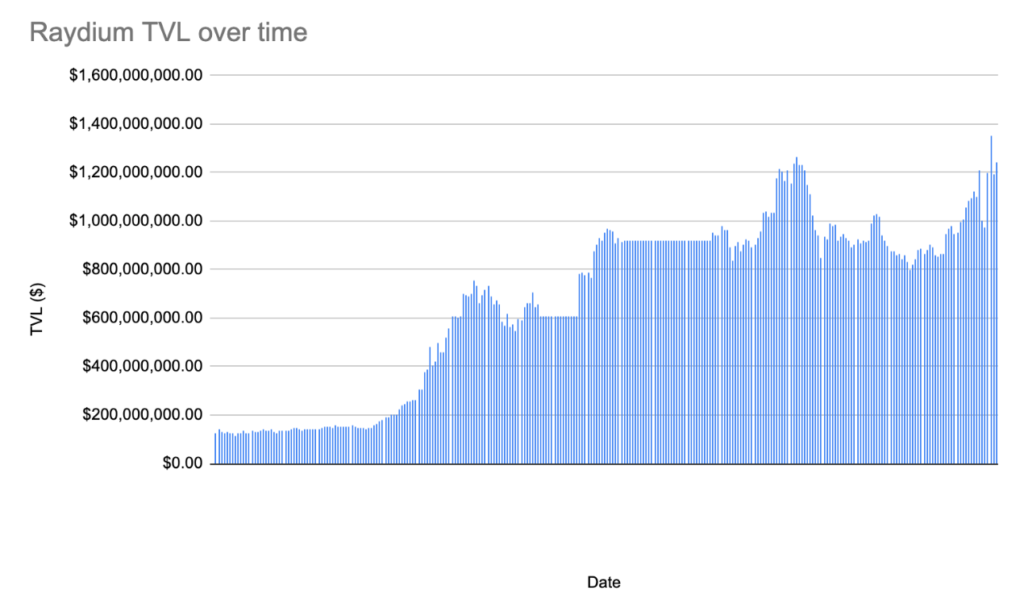
Figure 11: Raydium TVL
But like other areas of the crypto industry, this industry has strong cyclicality, and seeing indicators decline during bear markets is normal as risk appetite wanes.
In contrast, TVL can be used as a measure of a protocol's true antifragility. While revenue is highly cyclical, fluctuating with the arrival and departure of speculators, TVL is an indicator of a DEX's sustainability and how it weathers the test of time.
TVL is similar to the "occupancy rate" of a shopping mall, where the utilization rate of stores may fluctuate with the seasons, just like in the real world, and as long as the mall's occupancy rate is above the average, it can be considered successful.
Similar to a crowded shopping mall, Raydium's TVL has remained consistent over time, indicating that while revenue may fluctuate with market prices and sentiment, it has proven its ability to become a leading product in the Solana ecosystem and the best, most liquid DEX on Solana.
Therefore, while memecoins have indeed contributed to some of its revenue, the trading volume of memecoins is not always as such, and regardless of market conditions, liquidity continues to flow into Raydium.
Raydium and Aggregators
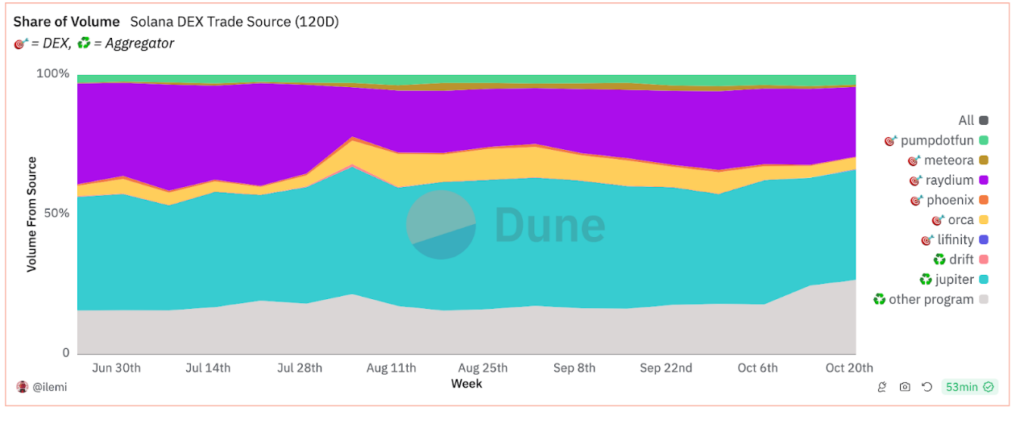
Figure 12: Solana DEX Trading Sources
While Jupiter and Raydium do not directly compete, Jupiter is a key aggregator in the Solana ecosystem, providing the most efficient trading paths across multiple DEXs, including Raydium. Essentially, Jupiter acts as a meta-level platform, ensuring users get the best prices by sourcing liquidity from various DEXs (such as Orca, Phoenix, Raydium, etc.).
On the other hand, Raydium as a liquidity provider, supports many of Jupiter's trades by providing deep liquidity pools for Solana-based tokens.
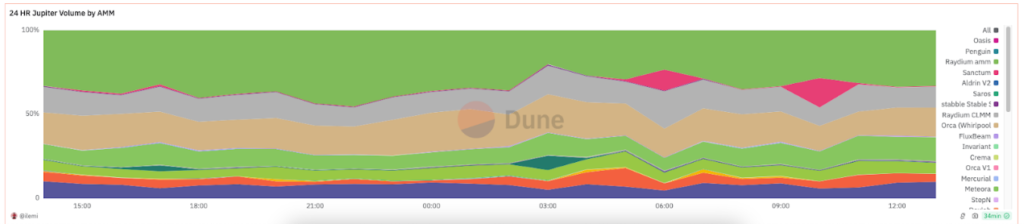
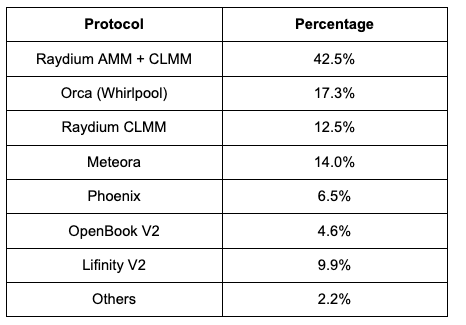
Figure 13: 24-hour Jupiter AMM Trading Volume
While the two protocols are evenly matched, Raydium's directly generated organic trading volume share is slowly increasing, while Jupiter's share is slowly decreasing. At the same time, Raydium accounts for nearly 50% of all order book trades on Jupiter.
This indicates that Raydium has successfully built a more powerful and self-sufficient platform that can directly attract users, rather than relying on third-party aggregators like Jupiter.
The increase in direct trading volume suggests that as users seek the most efficient and comprehensive DeFi experience without the need for aggregators, traders are discovering the value of interacting with Raydium's native interface and liquidity pools. Ultimately, this trend highlights Raydium's capabilities as a liquidity provider within the Solana ecosystem.
Raydium and The World
Finally, here is a comparative table built for Raydium using the Artemis plugin, comparing it to other DEXs on Solana, including aggregators.
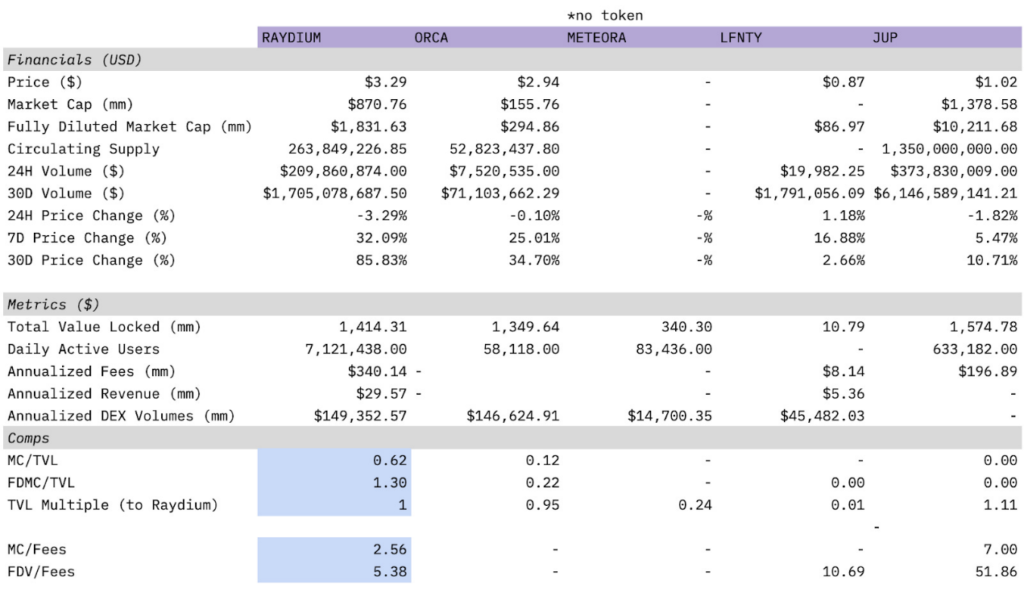
Figure 14: Raydium vs. Solana DEXs
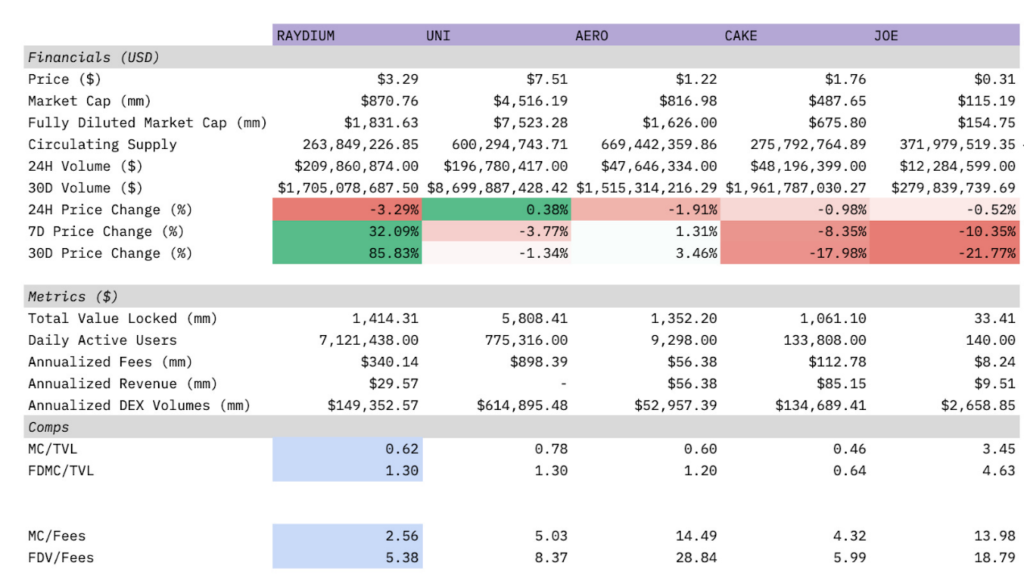
Figure 15: Raydium vs. Popular DEXs
In Figure 13, Raydium is compared to the most popular DEXs on Solana, namely Orca, Meteora, and Lifinity, which together account for 90% of the total Solana DEX volume. Jupiter is also included as an aggregator. Meteora has no token, but for the sake of comparison, it is still included.
It can be seen that among all DEXs, Raydium has the lowest MC/Fees and FDV/Fees. Raydium also has the highest number of daily active users, and all other DEXs have a TVL that is over 80% lower than Raydium's -- except for Jupiter.
In Figure 14, Raydium is compared to other more traditional DEXs on other chains. Raydium's annualized DEX trading volume is more than double that of Aerodrome, but its MC/Earnings ratio is lower.
Raydium Token
The token economics of Raydium are as follows:
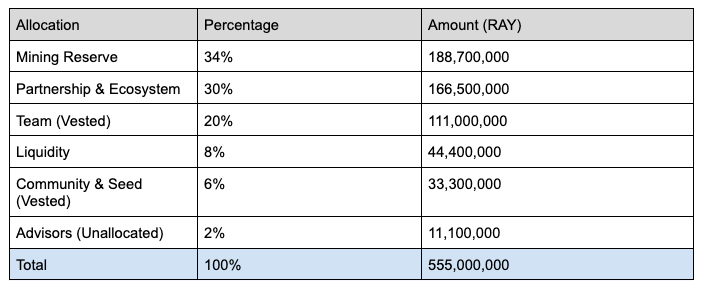
Note: The team and seed (25.9% of the total) are fully locked for the first 12 months after TGE, and linearly unlocked over months 13 - 36. Vesting ends on February 21, 2024.
Raydium tokens have multiple use cases: $RAY holders can stake their tokens to earn additional $RAY. Most importantly, $RAY is a mining reward used to attract liquidity providers to Raydium, thereby increasing the depth of liquidity pools. While the Raydium token is not a governance token, governance methods are in development.
Although token issuance has fallen out of favor in the DeFi summer, Raydium has an extremely low annual inflation rate, and its annualized buyback is one of the best token buybacks in DeFi. The current annualized issuance is around 1.9 million RAY, of which 1.65 million RAY is staked, which is negligible compared to the peak issuance of other popular DEXs.
At the current price, the annual issuance value of RAY is around $5.1 million. This is very low compared to Uniswap, which had a pre-fully diluted daily issuance of $1.45 million, or $529.25 million annually.
Each swap on Raydium's pools incurs a small trading fee. As stated in the documentation:
"Based on the specific fee of the given pool, this fee is split between incentivizing liquidity providers, RAY buybacks, and the treasury. In total, 12% of all trading fees are used to buyback RAY, regardless of the fee level of the given pool."
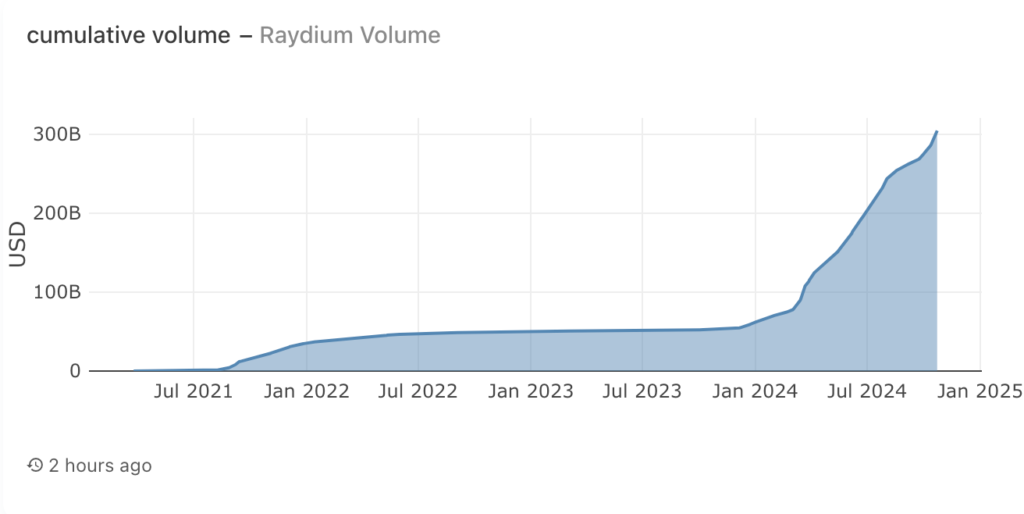
Figure 16: Raydium Cumulative Trading Volume
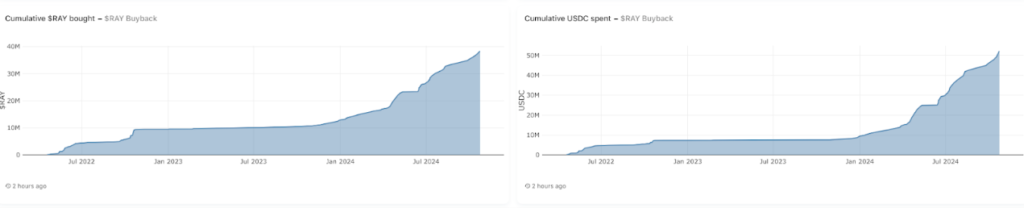
Figure 17: Raydium Buyback Data
Raydium has accumulated over $300 billion in trading volume and successfully bought back around 38 million RAY tokens, equivalent to $52 million. Raydium's buyback program is the most impressive among all DeFi projects, helping to position Raydium as a leading DEX on Solana.
The Raydium Case
In summary, Raydium is essentially leading all DEXs on Solana and is succeeding as Solana continues to grow. Raydium has experienced growth over the past year and does not seem to be slowing down anytime soon, as the memecoins hype persists, with the latest meme coin craze surrounding artificial intelligence (such as $GOAT).
As the leading liquidity provider and AMM on Solana, Raydium's unique position gives it a strategic advantage in capturing market share from emerging trends. Most importantly, Raydium's commitment to innovation and ecosystem growth is reflected in its frequent upgrades, incentives for liquidity providers, and active engagement with the community.
These factors indicate that Raydium is not only prepared to adapt to the ever-changing DeFi landscape, but also poised to lead DeFi.