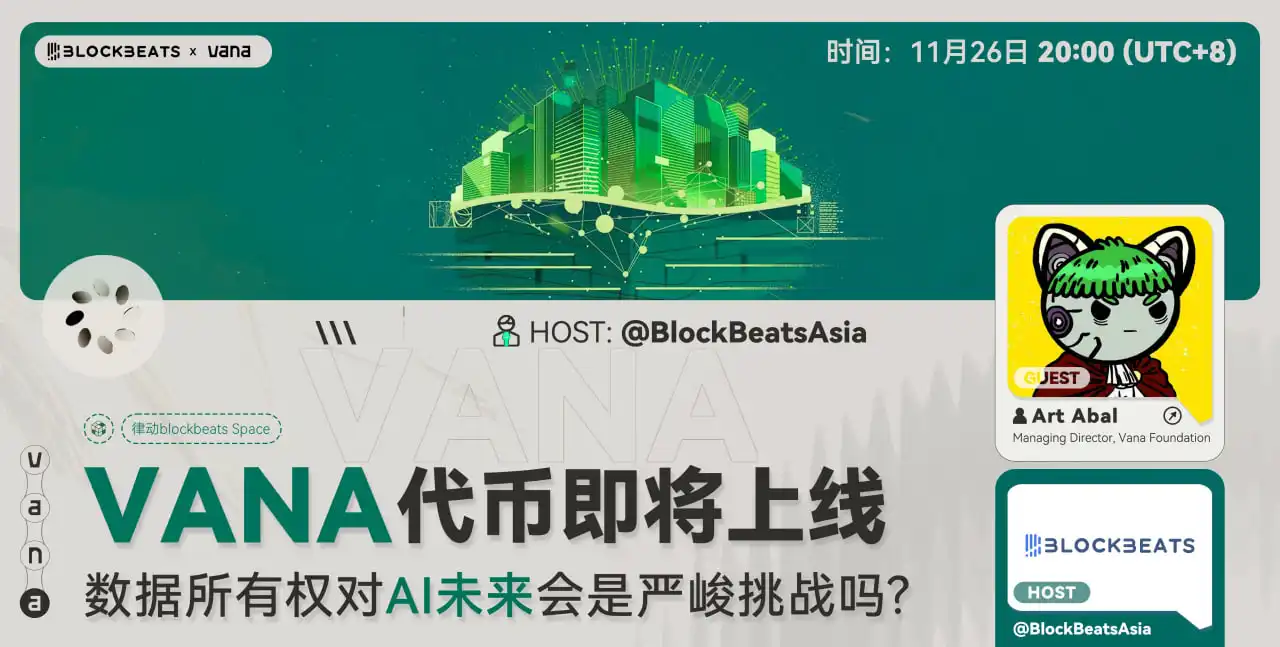
The Vana Foundation, a decentralized AI data flow network, has announced its establishment, with the mainnet and token set to launch soon. On November 26, BlockBeats had a dialogue with Art Abal, the Managing Director of the Vana Foundation, to discuss the progress of the VANA token and the issue of data ownership.
BlockBeats: Please give a brief self-introduction and talk about your experience in the crypto industry, as well as a brief introduction to Vana.
Art Abal: I am Art Abal, one of the founders of Vana and the Executive Director of the Vana Foundation. Vana's vision is to empower users by giving them control over their private data, thereby driving the development of the next generation of artificial intelligence. The current AI lacks high-quality private data, and we firmly believe that Vana can establish a decentralized ecosystem where users can own their data. Therefore, I am very pleased to be able to communicate with the Chinese community here.
In fact, my background is a bit unique. I initially entered the cryptocurrency field not because I was a blockchain enthusiast, but because I believed that blockchain technology solved a very specific problem. In fact, I specialized in the data sales field and worked for many years at one of the top data brokerage companies in the world, collaborating with companies like Facebook, Google, Amazon, Apple, and Microsoft, primarily responsible for buying and selling data for AI development.
Through these experiences, I have truly seen the challenges and flaws in the current data market, including transparency, user consent, and the effective use of private data for AI development, which is precisely why we founded Vana - to realize the ownership and decentralization of private data. We believe we can create better AI models while protecting and empowering user ownership.
BlockBeats: Vana is actually a VC token, but the narrative is about user data ownership, which is an anti-monopoly concept. Do you think there are contradictions between these two?
Art Abal: This actually depends on which venture capital firms are involved in the project and the terms of their participation. In some cases, venture capital funding is absolutely necessary, especially when a project requires a lot of research and development. Vana is such a case, and our excellent partners have provided us with great support, giving us ample funding for research, testing, and development, and ensuring Vana's long-term development.
Our approach has always been to only collaborate with venture capital firms that are aligned with our vision and values in the long run. All of our venture capital partners have long lock-up periods, so there is no risk of dumping at the time of token issuance. In addition, they have provided us with a lot of strategic value, introducing us to our current technology partners and key figures in the AI and Web3 fields.
So I don't think there is a contradiction here. Of course, if a project collaborates with the wrong venture capitalists or signs unfavorable terms, problems may arise. But the key is to thoroughly understand the terms, project structure, and the venture capital firms themselves, and understand the alignment of the venture capital firms with the long-term goals of the community. This requires careful analysis and research, rather than simply concluding that VC tokens are necessarily bad.
BlockBeats: In the process of Vana's system operation, there are some key components, such as the Data Liquidity Pool (DLP) and the Nagoya Consensus, etc. Can you introduce us to the most important parts of Vana that you think are the most important?
Art Abal: I would summarize Vana in three points: data aggregation, data validation, and data ownership and portability.
First, data aggregation. The reason why Web2 platforms have been so successful in data sales is that they are able to aggregate a large amount of data and maintain its structure and consistency. What Vana is doing is to achieve the same data aggregation, but in a decentralized way, without the need for a central authority to manage or control the data. This creates a fair competitive environment where users can autonomously control their data, rather than being controlled by enterprises and companies.
The second part is data validation. In Web2, these centralized companies will verify and ensure data quality, and we trust them, although this trust is sometimes abused. In Web3, we don't have intermediaries, so we need a system to verify data in a decentralized, trustless way. This is where Vana's architecture comes into play. Vana enables secure verification of data without exposing the underlying data itself, protecting the value and privacy of the data, so that no one can steal it.
Finally, data portability and ownership. Data portability means that data can be taken anywhere. Through Vana, users own their own data and control it with their private keys. Our non-custodial storage system means you can manage your data like handling tokens in a crypto wallet, authorizing your data to circulate anywhere. In Web2, the concept of data portability hardly exists. Vana has achieved true portability, allowing users to control their data and unlock its value anywhere.
If you are interested in Vana's mechanisms, you can visit our official website to read more detailed information about our project. The website link is: https://www.vana.org/
BlockBeats: It seems that people don't oppose contributing their own data, but there are still some concerns. For example, if I contribute my data, how can the security of the data be guaranteed?
Art Abal: I will explain this problem on two levels, one is the system and technical level of security, and the other is the behavioral and incentive level of security.
At the system and technical level, there are many technologies in the Vana ecosystem to help users protect their privacy and ownership. Data is encrypted with your private key, ensuring that it is always under your control, basically meaning that the data is as secure as your tokens. In the aggregation and processing process, the data will never leave your control unless you sign a transaction.
In terms of behavior and incentives, Vana provides transparency and choice to users. If a user submits data to a data DAO, they can view the DAO's terms, assess its credibility, and even check the open-source code. This is a significant improvement over Web2, where data operations are opaque and users have almost no control over their data.
BlockBeats: How can ordinary retail investors participate to obtain VANA tokens?
Art Abal: I'm often asked this question. Retail investors will soon be able to purchase VANA tokens on centralized exchanges, and we will announce the token listing details soon. Tokens are a topic of great interest, and we want to ensure that everyone who wants to participate has the opportunity to obtain tokens.
In addition to purchasing tokens, people who actively participate in the Vana network can also earn tokens by contributing data and participating in project governance. So users can both purchase tokens and earn them by participating in the Vana ecosystem. I suggest that everyone follow Vana's official channels, and we will release more information later.
BlockBeats: What is the role of VANA in this system, and what are the use cases for token holders?
Art Abal: I see two main application scenarios. VANA tokens play a core role in the ecosystem, just like ETH in the Ethereum network. The main function of VANA is to serve as the gas in the ecosystem, including sending data, verifying data, and participating in decentralized applications within the ecosystem.
The second part is the Data Liquidity Pool (DLP) reward system. Through this reward mechanism, VANA tokens can incentivize high-quality and large-scale data contributions to the ecosystem, bringing in the data, which is the most valuable input for AI. Data DAOs contribute data to these liquidity pools, earning additional rewards. Token holders can stake VANA tokens in these data DAOs to add data and earn additional rewards.
The distribution of Data Liquidity Pool (DLP) rewards is based on the amount of Vana staked by token holders, the amount and quality of data contributed, and their ability to bring in new users, all of which are rewarded in VANA tokens.
But if users stake their tokens in the liquidity pools, they can also earn VANA rewards. So I call this a data security system, where the community can use their VANA tokens to aggregate and store data on Vana.
BlockBeats: We know that the VANA token is about to be launched, because the previous airdrops of Paradigm's portfolio projects like blur and friend tech did not satisfy everyone. What retail investors want to know most is the airdrop ratio and rules. Can you share some details?
Art Abal: Due to regulatory reasons, I cannot directly discuss the airdrop. In Web3, early users are often rewarded, especially those who deeply engage with the community. For Vana, users who participate in the early data DAO mining can receive rewards. Many users actively engage with our community and project, whether through discussions on Discord, sharing information about Vana, or promoting the vision of user-owned data, and they can also receive rewards.
We have currently launched 16 data DAOs covering various domains, so there are many participation opportunities. Reserving a spot in these data pre-mining or interacting with the data DAOs can provide opportunities to receive airdrops in the future.
Each project is different, and each founder has a unique approach when designing their airdrop rules. Vana is fortunate to learn from the successes and failures of other projects. Our goal is to launch a fair reward mechanism that recognizes early contributors.
BlockBeats: In fact, many AI companies are using copyrighted data to train their models, and it hasn't caused a major backlash yet. Do you think the data copyright issue will be one of the biggest challenges facing AI in the future?
Art Abal: Copyright is actually an advantage of the Vana system. In Vana, users own their data and can securely transact it on-chain. We have actually solved two problems. First is consent and ownership - users obtain the right to use their private data through signed transactions, creating an immutable record of consent to ensure their data is not used without their approval.
The second is traceability - on Vana, private data is not only owned by the user, but the entire lifecycle of data usage is recorded on-chain and can be traced. This system effectively solves the copyright issue of private data. Once data ownership is recorded on-chain, any misuse can be traced back to the source. This contrasts with the public internet of Web2, where data is untraceable and copyright is difficult to enforce.
Space link: https://x.com/i/spaces/1BdxYEOjrWDxX
Welcome to join the official BlockBeats community:
Telegram subscription group: https://t.me/theblockbeats
Telegram discussion group: https://t.me/BlockBeats_App
Twitter official account: https://twitter.com/BlockBeatsAsia