By Jeremy Koch, Messari
Compiled by Yomi
Key Insights
- Autonomys Network has established a modular blockchain architecture based on Subspace Protocol to create the necessary infrastructure for AI3.0 applications.
- To achieve high scalability , Autonomy Network integrates decoupled execution (DecEx), modular domains, data sharding, and a multi-layer distributed storage network (DSN). DSN also supports AI Agents to directly store and retrieve on-chain data .
- The network adopts the Proof of Archive Storage (PoAS) consensus mechanism called Dilithium, combined with the Proof of Time (PoT) mechanism, which allows miners to solve the "miner's dilemma" by maintaining consensus without storing the entire blockchain history data , ensuring data availability, security and efficient storage management.
- Auto ID and Auto Score create a self-sovereign identity framework and personhood proof mechanism to facilitate verifiable human-computer interactions.
- Space Acres simplifies the process of participating in the Autonomys Network. This convenient app allows anyone to run a mining node on their computer to earn AI3 tokens .
Introduction
In the past few years, the rise of artificial intelligence has attracted most of the market's attention. From the advent of GPT-3.0 to the emergence of on-chain AI Agents, people are full of expectations for how AI will reshape the way the world works. However, a core problem facing AI is its positioning in a decentralized system. At present, the top AI models are still centralized and require permission to access. Because of this, it has become a general trend to promote the democratization of AI access. Giants like Meta are trying to achieve democratization through open source Llama3.1 . The last time a change of this scale was created by Satoshi Nakamoto in 2009. To build a world where everyone can freely use disruptive technologies, more projects like Meta and Bitcoin are needed to jointly explore the true value of open source and de-licensing.
Autonomy Network 's vision is consistent with Satoshi Nakamoto's: to create a permissionless and secure blockchain ecosystem, and to extend this concept to the infrastructure construction of AI3.0, making it a public good. AI3.0 represents an open, collaborative, and Web3-enabled artificial intelligence development path. In this model, people can freely customize, train, and deploy their own intelligent agents to help them complete tasks. Artificial intelligence is moving from centralized machine learning AI1.0 to centralized generative AI AI2.0, and then to decentralized AI3.0 with people at the core.
As the cornerstone of AI 3.0, Autonomys Network is built on Subspace Protocol, providing the infrastructure and tools needed to support this new stage, and is committed to solving problems such as scalability, security, data sources, and user control. With its focus on decentralization, people-oriented, and open collaboration, Autonomys is leading artificial intelligence into a future that is fairer, more valuable, and in line with human values.
background
Autonomys Network is a practical result based on Subspace Protocol , which was developed by co-founders Jeremiah Wagstaff and Nazar Mokrynsky after three years of research and development. Subspace Protocol realizes the permanent decentralized storage function of Web3. On this basis, Jeremiah and Nazar successfully realized the integration of decoupled modular computing and launched Autonomys Network. On June 14, 2024, the protocol announced that it was officially renamed Autonomys Network.
The project raised $32.9 million , led by Pantera Capital, with participation from well-known institutions including Coinbase Ventures, Crypto.com, KR1, GSR Ventures, Alumni Ventures, Hypersphere Ventures and Stratos Technologies.
After seven testnet iterations, the Autonomys Network has attracted more than 100,000 miners (participants), providing more than 180 PiB of storage space support. On November 6, 2024, the first phase of the Autonomys mainnet was officially launched, using the hash value of Bitcoin block #869146 as the global unified starting point of the network through the Proof-of-Time mnemonic generation ceremony. Within two weeks after the mainnet was launched, the network added more than 2,000 nodes, contributing more than 140 PiB of storage capacity. The native token of the Autonomys Network is AI3, which can be used for staking, governance, block rewards and payment of transaction fees, and is an important pillar of the network operation.
technology
Autonomy Network Technology Stack
The Autonomys Network adopts a modular blockchain architecture divided into four main parts: (i) decentralized application (dAPP) layer, (ii) decoupled execution domain, (iii) consensus layer, and (iv) storage layer.
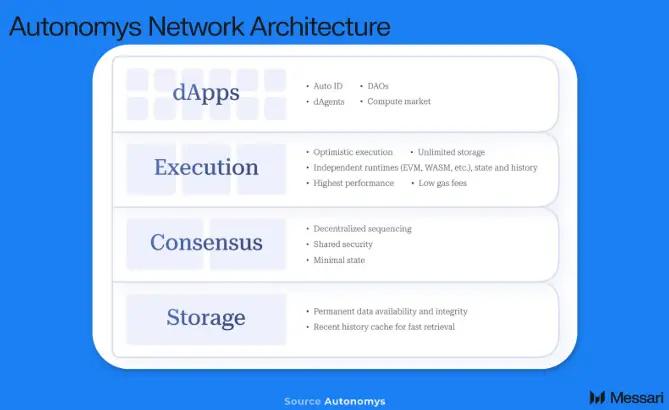
The modular design of the Autonomy Network has several core features, including decoupled execution (DecEx), domains, interoperability, data sharding, and an open source AI directory.
- Decoupled Execution : Separating transaction execution from consensus enables the network to independently scale throughput and storage capacity while maintaining decentralization.
- Domain : Allows developers to build application-specific blockchains with customized functionality, supporting diverse AI application scenarios while avoiding excessive load on the core protocol.
- Interoperability : Supports integration with different state transition frameworks and execution environments (such as EVM and WASM), facilitating seamless integration with the existing blockchain ecosystem.
- Data Sharding : Divide data into multiple shards and distribute them across different nodes to support parallel processing, reduce the load on a single node, improve the network's ability to process large-scale data sets, and provide support for AI training and deployment.
- Open Source AI Directory : Host a dedicated open source AI resource library to promote collaboration and innovation in the AI 3.0 ecosystem, promote knowledge sharing, and protect valuable AI resources from censorship threats.
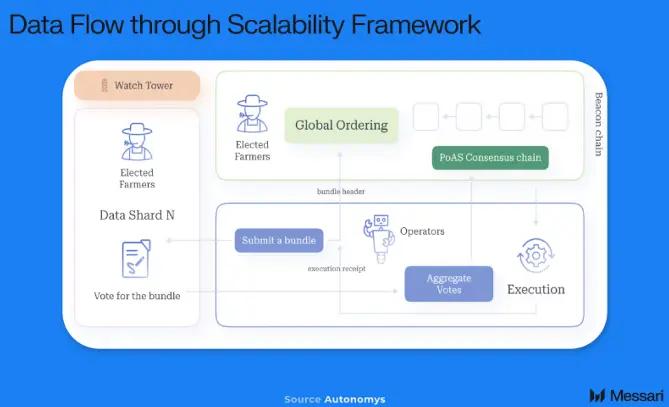
Autonomys Network plans to achieve high throughput through its scaling framework . The framework includes data sharding that can parallelize transactions, a beacon chain that uses a unique Proof-of-Archival Storage (PoAS) consensus mechanism, and domains. Currently, blockchains are limited in storage capacity and difficult to achieve scalability. Autonomys' scaling framework is not only committed to breaking through this bottleneck, but also plans to achieve a throughput level comparable to existing Web2 systems in terms of storage, bandwidth, and computing power, providing strong support for building a more efficient decentralized application ecosystem.
Consensus Mechanism
The consensus mechanism of the Autonomys Network is based on a PoAS protocol design called Dilithium . Dilithium is optimized for the characteristics of SSDs and relies on a mechanism of frequent random reading of small data blocks, making it more efficient on such storage devices. Dilithium's core functions include archiving, plotting, farming , proving, and verification, which not only rely on Dilithium itself, but also benefit from a Proof-of-Time (PoT) blockchain running in parallel with the PoAS blockchain. The design goal of the PoT blockchain is to simulate the advantages of Proof-of-Work (PoW) but avoid its high energy consumption. By introducing verifiable time constraints, PoT enhances network security and makes it difficult for malicious actors to create long historical forks. In addition, the output of PoT provides unpredictable randomness, which is similar to the randomness of the PoW mining block generation challenge, thereby further improving the fairness and reliability of the consensus. To maintain the operation of the PoT blockchain, the network introduces "Timekeepers", dedicated nodes that are responsible for calculating the delay function and generating unpredictable outputs to create a random source for block challenges. Through this mechanism, the Autonomys Network achieves an efficient, secure, and scalable blockchain consensus.
The PoAS consensus mechanism can be divided into the following three main stages:
- Archiving phase: This phase is completed by all nodes and is repeatable and deterministic. The task of archiving is to divide the blockchain historical data into several sections, each of which consists of data blocks of equal size.
- Setting up the Plotting phase: In this phase, each miner is responsible for processing and encoding its assigned fragment of blockchain history data and storing it.
- Audit phase: This phase uses a probabilistic method to audit the data stored by miners to verify the integrity of the data. At the same time, miners have the opportunity to propose new blocks.
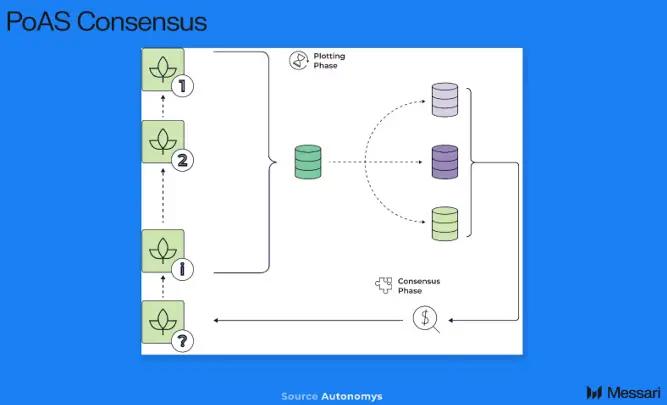
The successful operation of the PoAS consensus mechanism relies on the support of multiple cryptographic primitives , including hash functions, digital signatures, erasure codes, KZG polynomial commitments, Merkle trees, and encoding mappings.
Decoupled Execution
Decoupled Execution (DecEx) separates the consensus mechanism from transaction execution, significantly reducing the hardware requirements for participating in the consensus. This design makes the storage space widely available on modern electronic devices the only core resource for participation. Unlike traditional blockchain nodes that need to handle both consensus and computation, DecEx introduces two specialized roles for hardware-constrained users: (i) Farmers and (ii) Operators. Miners participate in the PoAS consensus mechanism by providing storage space, responsible for maintaining the availability of blockchain historical data and transaction ordering without having to perform complex calculations or maintain the complete blockchain state. This role greatly reduces the threshold for participation. Operators are generated through a pledge-based election mechanism and are primarily responsible for executing transactions and managing state transitions in a dedicated environment called a "domain."
Domains are modular, independent execution environments designed for specific applications or scenarios, such as smart contracts or decentralized AI training. They leverage the security and data availability of the underlying consensus layer while providing flexibility, scalability, and interoperability. By distributing execution tasks across multiple domains, the network achieves horizontal scaling, with each domain processing a portion of transactions, thereby reducing bottlenecks and increasing throughput. Autonomys has launched some domain-based real-world application products: Auto ID is a domain specifically designed for managing human and AI agent identities. Nova is a permissionless EVM domain for deploying and running smart contracts.
miner
In the Autonomys Network, the main responsibility of miners (Farmers) is to maintain consensus. Miners plot data fragments of the Archival History onto their hard disks and obtain blocks and voting rewards by mining the created plots . In addition, miners also join the Distributed Storage Network (DSN) as data retrieval nodes. DSN is a network composed of miners who plot archived historical data fragments, providing data storage, retrieval and replication services to clients. It is responsible for distributing and maintaining data in the network to ensure data availability and reliability.
Miners’ dilemma
With Subspace, Autonomys Network has successfully solved the "miner's dilemma". In Proof-of-Capacity (PoC) blockchain systems, the "miner's dilemma" arises from the need for miners to weigh between the following two options: (i) using limited storage resources to maintain the state and history of the blockchain; (ii) maximizing the storage commitment used to participate in consensus. Rational miners usually choose the latter to increase their chances of obtaining rewards, but this may cause them to run as light clients, which in turn centralizes the network. Autonomys Network's solution is to allow miners to maintain only minimal state and history data, thereby retaining the advantages of full nodes without having to bear excessive storage burdens. Consensus is achieved through proof of replicated storage of blockchain history, which is distributedly stored by miners according to hard disk capacity limitations. By decoupling consensus from computation, miners' responsibilities are focused on proposing transaction orders, while state maintenance and computational transformation are the responsibility of operating nodes. This design not only lowers the hardware participation threshold and incentivizes miners to participate through block rewards and handling fees, but also further promotes the decentralization of the network.
Distributed Storage Network (DSN)
Autonomy Network uses a multi-layer distributed storage network (DSN) to ensure the continuous availability and accessibility of blockchain data while avoiding the need for any single miner to store the entire history of the blockchain. DSN achieves efficient verification and dynamic availability through technologies such as consistent hashing, erasure coding, and Kademlia distributed hash tables. These technologies work together to ensure data integrity and can adapt to the dynamic entry or exit of miners. Each data fragment is replicated roughly the same number of times in the DSN to enhance data reliability. DSN is divided into multiple collaborative layers : the data fragment cache layer (Layer-2) uses distributed hash tables to achieve almost instant data retrieval to support fast access; the archive storage layer (Layer-1) is the basic "cold storage" layer, responsible for the persistence and redundancy protection of long-term data, and is also the core pillar of Dilithium consensus; the content distribution network layer (Layer-3) improves data retrieval speed to a level close to Web2, providing users with a smooth user experience. This architecture successfully solves the storage expansion problem by distributing the storage of growing blockchain data among miners, while ensuring efficient data management and access.
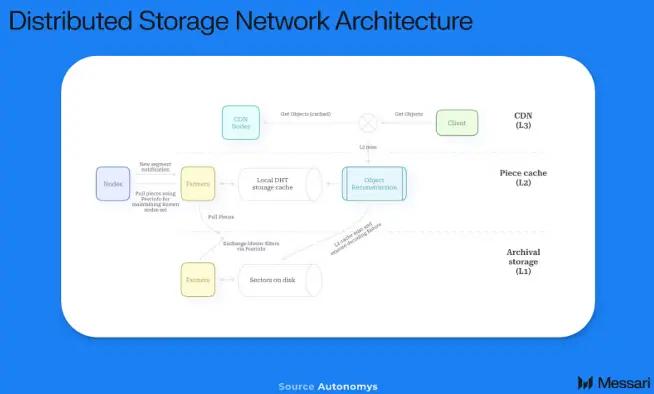
To incentivize users to participate in DSN, Autonomys Network has designed a unique algorithm that dynamically adjusts the price of on-chain storage based on changes in supply and demand. This mechanism clarifies three main roles for network participants:
- Farmers are responsible for maintaining the consensus layer. Miners who join DSN need to retrieve data for node synchronization and return the data to various clients.
- Domain Operators are responsible for ensuring the liveliness of the execution chain and are rewarded for their contributions.
- Timekeepers provide security for the network by maintaining the Proof of Time (PoT) blockchain. Their job includes preventing long-range attacks and ensuring the randomness of block proposals.
Data Flow
Data and its storage are at the core of the Autonomys Network’s uniqueness. To understand the flow of data, it is necessary to understand several key steps from transaction submission to data being permanently archived .
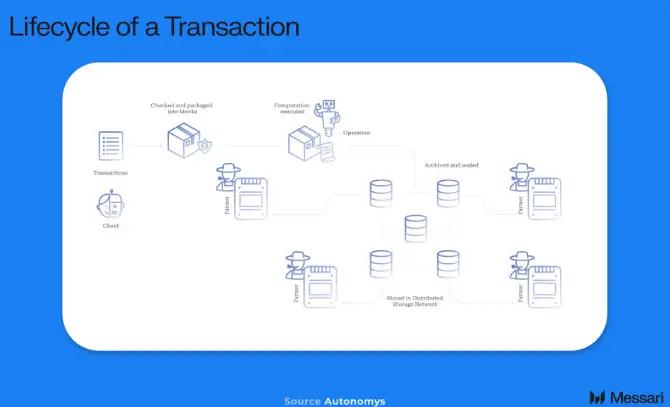
- A transaction is executed after being verified, triggering a state change.
- When the block containing the transaction reaches a certain depth (currently set to 100 blocks), it will enter the archiving process.
- These newly archived data fragments are added to the miner's cache via DSN, which means that these data fragments are encoded into the plot file on the miner's hard disk according to the Plotting protocol for permanent storage.
Based on this process, the client can request data at any time and reconstruct the original data through these archived fragments.
Staking
In the Autonomys Network, staking involves operators and farmers, who, as mentioned before, play different roles. Operators are rewarded with execution fees based on their staked percentage. Miners are rewarded based on their committed storage capacity, and can use their tokens to nominate an operator to increase the operator's total stake, thereby increasing their probability of becoming a slot leader . In return, miners receive a portion of the fees earned by the operator they nominated. The reward system uses a dynamic issuance model that adjusts rewards based on block height and block space requirements to incentivize early adopters and ensure long-term sustainability. Fees within the network are used to cover operating costs and promote efficient use of resources, with transaction fees covering storage and computing costs to reasonably compensate participants.
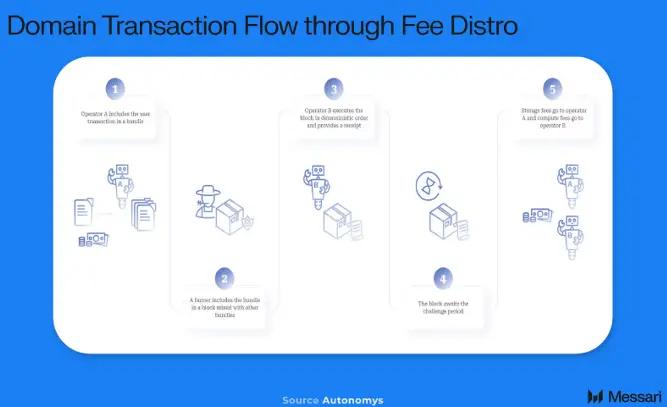
Each transaction requires a fee consisting of two parts: storage fee and computation fee . Storage fee is calculated based on the byte length of the transaction and the current storage capacity of the network to cover the cost of storing the transaction in the block and archiving it in the DSN. Computation fee is calculated based on the weight of the transaction and reflects the computational resources required to execute the transaction. This fee is used to compensate the operator for the computational work when processing transactions. In addition, operators can also earn domain block fees (Domain Block Fees) by executing transaction packages in the assigned domain. These fees are allocated to operators who successfully submit an execution receipt (ER) to prove the validity of their state transition.
Node Function
The Autonomy Network consists ofthree node types , each with a specific function:
- Full Nodes: The default configuration, which mainly undertakes the following responsibilities: (i) forming the core backbone of the network; (ii) processing blocks and providing services to other nodes; (iii) ensuring data integrity and network health.
- Archival Nodes: Expanding on the full node functionality, archival nodes preserve the entire blockchain history. These nodes are particularly important for block exploration and historical data analysis. Archival nodes are maintained by the Subspace Foundation as a public resource.
- Light Clients: Designed for resource-constrained devices, they do not need to store the complete blockchain state and rely on full nodes for data retrieval and network interaction.
Ecosystem
Space Acres
Space Acres is an application that anyone can run on their computer and earn AI3 tokens. The application allows the computer to run a mining node in the background, contributing unused hard drive space to the network.
AI Agent
Auto ID is a decentralized digital identity system deployed on a domain that supports the creation of digital identities for humans and AI agents. It provides a self-sovereign identity (SSI) framework that enables individuals to prove their identity without relying on biometric verification. Its main features include: (i) Self-sovereignty, where users can decide on their own information sharing and protect privacy through encryption, zero-knowledge proofs, and verifiable credentials; (ii) Verifiability, where cryptographic proofs are used to verify the authenticity of identity claims without exposing personal information; (iii) Universality, where Auto ID can issue identities for any entity, whether human or artificial intelligence, to establish a unified identity standard in the digital ecosystem; (iv) Diversity, where identities can be issued by themselves, others, or multiple parties, to meet the needs of a variety of usage scenarios; and (v) Interoperability , where existing identity systems and decentralized identifiers (DIDs) can be seamlessly integrated.
Auto ID also integrates a "Proof-of-Personhood" (PoP) mechanism called Auto Score , which is used to assess the likelihood that a user is human without exposing personal privacy. Auto Score calculates a probability score by aggregating multiple pieces of evidence to prove human identity, including: verifying official documents, linking social media accounts, participating in decentralized networks, etc. These verifications are mainly completed through zero-knowledge proofs (ZKPs) to ensure that user privacy is fully protected.
Auto ID and Auto Score play a vital role in building content traceability and data sovereignty. By providing entities with the ability to digitally sign, they can generate a verifiable and tamper-proof authenticity record for the content they create, which is closely linked to Auto ID. As the boundaries between human-created and machine-generated content become increasingly blurred, the importance of this feature is becoming increasingly prominent. With Auto ID, users can safely delegate permissions to AI Agents and define specific task roles and permission scopes for them based on their needs.
The Autonomys Network uniquely illustrates the need for verifiable human-machine interactions, privacy-first authentication, and data traceability through the standardized digital identity and data provenance framework provided by Auto ID and Auto Score. This framework serves as a touchstone for potential users to understand why this path is critical in an increasingly AI-driven world.
Autonomy's Github provides AI Agents with the necessary tools to implement the ability to store memory and context on-chain using DSN. This means that Agents can store and retrieve data directly from the blockchain, thereby maintaining persistent memory and context. This capability enables Agents to perform more complex tasks, adapt to dynamic environments, and provide end users with personalized and context-aware interactive experiences, which is fully demonstrated in Autonomy's Auto Chain Agent demo .
Astral
Astral simplifies user participation in the Autonomys Network’s PoAS system by: (i) providing a user-friendly interface for managing staking activities; and (ii) acting as a block explorer. As the Autonomys Network continues to grow, Astral’s role in facilitating operator participation and supporting the decentralized governance of the network is expected to grow further.
Token Economics
AI3 is the native token of the Autonomys Network , with a total supply of 1 billion. Approximately 65.00% of the tokens will be minted when the Mainnet Phase 1 launches in November 2024. Tokens will not be transferable until the official Token Generation Event (TGE), which is scheduled to take place with the Mainnet Phase 2 launch, expected in Q1 2025.
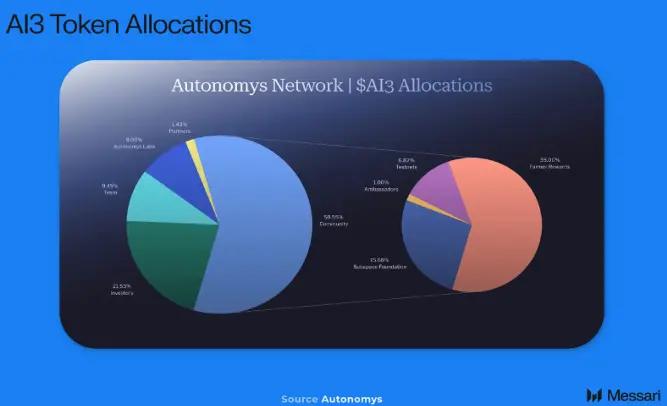
Investors, teams, Autonomy Labs (DevCo treasury), Subspace Foundation (long-term treasury), and partners received a total of 494.5 million AI3, representing approximately 76.08% of the initial token supply, or 49.45% of the maximum token supply. These tokens have a 12-month lockup period and a 36-month linear release schedule, which is released proportionally every month. At the end of the 12-month lockup period, 25.00% of the tokens will be unlocked, and the remaining 75.00% will be released linearly at a rate of 1/36 per month over the next 36 months.
155.5 million AI3 (approximately 23.92% of the initial token supply, or 15.55% of the maximum token supply) will be distributed to Autonomys Labs (operational activities), Subspace Foundation (operational activities and short-term treasury), Ambassadors, and Testnet/Stake Wars participants. These tokens are not subject to the linear vesting schedule, but some participants (such as Ambassadors) may be eligible for special vesting schedules based on their specific needs.
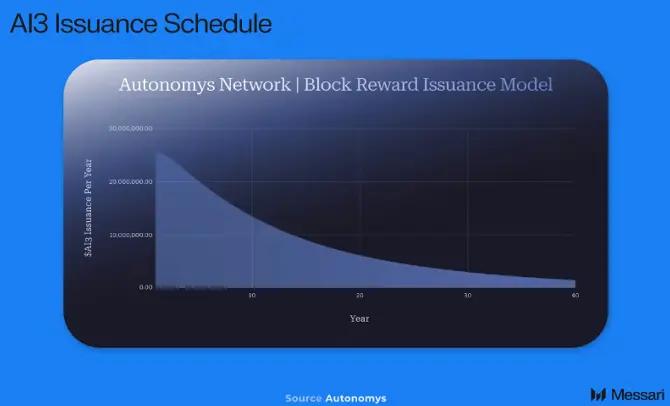
The remaining 35.00% of the maximum token supply will be distributed to miners (Farmers) and operators (Operators) in the form of block rewards over approximately 40 years.
Roadmap
With the launch of the first phase of the mainnet, Autonomy Network plans to launch the second phase in the first quarter of 2025. The second phase of the mainnet will deploy the domain layer and Nova EVM (currently launched on the Tarus testnet), and enable the transfer and release of tokens. The third phase of the mainnet is expected to be launched in 2026 and aims to implement the scalability roadmap, including the implementation of data sharding.
Summarize
The modular design of the Autonomys Network enables it to scale efficiently to meet growing user demand and the increasingly complex AI ecosystem, while maintaining a high level of security and decentralization through specialized security measures at all levels. Features such as Decoupled Execution (DecEx), Domains, Proof of Archive Storage (PoAS), Distributed Storage Network (DSN), and staking together form the foundation of the open, collaborative, and human-centric AI future that Autonomys pursues. Autonomys Network is committed to giving everyone equal access to transformative technologies. This vision is in line with the spirit of pioneers such as Satoshi Nakamoto, driving us towards a new era of AI as a public good - available, fair, and in line with human values.