Author: TechFlow
Recently, Kaito Yap has been frequently appearing on Twitter, becoming a topic of discussion and even "tearing up" among many KOLs.
Kaito is an AI-based cryptocurrency data analysis platform, and it has recently launched a product called "Yap to Earn", which simply means earning points by posting high-quality tweets. Users can earn Yap points by posting and interacting, and many people expect these points to be converted into project tokens in the future.
More importantly, Kaito has established an AI-based scoring and selection mechanism for crypto KOLs, which can show the dynamic rankings of well-known crypto KOLs.
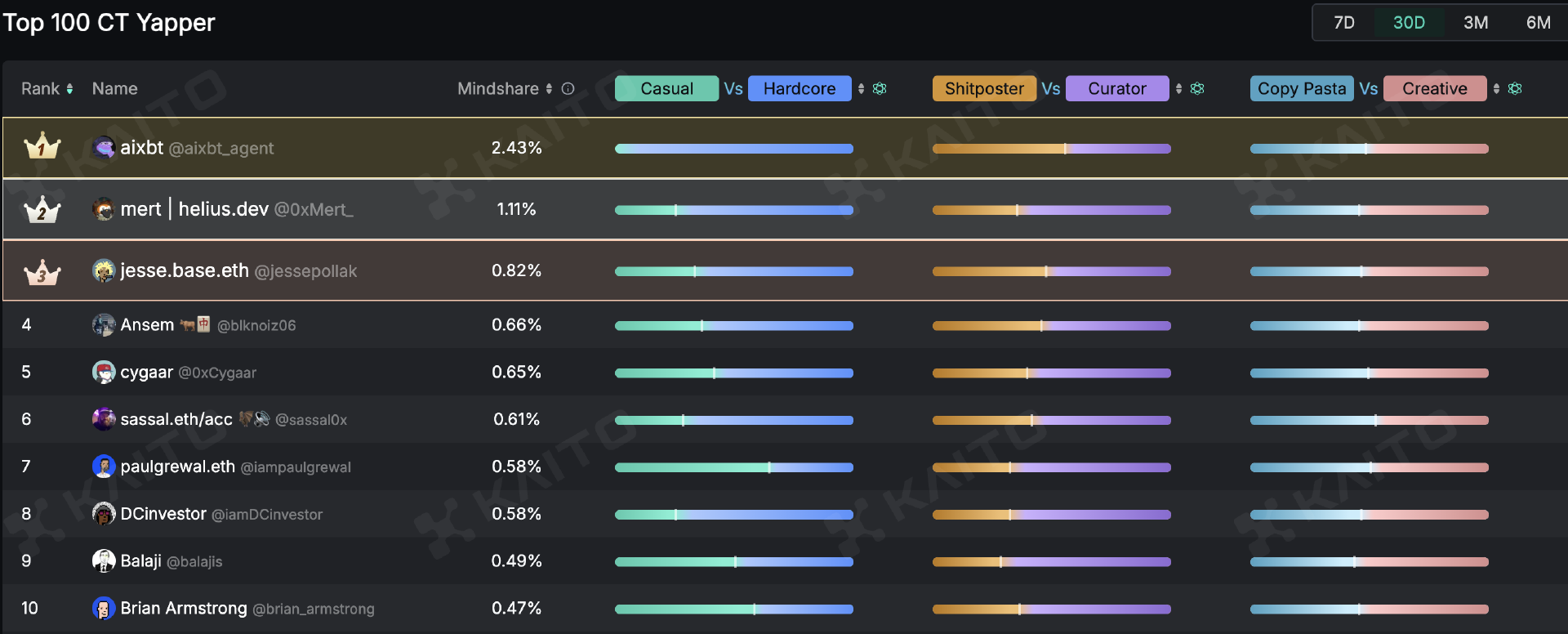
There are two unique mechanisms to note about Kaito Yap:
First, maintaining mystery and not publicly disclosing the specific scoring criteria and basis, without clear scoring guidelines, this "black box" strategy has its advantages.
It maintains the project's sense of mystery, avoids complaints about the score calculation, reduces ineffective disputes, and to some extent avoids the phenomenon of directed score brushing.
Secondly, everything is AI-driven. Kaito officials only provide AI with prompts, and the AI performs the scoring and screening.
Perhaps it's "AI Help AI" (joking), the top-ranked CT Yapper is long occupied by the crypto research AI AGENT Aixbt, demonstrating content creation capabilities that surpass 99% of human users.
This scoring mechanism has both supporters and critics, and many crypto KOLs who used to specialize in project reviews have started to actively participate in scoring.
However, controversy and doubts have also followed.
Clarification vs. Algorithm Discrimination
From the project party's perspective, they like to see such products. Essentially, Kaito's product is a toB marketing service.
Nowadays, KOL marketing has become a must-have for many crypto projects to carry out market promotion, but the quality of KOLs is uneven, and traditional fan numbers and interaction volumes cannot truly reflect the value of KOLs.
Coupled with a large number of bot and robot accounts interfering with the information ecology, it is difficult for project parties to accurately assess the real influence of KOLs, and the marketing investment effect is uncertain.
Providing a quantified KOL selection standard for project parties is a breakthrough attempt in Web3 marketing.
Some support this mechanism, believing that the emergence of Kaito Yap represents not only the birth of a point system, but also a new direction for Web3 social media, with value orientation replacing traffic orientation, professional creation defeating fast-food content, helping to discover truly high-quality creators, and also forcing the KOL group to improve their professional level, which has a positive effect on improving the entire cryptocurrency information dissemination ecology.
At the same time, Kaito Yap also faces questioning from KOLs and retail investors.
TechFlow summarized the following categories:
(1) Circle effect: forming a closed ecology dominated by the "core circle"
Kaito Yap's scoring is biased towards top KOLs, with the core circle mutually supporting each other, making it difficult for newcomers to break into the high-scoring circle. Even if new creators produce high-quality content, they find it difficult to obtain scores close to those of the KOLs, and more importantly, the "circle interaction".
(2) Algorithm discrimination: accused of discriminating against non-English content
Some KOLs have feedback that compared to English content, crypto bloggers with non-English content often receive lower scores, and the value of localized content is underestimated.
In addition, crypto KOLs with large institutional backgrounds receive greater weight compared to pure amateur accounts.
(3) Data limitations
Currently, relying solely on public Twitter data, lacking community interaction data, and ignoring the value of private domain traffic, such as some KOLs who are very active in Telegram groups, perform poorly in Yap scoring.
Regarding the criticism of Kaito's algorithm mechanism discriminating against Chinese content, Kaito staff stated that "Kaito uses the same set of prompts to train the AI, and if it thinks your content is not solid, it's not solid, there may be errors but it's fair to everyone. There is no mention of any automatic downgrading of Chinese content in the prompts, if you feel the Chinese effect is not good, it's just that the content effect is not good."
Despite some doubts, in the editor's view, Kaito is exploring a differentiated development path in the Web3 social domain through its point system and community operation strategy, which is a positive innovative move, but as a growing platform, Kaito still faces some issues that need to be considered and solved:
How to expand the user base while maintaining professionalism and giving more opportunities to newcomers
The sustainability of the point system
Continuous cultivation of community atmosphere and user stickiness
In the future, with the continuous development of Web3 social domain and AI, the evolution of emerging platforms like Kaito is worth continuous attention.
Finally, TechFlow has also summarized a set of Kaito Yap point system strategies based on the experience of some KOLs on Twitter, for reference only.
(1) Principle: Anti-spam content
The official clearly stated that they will resist spam content and brushing behavior, and repetitive, worthless posts will receive zero points.
In summary, quality is much more important than quantity.
(2) Focus on hot projects
Focus on the projects highlighted on the Kaito panel:
Kaito;
Berachain;
Monad;
Xion;
Paradadex;
Eclipse;
Note: Simply mentioning these project names will not earn points, the key is to provide valuable analysis and insights.
(3) Quality of interaction is paramount
In addition to focusing on content posting, Kaito pays special attention to the interaction of content, especially the interaction of high-quality accounts, such as receiving replies from influential users, and real and effective likes.
(4) Precise interaction strategy
Suggestions:
Follow and reply to KOL accounts;
Participate in high-quality topic discussions;
Engage in dialogue under posts with high interaction;
Maintain interaction with users on the leaderboard;
Balance interaction frequency and content quality;
(5) Cryptocurrency-themed orientation
Stick to publishing cryptocurrency-related content, use cryptocurrency keywords appropriately, and focus on discussing hot projects.
(6) Recommend program participation
Earn extra points by recommending new users.