Bank of America economist Aditya Bhave said in a report to clients on Wednesday that there are increasing signs of stubborn inflation, and given the incoming Trump administration, the Federal Reserve may have completed its final rate cut this cycle:
Even without considering fiscal stimulus or tariffs, inflation is already a concern. These policy changes could pose upside risks to the Fed's core personal consumption expenditures (PCE) forecast (we forecast 2.8% by the end of 2025), so if the new administration announces major tariffs shortly after taking office, the Fed may not cut rates further.
Tariffs are taxes imposed by the government on imported goods, and while American consumers do not directly bear the tariffs, economists warn that some of the costs will be passed on to consumers in the form of higher product prices, which could push up inflation at least in the short term.
According to the Federal Reserve's Summary of Economic Projections released last month, officials expect to cut rates two more times in 2025, but Fed Chair Jerome Powell said at the time that only some members factored in the potential impact of Trump's policies when making their forecasts.
Trump raised tariffs during his first term as president and has promised to further expand tariffs in his second term, and there have been recent reports that Trump is considering declaring a national emergency as a justification for imposing broad tariffs, but the actual scope of the tariffs remains uncertain, and some of Trump's high-profile supporters have also opposed plans for comprehensive tariffs.
Market expects only one rate cut this year
Amid the uncertainty around tariffs, recent inflation data has been stable but still above the Fed's 2% target, and investors' expectations for further Fed rate cuts in 2025 are waning. The Fed's benchmark overnight lending rate is currently in the range of 4.25% to 4.50%.
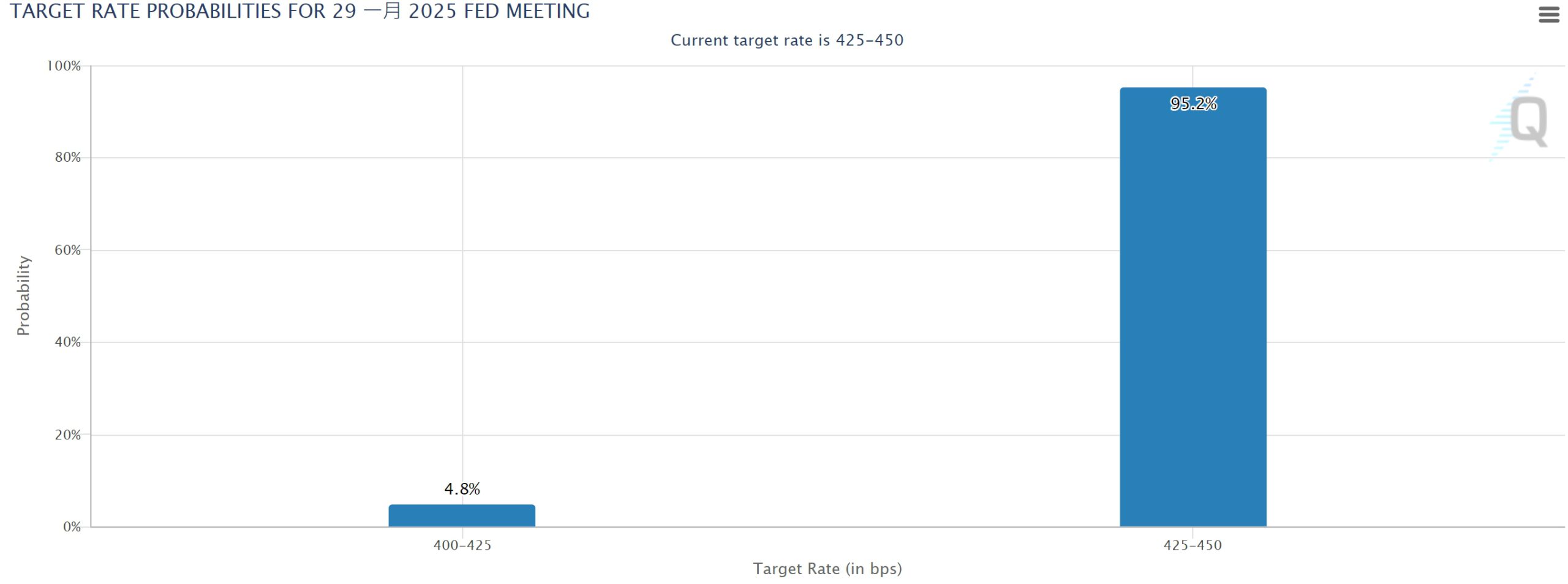
CME's FedWatch tool shows a 95.2% probability that the Fed will hold rates steady in January, with only a 4.8% chance of a 25-basis-point cut, and the market currently expects the Fed to cut rates only once more by the end of this year.
 U.S. Treasury yields have also been steadily rising in recent weeks, another sign that traders expect rates to remain elevated for a longer period. The current 10-year U.S. Treasury yield is 4.68%, far above the 4.178% seen at the end of November last year.