Preface
In 2025, the Crypto industry continues to move towards the future that the market commonly expects. Looking back on the past from the hopeful present, it is impossible not to sigh that 2024 was a year of profound transformation for Crypto. This is reflected not only in the "crypto bull market" brought about by the approval of the Bitcoin spot ETF, which represents a systemic breakthrough, but also in the fundamental change in the attitude of traditional financial institutions towards crypto technology, which is directly reflected in market sentiment and prices. Moreover, the successful election of Trump, who is friendly to crypto, at the end of the year has injected a strong stimulant into the market.
Among this wave of transformation, the most eye-catching is the move of BlackRock, the world's largest asset management company, in the crypto field. Its main investment, the on-chain money market fund BlackRock USD Institutional Digital Liquidity Fund (BUIDL Fund), has exceeded $530 million in size, and its business footprint has also expanded to networks such as Aptos and Arbitrum. The integration of DeFi and RWA is gradually becoming an undeniable trend.
Recently, BlackRock has also continued to carry out new practices based on this trend: the BUIDL Fund has partnered with the digital securities platform Securitize and the DeFi infrastructure layer Elixir to launch the deUSD RWA Institutional Program, building a bridge for over $1 billion in institutional-level RWA assets to the DeFi ecosystem.
As the link between BlackRock and the DeFi world, Elixir is not just an "asset tokenization platform", but a complete infrastructure layer. Its core product deUSD not only needs to solve the on-chain liquidity problem of institutional-level assets, but also needs to explore a new path of innovation co-existence between TradFi and DeFi while ensuring asset security. Perhaps this attempt will pave a new viable path for DeFi.
This article will delve into BlackRock's new moves and the key role played by Elixir as the infrastructure layer in this connection, exploring the new direction of DeFi under the current market trends, and presenting to readers the innovative path for traditional financial institutional-level assets to enter the DeFi track.
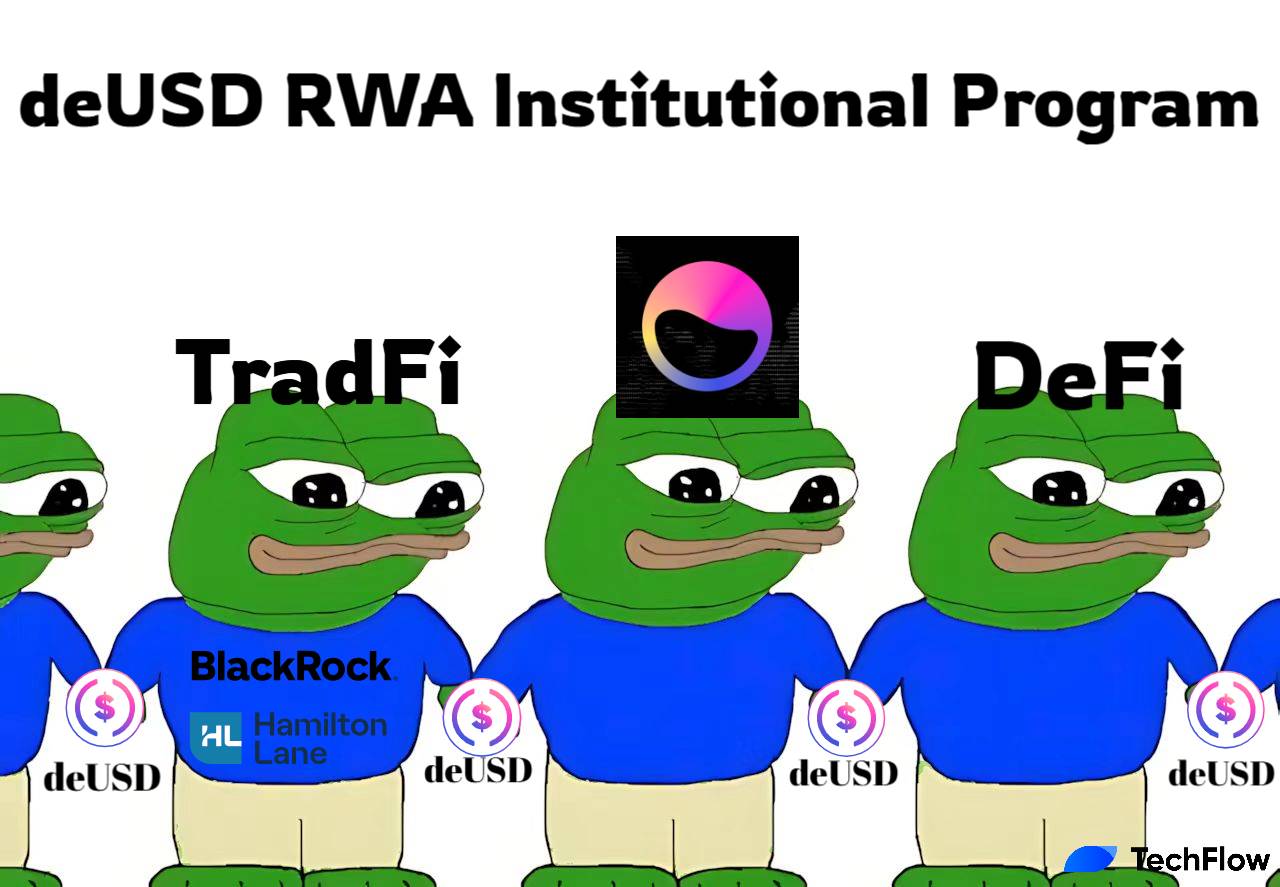
Institutions Entering DeFi, How Does the deUSD RWA Work?
Of course, it's not just BlackRock, the asset management giant, that is involved in the deUSD RWA Institutional Program, the framework also supports other assets such as Hamilton Lane's SCOPE Fund. The big institutions have actively reached out, so how to fully realize on-chain liquidity while ensuring asset security is the key focus of this collaboration, and Elixir and Securitize have cleverly addressed these collaboration priorities through innovative technical architecture.
Dual-Track Parallel: Perfect Combination of Yield and Liquidity
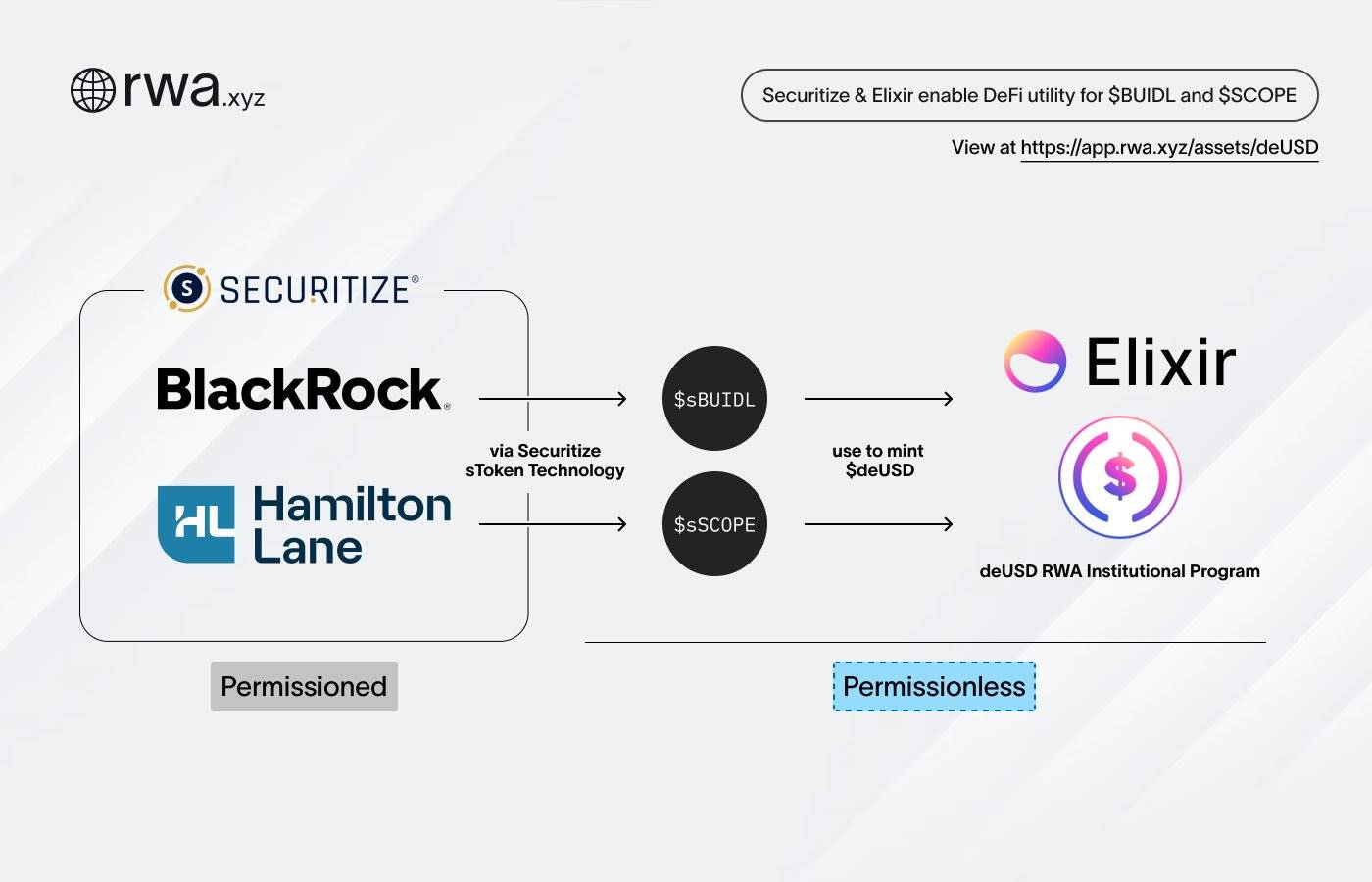
Through the unique dual-layer architecture design of the deUSD RWA Institutional Program, it cleverly connects the permissioned environment of traditional finance and the permissionless ecosystem of DeFi.
Permissioned Environment: The Starting Point of Asset Tokenization
In the first layer, BUIDL and SCOPE Funds tokenize their traditional financial assets into $sBUIDL and $sSCOPE tokens through Securitize's "sToken" technology based on the ERC-4626 standard. Securitize's permissioned environment ensures that the entire tokenization process complies with regulatory requirements, providing the necessary compliance assurance for institutional participants.
Permissionless Environment: Extension of DeFi Innovation
The tokenized assets enter the permissionless environment of Elixir, which is the second layer of the entire solution. Here, $sBUIDL and $sSCOPE holders can simultaneously:
Use their tokens to mint deUSD, gaining liquidity in the DeFi ecosystem
Continue to enjoy the stable returns from the underlying assets (such as US short-term Treasuries)
Participate in a wider range of DeFi applications without affecting their original yield rights
The brilliance of this dual-layer architecture lies in the complete risk isolation:
Clearly, Elixir has incorporated risk isolation as a core consideration in the design of deUSD RWA. The standardized interface of the ERC-4626 vault provides a unified standard paradigm for asset valuation and risk monitoring. Through the precise decoupling mechanism of yield rights and liquidity, the original assets (such as the Treasury returns of BUIDL) and the DeFi interaction layer are completely separated. Smart contracts ensure the independence of yield rights, so that even if there is volatility on the DeFi side, it will not affect the security of the underlying assets.
Separation of yield rights and liquidity: the original yield flow remains unchanged at the Securitize layer
Separation of environments: the permissioned environment ensures compliance, and the permissionless environment provides space for DeFi to thrive
Separation of risks: even if there is volatility on the DeFi side, it will not affect the security of the underlying RWA assets
The Elixir Favored by BlackRock, How Does It Support the Entire Chain?
Elixir's gaining the favor of a traditional financial giant like BlackRock is no coincidence.
In its in-depth collaboration with BlackRock and Securitize, Elixir has demonstrated mature institutional-level service capabilities. The project team is composed of seasoned practitioners from top investment banks such as Goldman Sachs and Morgan Stanley, with a deep understanding of the business needs and compliance requirements of traditional financial institutions.
With its deep accumulation in the DeFi infrastructure field, Elixir has smoothly provided comprehensive asset management lifecycle support for institutions. From being the "DeFi liquidity aggregator" to becoming the "one-stop RWA liquidity solution provider", this bridge connecting TradFi and DeFi can be said to be quite solid.
Building Institutional-Grade Infrastructure
For institutional users entering DeFi, not only do they need to meet the strict security and compliance requirements of traditional financial institutions, but they also need to ensure that the system has sufficient scalability and interoperability. Based on a deep understanding of institutional needs, Elixir has built a complete solution.
The Three-Layer Security Architecture of deUSD
The first layer is the asset isolation layer, where smart contracts achieve complete isolation of institutional assets, and each institution's asset pool has independent risk control parameters and liquidation trigger mechanisms, ensuring that a risk event in a single institution will not affect the stability of the entire system.
The second layer is the cross-chain liquidity and pricing layer, where deUSD realizes a unified issuance and redemption mechanism across chains, so that regardless of where the underlying assets are, they can maintain unified pricing and liquidity management.
The third layer is the cross-chain liquidity optimization layer, where the smart market maker (SMM) algorithm automatically adjusts the liquidity distribution of deUSD on different chains, ensuring minimal slippage during cross-chain transfers. This innovation has enabled deUSD to achieve over $800 million in stable trading volume in the past three months.
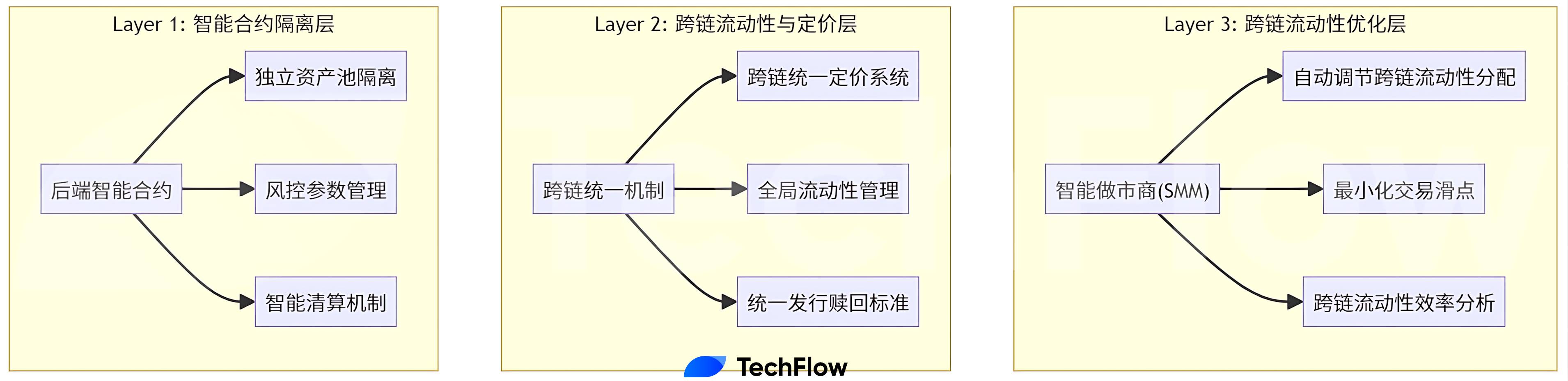
Cross-Chain Interoperability Architecture
At the same time, in order to support the future access of more institutions, as an industry expert, Elixir has utilized its own resources accumulated in the cross-chain field. Currently, it has been launched on mainstream networks such as the ETH mainnet, Arbitrum, Avalanche, and Sei, and may integrate ecosystems such as Movement, Optimism, and Polygon in the future, realizing liquidity interconnection through a unified cross-chain bridge interface. This ensures that institutions have both cross-chain choices and efficient capital interoperability.
Through deeply optimized technical implementation, Elixir has successfully established a secure, reliable, and efficient institutional-grade RWA infrastructure. However, the innovative value of the technical architecture must ultimately be reflected through application scenarios. After a detailed analysis of the core asset deUSD in this collaboration, we can easily find that the design concept of this system is in line with the current situation faced by institutional-level users in the DeFi field. From asset management to ecosystem collaboration, from single-chain deployment to cross-chain integration, deUSD is interpreting what "institutional-grade" DeFi infrastructure is with its unique technical advantages.
The Noteworthy Synthetic Asset deUSD
If Elixir's technical architecture is the skeleton of the entire project system, then deUSD is the heart that pumps blood into the entire system. As the core asset of the entire system, the specific design of deUSD itself is sufficiently "stable".
deUSD is a fully collateralized, yield-bearing synthetic US dollar supported by the Elixir Network. Its core innovation lies in establishing a delta-neutral position through stETH collateral and ETH perpetual contract short, while also obtaining yield through the MakerDAO USDS government bond protocol.
Compared to traditional synthetic assets, deUSD has three significant advantages:
Fully Decentralized
The powerful validator network is the core of the Elixir protocol. The Elixir validator network is composed of more than 13,000 independent nodes distributed globally, with each node participating in transaction verification and consensus mechanisms. The decentralized validator network has no single point of control, ensuring the protocol is free from any centralized intervention, and guaranteeing protocol transparency and security.
Innovative Risk Management
Anyone can mint deUSD by collateralizing stETH, and each stETH collateralized will be used to short an equivalent amount of ETH in the market, with the short position also capturing the positive funding rate to generate additional yield for deUSD.
When the funding rate is negative, deUSD will dynamically adjust its asset composition ratio based on the balance of the OCF (Overcollateralization Fund, used to support the value of deUSD) to maintain price stability.
Ecosystem Integration
Combining Elixir's high-quality resource integration, deUSD abstracts the products and exchanges of different public chains into a single yield asset, reducing the complexity for deUSD holders to operate across different blockchains and exchanges, allowing them to manage assets more conveniently, converting more institutions and individuals into potential liquidity providers. deUSD is like a universal ticket in the Elixir collaborative ecosystem, where users can participate in staking interactions on multiple platforms or even multiple chains using deUSD, achieving multi-chain demands through Elixir.
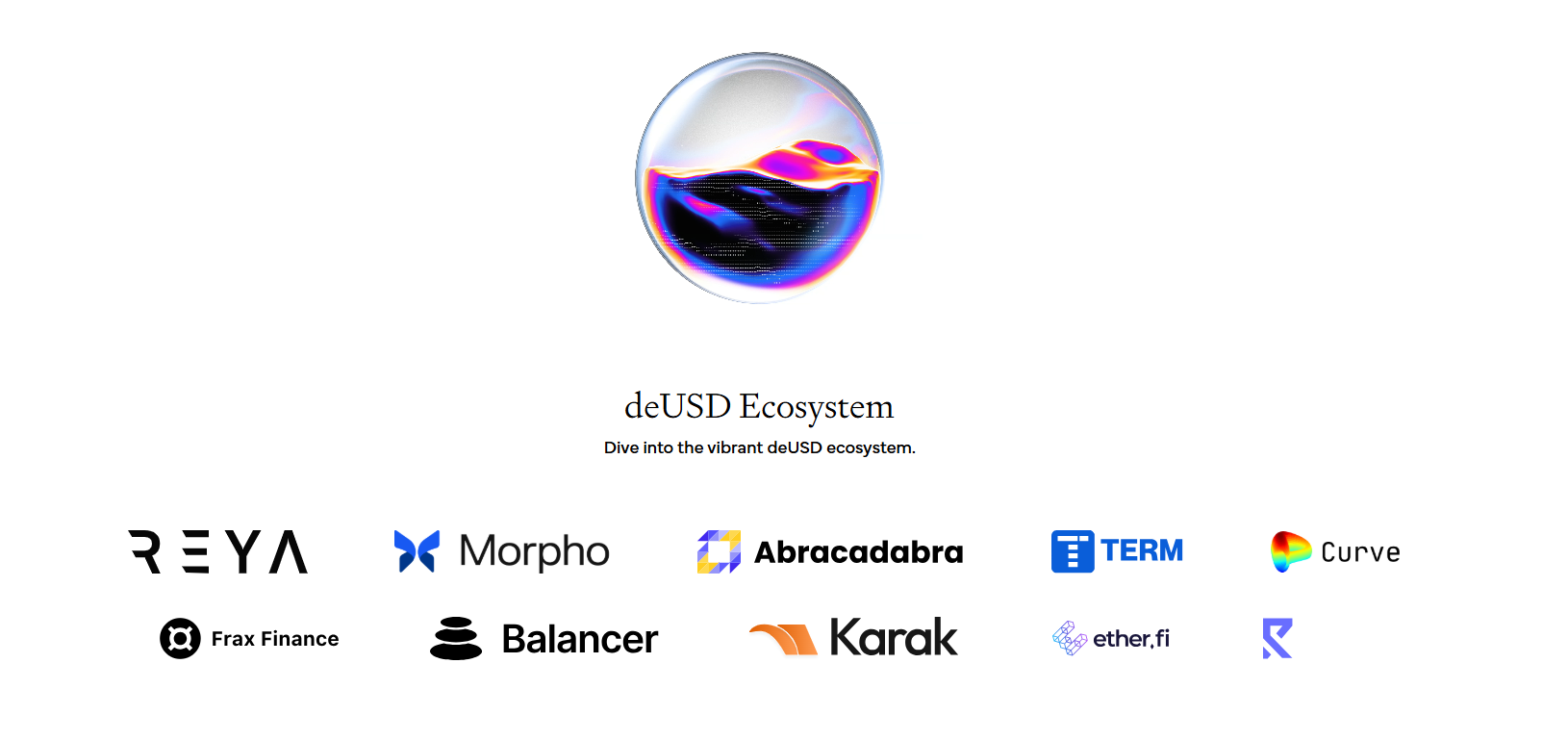
Unlike many stablecoins, deUSD, as a synthetic US dollar, does not maintain stability through a 1:1 US dollar reserve or centralized issuance, but rather through innovative financial engineering and decentralized mechanisms. This design not only provides higher capital efficiency, but also makes this integration of TradFi and DeFi more "Crypto Native".
DeFi Collaboration to Absorb Liquidity
The recent "old money entering the market" move by BlackRock has already quite representatively demonstrated the practicality of deUSD - security and yield combined, bringing the "one fish, two knives" experience loved by on-chain players to the adventurous financial veterans.
And in the DeFi ecosystem, which is already a forte, deUSD has an even richer space to showcase.
Through deep integration with mainstream DeFi protocols, deUSD has built a comprehensive liquidity supply system for institutional users. With the support of liquidity optimization, institutions can participate in more complex DeFi strategies while ensuring asset security, achieving better yield performance.
Take Curve, the liquidity center for deUSD, as an example:
Curve can deeply absorb the large institutional-grade liquidity from RWA assets on the deUSD side - users can deploy the four main liquidity pools of deUSD/USDC, deUSD/USDT, deUSD/DAI and deUSD/FRAX in the Curve deUSD Pool, and LP users can not only earn trading fee rewards, but also enjoy the additional stacking rewards from Curve & Elixir Apothecary: Elixir provides up to 5 times the Elixir Potions rewards for Curve's basic liquidity providers, and staking LP tokens can also earn 10 times the points rewards. This provides extra treatment for liquidity in the RWA direction, capturing all the layers of DeFi rewards.
Elixir vs Ethena: Two Paths of Institutional-Grade DeFi
Coincidentally, as the track heats up, Ethena has also collaborated with Securitize to launch the stablecoin USDtb, which is also supported by the BlackRock BUIDL fund. Being both institutional-grade DeFi, will Ethena's solution and Elixir "collide"?
It is found that although Elixir and Ethena are both heading in the direction of TradFi+DeFi, they are taking two different paths, with some differences:
Different Track Choices
Ethena: Focusing on the Stablecoin Track
Ethena has chosen a relatively focused development path. The project has taken BlackRock's BUIDL as the core supporting asset to launch the stablecoin product USDtb. This model has the following characteristics:
Supported by a single asset
Relatively simple operating model, with controllable risks
Elixir: Building a Complete Ecosystem
In comparison, Elixir has taken a more comprehensive and systematic approach:
Building a complete RWA-DeFi infrastructure
Supporting diversified financial product innovation
Constructing an open ecosystem
Technical Architecture
From the perspective of technical implementation, the two projects have adopted different architectural designs.
Ethena's Technical Roadmap:
Adopting a direct asset-backed model
Relatively simple minting and redemption mechanism
Focusing on the security and reliability of the stablecoin
Elixir's Technical Solution:
Building a multi-tiered asset management system
Realizing cross-chain asset interoperability
Supporting the innovation and expansion of complex financial products
Market Positioning
Ethena positions itself as an institutional-grade stablecoin issuer, emphasizing:
Simple and straightforward product
High security
Elixir, on the other hand, positions itself as an RWA-DeFi infrastructure provider, highlighting:
The completeness of the ecosystem
Scalability of the product
Diversity of institutional services
The different development paths of the two projects provide a new perspective for the market to think about the development of institutional-level DeFi. Whether to take the path of specialization or platformization needs to be decided based on the project's own advantages and market demand. The key is how to balance innovation and practicality while ensuring security.
Conclusion
BlackRock's latest move is not just a simple attempt at asset tokenization, but a starting point for the deep integration of TradFi and DeFi. Through the technical innovation of Elixir and the compliant infrastructure of Securitize, we see a mature institutional-level infrastructure layer that reasonably balances the security and compliance of assets, while also releasing the innovative vitality unique to the crypto world, proving that DeFi is not just a self-enclosed circle in the crypto field.
From the BUIDL fund to the deUSD RWA institutional plan, to the deep integration with DeFi projects like Curve, this innovation path clearly demonstrates the feasibility of combining institutional assets and crypto assets, and the two different development paths of Elixir and Ethena also provide valuable reference samples for the entire industry.
Undoubtedly, as more traditional financial giants like BlackRock enter the field, the demand and development of institutional-level DeFi will enter the fast lane, and the concept of RWA will no longer be just a simple concept hype. Whether they can maintain the native characteristics of crypto while meeting the strict requirements of institutional-level users will become a new evaluation standard for projects in this cycle, and Elixir's practice undoubtedly provides a promising development model for the market.