Author: Reforge
Compiled by: TechFlow

Framework Overview
Data as of January 12, 2025
Latest Version/Release: v0.1.8+build.1 (January 12, 2025)
GitHub Repository: Eliza
License: Open Source MIT License
Primary Language: TypeScript
Statistics:
11,200 stars
3,100 forks
366 contributors
Introduction
Eliza is an open-source intelligent agent development framework, aimed at making the construction of AI agents simpler, more powerful, and more flexible. Does it really live up to its claims? In this article, we will delve into Eliza's strengths, limitations, and important considerations for practical use.
Eliza's Positioning
Framework Goal: To provide a one-stop tool for developing personalized, multimodal AI agents capable of handling complex tasks.
Key Application Scenarios: Including AI assistants, social media characters, knowledge workers, and interactive virtual characters.
Core Functional Features:
Modular Runtime: Supports registered operations and plugins for easy functionality expansion.
Cross-Platform Deployment: Compatible with X (formerly Twitter), Discord, Telegram, and various other platforms, supporting a wide range of application scenarios.
Role-Driven Customization: Achieves highly personalized agents through detailed role files (e.g., background story, knowledge base, tone, etc.).
Multimedia Processing Capabilities: Supports processing of text, video, images, and other multimodal data.
Inference Capabilities: Supports both local and cloud-based inference, making it suitable for different deployment environments.
Retrieval-Augmented Generation (RAG): Provides long-term memory and context awareness through external data sources and knowledge bases.
Based on the functional description, Eliza appears to be a multi-functional intelligent agent development platform. But how does it perform in actual applications?
Eliza's Actual Capabilities
Role Customization: Eliza provides a powerful role system that allows users to create agents with unique tones, styles, and background stories.
This makes Eliza particularly outstanding in building narrative-driven virtual assistants or maintaining consistent brand tones.
Users can flexibly adjust the personalized performance of agents by setting attributes such as personal profiles, background stories, knowledge points, and tones.
Cross-Platform Integration: Eliza supports seamless integration with platforms like Discord, Slack, and Telegram, allowing agents to adapt to different community interaction needs.
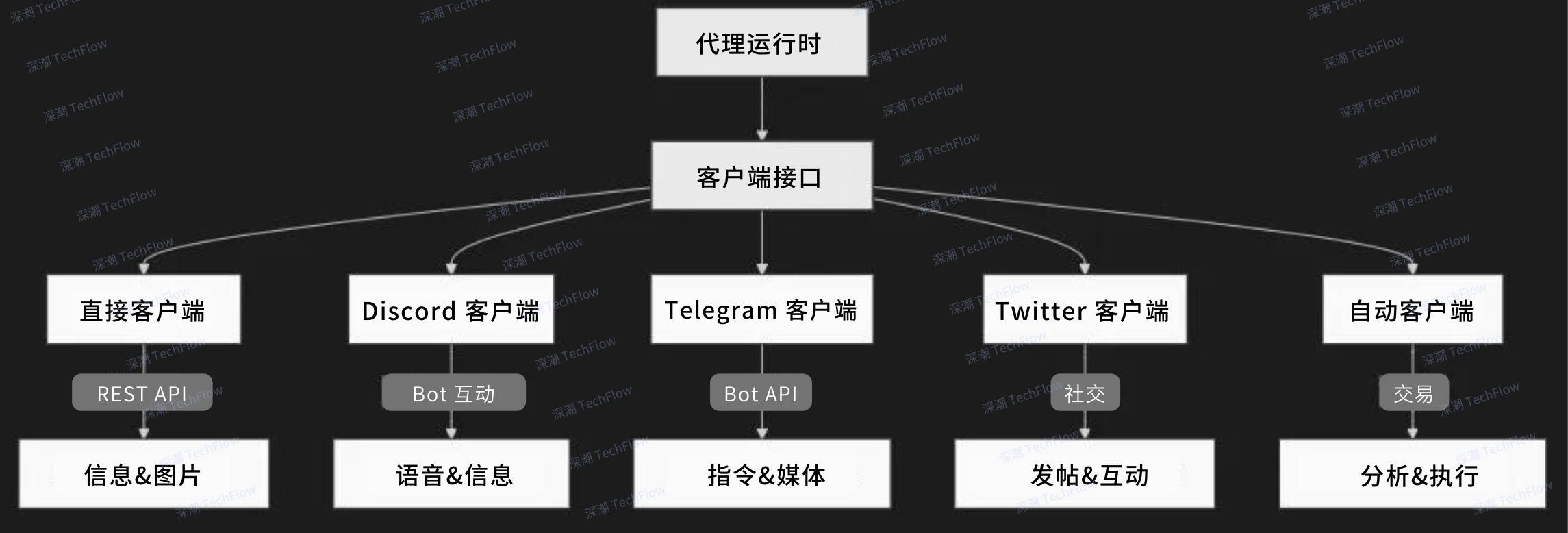
For example, social media bots and customer service agents can be easily deployed across multiple platforms and work collaboratively to improve efficiency.
Client-side package architecture overview (source: Eliza Docs). Original image from Reforge, compiled by TechFlow.
Extensible Plugin System: Eliza provides a rich plugin support, allowing users to extend functionalities as needed, such as text-to-speech, image generation, and blockchain data retrieval.
For instance, in a market analysis scenario, users can leverage plugins to achieve real-time data acquisition and generate high-quality commentary or insights.
Retrieval-Augmented Generation (RAG): This feature enables agents to generate more accurate responses by integrating external data sources and knowledge bases.
For example, a market analysis bot can leverage external documents and caching mechanisms to provide context-relevant and fast responses, thereby improving service quality.
Trusted Execution Environment (TEE) Support: Eliza provides a layer of security protection, allowing agents to handle sensitive data and workflows, ensuring the security and reliability of critical tasks.
Eliza's Shortcomings
Lack of Adaptive Learning
Static Role Configuration: Eliza's role personality configurations are predefined and cannot be dynamically adjusted based on real-time user interactions or historical conversations. This means that agents may appear "monotonous" over prolonged use, unable to adapt to user needs.
Inability to Learn from Feedback: Currently, Eliza lacks mechanisms to learn from user corrections or feedback, and cannot adjust its own behavior based on past mistakes. This lack of adaptive learning can lead to agents repeatedly making the same errors or providing responses that do not meet user expectations.
Lack of Hierarchical Planning Capabilities
No Sub-Task Decomposition: Eliza cannot break down complex high-level goals into multiple smaller tasks. For example, in scenarios requiring research across multiple literature sources and summarizing multiple content segments, Eliza may fall short. Hierarchical planning, which typically involves goal decomposition and sub-task allocation, is not natively built into Eliza, and developers need to integrate task planning libraries to address this limitation.
Limited Collaboration Capabilities Between Agents
Lack of Coordination Mechanisms: Although Eliza supports multi-room and multi-user environments, it does not have dynamic collaboration capabilities between agents. Agents cannot share context information, allocate tasks, or resolve conflicting goals, which is a significant limitation in scenarios requiring multiple agents to work together.
Limitations in Memory and Context Processing
Basic Key-Value Storage: Eliza's memory system can only store data simply, without the ability to prioritize the most recent or most relevant context information. In long-term conversations, agents may forget key details, leading to a lack of coherence.
Lack of Memory Cleanup Mechanism: Eliza does not have an built-in memory cleanup function, unable to automatically remove outdated or irrelevant data. This can lead to the memory system gradually bloating, not only reducing performance but also generating responses unrelated to the context.
Insufficient Error Handling Capabilities
Basic API Error Handling: When external services fail, Eliza only returns error prompts, without attempting to switch to backup data sources. More robust error recovery mechanisms, such as falling back to secondary options when a service fails, would significantly improve system stability and user experience.
Lack of True Multimodal Intelligence
Insufficient Cross-Modal Capabilities: Although Eliza supports some multimodal plugins (e.g., text-to-speech and image generation), it cannot unify the analysis and reasoning of text, images, and audio inputs. For example, Eliza cannot simultaneously process visual data and text input, limiting its potential in multimodal scenarios.
Eliza's Most Suitable Application Scenarios
Market Intelligence Agents: Can help businesses track user sentiment trends, analyze social media discussions, and generate real-time automated responses. Such agents are particularly suitable for fast-paced market research or brand management tasks.
Content Generation Bots: Generate consistent, branded content across multiple social platforms, such as regularly published posts or advertisements. These bots can ensure brand tone consistency while reducing manual effort.
Customer Support Chatbot: Based on a well-organized knowledge base, it provides users with quick and accurate answers, especially suitable for handling common questions (FAQs). These chatbots can not only provide scripted responses based on context, but also be personalized with character design to align with brand culture and enhance user experience.
Summary
Eliza provides a flexible and scalable framework that is particularly suitable for developing role-centric agents, especially in simple or scripted workflows. It has clear advantages in creating consistent virtual characters across platforms, but it cannot be considered a true autonomous agent development framework due to the lack of learning capabilities and strategic planning functions.
If the user's goal is to build agents that can adapt to the environment, collaborate, or handle complex logic, the development team needs to do a lot of secondary development based on Eliza. This means that for those applications that require efficient and practical use cases, the core value lies more in the development of customized functions rather than the native capabilities of the framework itself.
It should be noted that the current stage of Eliza should not be regarded as a comprehensive agent development framework. Compared to its Web2 counterparts (such as Langchain, Autogen, and Letta), its functionality still has a certain gap. Eliza's true advantage lies in role-driven automation applications, but it is still in the early stage of realizing truly autonomous agent development and can only meet some basic needs.