Title: Demystify Bittensor: How's the Decentralized AI Network?
Author: Ming Ruan, Wenshuang Guo, Animoca Brands Research
Translator: Scof, ChainCatcher
Executive Summary
- The development of Artificial Intelligence (AI) has reached a critical juncture, with its far-reaching impact on the world being not only inevitable but also expected to grow exponentially in scope and depth. The market size is projected to exceed $1 trillion in the next five years, and projects that can accelerate AI growth will create immense value.
- Bittensor, driven by the TAO token, is a decentralized AI network that aims to enable projects to crowdsource AI-related "digital goods" as an alternative to centralized AI training.
- Bittensor's functionality relies on two core mechanisms. The first is the innovative Yuma consensus, which allows validators to reach consensus on the reward distribution among miners. The second is the continuous issuance of TAO tokens, with one token minted every 12 seconds. The issuance rate is halved every four years, creating a predictable but gradually decreasing TAO supply.
- The basic building blocks of Bittensor are subnets, which consist of three key participants: 1) Subnet owners, who set the subnet's objectives; 2) Miners, who provide computational power and compete for a larger share of the rewards; and 3) Validators, who evaluate the miners' performance and are rewarded for their assessments. The total rewards allocated to a subnet are determined by the "root subnet" or Subnet 0.
- Currently, Bittensor hosts over 50 subnets, covering a range of AI-related needs, including infrastructure, data sources, model training, and fine-tuning. Some subnets have outperformed centralized alternatives in specific dimensions and have shown early signs of success.
- Like many newly established ecosystems, Bittensor's economic model still has flaws. Its top-down funding allocation design has not yet fully aligned the interests of all participants. Additionally, the price of the TAO token, which supports the network's funding, remains vulnerable to the upcoming halving event. We propose a solution to address these issues and enhance the alignment of interests and sustainability of the Bittensor ecosystem.
The Demand for Decentralized AI
The field of Artificial Intelligence (AI) is advancing at an unprecedented pace, but not without challenges. Currently, centralized data-trained models dominate the field, primarily controlled by tech giants such as OpenAI, Google, and X (formerly Twitter).
While centralized AI training has achieved significant accomplishments in recent years, it also has certain limitations. First, there are issues in the data training process, such as unauthorized use of private information, data censorship leading to biased training results, and a lack of traceability in data sources. On the algorithmic side, centralized models heavily depend on data quality and often struggle to perform real-time evaluations for iterative improvements.
Decentralized AI training offers an alternative, but it faces enormous challenges, particularly in terms of resource constraints. Currently, the cost of training large models exceeds $100 million, making it nearly impossible for community-driven projects to compete. Decentralized efforts rely on the voluntary contribution of computational power, data, and talent, but these resources are insufficient to support projects of similar scale. As a result, the potential of decentralized AI remains limited in scale and impact compared to its centralized counterpart.
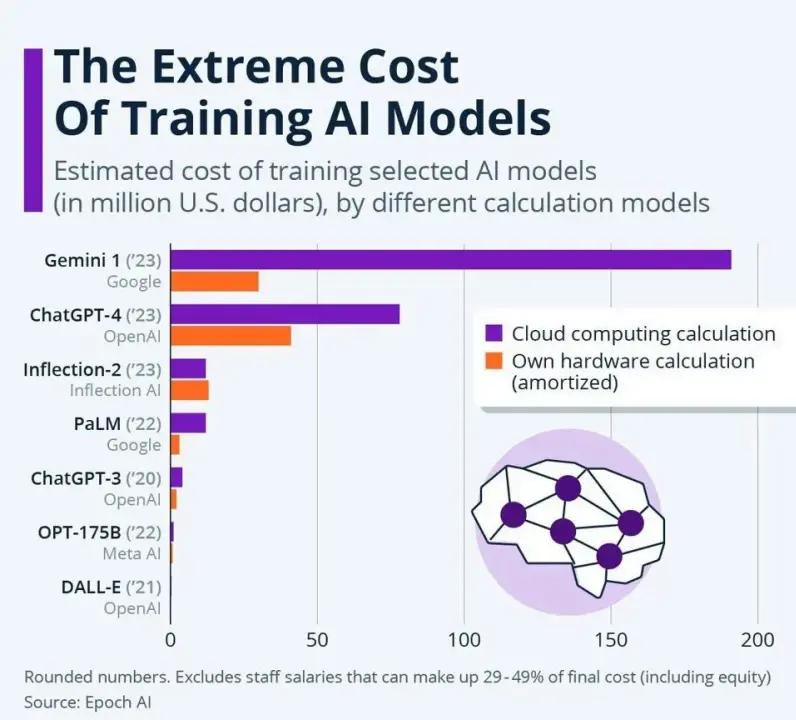
Source: Statista
Overview of Bittensor
Bittensor is a decentralized network that aims to form an intelligent market where high-quality AI models can be developed in a decentralized manner. By leveraging incentive mechanisms and rewarding participants for providing computational resources, expertise, and innovative contributions, Bittensor has built an open-source AI capability ecosystem, where the native currency TAO serves as both a reward token and a credential for accessing the network.
Bittensor's core components, including its Yuma consensus, subnets, and TAO token, were initially launched in November 2021 with the "Satoshi" release and were built as a parachain on Polkadot. In 2023, Bittensor migrated to a Layer 1 chain built on the Polkadot Substrate, while maintaining the TAO issuance plan.
The creators and operators of Bittensor, the Opentensor Foundation, were co-founded by former Google engineer Jacob Steeves and machine learning scholar Ala Shaabana. The foundation currently has around 30 employees, almost all of whom are in engineering roles, with a lack of functions such as B2B market expansion, business development, partnership relations, or developer relations.
How Does Bittensor Work?
Bittensor has developed an innovative network based on a dynamic incentive-driven consensus framework, allowing participants to contribute the resources needed for producing machine intelligence. Each subnet operates as a model for a specific task, with its own independent performance evaluation criteria, and rewards are allocated through Bittensor's overall Yuma consensus.
Let's use an analogy to explain how subnets work. A subnet can be likened to a magazine publisher that organizes a monthly writing competition. Each month, an editor will publish a theme, and writers will compete for a $10,000 reward pool. The standard is "the work that best embodies the web3 spirit." Writers will submit their articles to the editor for review, and all editors will evaluate the submissions, with their scores determining the final rankings. The highest-ranked article will be published and receive the largest reward share, while lower-ranked articles may also receive smaller rewards. All submitted articles and their scores will be shared with the participating writers and editors for feedback and learning. Through this incentive structure, writers will continue to participate and contribute, and the standards between writers and editors will gradually converge, allowing the magazine to publish the highest-quality articles that "embody the web3 spirit".
In this analogy, the magazine publisher represents the subnet, the writers represent the miners, and the editors represent the validators. The process of editors compiling their evaluations of the articles is the Yuma consensus mechanism. In the actual subnets, miners will receive TAO tokens instead of dollars, and these tokens are allocated by the root subnet (Subnet 0); the validators will also be incentivized, so that their standards align with the aggregated scores, allowing them to earn more rewards.
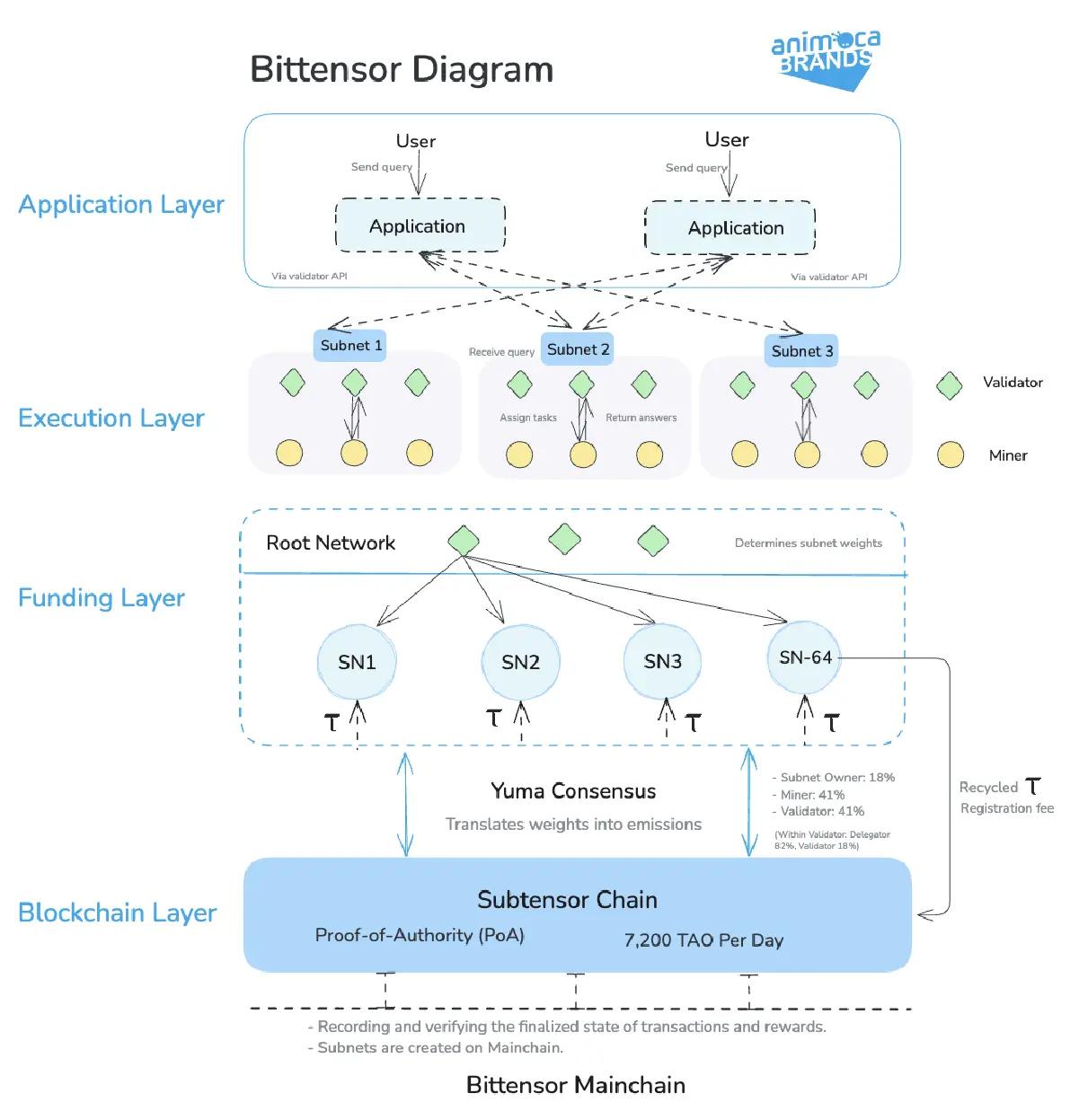
Within this framework, subnet owners, through the validators, train and acquire intelligent capabilities from miners to build AI modules with specific functionalities. In addition to subnets, Bittensor has other layers that support the overall network functionality:
- Application Layer: External applications send requests to subnets to obtain intelligent responses.
- Execution Layer: Composed of a set of subnets, each training and utilizing miners to achieve its goals of developing intelligence and other related capabilities.
- Funding Layer: The root subnet (Subnet 0) is responsible for allocating the TAO issuance to subnets to fund their activities.
- Blockchain Layer: Distributes TAO and records transactions on the subnet chains.
a. Application Layer
Users can interact with Bittensor through various applications, which connect to subnets or act as subnets themselves. Users make service requests, such as language translation or data analysis, and the applications route the requests to subnets through the validator API. The best miner responses are selected by the validator consensus and returned to the users.
b. Execution Layer
This layer consists of a set of subnets, all of which use the Yuma consensus to train and utilize miners. Without delving into the specifics of each subnet, we will discuss the Yuma consensus and the subnet participation here.
Subnets
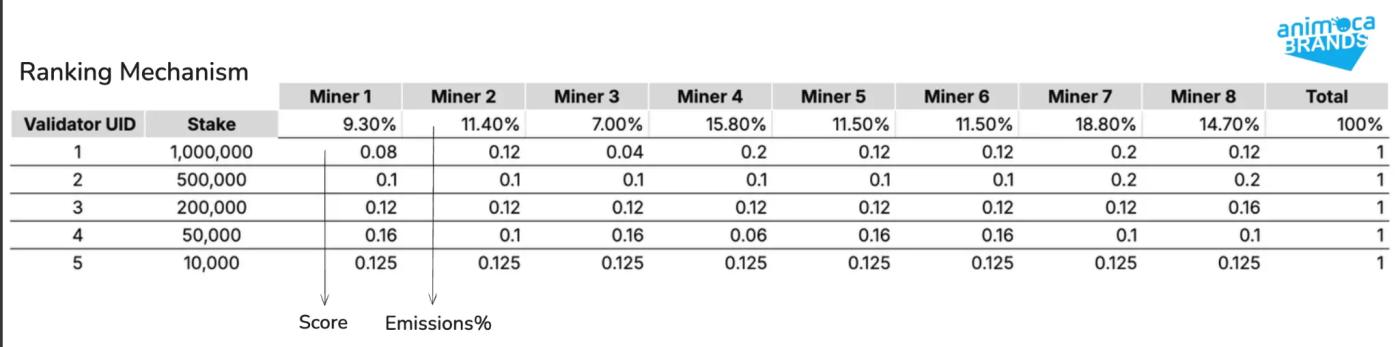
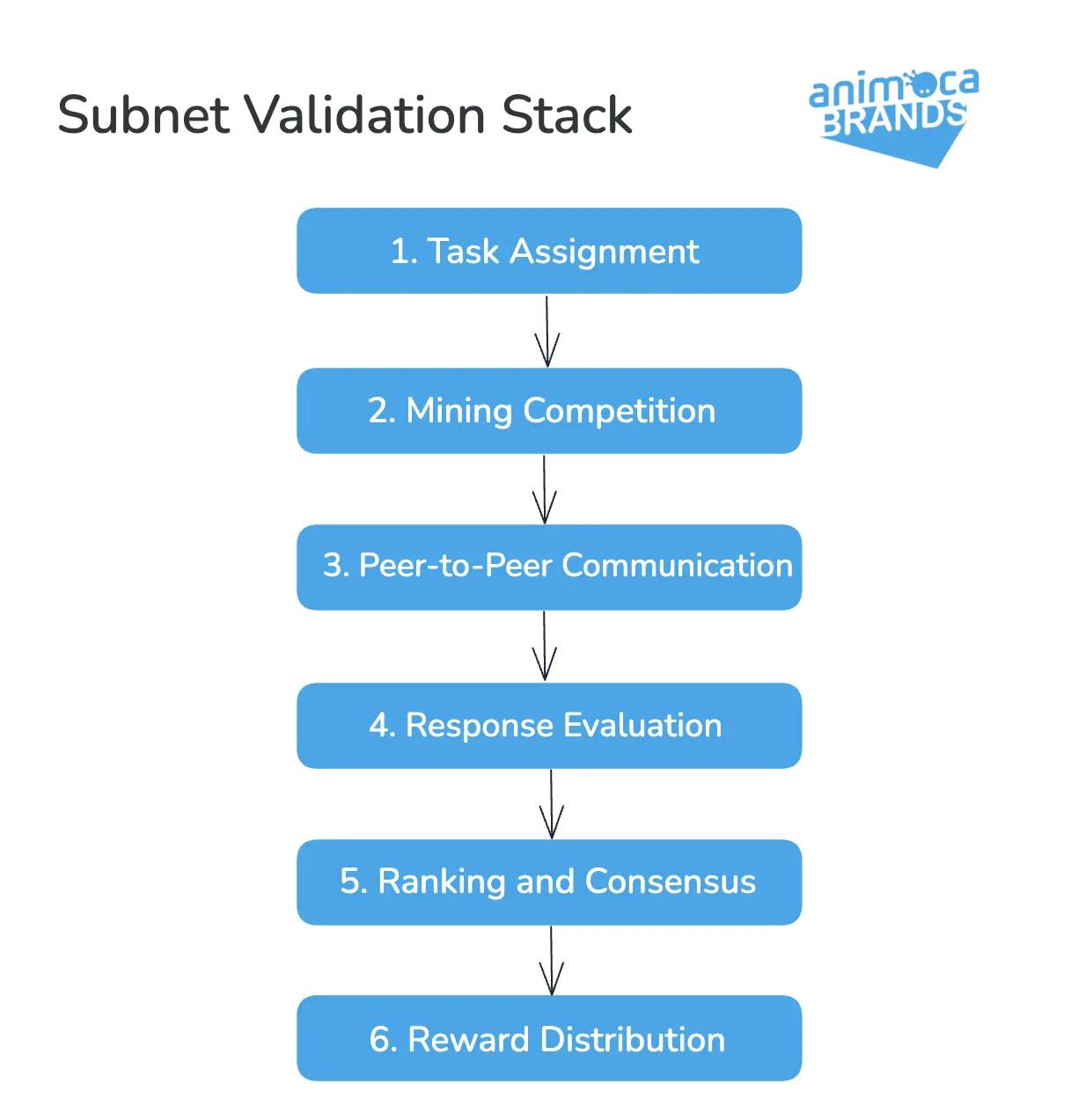
Task-specific subnets use a framework designed for their objectives, called the "validation stack." Validators execute this stack, guiding miners towards value-creating tasks and ensuring the subnet's goals are met. The miners' goal is to outperform their peers and win a larger share of the rewards.
To become a Subnet owner, one must first pay a registration fee before being able to connect to the Subnet. The registration fee fluctuates based on demand and is currently around 3000 TAO. The fee will be refunded when the Subnet is deregistered.
To become a Validator, TAO must be staked. The minimum staking threshold is determined by the 64th ranked Validator by staking amount. Validators with larger staking amounts have higher weights in service requests and Yuma consensus for each Subnet. Additionally, a Validator can serve across multiple Subnets.
To join a Subnet, whether as a Validator or Miner, one must register a "Neuron" position. The registration fee varies by Subnet and fluctuates based on supply and demand, but is typically less than 1 TAO. Once deregistered, the registration will be reclaimed and not refunded. In addition to the entry fee, Miners must also customize their software and hardware to serve the Subnet's purpose. As a result, Miners are typically bound to a single Subnet.
As of December 2024, there are 250 Validators operated by 173 user accounts, and 11,856 Miners operated by 2,709 user accounts.
Reward Distribution
Within each Subnet, the TAO issuance allocated is determined by the root Subnet (in the funding layer) and distributed according to a predefined ratio: 41% to Miners, 41% to Validators, and 18% to Subnet owners. For Miners, the rewards are determined based on the "trust value" allocated by Validators. For Validators, the rewards are distributed based on their "trust score" and staking amount. For Validators with delegated TAO staking, the Validator shares the rewards with other stakers, after deducting their "cut".
c. Funding Layer
The root network, also known as Subnet 0, is the funding layer of the Bittensor stack. In the root Subnet, each Validator runs the validation stack for all Subnets, evaluating the quality, accuracy, and response time of the self-benchmarks of each Subnet, and converting these scores through Yuma consensus into shares of TAO issuance.
The root Subnet has two unique features: first, Miners are replaced by Subnets as the subject of evaluation; second, the number of Validators in the root Subnet is fixed at 64. In the design, new applicants must stake an amount of TAO exceeding the minimum staking of the existing Validators to join the root Subnet. However, this replacement mechanism is currently suspended, so a fixed set of 64 Validators, with varying staking amounts, control the root Subnet.
d. Blockchain Layer
Subtensor is the blockchain of Bittensor, responsible for issuing TAO. Validators in the Subnets submit their weight scores, transaction data, and performance metrics to the Subtensor blockchain. The Validator nodes of the Subtensor blockchain are operated by the Opentensor Foundation using Proof-of-Authority, responsible for verifying transactions, updating the Subtensor ledger, and governing the reward distribution. The decentralization claim of this blockchain layer is controversial, as the Opentensor Foundation team can pause the blockchain when needed.
Evaluating the Subnets
As of December 2024, there are 56 active Subnets. These Subnets cover various aspects of AI development, such as training data pipelines, compute capacity, training platforms, general AI models, and specialized AI tools. The issuance distribution across Subnets is uneven, with the top 10 Subnets accounting for around 50% of the total issuance.
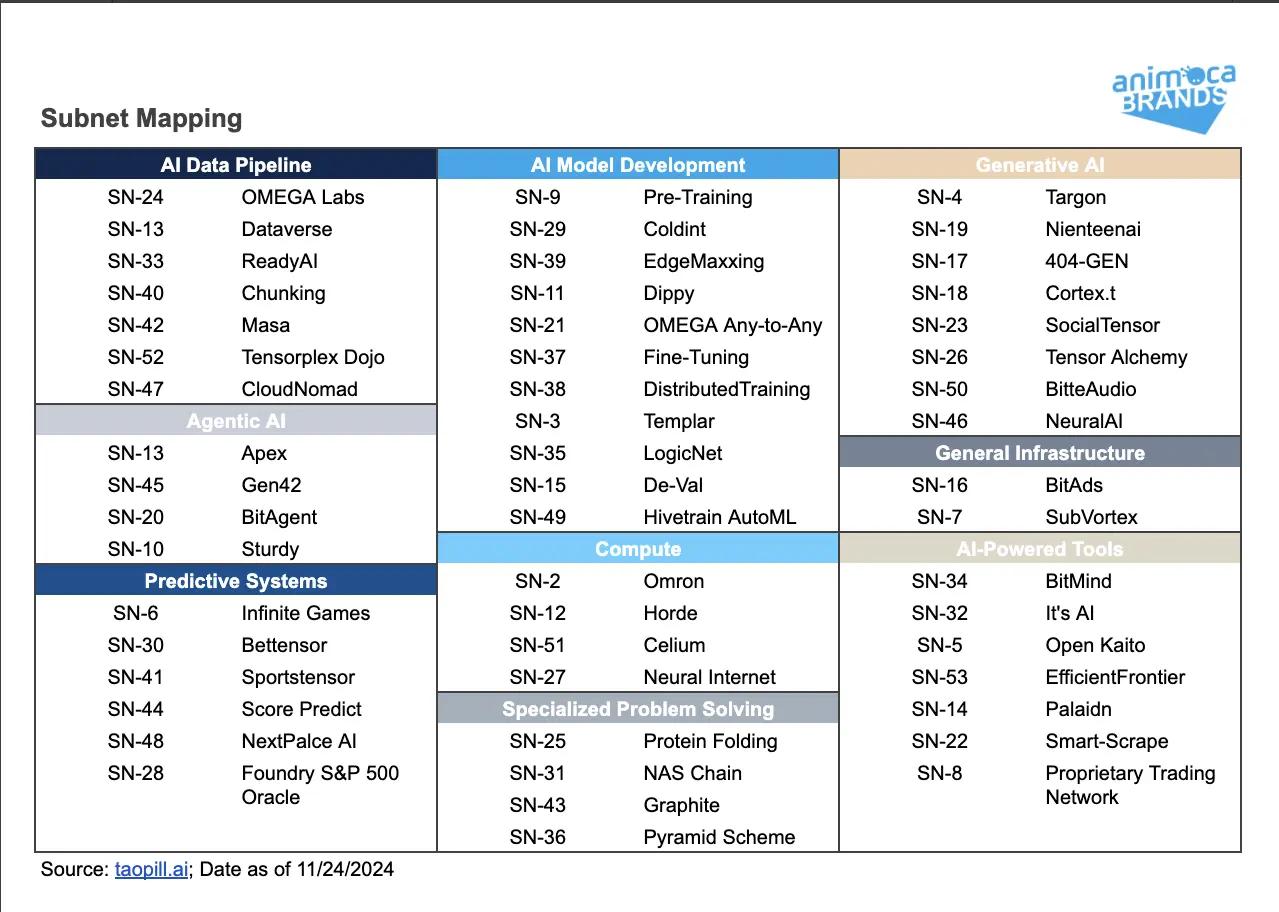
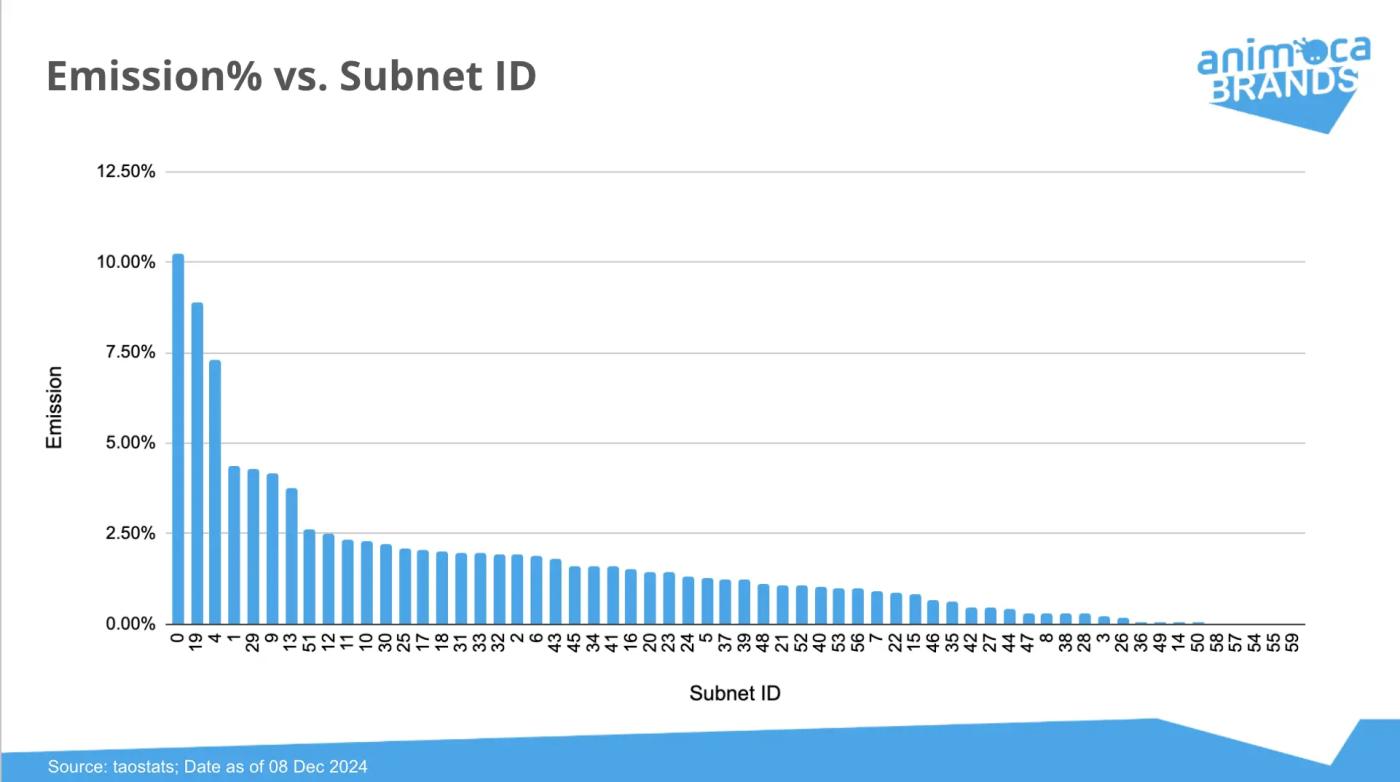
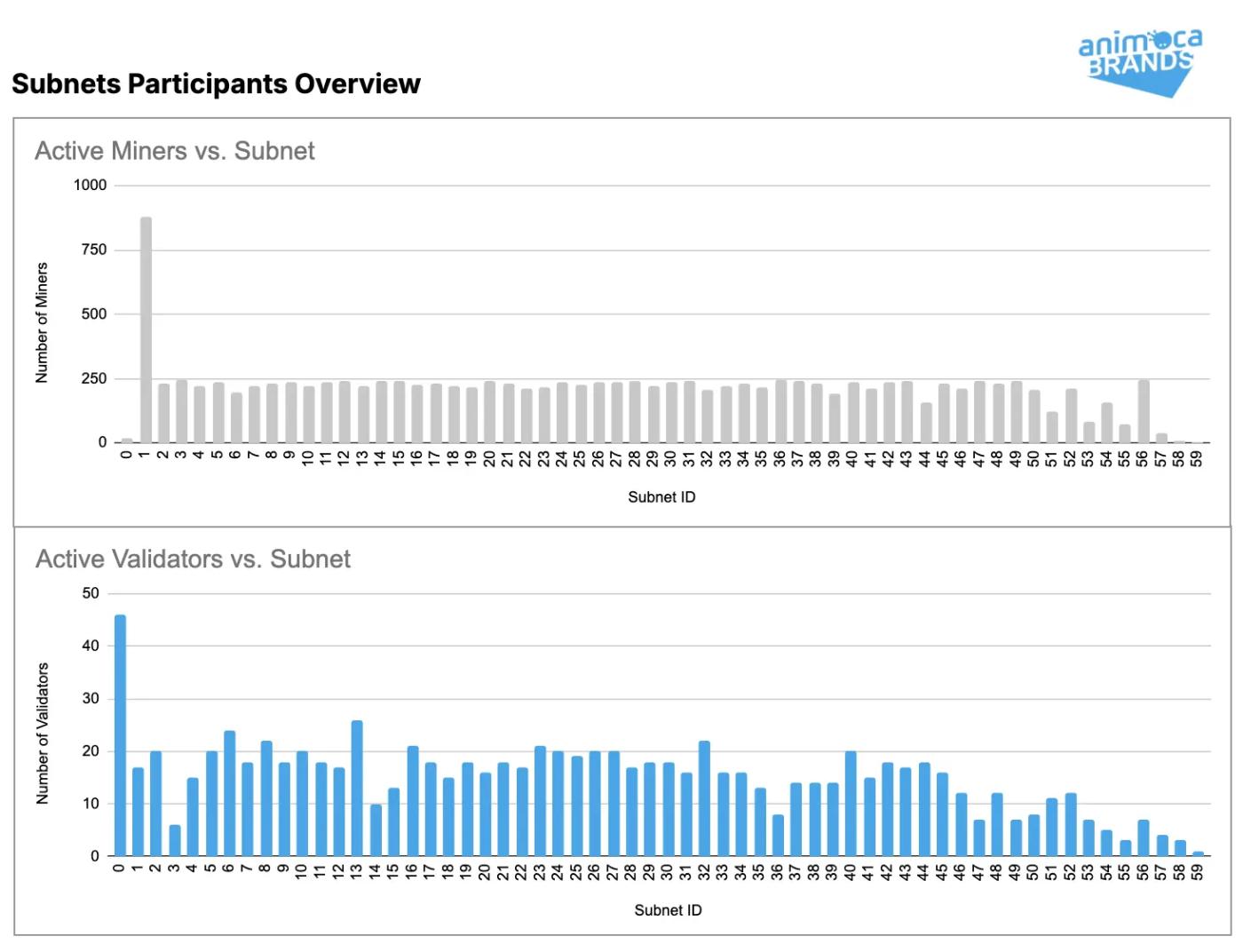
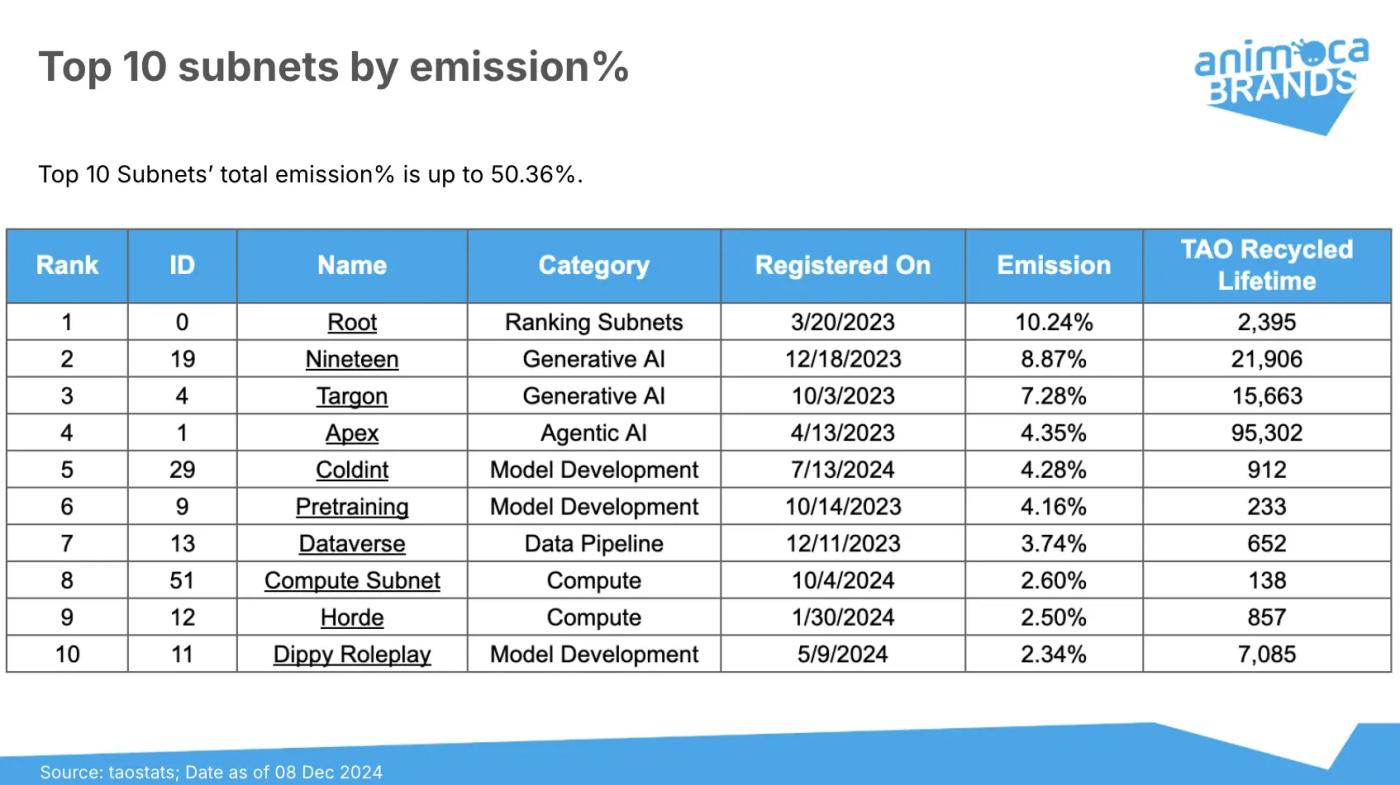
In the rest of this section, we will dive deeper into three interesting Subnets to illustrate how Subnet owners can utilize them.
Subnet 18: Cortex.t
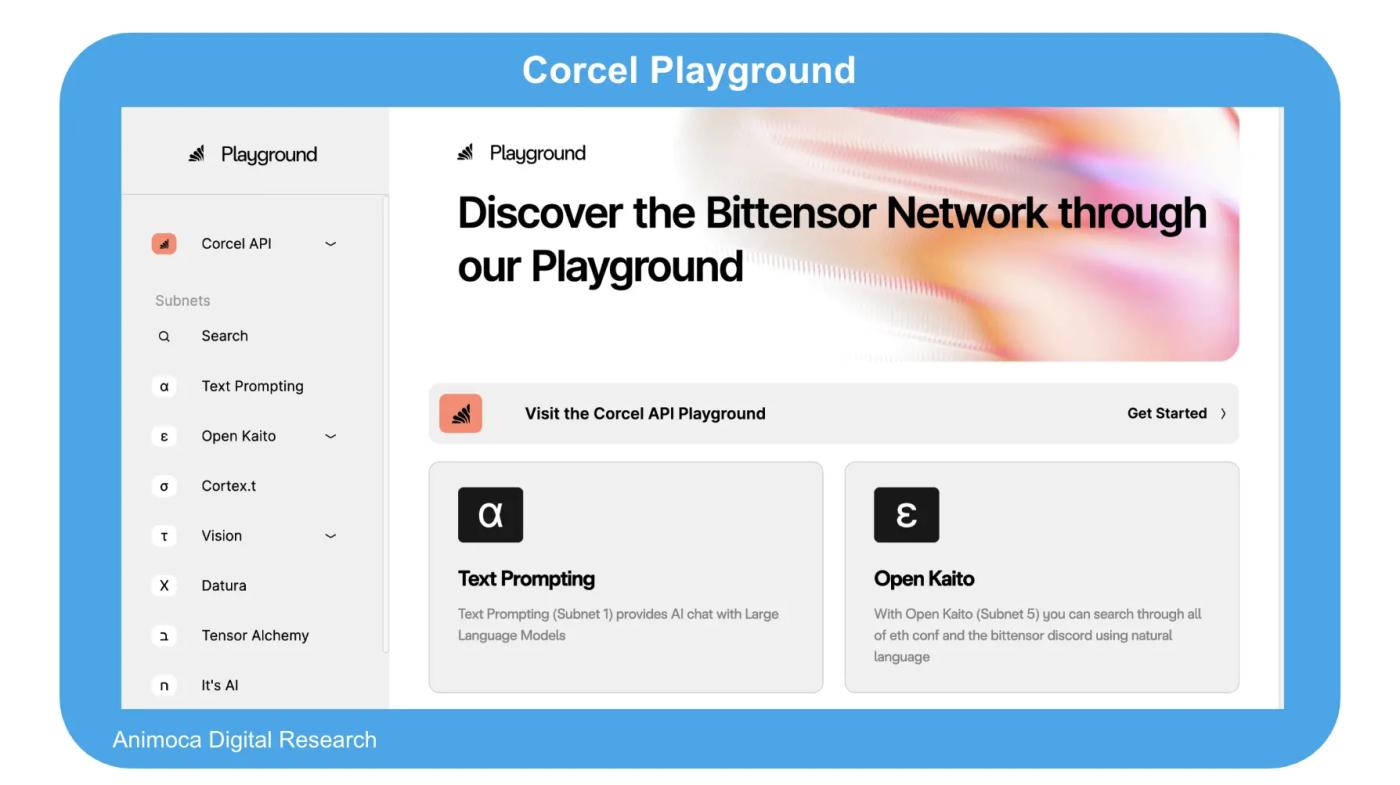
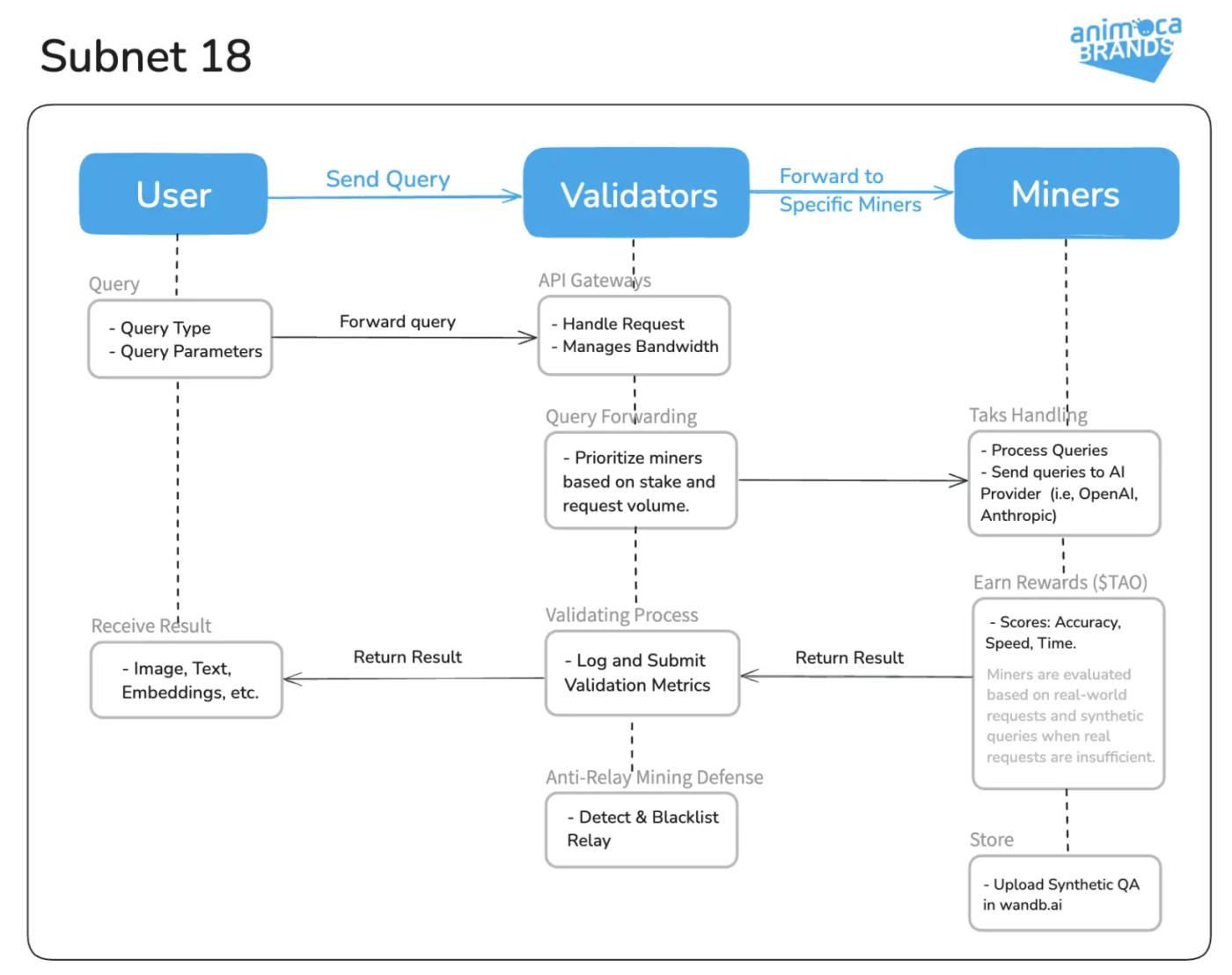
Cortex.t is a Subnet developed by Corcel under the DSIS framework, aiming to generate dynamic synthetic data for model testing and unbiased AI evaluation using GPT4o and GPT4. It creates high-quality prompt-response pairs and archives them as synthetic question-answering data on wandb.ai, while optimizing the outputs using techniques like prompt evolution and data augmentation.
In the Cortex.t Subnet, Miners process prompts requiring GPT4o and GPT4 outputs, and their accuracy, speed, and efficiency are evaluated by Validators. These Validators use the same models to form the synthetic data repository and manage the API servers to send prompts. Additionally, Validators can also sell bandwidth as a service under the DSIS framework for production-grade applications.
Subnet 37: Model Finetuning
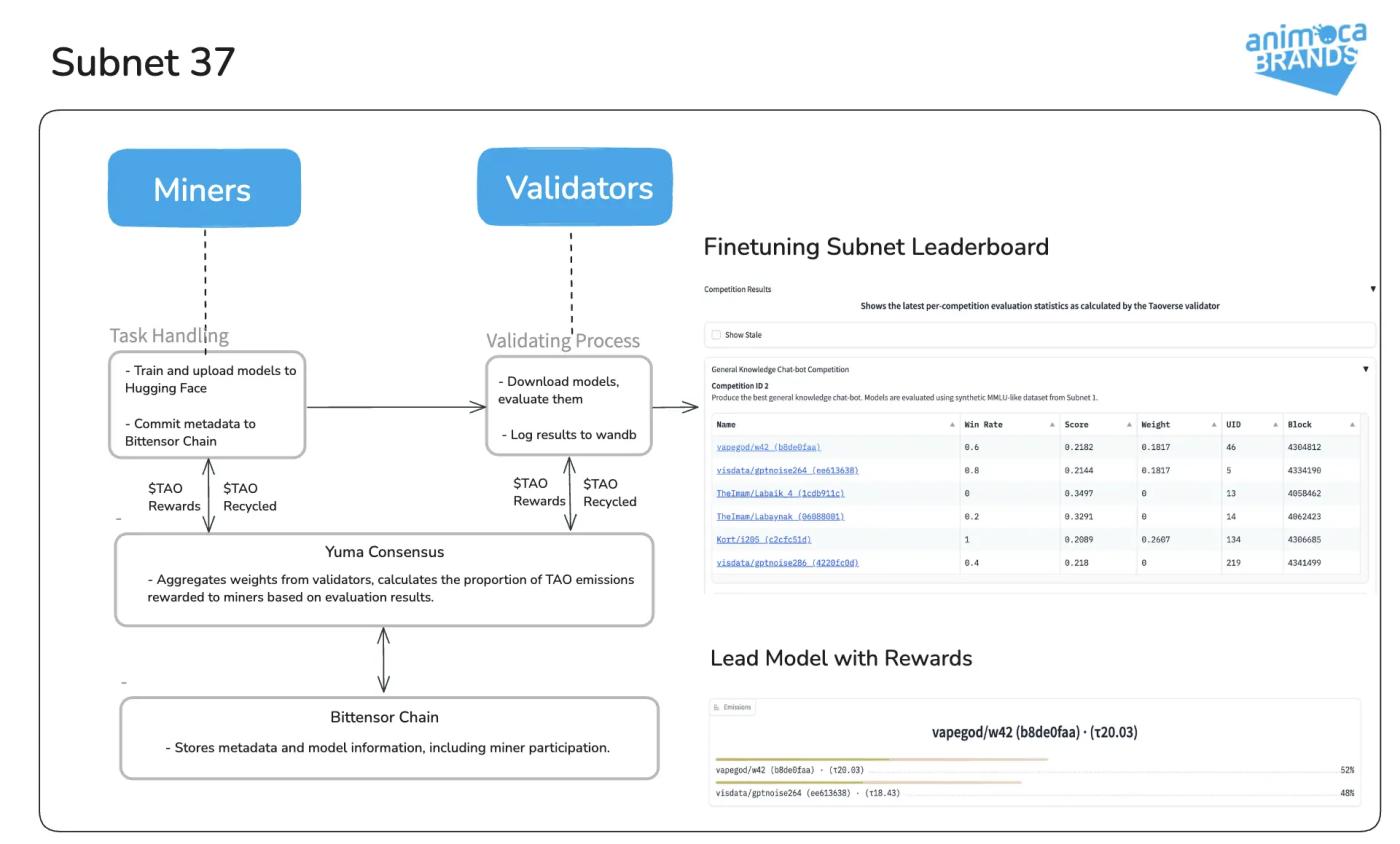
The Model Finetuning Subnet aims to leverage decentralized capabilities to train advanced specialized models, such as chatbots or reasoning systems. Model finetuning is typically time-consuming, computationally intensive, and requires specific skills. By applying the Subnet structure, Miners can contribute their skills and resources to improve models and receive corresponding rewards.
Miner tasks are organized in the form of finetuning model competitions. Each competition publishes the base model, constraints, and objectives. Miners start from the base model, run the finetuning offline, submit the finetuned model to Hugging Face (an AI community website), and submit the model metadata to the Bittensor chain.
Validators retrieve the metadata to identify the models and use the synthetic question-answering data from Subnet 18. They then evaluate the multiple-choice accuracy of the Miner models on the SYNTHETIC_MMLU task, measuring the Miners' performance. Miners are ranked and rewarded based on the Validators' scores.
Subnet 5: Open Kaito
Subnet 5 focuses on developing text embedding models to enhance capabilities in applications like semantic search and natural language understanding. Miners train these models using large-scale text datasets to ensure high-efficiency performance in generating embeddings. Validators evaluate the model performance by comparing it to state-of-the-art benchmarks, driving continuous improvement.
These models will be made accessible through a public Validator API for integration into various applications, with the goal of surpassing existing performance standards.
The Open Kaito team recently claimed that the Miners in Subnet 5 have outperformed the OpenAI embedding models in external benchmark tests, building on their previous achievements of lower loss and higher Top-1 accuracy using large-scale synthetic data sets. This success is significant, as it demonstrates that decentralized AI model training can outperform centralized models in certain aspects.
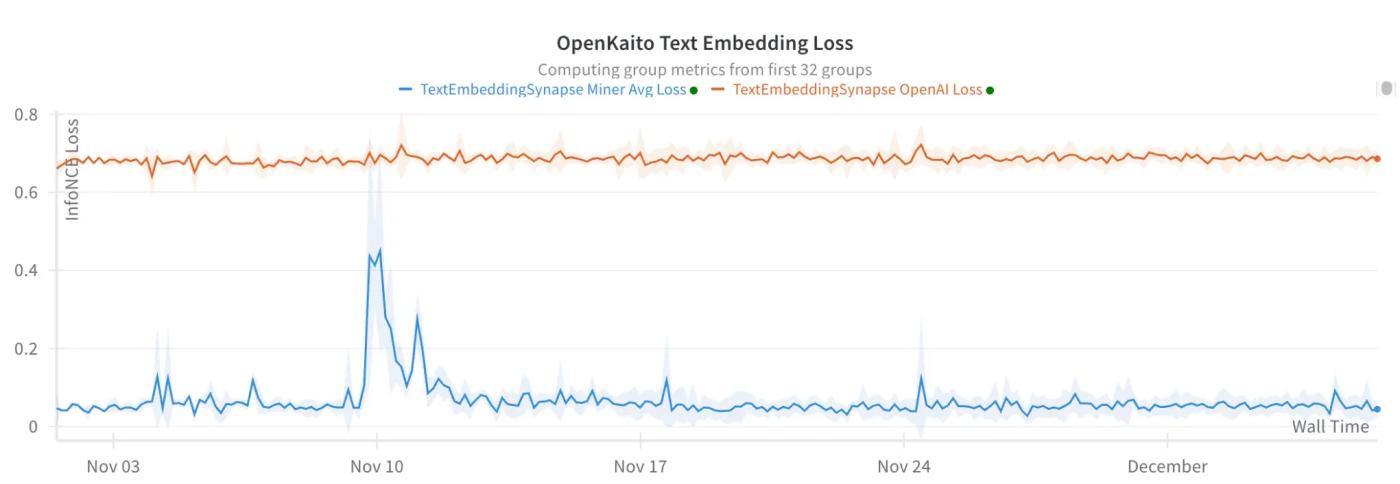
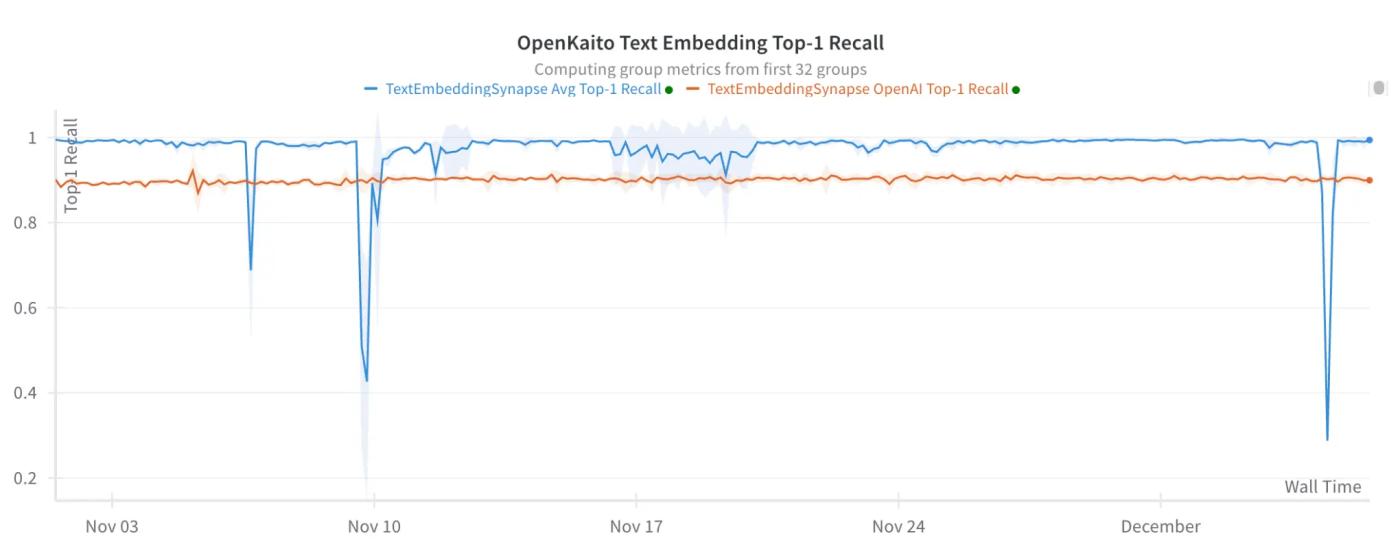
Source: wandb
From these Subnet examples, we can see early signs of success for Bittensor as a decentralized AI ecosystem. At the individual Subnet level, decentralized model training and finetuning are feasible. This is also supported by Prime Intelligence's recent successful training of the first decentralized 100 billion parameter model, INTELLECT-1. At the ecosystem level, the Subnets can collaborate to form a value chain. Therefore, not only the model training part, but the entire AI value chain can potentially be decentralized through Bittensor.
After evaluating the technical feasibility of decentralized AI on Bittensor, we will further explore the economics of its ecosystem to assess whether its design can support a sustainable AI training value chain.
TAO Token Economics
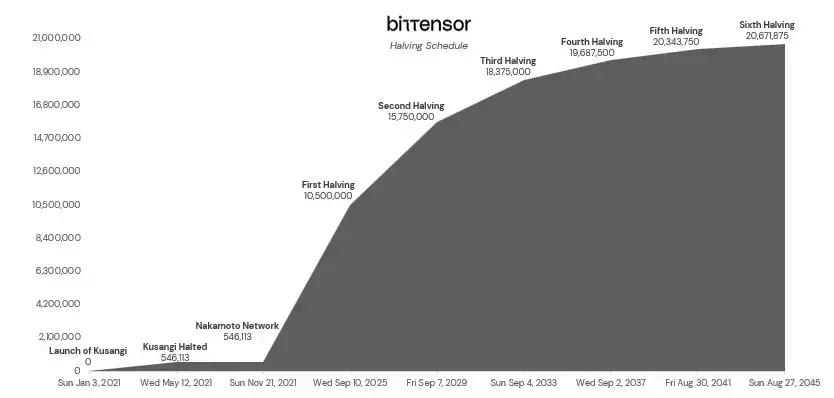
Bittensor's incentive token, TAO, is built on its Subtensor blockchain. Currently, a new block is generated every 12 seconds, minting 1 TAO per block as rewards distributed to network participants. The TAO issuance rate will see its first halving after the initial 10,500,000 tokens are minted, and subsequent halvings will occur whenever the previous halving cycle's issuance is reached (e.g., the 2nd halving at 5,250,000 tokens). This halving mechanism sets a total supply cap of 21 million TAO. As of December 2024, approximately 37.8% of the total supply, or 7.93 million TAO, has been minted.
Here is the English translation:The timing of each halving event is mainly determined by the block generation rate, and is also affected by token reclamation. For every 1 TAO reclaimed (usually from blockchain transaction fees or subnet participant registration fees), 1 new TAO minting is prevented, thereby delaying the halving time of one block generation cycle. According to the latest estimates, the next halving date will be November 29, 2025.
In the previous text, we mentioned that the main use of TAO is as a reward token to incentivize network participants. Here are other uses of TAO:
- Staking: TAO holders can directly stake TAO to their own validators, or delegate to validators and share in the rewards of validator activities, with a minimum staking amount of 0.1 TAO.
- Network Access: Miners, validators, and subnet owners need to pay a TAO registration fee to join the Bittensor network.
- Governance: TAO holders can influence network governance decisions through the "Senate", such as protocol upgrades and issuance adjustments, with the "Senate" members including active subnet validators.
- Transaction Fees: TAO is the fuel fee token of the Subtensor blockchain.
Is Bittensor Sustainable?
Bittensor is positioned as a smart market that allows users seeking AI capabilities to attract validators and miners to collaborate by establishing subnets. However, its mechanism deviates from the traditional market structure: subnet owners do not directly pay for the services of miners or validators, and the income of these contributors is also not tied to their output or workload.
In fact, Bittensor is more like a top-down grant system than a market. Subnet activities are incentivized through grants allocated by the "root" network, but the criteria for determining the grant amount are not always consistent with the actual value or workload of the subnet.
To better understand this practice, it can be analogized to a city. In this city, in addition to the magazine publishers we discussed earlier, there are also book publishers, music studios, and performing arts schools as business entities. The only source of income for these enterprises is government grants, and as long as they can obtain the approval of the grant committee, they can continue to receive funding, regardless of their actual value creation.
This non-traditional system distorts market dynamics and leads to inefficient resource allocation. The grant allocators (the root network) lack effective means to measure the contributions of subnets, while the subnets have no incentive to share the profits from their AI capabilities with the broader ecosystem. Miners tend to seek the maximum TAO allocation with the minimum effort, rather than improving their capabilities or taking on more workload.
Although a proposal for Dynamic TAO was made in January 2024 to address some of the inefficiency issues, its effectiveness remains uncertain as it has not yet been implemented.
The TAO incentive model is highly dependent on a strong TAO price, and since most network participants' primary income is TAO, this leads to persistent selling pressure. To balance this pressure, staking has become the main mechanism, but the token reclamation from blockchain fees and registration fees is still limited.
Staking takes two forms:
- Validator Staking: Participants stake TAO to support network security and receive rewards, accounting for about 75% of all issued TAO. Validators currently distribute 2,952 TAO per day, with an annualized return of 16%. However, after the first halving, this distribution will be reduced to 1,476 TAO per day, reducing the attractiveness of staking and weakening its impact on token supply and demand balance.
- Subnet Registration Staking: The subnet registration fee is around 3,000 TAO, and the addition of new subnets significantly impacts the TAO supply. But this also raises a dilemma: since the total TAO issuance is fixed, an increase in the number of subnets will dilute the rewards for all subnets, making it difficult for existing subnets to maintain operations and potentially leading to the exit of some subnets from the network.
The current economic model of Bittensor is not sustainable. Its top-down grant structure has failed to efficiently allocate resources among subnets. More importantly, the lack of TAO demand is insufficient to support its value after the halving, exacerbating the network's fragility and threatening its long-term viability.
Our Proposal
We propose a two-part strategy to enhance the sustainability of Bittensor:
- Incentivize Subnet Contributions: Allow subnet owners to provide additional TAO rewards to their subnets, which will be added to the total incentive pool allocated by the root network to the subnets and distributed to participants through the existing consensus mechanism. This will incentivize subnet owners who derive significant value from their subnets to contribute funds to the subnet reward pool, ensuring the active participation of miners and validators, and making subnet owners a buying force for TAO tokens, effectively supporting its price.
- Prioritize Grant Allocation: The root network should prioritize allocating grants to new and high-potential subnets, while gradually reducing support for older subnets. This will naturally eliminate subnets with lower value, ensuring that new subnets receive sufficient funding without being diluted by the total number of subnets. Additionally, this approach will reduce the burden on the root network validators, allowing them to focus on the growth of new subnets, which is more in line with the top-down grant model.
By implementing these strategies, Bittensor can create sustained demand for TAO tokens, helping to maintain their value, rather than relying solely on staking. At the same time, these measures will drive ecosystem growth by introducing a natural selection mechanism, concentrating resources to incubate new subnets.
Conclusion
Artificial intelligence undoubtedly represents the future of technological progress, as evidenced by the high valuations of leading companies in the AI value chain and their widespread application potential across various sectors. While centralized AI development has driven progress, it has also exposed the drawbacks of relying on centralized data, model development, and profit concentration.
Bittensor offers a compelling decentralized alternative for AI development. Under the top-down grant model and the support of a robust TAO token price, multiple subnets have demonstrated the potential to drive the advancement of AI capabilities. Overall, Bittensor can form a comprehensive platform covering the entire AI ecosystem value chain.
However, like other emerging ecosystems, Bittensor faces challenges, particularly in terms of the sustainability of its token economic model and the effectiveness of its reward distribution system, especially after the first halving. To address these issues, we recommend adjusting the reward model to prioritize support for new and high-potential subnets, allowing them to operate like venture investments. This will enable existing subnet owners to fund their participants and benefit from the contributions of decentralized AI.
With this adjustment, we believe Bittensor's incentive model can achieve sustainability, allowing it to shift its focus to the truly critical question: when will decentralized AI be able to create high-value real-world applications?