Author: Kaori & Penny
On January 21, Eric Conner, a well-known core developer of Ethereum, posted on social media announcing his departure from the Ethereum Foundation, and pointed out a series of issues with the Ethereum Foundation, such as lack of transparency, disconnection from the community, and resistance to change.
The criticism of the Ethereum Foundation (EF) has been ongoing for a long time, and the recent sluggish performance of Ethereum has further fueled the dissatisfaction in the community. Many famous investors and developers have expressed their opinions and dissatisfaction with the EF, but the departure of the veteran developer indicates that the internal divisions within the EF have reached an irreconcilable stage, and the EF has been directly pushed into the eye of the storm.
As the public opinion continues to ferment, and the community's anger has not yet subsided, a grassroots "Second Foundation" has quietly been established.
Ethereum is facing internal and external troubles, and urgent reform is needed.
Who is Eric?
Eric Conner, a well-known core developer of Ethereum, has left the ecosystem community after nearly 11 years of collaboration with Ethereum, citing the reason that Vitalik rejected the proposal to restructure the leadership.
Eric is a co-author of EIP-1559, a major network change that alters the way Ethereum transaction fees operate. He was not formally employed by Ethereum, but has been providing consulting, investment, and has been one of the leaders in the ecosystem development since the early days.
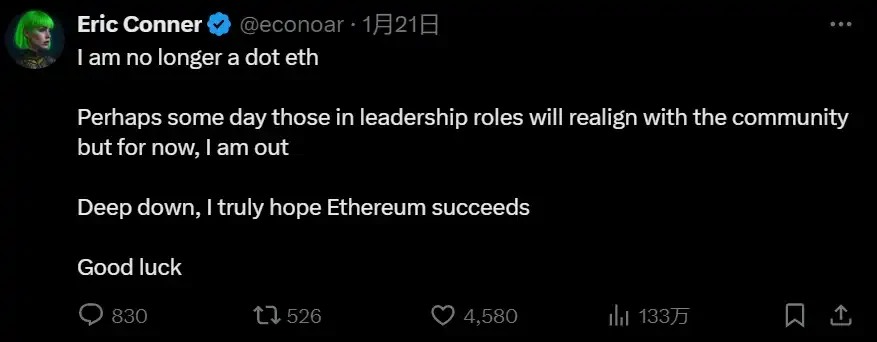
On January 21, Ethereum core developer Eric Conner posted on a social platform, saying, "I am no longer '.eth'. Perhaps one day, the people in leadership roles will realign with the community, but for now, I'm out. Deep down, I truly hope Ethereum succeeds. Good luck."
Later, he also posted to explain why he entered Ethereum and why he chose to leave. Eric first encountered Bitcoin in 2012, and after the Mt Gox incident, he witnessed many friends suffer heavy losses due to reliance on centralized exchanges. Eric and some friends tried to develop the first decentralized exchange (DEX) on Ethereum - EtherEx, although the project did not succeed due to untimely circumstances, it allowed him to integrate into the Ethereum community.
Previously, Eric had stated that the Ethereum Foundation (EF) is becoming increasingly opaque and disconnected from the community. The Foundation could have reduced its budget by 80%, and Ethereum would have operated and developed normally. The problem is that the current Foundation does not report to stakeholders, is gradually sinking into the quagmire, and is resisting change. The Foundation currently exhibits an "anti-victory and competitive mentality", which has led many community members to question whether they should stay.
It's not just a one-day chill
Since last year's Black Mountain EDCON, the industry's dissatisfaction with the Ethereum Foundation has begun to manifest. Layer 2 (L2), as a solution to improve Ethereum's scalability, has been shackled with the "Ethereum alignment" constraint from the very beginning, accepting and executing the will of the EF. Everyone is pledging allegiance to Ethereum, trying to be the most EVM-compatible L2, which has made the project teams more concerned about how to gain the recognition of the EF than the product and technology itself for a long time, causing the Ethereum ecosystem to become distorted under the pressure of the EF.
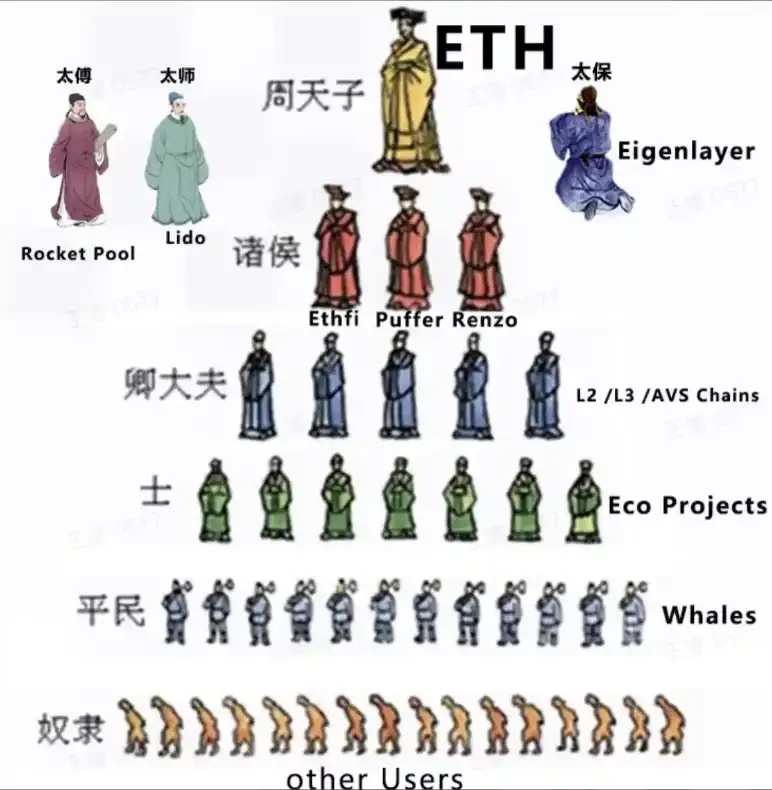
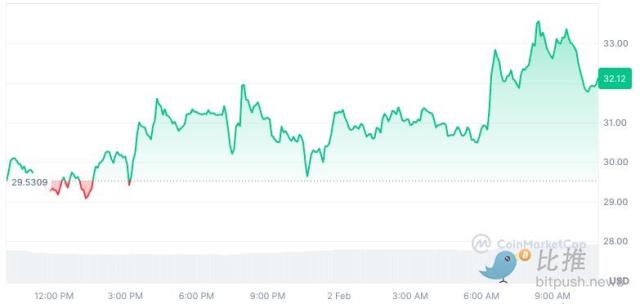
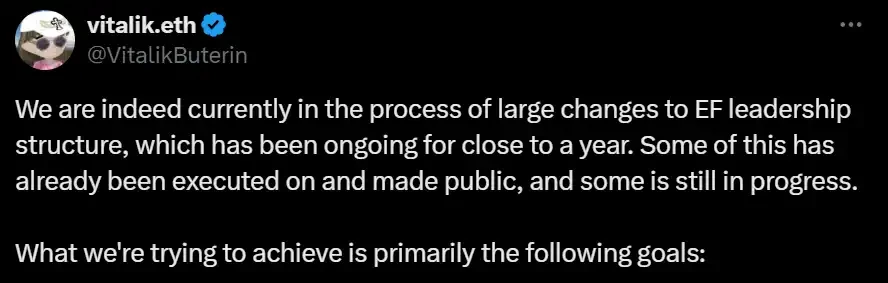
The complex web of interests within the EF, the EF's constraints on the "orthodoxy" of projects in terms of ideology, and the fact that major protocols are gradually fleeing Ethereum while still being stabbed in the back, this organization seems to have entered a mid-life crisis, facing difficulties in structure, efficiency and culture. With the rise of Solana driven by the meme tide, the repeated breakthroughs of Bitcoin's previous highs, and the recent launch of Trump's token on Solana driving SOL to new highs, the decline of Ethereum has become increasingly apparent, fueling the community's dissatisfaction with Ethereum. Under public opinion pressure, on the 18th, Vitalik himself published an article to respond positively to the questions, explaining that he is carrying out a large-scale restructuring of the EF leadership, as well as the specific goals of the reform.
A stone has stirred up a thousand waves, and a campaign to overthrow the EF has followed.
On the 20th, Kain Warwick, the founder of Synthetix and Infinex, first posted that he was dissatisfied with Layer 2 (L2): "If I were to run the EF, I would definitely put pressure on Layer 2 to use their ordering revenue to burn ETH. Ethereum has a lot of leverage in this negotiation..." At the same time, Aave founder Stani Kulechov also stated that after reading the Ethereum 2024 budget report, he believes there are 12 areas that can be improved to ensure the sustainable development of the EF, including slowing down the burning of money, reducing the number of employees, and establishing a sustainable revenue model. However, on January 21, Stani Kulechov posted again, saying: "I don't advocate dissolving the EF, but rather a better, faster, stronger and broader EF path...... We should focus less on internal politics or neutrality, and more on accelerating technological progress."
On the same evening, Evgeny Gaevoy, the founder and CEO of the top-tier market maker Wintermute, also posted his views on Ethereum, mentioning that Ethereum currently faces the risk of falling into a "death spiral": "If there are no casinos, the entire use of ETH is to send things in Zazulu, then the price will be very low and the security will also be very low. As the ETH price falls, fewer and fewer dapps will consider it secure and will flee to other chains, which could form a very (death) spiral, further lowering the price."
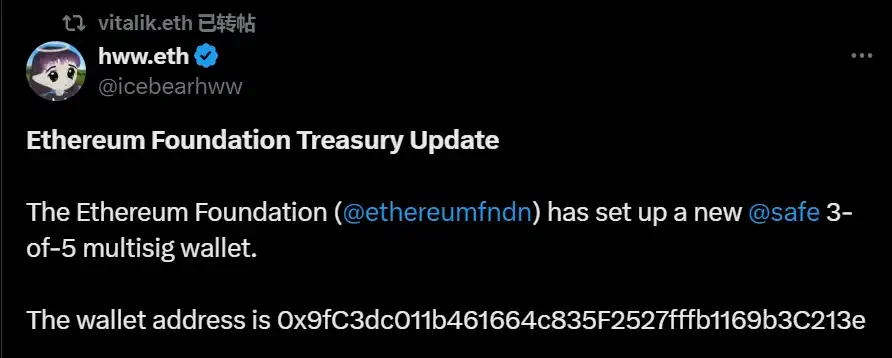
Faced with the sudden onslaught from the community, the EF obviously did not have a comprehensive strategy to appease the public anger, and even went against the tide, responding to the community's staking proposal by selling ETH. The next day, Vitalik posted an announcement that the Ethereum Foundation has established a new 3-of-5 multi-signature wallet, and the EF will use this new wallet to participate in the DeFi ecosystem, and has already conducted test transactions on Aave.
But the community doesn't seem to buy it, mocking it as "are they preparing to sell again". This campaign to overthrow the EF, the community's anger has not yet subsided, and the gunpowder smoke is still lingering.
Even a Second Foundation has emerged, left or right?
On January 22, market rumors said that Lido founder Konstantin Lomashuk has established the Ethereum Second Foundation (Second Foundation). The Official Twitter (@2nd_foundation_) of the Second Foundation has already gone online, and Konstantin Lomashuk has also forwarded its first tweet in a timely manner.
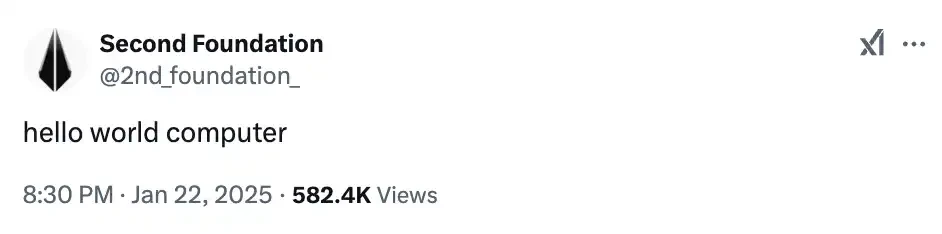
On January 23, Lido founder Konstantin Lomashuk posted again, saying that this tweet was just an idea, and there is currently no real establishment of a "Second Foundation".
He stated that Ethereum is the ultimate world computer, and every member of the Ethereum community can contribute to its growth, development and success. If a Second Foundation is established in the future, it must have a clear goal to complement the great work done by the current contributors. "Thank you all for your support, and I also believe that Ethereum needs more organizations to work together to promote its development. I will share more ideas after further communication with the people who contacted me."
Although this plan has not been actually implemented yet, combined with Eric Conner's departure, the community has engaged in a heated debate on the internal and external troubles facing Ethereum's development.
Regardless of the heated debates in the domestic and foreign communities, there is a consensus that the Ethereum Foundation needs to make a choice, as the differences between the left and right are inherent. One person cannot be both a leftist and a rightist. During industry difficulties, the idealism of the left is needed, and during industry development, the accelerationism of the right is needed. A netizen commented that "if Ethereum takes the path of network nation-building, political diversity will inevitably exist. If multiple foundations can confront and cooperate with each other, it will guide Ethereum towards a greater future."
Second Foundation currently appears to be a troublemaker, but some also say why not expect a few more decentralized control departments to manage power, just as Vitalik said in an article on January 21 that the future of the Ethereum blockchain is decentralized, and the Ethereum Foundation is just a part of it. He further pointed out: "EF should not 'over-intervene', it should confidently represent the part of Ethereum that it can effectively represent, while consciously creating and cultivating open space, allowing other organizations to represent other aspects of Ethereum. Some of these aspects may even be more suitable to exist in a profit-oriented form."