Author: 2077Research Source: X, @2077Research Translator: Shan Eoba, Jinse Finance
In the first article of our Rollups 2.0 series, we discussed Layer 1 (L1)-based rollups - the most decentralized and Ethereum-compatible way to manage rollups. By delegating the task of transaction ordering to the Ethereum L1, L1-based rollups can leverage the decentralization, simplicity, and activity of L1, while also bringing other advantages.
In today's article, we will explore the next evolution of rollups: Booster Rollups. Booster Rollups not only build on the foundation of L1-based rollups, but also further expand the composability of Ethereum. But how can we truly scale this composability?
Issues in the Current L2 Landscape
To ensure the L2 network operates as expected, additional checks are typically required. However, the main settlement and execution processes still occur directly on L1. This means that while L2 expands functionality (e.g., off-chain EVM execution), it also adds additional complexity. Although this extra logic is not ideal, the ultimate goal is to standardize operations and rely entirely on the standard EVM.
Standardization is crucial for enabling smooth transaction exchange between different L2s. To achieve this, a new type of transaction may be needed - one that can operate across multiple chains.
In such a system, a single transaction can generate smaller sub-transactions. Each sub-transaction would contain the following details:
1. Source chain ID
2. Destination chain ID
3. Input data (e.g., caller, address, and call data)
4. Output generated on the destination chain
The two main uses of this transaction data are:
1. As input on the source chain
It allows participants to directly view the output without directly engaging the destination chain.
2. To verify the consistency of input and output on the destination chain
It is used to confirm that the given input produced the expected output.
In this way, each chain can independently verify its own transactions while adhering to a shared standard for transaction format and inputs.
This approach keeps block verification simple, using familiar L1 verification contracts to ensure block validity. This shared standard and improved cross-chain transaction mechanism lays a solid foundation for the future development of L2 networks, making Booster Rollups a key driver for the growth of the Ethereum ecosystem.
What Makes Booster Rollups Different?
Booster Rollups handle transactions in a manner similar to executing on L1, with the ability to access L1 state but with independent storage, thereby scaling execution and storage to L2. Each L2 extends the block space of L1, distributing transaction processing and data storage across a wider range.
Imagine deploying a decentralized application (dapp) once, and it automatically scales to all Layer 2 (L2) networks. If more block space is needed, simply add more Booster Rollups without additional configuration. This means developers don't incur more work, redeployment costs, or additional complexity.
In simple terms, Booster Rollups are like adding more CPU or SSD to your laptop: they boost performance, making applications run more efficiently, while easily scaling.
From a technical perspective, Booster Rollups can also be described as "distributing transaction execution and storage across multiple shards".
How Booster Rollups Work
Both Optimistic Rollups and zk Rollups can adopt the Booster functionality. However, not all Rollups require full boosting, as some Rollups can benefit from L2-specific optimizations.
If the goal is to achieve native Ethereum scaling, the optimal boosting scenario is to implement it on top of L1-based Rollups. By having L1 validators propose blocks for the entire Boosted network, it seamlessly scales Ethereum.
Boosted Rollups also solve the fragmentation issue that is prevalent in the current Rollup ecosystem. Through a L1-based ordering mechanism (Based Sequencing), they retain the advantages of L1 ordering while introducing atomic cross-Rollup transactions across all L2 Booster networks. This design realizes the scaling vision for Ethereum from the beginning - unified yet scalable, providing a unified solution to Ethereum's growth challenges.
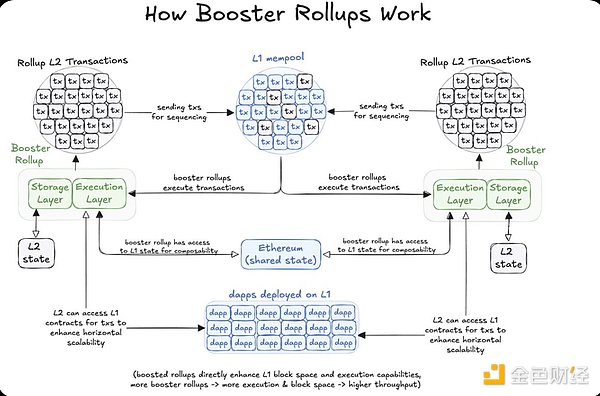
Because Booster Rollups naturally support synchronous composability, this rollup model eliminates the hassle of dealing with fragmentation or switching between multiple L2s. All prioritized decentralized applications (dapps) can be used on each L2, providing users with a seamless Ethereum experience.
With Booster Rollups, developers can scale their dapps without the need for multiple redeployments across different L2s. By deploying once on L1, dapps will automatically scale to all existing and future Boosted L2s, greatly simplifying the development and deployment process.
Advantages of Booster Rollups
1. Transparent Scalability
Booster Rollups enhance scalability in a transparent manner, like adding more servers to a server farm. Applications can seamlessly leverage additional resources, and developers can scale solutions without deploying complex L2 infrastructure.
2. Solving Fragmentation
Booster Rollups provide a unified user experience between L1 and L2. Since smart contracts share the same addresses across all networks, users can enjoy consistency and simplicity across L1 and L2 environments.
3. Solving Deployment Inefficiency
Developers only need to deploy once on L1, and dapps can default to supporting multiple Rollups, with updates centrally managed. Whether users have externally owned accounts (EOAs) or smart wallets, they can transact seamlessly across networks using a single address.
4. Solving Rollup Operator Attractiveness
Developers don't need to specifically choose deployment networks, as dapps will automatically support various Rollup networks. Booster Rollups can be combined with L1-based Rollups to achieve significant scaling, and not all L2s need to become Booster Rollups, making hybrid networks possible.
5. Enhancing Sovereignty and Security
Booster Rollups eliminate the need for specific wrapper contracts, as smart contracts work the same way on L1 and L2, with control remaining in the hands of developers. By applying security measures individually for each dapp, rather than relying on bridges or specific implementations, security is significantly improved, and the risk of single points of failure is eliminated.
Limitations of Booster Rollups
To ensure consistency between L2 and L1, smart contract deployment should be limited to L1. This constraint ensures unified access across L2s. This is not a major limitation, as smart contracts can still exhibit different behaviors through data-driven methods, such as having contract addresses vary across different chains.
While L1 holds the shared data, this does not directly improve scalability, which is an inherent challenge for any scalable system. Developers must optimize to minimize this impact. Similar to traditional software, not all decentralized applications (dapps) can fully leverage parallel processing. However, even if these dapps run on separate L2s, they can still benefit from interoperability, as they remain universally accessible to all users.
Booster Rollups are essentially an extension of L1, but they have unique mechanisms for transaction execution and storage. To correctly interpret Booster Rollup transactions, L1 and L2 nodes must remain synchronized. One possible solution is to run both L1 and L2 on the same node, switching between the shared L1 storage and L2-specific storage when executing transactions.
Conclusion
Booster Rollups provide a transformative solution by seamlessly integrating with L1, enhancing transaction throughput and storage efficiency to address Ethereum's scalability challenges. They solve issues such as fragmentation and deployment inefficiency, allowing developers to easily scale dapps across multiple L2s while maintaining security and sovereignty.
By simplifying scalability and fostering interoperability, Booster Rollups pave the way for a more unified and user-friendly Ethereum ecosystem.