The SocialFi track, which has been quiet for a long time, is once again in turmoil, and an application called Clout is rewriting the rules of "monetizing influence".
Just today, this platform that allows users to issue personal tokens officially went live, and its first token $PASTERNAK soared to a market value of over $80 million in 5 hours (BlockBeats note: as of the time of writing, the market value of PASTERNAK is temporarily reported at $38 million. The price of meme tokens fluctuates greatly, and the content shared in this article is for learning and research purposes only, not as investment advice.), instantly becoming the focus of the crypto market. The behind-the-scenes operator - Ben Pasternak is no stranger, this 15-year-old dropout who developed a hit social app, and the 25-year-old selected for Forbes 30 Under 30, is trying to inject the crypto gene into the influencer economy with Clout.
It is worth noting that this experiment coincides with the golden window period of the celebrity token craze. Starting with the Trump family's series of tokens, the influence of social media is being quantified into tradable digital assets. The special thing about Clout is that it simplifies the complex token issuance process to be as easy as creating a social media account: binding social media authentication, supporting credit card payment, and automatic distribution of internal and external trading mechanisms - this "Web2 influencer-friendly" design may be bringing a huge influx of new blood to the crypto industry.
What is Clout?
The essence of Clout is a bold genetic recombination experiment in the SocialFi field - it cleverly combines the social asset logic of FriendTech and the low-threshold token issuance mechanism of Pump.fun, and finally incubates a "influencer version of Nasdaq".
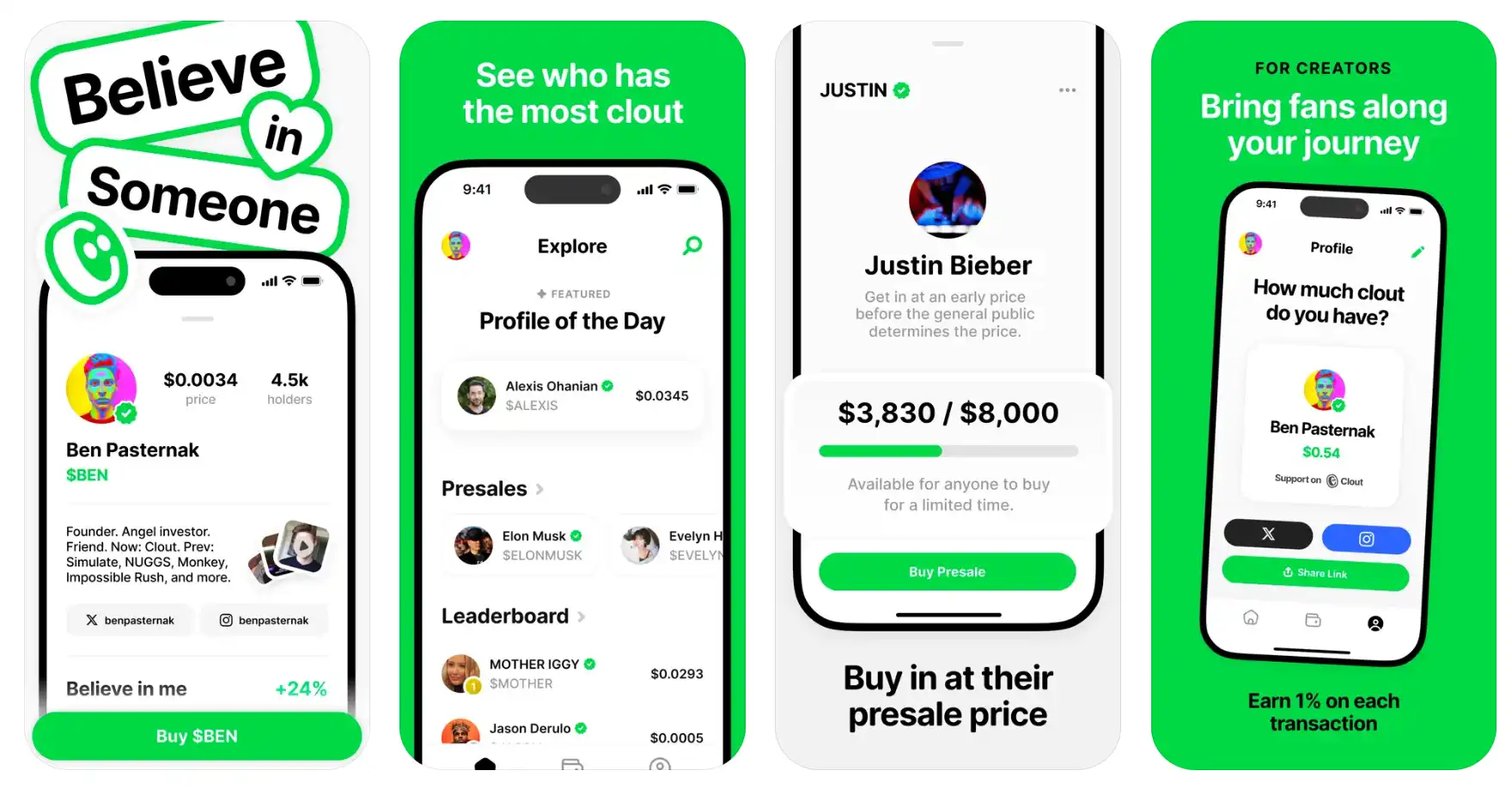
Dissection of the model:
1. The social viral gene of FriendTech
· Similar to how FriendTech converts Twitter followers into private domain traffic, Clout further "chains" influence: creators issue personal tokens by binding X account (requires ≥10,000 real followers), and fans who purchase the tokens can obtain "financialized association" with the idol.
2. The liquidity enhancement technique of Pump.fun
· Borrowing the ultra-simple token issuance process of Pump.fun, Clout allows creators to create tokens in 5 minutes, and controls liquidity through an internal and external trading mechanism: internal pre-sale accumulation (limited to platform-internal trading), and after opening the external market, it is connected to DEXs like Raydium to form a price discovery closed loop.
Operation path:
STEP 1: Create username → Bind X account → X account Twitter verification (viral marketing)
STEP 2: Enter token name/symbol → Set total issuance
STEP 3: The system automatically reviews the number of followers → After passing, pay the on-chain fee → Generate the token
STEP 4: Fans use credit card/Apple Pay/crypto wallet to participate in the internal pre-sale
This hybrid model retains the imagination of FriendTech's "social capital securitization", and also uses Pump.fun-style technical popularization to dissolve the crypto threshold. While other platforms are still debating "which is more important, social or finance", Clout has already used a standardized production line to push the influencer economy into an industrialized mass production era.
Who is the founder?
Ben Pasternak is a 25-year-old Australian guy. His game "Impossible Rush" developed at the age of 15 rushed into the Top 20 of the US App Store, his youth social platform "Monkey" he founded at 17 had over 20 million users, and at the age of 20 he conquered the Walmart shelves with the plant-based chicken nugget NUGGS. Now this entrepreneurial genius has entered the crypto field with Clout.

This seemingly jumpy entrepreneurial trajectory actually hides a secret logic: standardizing abstract value. Whether it's packaging teenage social needs into video matching algorithms, or reconstructing soy protein into "cyber chicken nuggets", Ben has always been deconstructing complex systems and transforming them into scalable commodities. And Clout is the standardized measuring instrument he has put on "personal influence" - when a social media account is verified with 10,000 followers, the automatic generation of token contracts by the system, and the NUGGS factory pressing plant-based protein into chicken nugget shapes, essentially share the same industrialization mindset.
The ultimate experiment of this mindset is the token PASTERNAK named after him. As the debut case of Clout, it also received the official support and retweet from Solana, and its market value broke through $80 million in 5 hours after its launch, but its white paper clearly stated "the founder has 0 holdings". This deliberate separation of interest association is like setting a control group in the laboratory: when the founder's interest is completely decoupled from the token value, is the market's frenzy a recognition of the technical logic, or a blind worship of celebrity IP?
Ben's ambition is obviously not limited to this. In a recent AMA, he compared Clout to "Wall Street + Hollywood in the Web3 era", trying to integrate financial pricing and celebrity dream-making. However, history always repeats itself: in the 1990s, the sports card trading market collapsed due to excessive speculation; in 2023, the token-based social graph of Friend.tech experienced a surge and then a plunge. When Clout equips every influencer with a mini money printer, perhaps we should ask: when traffic becomes a fixed asset on the balance sheet, will social media evolve into a more efficient value network, or degenerate into a financial reality show with universal participation?
Celebrity Token Craze and Business Model Analysis
When Trump's MAGA token has a market value of $50 billion, surpassing the valuation of his own tech and media conglomerate (DJT), the crypto market has fully awakened - the capital mobilization power of celebrities has far exceeded the value-bearing capacity of traditional physical assets. The emergence of Clout seems to have turbo-charged this "influence IPO" wave: it not only standardizes celebrity token issuance into an assembly line operation, but also upgrades this crypto game into a nationwide financial experiment through a fiat currency entry + liquidity enhancement double helix structure.
1. Timing: The "Perfect Storm" of Celebrity Tokens
The crypto market in early 2025 is experiencing a paradigm shift from "technical narrative" to "cultural narrative". The wealth creation myths of one presidential family after another have collectively verified a underlying logic: social media influence is programmable capital. Clout has keenly captured this trend, lowering the token issuance threshold to the ultra-simple operation of "binding a Twitter account with 10,000 followers", making it even more convenient than traditional financial IPOs.
2. Genetic Recombination: The Hybrid Evolution of FriendTech+Pump.fun+Moonshot
The business model of Clout is essentially a synthesis of three genetic strands:
· Social Capital Monetization of FriendTech: Inheriting its core of tokenizing fan relationships, but Clout solves the problem of liquidity fragmentation through standardized tokens (rather than fragmented Keys). FriendTech's Keys can only be traded within the closed ecosystem, while Clout tokens automatically connect to DEXs like Raydium after the internal pre-sale is completed, forming an open market price discovery mechanism.
· Industrialized Token Issuance of Pump.fun: Absorbing its low-threshold 5-minute token creation feature, but achieving compliance upgrade through "identity verification + fiat currency entry". While Pump.fun users are still struggling with SOL chain Gas fees, Clout's credit card payment channel has already attracted a large number of Web2 influencers.
· Liquidity Migration Logic of Moonshot: It is worth mentioning that Ben is an investor in Moonshot, which designed the "migration to DEX after reaching market cap threshold" mechanism, and Clout has improved it into an "internal and external trading dual-track" - the internal pre-sale accumulates initial liquidity, and after the external market opens, it continues PVP, and there are also expectations of listing on CEX in the future, forming a liquidity ladder from closed to open, avoiding the fate of token listing and immediate collapse.
3. Advantages of the Business Model
Clout's revenue structure shows differentiated competitiveness compared to traditional social platforms:
· Creator end: Earn revenue through on-chain fees and 1% transaction fees. Compared to FriendTech's reliance on a single Key transaction fee, Clout's diversified fee model (such as on-exchange transaction fees, off-exchange liquidity sharing) is more adaptable to market fluctuations.
· Investor end: The fiat currency deposit channel lowers the participation threshold and attracts a flood of Web2 users. This design is similar to Alipay's early simplification of the payment process by binding bank cards, bringing a large number of Web2 speculators to Web3.
4. Catalysts for the SocialFi track
The rise of Clout may become a turning point for the SocialFi ecosystem. Its innovative mechanism directly addresses the three major pain points of the industry:
· Liquidity dilemma: Traditional SocialFi platforms (such as Friend.tech) have lost users due to token liquidity fragmentation, while Clout has built a complete transaction path from pre-sale to the secondary market through the linkage of on-exchange and off-exchange and CEX access.
· High user threshold: Crypto-native platforms rely on wallet operations, while Clout's email registration and credit card payment design have reduced user education costs to a minimum. This is similar to WeChat Pay's disruption of cash transactions through QR code scanning, making technology invisible behind the experience.
· Imbalance between content and finance: Most SocialFi projects rely too heavily on token speculation, while Clout dynamically links token value to the content output of creators by binding real social media influence. This "influence as an asset" narrative may spawn more "subscription content + token incentives" hybrid models similar to Substack.
If Clout can continue to attract top-tier KOLs to join and improve its ecosystem tools (such as data analysis panels, DeFi staking protocols), it has the potential to become a "infrastructure-level" application in the SocialFi field. Just as Uniswap reshaped the DEX landscape through automated market makers, Clout may redefine the liquidity standard of social assets through a "personal token issuance protocol".
Conclusion: The Future Landscape of Clout
In 2007, when YouTube launched its first creator revenue sharing program, Silicon Valley critics mocked it as a "naive experiment to give pocket money to amateur hobbyists." No one could have imagined that this move would leverage a trillion-dollar creator economy - seventeen years later, the monthly income of top YouTubers is enough to rival small businesses.
And Clout's experiment is replaying this transformation in a more radical way: it is trying to upgrade YouTube's "ad revenue sharing button" to a "personal IPO button." Fitness bloggers no longer need to wait for the platform algorithm to bestow traffic, they can directly package the expectations of their hundred thousand followers into crowdfunding tokens; independent musicians no longer need to have seventy percent of their earnings taken away by record companies, the token appreciation brought by a hit video may be equivalent to the royalties of a platinum album.
The core contradiction of this experiment is actually a replay of the evolutionary history of the Internet: how to find a balance point between openness and regulation, speculation and creation, short-term arbitrage and long-term value. Clout's answer is quite enlightening - by "lowering friction through fiat currency entry, filtering bubbles through on-exchange and off-exchange mechanisms, and anchoring value through real social relationships," it is trying to carve out a well-cultivated experimental field in the wild west of SocialFi.
Looking back at history, from PayPal unlocking online payments to TikTok reshaping content distribution, each technological empowerment has been accompanied by the fragmentation of the old order. And now, Clout is pointing the spearhead of fragmentation at the most entrenched fortress of social media: the pricing power of the attention economy. If it can withstand the entropy of short-term speculation and truly build a "influence-token-use case" value flywheel, perhaps we will witness -
The Web3 manifesto that was once seen as a delusion, "You are the IPO," is turning from the rambling of crypto geeks into a tangible reality on every mobile screen.
Welcome to join the official BlockBeats community:
Telegram subscription group: https://t.me/theblockbeats
Telegram discussion group: https://t.me/BlockBeats_App
Twitter official account: https://twitter.com/BlockBeatsAsia