Source: Permanence DAO, PolkaWorld
Polkadot aims to become a true Web3 cloud (Polkadot cloud), providing the infrastructure for building highly scalable and extremely reliable Web3 applications and services. While different, this is similar to the work AWS has done for Web2 applications and services.
Want to know how JAM and JAM Grid are driving Polkadot to become a true Web3 cloud? Check out this article to learn what JAM and JAM Grid are!
JAM: Unprecedented Scale and Computing Power
JAM Grid: Unlocking 1 Billion TPS
Comparison with Other Blockchains
What Applications Can JAM Achieve?
What Applications Can JAM Grid Achieve?
How JAM Grid Empowers Developers
How DOT Drives JAM Grid
Conclusion
Additionally, Dr. Gavin Wood will be hosting the JAM Tour in 6 cities in China from late February to early March, where he will share what JAM is, what problems JAM solves, and what developers can build on top of JAM at local universities and centers! You will have the opportunity to meet Gavin Wood in person and discuss the latest Web3 technologies and concepts! Sign up here! JAM Tour China Registration Now Open! Meet Gavin Wood in 2025!
Before we begin, let's take a look at a brief timeline of the Polkadot cloud:
Polkadot Cloud — Genesis Phase: May 2020
Polkadot launched and produced its first block, marking the official "launch" of the Polkadot cloud.
Polkadot Cloud — First Milestone (Parachains), November 2021
This was the birth of the first cloud service of the Polkadot cloud. This service allows developers to build custom blockchains and connect them to the Polkadot cloud, achieving shared security.
First Cloud Service Deployment — Second Milestone, December 2021
The first cloud service (parachains) went live, and different teams began using it to deploy their parachains.
Polkadot Cloud — Third Milestone (JAM), TBD, perhaps before the end of 2025
JAM (Join-Accumulate Machine) is a trustless supercomputer that forms the foundation of the Web3 cloud.
Polkadot Cloud — Potential Fourth Milestone (JAM Grid), TBD
JAM Grid is a hypothetical interconnected supercomputer cluster, with each computer running the JAM protocol.
Today's blockchains, even the so-called "high-performance" ones, struggle to handle real-time, data-intensive workloads. In contrast, JAM Grid is theoretically capable of 1 billion transactions per second (TPS), exabyte-scale storage, and hundreds of GB/s of bandwidth, potentially providing Web3 services with capabilities on par with modern cloud data centers.
Introduction to JAM and JAM Grid
JAM is a single supercomputer that enables the construction of scalable and reliable Web3 applications and services. The primary goal of JAM is to provide a flexible and efficient framework for managing data and computation across the network. It aims to simplify data integration and maintenance while ensuring the integrity and security of the network. You can learn more about JAM from Gavin Wood's Gray Paper (https://graypaper.com/) or PolkaWorld's articles.
Gavin Wood: JAM is a Trustless Supercomputer that Forms the Foundation of the Web3 Cloud!
Big News! Gavin Announces JAM Roadmap! JAM Asia Tour to Launch Next Year!
JAM Tour China Registration Now Open! Meet Gavin Wood in 2025!

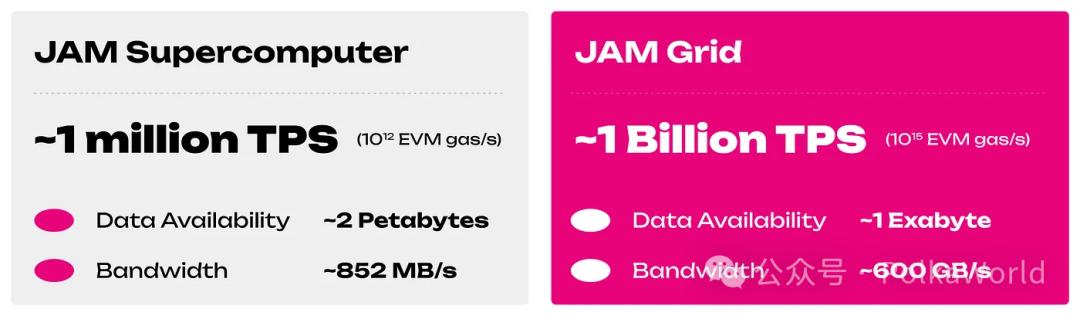
A new concept — JAM Grid, proposes the next leap: a network of multiple supercomputers, theoretically capable of 1 billion transactions per second (TPS), exabyte-scale data availability, and high-performance computing (HPC) level bandwidth.
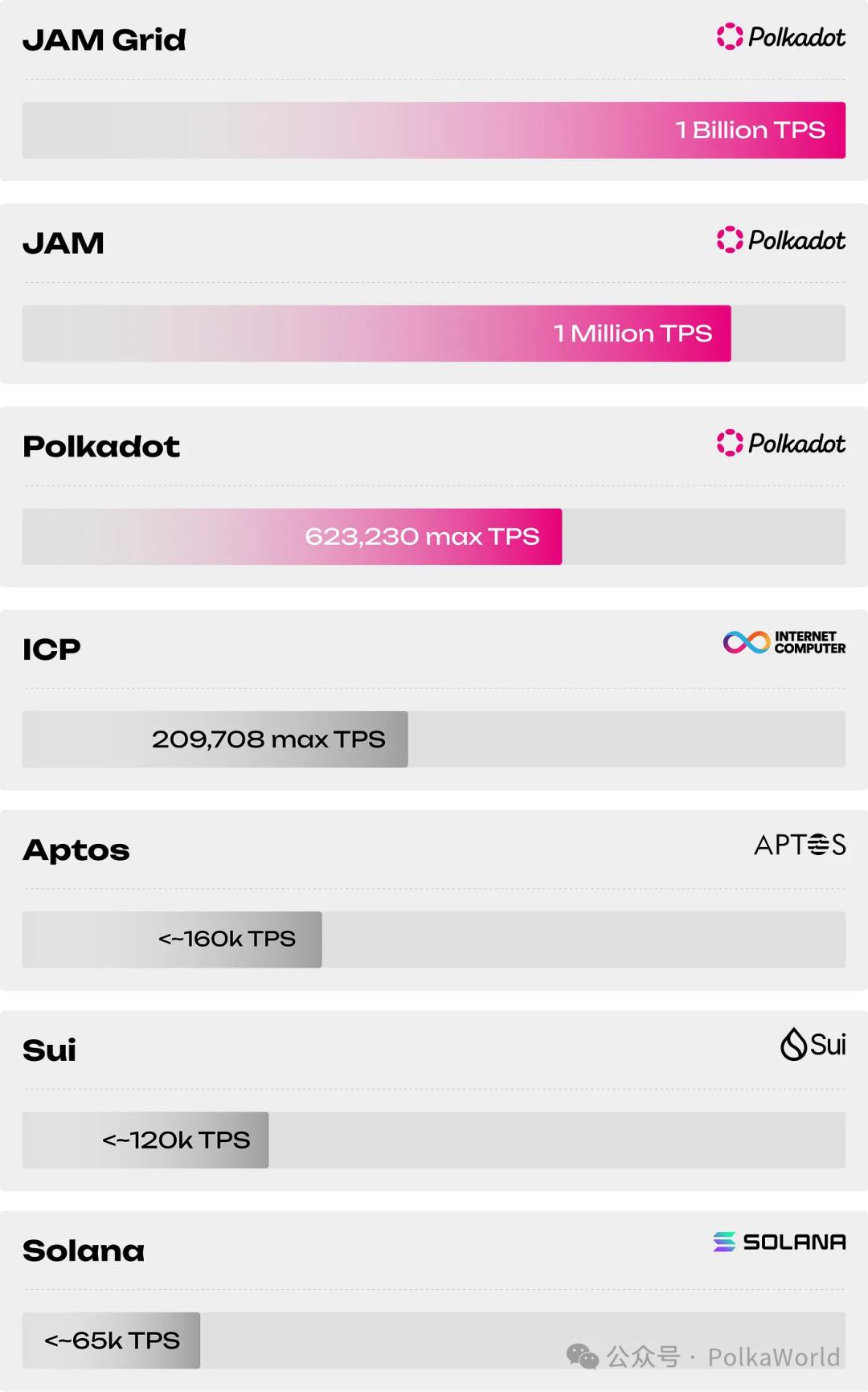
Regarding the TPS metric, it's worth noting that, in Gavin Wood's year-end summary article, he mentioned that the computing power could potentially reach 10 quadrillion EVM-equivalent gas per second. Due to the vast differences in gas consumption between different transactions, there is no universally applicable "transactions per second" (TPS) metric. For example, on Ethereum, a simple ETH transfer might require 21,000 gas, while a more complex smart contract interaction could require hundreds of thousands or even millions of gas. The following is a comparison table (note that these data are approximate).
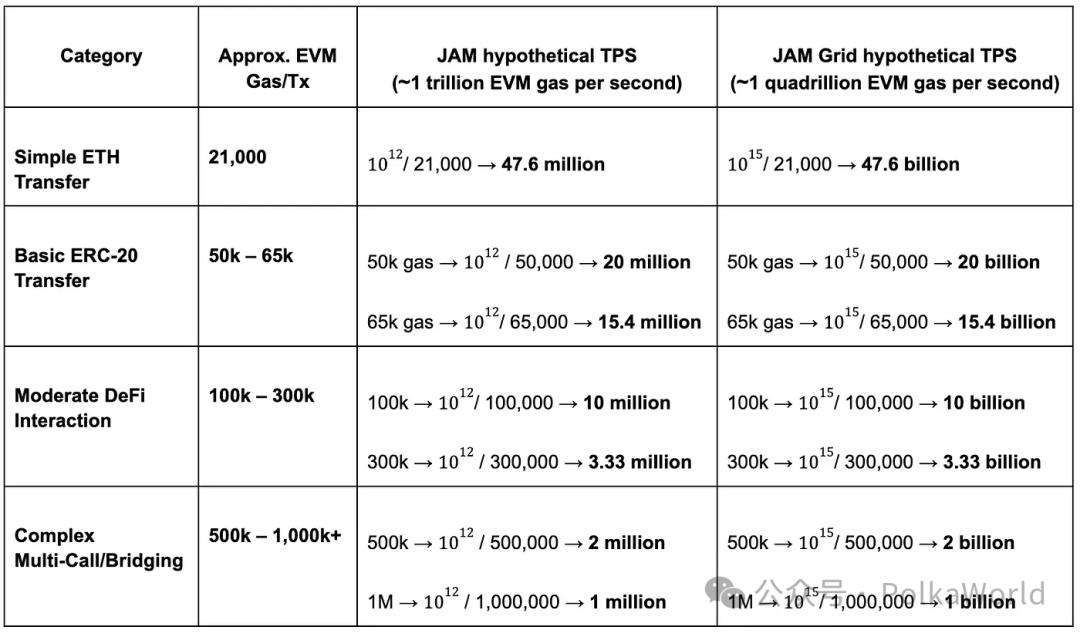
The image shows that for transactions consuming a large amount of gas, the upper limit for JAM is around 1 million TPS, and the upper limit for JAM Grid is around 1 billion TPS. However, it's worth noting that these figures are approximate.
JAM: Unprecedented Scale and Computing Power
What is JAM?
JAM (Join-Accumulate Machine) is a trustless supercomputer that forms the foundation of the Web3 cloud. It is a new computing model and protocol aimed at enhancing Polkadot's capabilities and addressing the scalability challenges in blockchain technology. JAM will support 1 million transactions per second (TPS), 2 PB of data availability, and 857 MB/s of bandwidth.
Why is it important?
JAM is the next upgrade that will bring Polkadot closer to its original vision - becoming a permissionless global supercomputer.
How do other blockchains compare?
JAM's scalability is designed to support large-scale real-time applications that traditional blockchains cannot handle.
JAM Grid: Unlocking 1 Billion TPS
What is JAM Grid?
JAM Grid is a hypothetical interconnected supercomputer cluster, with each computer running the JAM protocol, promising 1 billion transactions per second (TPS), 1 exabyte of data storage, and 600 GB/s of bandwidth.
Why is it important?
These numbers far exceed the standards of today's blockchains, hinting at a scale similar to high-performance computing (HPC). If realized, it would be able to handle global-scale applications while maintaining decentralized security.
How do other blockchains compare?
Projects like Solana, Aptos, Sui, and Avalanche have pushed for higher throughput than traditional blockchains, but they still fall short of exabyte-scale storage or high-performance computing (HPC) level bandwidth.
Comparison with Other Blockchains
TPS (Transactions Per Second): Measures raw throughput - how many transactions the blockchain can process per second. Higher TPS usually means more scalable decentralized applications (dApps) and better user experience.
Data Availability: The blockchain network's ability to store and manage data on-chain. It includes the total data volume and accessibility across all network nodes. Strong data availability ensures consistent access and verification of transaction records, application states, and user data, while maintaining the blockchain's integrity, security, and decentralization.
Bandwidth: Reflects network capacity - the speed at which data can be transmitted through the system. For blockchains aiming to handle large transaction volumes (and related data), high bandwidth is key to preventing bottlenecks.
Architecture: Highlights the design approach - e.g., the difference between single-chain and sharded or subnet architectures. Architecture impacts TPS as well as the ease of scaling and evolving the blockchain.
Now that we understand why these metrics are important, let's see how JAM Grid's vision compares to other leading projects.
Note that many TPS figures are from test nets or theoretical maximums - actual performance may differ. Data availability and bandwidth metrics are also ranges/approximations, as there are no precise numbers. We've tried to present a fair and accurate comparison, but if you find any inconsistencies, please let us know so we can correct them.
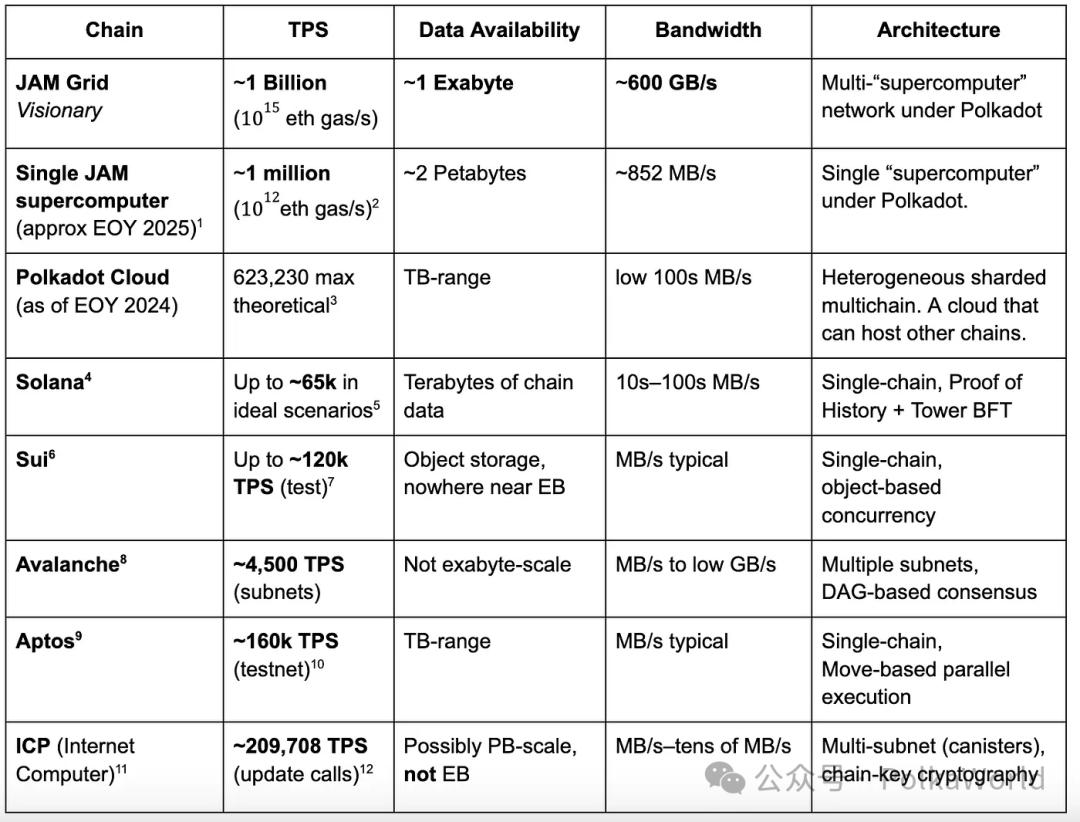
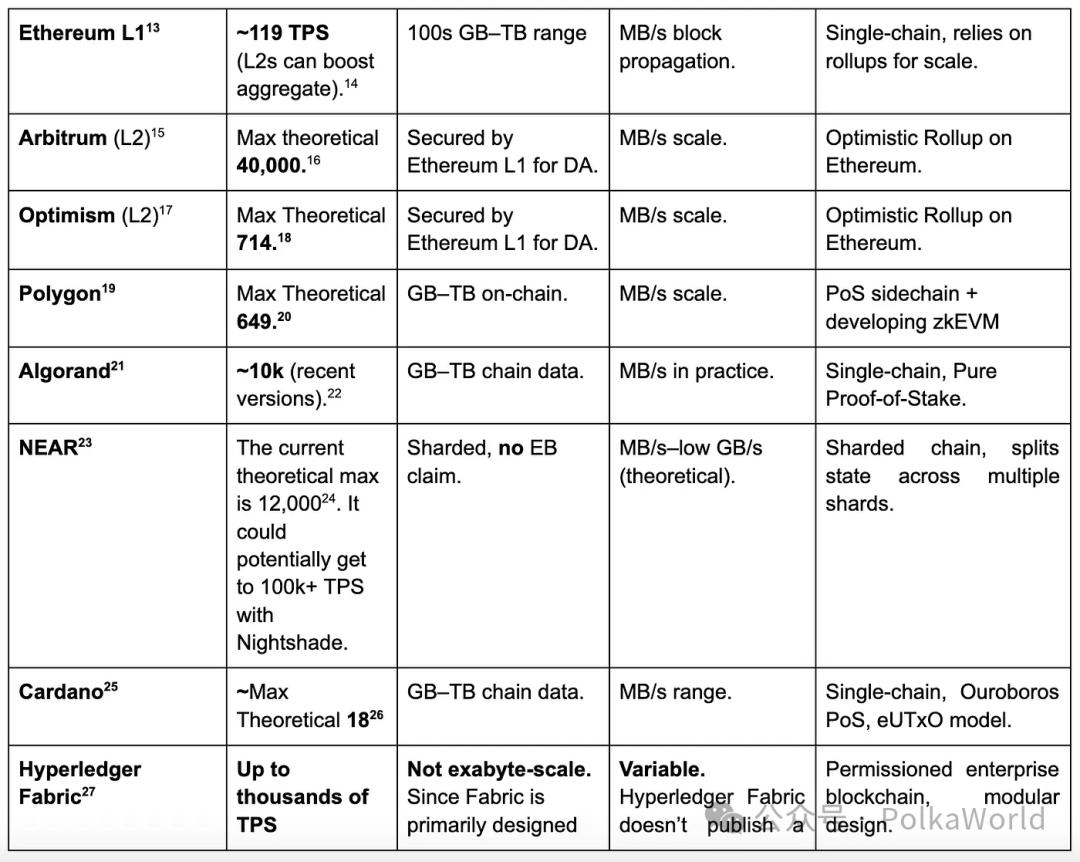
You can find the Google Doc with the charts and footnotes here.
Again, the metrics in the charts above are ranges/approximations. If you have more accurate numbers, please feel free to reach out to us.
Key Takeaways
Exabyte Storage and HPC Bandwidth: JAM Grid envisions providing 1 exabyte of data storage and 600 GB/s of throughput - on par with large data centers, not typical blockchains.
Comparison to Current Networks: While blockchains like Solana, Avalanche, and Aptos surpass older platforms in TPS, they cannot approach the level of data availability or sustained bandwidth of HPC-grade systems.
Multi-"Supercomputer" Approach: There will be multiple supercomputers, each running the JAM protocol. This will create a network where all the supercomputers can communicate with each other and potentially share resources. How these supercomputers will communicate with each other will be a key challenge.
What Applications Can JAM Unlock?
With around 1 million TPS, 2 PB of data availability, and 857 MB/s of bandwidth, the JAM supercomputer represents a massive leap beyond what most existing blockchains can offer. Here are some examples of applications that JAM can unlock:
Real-Time Gaming and Virtual Worlds (City-Scale or Nation-Scale)
Why Not Now? Current blockchains cannot handle the frequent game state changes of thousands (let alone millions) of concurrent players.
How JAM Helps: 1 million TPS means that city-scale or nation-scale virtual world interactions can be kept on-chain, reducing reliance on centralized servers.
Real-Time IoT and Automation (Enterprise or City-Scale)
Why Not Now? IoT devices generate millions of events per second in city or industrial deployments. Most blockchains cannot handle so many on-chain events, leading to severe congestion.
How JAM Helps: Around 1 million TPS throughput combined with PB-scale data availability means each device can reliably publish millions of events per second on-chain, well-suited for large enterprises or smart cities. Hundreds of MB/s of bandwidth ensure sensor data can sync quickly across global nodes - enough for city or enterprise-scale needs, but not the entire global IoT ecosystem.
High-Volume Stablecoins or Payment Systems (Nation-Scale)
Why Not Now? Traditional blockchains face network congestion and high fees under heavy load, limiting mainstream adoption of on-chain micropayments.
What JAM Can Provide: Around 1 million TPS capacity (assuming simple transactions) means stablecoins or payment networks can serve national or regional economies. The fast throughput keeps fees low and confirmations rapid. While it cannot handle billions of daily micropayments globally, it exceeds the limitations of most existing L1s.
With JAM realized, the Polkadot Cloud will vastly outperform many existing L1s in throughput, storage, and bandwidth, enabling real-time, data-intensive dApps that are currently infeasible on blockchains.
What Applications Can JAM Grid Unlock?
Today's blockchains - even "fast" ones - struggle to handle real-time, high-data workloads. In contrast, the JAM Grid supporting tens of billions of TPS, exabyte-scale storage, and hundreds of GB/s of bandwidth can provide cloud data center-grade performance for Web3 services. Here are some examples of applications that could become reality under these conditions:
Massive Multiplayer Virtual Worlds and Games
Why Not Now? Current blockchains cannot handle the real-time updates of millions of concurrent players, let alone store large game assets, states, and logs on-chain.
How JAM Grid Helps: With billions of TPS and massive bandwidth, the JAM Grid can handle frequent state updates (like player actions, world changes) with all data kept on-chain, eliminating the need for centralized game servers. Exabyte-scale storage means a huge 3D asset library, character inventories, and item histories can be verifiably and persistently maintained.
Real-Time IoT and Automation
Why Not Now? IoT devices continuously generate data streams - like temperatures, vehicle telemetry, sensor updates - potentially producing millions of events per second. No mainstream blockchain can process and verify such massive data volumes in near-real-time.
How JAM Grid Helps: High throughput and scalable data availability mean each device can directly record updates on-chain without overwhelming the network. High bandwidth ensures data can propagate quickly across globally distributed nodes.
Global-Scale Social Networks
Why Not Now? Social platforms generate billions of interactions (likes, posts, comments, messages) daily, requiring immense throughput and storage. Existing blockchains cannot handle such vast on-chain activity.
How JAM Grid Helps: Billions of TPS can support near-instant publishing, while exabyte-scale storage can preserve rich media and user histories without relying on off-chain solutions. Built-in decentralization ensures no single company controls user data or content moderation.
Decentralized AI and Large-Scale Machine Learning
Why Not Now? Training and inference for large AI models require massive compute power and datasets, typically handled by centralized high-performance computing (HPC) clusters.
How JAM Grid Helps: The JAM Grid's HPC-like throughput and bandwidth can host distributed AI workloads on-chain, ensuring data auditability, verifiable training results, and equal access to HPC resources for all.
Global Stablecoin Payment System
Why not now? Traditional stablecoins on L1 blockchains already face congestion and high fees under high loads. Billions of daily micro-payments (such as IoT micro-transactions and everyday purchases) become infeasible.
How can JAM Grid help? High throughput + fast confirmation makes stablecoins scalable to global scale without astronomical fees or bottlenecks. This lays the foundation for a ubiquitous and low-cost payment system, more open than any corporate provider.
In short, JAM's extreme throughput and storage capabilities unlock new Web3 services that rival the performance of traditional cloud solutions, while maintaining decentralized ownership.
How does JAM Grid empower developers?
In the previous section, we showed examples of global-scale applications that JAM Grid can support, and developers may wonder: how does this open new doors for me? Here are some ways JAM Grid changes the development experience, beyond just unlocking theoretical workloads:
Large-scale on-chain data processing
Today's bottleneck: Even "fast" L1s and many L2s impose strict limits on data or state, forcing developers to heavily rely on off-chain servers, IPFS, or private storage. This makes architectures complex, increases trust assumptions, and limits transparency.
JAM Grid's breakthrough: With exabyte-scale data availability, developers can design truly data-intensive decentralized applications (dApps) where both logic and large datasets are stored on-chain. This ensures auditability and composability without relying on off-chain databases.
Easier to build global-scale applications
Today's bottleneck: Even successful Web3 projects often hit performance ceilings, where mainstream users feel alienated as fees spike or throughput drops.
JAM Grid's breakthrough: Supporting billions of TPS, developers can target mass-market adoption - like truly mainstream social apps or cross-border supply chain solutions - without the system collapsing under load.
JAM Grid not only supports large, high-profile use cases; it significantly reduces the friction between innovative ideas and efficient, trustless solutions. Imagine if you've spent years banging your head against scaling problems, or cobbling together partial solutions - in that case, JAM Grid's HPC-grade design opens up a future where developers can fully rely on on-chain, horizontally scalable, yet still secured by a shared safety layer.
You can think of it as the "cloud moment" for Web3 development: you write the code, you deploy the app, and the network (via the HPC-secured Polkadot DOT-backed safety layer) ensures performance and security - while still preserving blockchain's core decentralized ethos.
How does DOT drive JAM Grid?
DOT is key to securing the entire Polkadot ecosystem - from Polkadot Cloud to every JAM supercomputer in the JAM Grid.
Staking for security
To ensure the security of the Polkadot network - and thus the security of JAM Grid - validators need to stake DOT. As JAM Grid scales, the required staking amount will increase, potentially elevating DOT's role in safeguarding these supercomputers.
Access and participation
To build or deploy services on JAM-based supercomputers, users and developers will interact with Polkadot's infrastructure, paying fees or staking DOT. Essentially, DOT becomes the passport to access the world's most powerful supercomputer (or supercomputer grid) for Web3 development.
Economic alignment
If JAM Grid succeeds, it will enhance Polkadot's utility, further driving demand for DOT - creating a positive feedback loop between supercomputer growth and the fundamental value of DOT.
By making DOT the asset for securing, accessing, and powering JAM Grid, DOT becomes the core economic driver of the global-scale Web3 cloud. This synergy means DOT is no longer just "another token" - it becomes the foundation for hosting and running the next generation of decentralized high-performance applications.
Conclusion
If JAM Grid can truly achieve 1 billion TPS and exabyte-scale storage, it will prove that there is a way to build a decentralized infrastructure capable of handling global-scale demands. Rather than forcing a zero-sum competition, this vision emphasizes a shared impetus - to establish a "supercomputer" that is community-governed, permissionless, and globally accessible, rather than controlled by tech giants.
These ambitious specifications point to a true Web3-native "cloud": globally accessible, economically incentivized, and free from centralized control. If JAM Grid succeeds, it will not only raise the bar for Polkadot - it will inspire a broader ecosystem to envision new possibilities for high-throughput, trustless computing. The ultimate goal is to benefit billions with transparent, censorship-resistant services.