On January 22, 2025, the People's Bank of China, the Ministry of Commerce, the Financial Supervisory Authority, the China Securities Regulatory Commission, and the State Administration of Foreign Exchange jointly issued the "Opinions on Promoting Institutional-level Opening-up in Eligible Free Trade Zones (Ports) to Align with International High Standards in the Financial Sector" (hereinafter referred to as the "Opinions").
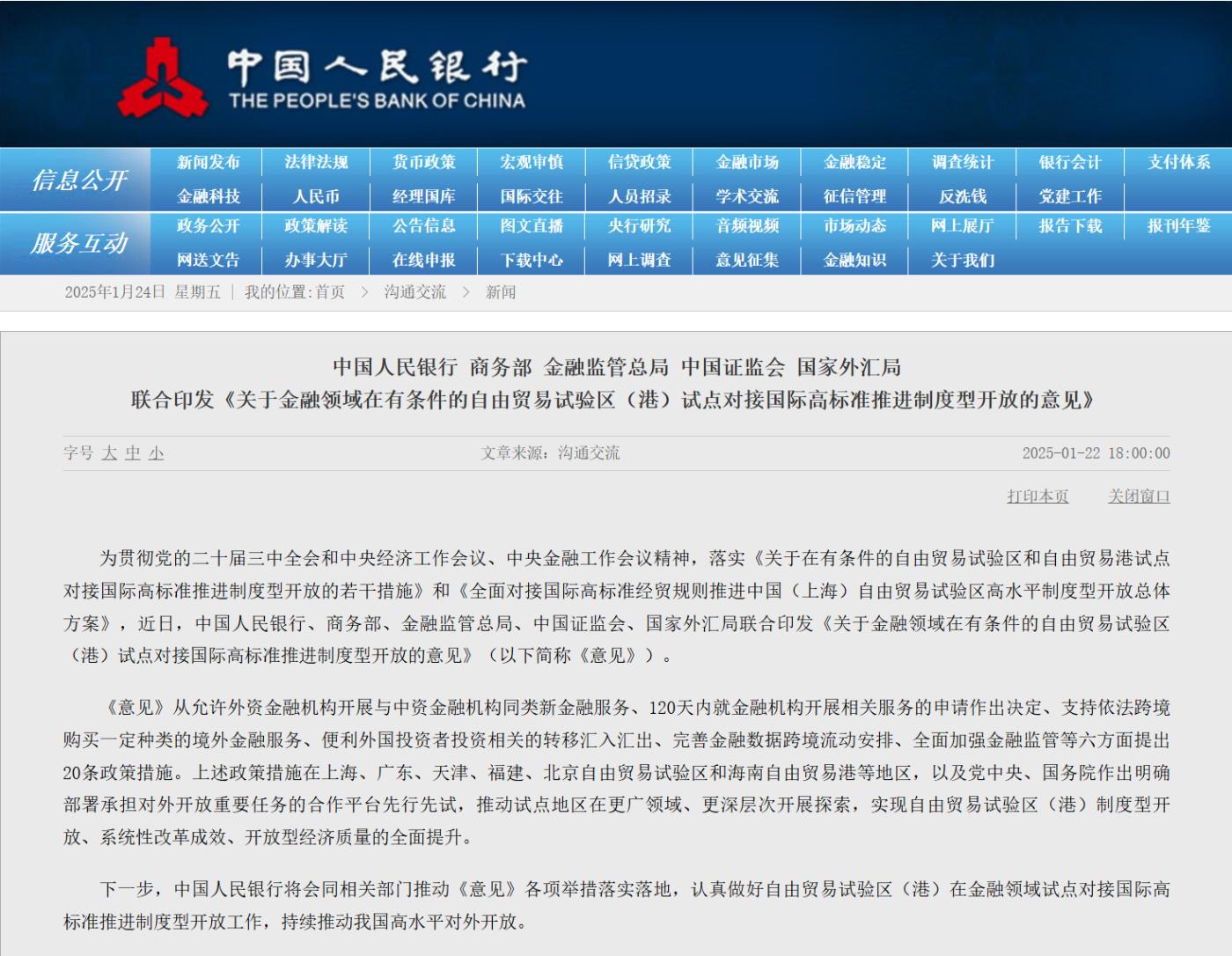
The "Opinions" propose 20 policy measures in several aspects, including allowing foreign-invested financial institutions to provide the same types of financial services as their Chinese counterparts, supporting the lawful cross-border purchase of certain types of overseas financial services, facilitating the investment-related transfer of funds in and out by foreign investors, and improving the arrangements for cross-border flow of financial data.
These policy measures mark the arrival of a new wave of opening up in the financial industry. For participants focused on cross-border investment, blockchain, and the cryptocurrency industry, these changes also contain important relevance and potential positive directions. This article will analyze them one by one.
I. Investors can invest in new financial services through the "Cross-border Wealth Management Connect" pilot in the Guangdong-Hong Kong-Macao Greater Bay Area
What are the new financial services? What investable products are available in the Guangdong-Hong Kong-Macao Greater Bay Area?
The new financial services mentioned in the "Opinions" refer to financial services that are not yet provided in our country but have been provided and regulated in other countries or regions. The new financial services will be piloted first in the Shanghai, Guangdong, Tianjin, Fujian, Beijing Free Trade Zones and the Hainan Free Trade Port, as well as the cooperation platforms that have been clearly deployed by the Party Central Committee and the State Council to undertake important tasks of opening up to the outside world.
This regional pilot model allows us to expect to see pilot rules with distinctive features in different regions in the future, which is worth looking forward to.
More notably, the "Opinions" specifically mention that the new financial services will also be continuously optimized in the "Cross-border Wealth Management Connect" pilot in the Guangdong-Hong Kong-Macao Greater Bay Area, supporting Mainland residents in the Greater Bay Area to purchase eligible investment products sold by Hong Kong and Macao financial institutions through Hong Kong and Macao financial institutions, and expanding the scope of participating institutions and eligible investment products.
Why is the Guangdong-Hong Kong-Macao Greater Bay Area so special? That's because the "Cross-border Wealth Management Connect" regional financial product model has already provided Mainland residents with an innovative and convenient cross-border investment path and a rich selection of product categories, which is the "vanguard" and "bridgehead" in China's cross-border investment field. Now the introduction of a comprehensive pilot to relax the participation of foreign financial institutions, the types of overseas financial products, and the restrictions on foreign exchange transfers will further boost its development.
Taking the typical HKMA-licensed cryptocurrency asset management business in Hong Kong as an example, originally these products could only be operated in Hong Kong, but with the new pilot framework, Hong Kong's virtual asset ETFs and other innovative financial products may be opened to Mainland investors through the Cross-border Wealth Management Connect in the future, further enriching the investment choices for Mainland residents.
What institutions can participate in the launch of the products? How to apply to carry out new financial services?
The "Opinions" allow foreign-invested financial institutions to carry out the same types of new financial services as their Chinese counterparts in the pilot areas.
The financial regulatory authorities can, in accordance with the principle of equal treatment of domestic and foreign parties, make a decision within 120 days from the date of receipt on the complete and legally compliant applications submitted by overseas financial institutions, overseas investors of financial institutions, and cross-border financial service providers to provide financial services in the pilot areas, and promptly notify the applicants.
Crypto Salad's view:
Under the push of the new policy, the blockchain field is expected to welcome more compliant product innovations. Some overseas regions have already allowed the issuance, mining, and trading of virtual currencies, and these mature technologies and models can be introduced to the domestic market through the pilot areas. For example, through the "Cross-border Wealth Management Connect" pilot, virtual asset-related products are expected to be included in the investment scope, providing investors with indirect investment opportunities. This compliant channel will inject new vitality into the development of the blockchain industry, pushing it from the gray area into the sunshine.
After the launch of these products, a large amount of capital is expected to flow into the blockchain field. With more capital inflows, the market size of the blockchain industry will expand rapidly, and the competitiveness of new financial products will also be significantly enhanced. The participation of financial institutions will bring more abundant resources and more professional management experience to the blockchain industry, promoting the healthy development of the industry.
II. Facilitation of Cross-border Capital Flows: Facilitating Foreign Investors' Investment-related Fund Transfers In and Out
The "Opinions" propose that, under the premise of true compliance, all transfers related to foreign investors' investments, including capital contributions, profits, dividends, interest, capital gains, royalties, management fees, technical guidance fees and other fees, full or partial sale of investment proceeds, full or partial liquidation of investment proceeds, payments under contracts including loan agreements, legally obtained compensation or indemnification, and funds arising from dispute resolution, shall be freely remitted in and out of the pilot areas without delay.
Crypto Salad's view:
Many readers know that our country has always strictly controlled the inward and outward remittance of foreign exchange under the capital account. From the many consultations and practical case handling experiences we have received, many times investors, even if they have met the formal review requirements of the foreign exchange administration or banks, still cannot pass the substantive review due to reasons such as the inability to trace the source of funds. The reason is that once the policy concept is penetrated into practice, there will be numerous complex detailed rules to be followed, and as long as one link is missing, the entire project will be affected.
Not only is this the case for the capital account, but many businesses under the current account also face difficulties in foreign exchange circulation. From our experience in serving many overseas companies, enterprises often encounter complex requirements from banks when remitting or settling various foreign exchange payments such as royalties, management fees, and technical guidance fees, and need our assistance.
Now with the introduction of the new policy, not only is foreign exchange circulation clearly beneficial, facilitating cross-border investors to flex their muscles, but it can also significantly improve the capital efficiency of enterprises and reduce management costs.
III. Improving the Arrangements for Cross-border Flow of Financial Data
The "Opinions" also propose to facilitate and regulate the cross-border flow of data by financial institutions in the pilot areas, explore the formation of a unified compliance standard for the cross-border flow of financial data within the framework of the national data cross-border transmission security management system, clarify the rules for the cross-border flow of financial data, and allow financial institutions in the pilot areas to legally transmit the data necessary for their daily operations to overseas.
Crypto Salad's view: This policy may bring significant benefits to RWA
As is well known, the core of RWA is to convert real-world assets (such as real estate, financial certificates, commodities, etc.) into digital tokens and deploy them on the blockchain. This process involves a large amount of data collection, storage, and transfer, such as market pricing, reference data, identity information, etc. In order to ensure the accuracy and timeliness of asset status, financial institutions rely on cross-border data flows to achieve secure and transparent transactions.
A positive cross-border data flow policy not only can significantly support the exploration and implementation of RWA projects, but also can effectively reduce the costs of data processing and compliance for various parties including financial institutions, accelerate the efficiency, and provide more possibilities for RWA innovation.
We have always said that RWA is very suitable for being deployed on domestic assets to attract foreign capital, and in the long run, it is also expected to become an important way for domestic enterprises to expand their financing channels. The new policy not only allows the free and timely remittance of foreign exchange in and out of the pilot areas, providing convenience for cross-border capital flows, but also introduces a cross-border data flow mechanism, which seems to be tailor-made for more RWA projects to be implemented. More domestic and foreign investors and project parties are expected to enjoy the policy dividends.
IV. Conclusion
From the experience of implementing various policies in the past, we can easily find that the implementation and promotion of all policies is a gradual process. This new policy to support cross-border financial services and new financial products is just the first step. In the future, with the introduction of more pilot projects, there will be more compliant financial institutions launching qualified and mature financial products.
The institutions that can take the lead in launching outstanding products ahead of other competitors will undoubtedly receive higher attention and capital inflows, forming a demonstration effect and driving more institutions and capital to enter this field. Therefore, it is recommended that all financial institutions and investors, especially our partners in the blockchain and crypto-asset sector, should maintain long-term and continuous attention to the implementation of the various measures in the 'Opinion' by the People's Bank of China and the relevant departments.
This represents the personal views of the author of this article and does not constitute legal advice or a legal opinion on any specific matter.