Source: Matt Hougan
Compiled by Odaily (@OdailyChina)
Translator: Wenser (@wenser 2010)

Editor's Note: As we enter 2025, with the emergence of former US President Trump's official Meme coin TRUMP and the short-term volatility in the market, the Crypto market is once again facing a turning point: on the one hand, the process of Crypto mainstream adoption is accelerating; on the other hand, the alternating focus of industry hotspots is causing the market's attention to wane rapidly. Many believe that the recent market performance indicates that the bull market cycle is nearing its end, but there are also those who hold the opposite view, believing that new Crypto ATHs are still on the way and that the market could double in 2025. In light of this, Odaily has compiled and summarized the recent views of Matt Hougan, Chief Investment Officer of Bitwise, for readers' reference.
Each Cycle Has Its Own Catalysts, and Deleveraging Is Also a Foregone Conclusion
The traditional four-year cycle has come to an end in the Crypto currency market.
This is a tweet about what changes have occurred in the market.
Bitcoin has historically followed the "four-year cycle" pattern - three years of growth, one year of correction (Odaily note: this can be understood as three steps forward, one step back).
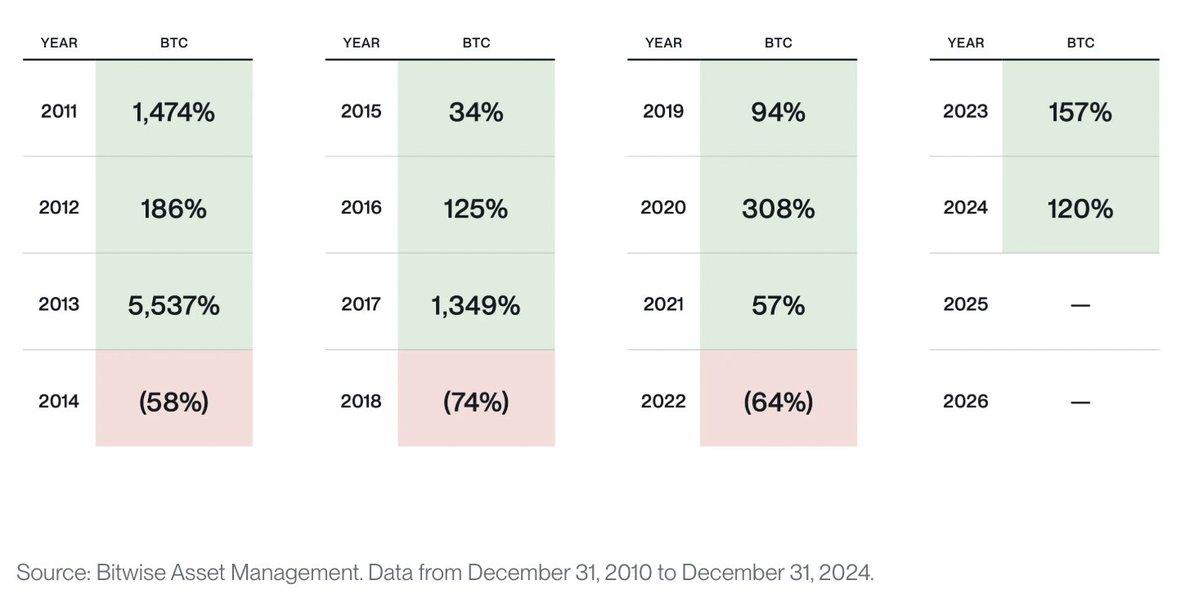
Bitwise's compilation of BTC annual return data
In broad terms, each cycle of growth and decline is driven by the same forces that drive the broader economic cycles of expansion and contraction.
Typically, a market cycle begins with a catalyst that brings new investors and new capital into the market.
For example, in 2011, it was the creation of the first Crypto companies and platforms (such as Coinbase, Mt.Gox, etc.) that provided support for individuals to buy BTC.
Once a bull market is underway, the Crypto market gains its own momentum:
Rising prices attract widespread attention and more capital flows in.Investors eventually become extremely greedy and leverage up.Bubbles and fraud then emerge.Sometimes, legacy infrastructure ultimately collapses under the immense pressure.
What ultimately happened in different Crypto cycles?
In 2014, the Mt.Gox collapse;
In 2018, the US SEC cracked down strongly on ICOs.
Regardless of the reason, the correction is painful, accompanied by rapid deleveraging and despair. But ultimately, the Crypto market experiences a new breakthrough, ushering in a new cycle.
The current cycle stems from the massive deleveraging that occurred after the industry scandals in 2022: the FTX collapse, the downfall of Three Arrows Capital, the bankruptcy of Genesis, the collapse of Blockfi, and the implosion of Celsius.
The catalyst event for this upward cycle occurred on March 10, 2023, when Grayscale convincingly won the opening argument in its "lawsuit against the SEC over the approval of a BTC ETF".Although the final ruling will not be made for several more months, from that moment on, the arrival of a BTC ETF became inevitable. This also means that Crypto has officially entered the mainstream.
Sure enough, the BTC spot ETF was officially launched in January 2024, setting the stage for the subsequent price trajectory - the market price rose as expected.
2026 May Be a Correction Point, Early Signs of Leverage Emerging in the Industry, and Washington Becoming the Crypto Hub
Within the classic four-year cycle pattern, we will be prepared for a correction in 2026.
To be frank, I do see early signs of leverage building up in the Crypto industry, as some companies are issuing debt to buy BTC, and the growth rate of "BTC-backed loans" is rising rapidly.
However, this cycle has seen some new changes in the Crypto industry: Washington's (referring to the US government) attitude towards Crypto has shifted.
Crypto executive orders have become a factor to be considered: previously, Washington had referred to Crypto as a "national priority", which to some extent laid the foundation for a regulatory framework. Additionally, the US government may plan to establish a "national-level Crypto reserve".
Washington's attitude change has paved the way for mainstream institutions to enter the Crypto currency market in a big way.
But the reality is: mainstream investment institutions will not take action in line with the expectations of the Crypto native community.
Washington's attitude change is the result of years of effort by multiple parties, not a sudden shift in a few months.
Under the best-case scenario that has already been determined, the Crypto industry will still need about a year to align with the new Crypto regulatory framework, and large companies and institutions will also need the same amount of time to prepare for the transition from planning to action.Wall Street and mainstream investment institutions are more like giant oil tankers that are difficult to turn quickly, rather than agile speedboats that can change direction rapidly.If these institutions only start to truly turn to Crypto next year, will the "Crypto Winter" we expected to arrive in 2026 actually materialize as predicted?
To be honest, I'm not sure.After all, the capital size of traditional financial institutions is truly massive.The BTC spot ETF has brought hundreds of billions of dollars in capital and new investors into the Crypto currency market; in contrast, the changes led by Washington will bring trillions of dollars in liquidity.
Since the early stages, the Crypto market has always followed the four-year cycle pattern. But the changes brought by Washington (the US government) will lead to a new wave that will continue to play a role in the next decade.
My personal guess is that when the classic "deleveraging action" begins next year, this emerging, larger trend is likely to submerge it.
What does this mean?
This does not mean that the traditional "four-year cycle pattern" has completely disappeared. Undoubtedly, leverage will still be generated; excess debt and liquidity will still appear; bad actors, fraudsters, and poor performers will still emerge in the market.
At some point, these things and people may be weeded out, bringing more liquidity into the market.
Furthermore, I personally estimate that any correction will be shorter and less severe compared to the past few years.
Undoubtedly, we are in a new era of Crypto mainstream, an era that is both exciting and intriguing.