How many publicly traded blockchain companies are there?
There are 46 notable publicly traded blockchain companies. As expected, most blockchain companies are listed on the Nasdaq, with 24 companies. The largest to date is the cryptocurrency exchange Coinbase (COIN), with a market capitalization of $74 billion. Bitcoin mining company Mara Holdings (MARA) is close behind, but with a market value 10 times lower, at $7 billion.
The Nasdaq Stock Exchange is the most concentrated exchange for tech companies. In the Nasdaq 100 (NDX) index, 59.6% of the 100 companies with the highest market capitalization, excluding financial companies, come from the IT industry.
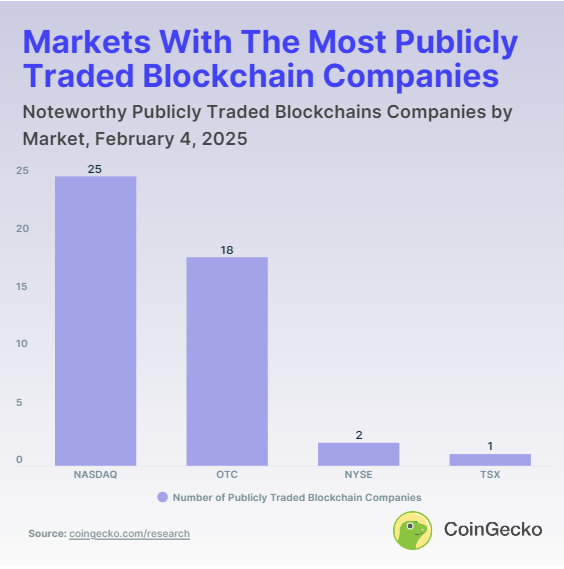
The smallest publicly listed blockchain company is the blockchain industrial company for the metaverse (BCII), but it is only traded over-the-counter (OTC). In the decentralized over-the-counter market, there are 18 blockchain companies available for trading.
On the New York Stock Exchange (NYSE), only two listed companies are involved in the cryptocurrency sector, namely Bit Mining (BTCM) and Hyperscale Data (GPUS). The latter is an example of a trend, as it has been renamed from the cryptocurrency mining-focused Ault Alliance (AULT) to GPUS, becoming a provider of AI data center infrastructure.
Including Galaxy Digital (GLXY) led by Michael Novogratz, 46 publicly traded blockchain companies are listed solely on the Toronto Stock Exchange (TSX).
Notably, there are 47 blockchain companies listed on various Canadian exchanges, from the TSX and TSX Venture to the CSE and Cboe. However, the largest companies are also listed on the Nasdaq, and most other companies have a market capitalization of less than $10 million or are ETFs. Therefore, Galaxy Digital listed on the TSX is the only notable non-penny stock exception.
Which industries do most blockchain companies belong to?
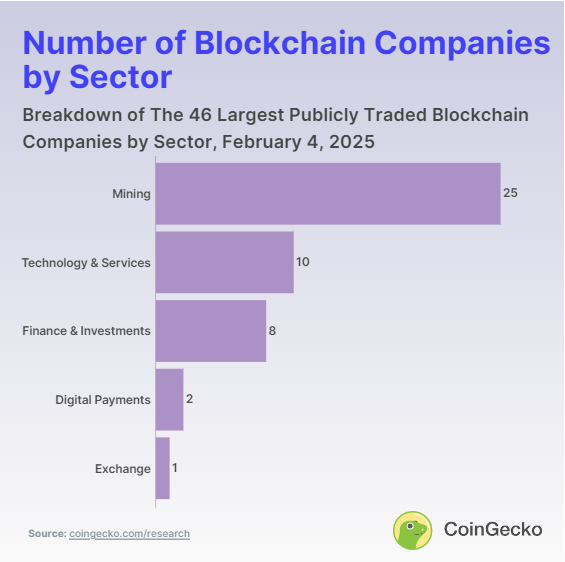
Predictably, among the 46 largest publicly listed blockchain companies, the majority, 25 companies, focus on cryptocurrency mining business. Although some companies have expanded their business from mining to AI and Web 3 solutions, such as Bluesky Digital Assets, they can broadly be divided into five industries.
After the fourth Bit halving, the Bitcoin mining reward decreased from 6.25 BTC to 3.125 BTC, and the trend towards diversification has clearly accelerated. Leveraging their existing server scaling and infrastructure maintenance expertise, Bitcoin mining companies are moving into high-performance computing (HPC) and AI data centers.
The most prominent examples of this trend are the previously bankrupt Core Scientific (CORZ), Hut 8 Mining (HUT), TeraWulf (WULF), HIVE Digital Technologies (HIVE), and CleanSpark (CLSK). However, in terms of the total market capitalization of publicly listed companies in the cryptocurrency sector, a few companies dominate.
Blockchain company market capitalization vs. total cryptocurrency market
Among the 46 publicly listed blockchain companies, Coinbase (COIN) is the only one representing the exchange industry, and as mentioned, its market capitalization is 2.2%. However, Coinbase's market value of $71.2 billion dwarfs all other companies, with only MicroStrategy (MSTR) having a larger market value of $97.7 billion.
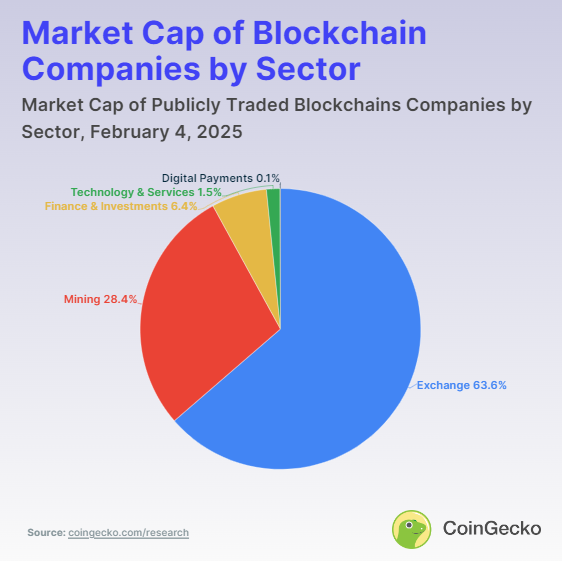
If we exclude MicroStrategy's market value, as the only company that has adopted a debt leverage strategy to accumulate BTC and leverage BTC price fluctuations, the market value is $121.9 billion.
While Coinbase is the sole slice in the blue pie chart, with a market value of $71.2 billion, accounting for approximately 63.6%, the mining sector's stock value is $31.7 billion, primarily dominated by MARA ($7 billion), CORZ ($4.2 billion), RIOT ($4.7 billion), and CLSK ($3.4 billion). The market values of other mining companies are all below $3 billion.
Similarly, in the $7.1 billion financial and investment sector, Galaxy Digital accounts for the majority at $6.7 billion. Overall, the total market capitalization of publicly traded blockchain companies is $199.5 billion. This represents only 5.8% of the total cryptocurrency market value of $3.45 trillion.
Methodology
Data as of February 3, 2025. To determine the number and market value of listed companies, we used public data from North American over-the-counter and institutional exchanges. Canadian exchanges primarily hold ETFs, which were excluded as they are not structured as companies but as investment funds. Although there is some overlap with US exchanges, Galaxy Digital is the only notable exception as a non-penny stock with a share price well above $5.