Author: BUBBLE
In January 2025, the emergence of DeepSeek R 1 caused a stir in the AI world, and it also truly transformed the Crypto AI ecosystem. In the past cycle, Crypto AI mainly revolved around AI Agents, but DeepSeek R 1 and its open-source strategy have completely changed the rules of the game: extremely low training costs and breakthrough adaptive training methods have made the vision of AI industry decentralization no longer just talk, but a tangible reality. This transformation has far-reaching impacts. The total market capitalization of the Crypto AI market has shrunk significantly, and many AI tokens have experienced a 70% correction, but is this really a crisis? Or does it mean a thorough reshuffle of Crypto AI? Is DeepSeek the "terminator" that shatters the Crypto AI narrative, or the "disruptor" that accelerates its entry into the era of practical application?
The Rapid Growth of DeepSeek
The development of DeepSeek can be traced back to 2021. At that time, the quantitative trading hedge fund Phantasy began to massively recruit AI talents, which was not common for quantitative companies to shift to AI. The majority of the recruits were AI researchers exploring frontier directions, including large language models (LLMs) and text-to-image models. Although there were rumors that Phantasy's transformation was to better utilize the company's idle GPU resources, the main reason was likely to seize the high ground of frontier AI technologies such as large models.
By the end of 2022, Phantasy had attracted more and more top AI talents, mainly from Tsinghua University and Peking University students. Inspired by ChatGPT, Phantasy CEO Liang Wenfeng decided to venture into the field of general artificial intelligence and established DeepSeek in early 2023. However, as AI companies like Zhishitu, Yuezhi, and Baichuan were rapidly rising, DeepSeek, as a pure research institution without a star founder, faced great difficulties in independent financing. Therefore, Phantasy chose to spin off DeepSeek and fully fund its development, despite the high risk of this decision. DeepSeek did not need to bear the profit commitment or valuation pressure from investors, and it had a relatively sufficient GPU resource reserve, allowing the team to focus on technical breakthroughs. This group of young people with a spirit of innovation could charge ahead in this promised land, and at this moment, DeepSeek was more like a research institute than a company.
Just like OpenAI in its early days, no one would have thought that a company researching robot hands playing Rubik's cubes would eventually develop ChatGPT, and no one could have imagined how Phantasy, a quantitative company, would use DeepSeek to burst the current AI bubble, taking only 2 years compared to OpenAI's 7 years. In November 2023, DeepSeek released its LLM with 67 billion parameters, with performance close to GPT-4. In May 2024, DeepSeek-V2 was launched, and in December of the same year, DeepSeek-V3 performed on par with GPT-4 and Claude 3.5 Sonnet in benchmark tests. DeepSeek's rapid technological leaps were not due to the company's financial strength or high academic qualifications, but rather the result of a technological singularity, where "the impact of ChatGPT on the AI industry" accelerated the occurrence of small and large singularities in any soil that could satisfy the imagination, until the next critical singularity appeared.
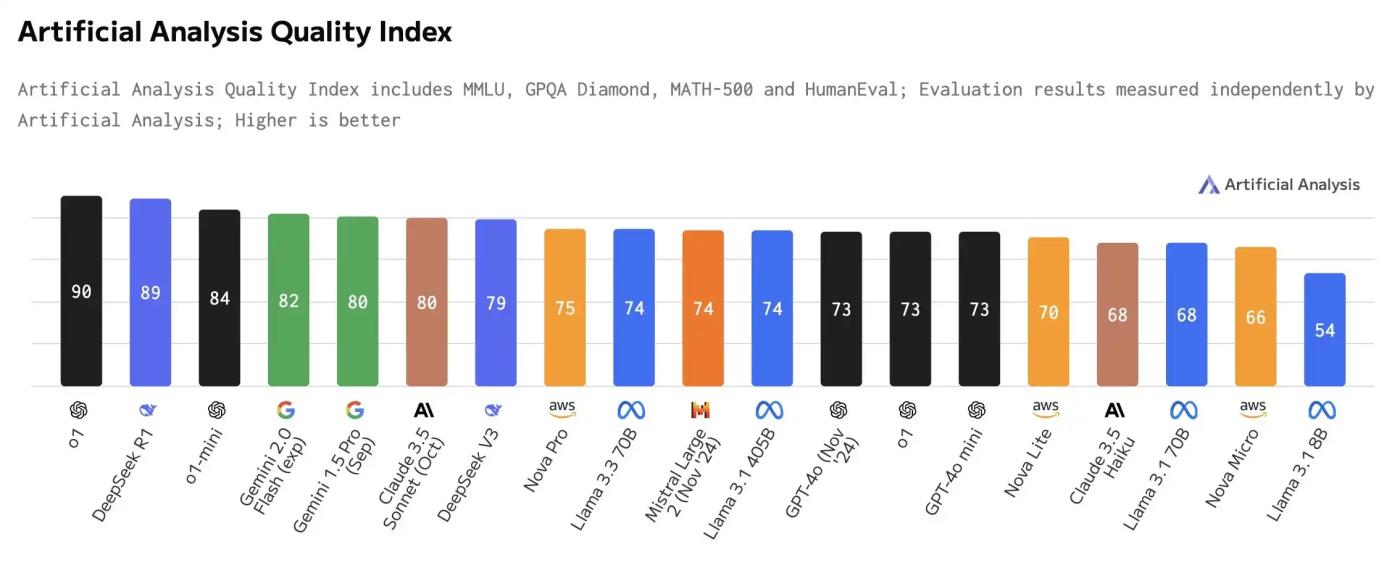
Finally, in January 2025, DeepSeek accelerated through the singularity, using the first-generation large model with reasoning capabilities, DeepSeek-R 1, to open the door with training costs far lower than ChatGPT-O 1 and outstanding performance.
Using Open Source to Distribute the Key to the Stargate to the World
One day after the release and open-sourcing of DeepSeek R 1, former US President Trump officially announced the start of a $500 billion "Stargate" program at a White House press conference. A joint venture called Stargate, formed by OpenAI, SoftBank, Oracle, and the investment firm MGX, was established to build new AI infrastructure for OpenAI in the United States.
This level of investment is even comparable to the "Manhattan Project," with the apparent intention of using algorithmic stacking to push closed-source AI to its peak, monopolizing the AI market to ensure the leading position of the domestic AI industry in the United States. However, the plan's initiators could not have anticipated that just a few days later, this open-source model from across the ocean would simply not open the door, not only bringing a hammer to smash the wall, but also distributing hammers to others.
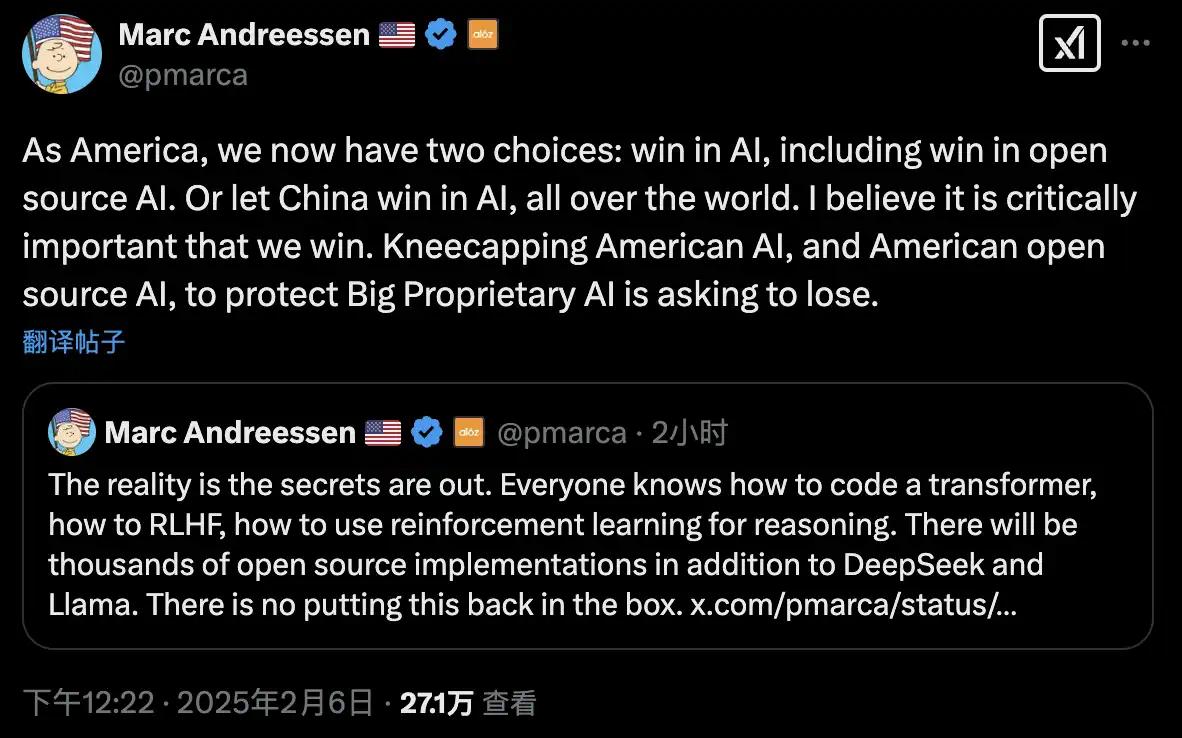
As an open-source model that can match the top closed-source models, DeepSeek's entirely new training architecture has triggered a chain reaction, making it difficult for closed-source AI to move forward, as closed-source models that cannot keep up with DeepSeek R 1 will be directly eliminated by the capital market. Even Marc Andreessen, the founder of a16z, an investor in OpenAI, publicly stated that more attention should be paid to open-source AI rather than closed-source AI. Within the industry, whether supporting the potential of AGI or supporting AI only as an upgraded version of the SaaS industry, it is widely recognized that the drawbacks of closed-source are far greater than those of open-source, be it black boxes, industry monopolies, information security, or capital control of attention, any of which is a highly dangerous direction of development.
Although some industry insiders have doubts about the large data sets required for V3's Mixture of Experts (MoE) technology, suspecting the use of OpenAI's models for distillation, and the massive hardware resources required for the reinforcement learning (RL) method in R 1, suspecting the use of an excessive number of training chips, these doubts do not affect the industry-wide structural reform brought about by DeepSeek.
The open-sourcing of DeepSeek R 1 has broken the closed-source large model business logic of OpenAI, using the logic of self-evolution to avoid the massive investment in computing power and data annotation required by the traditional paradigm. Although the model training is still a black box, the cost of the black box has been greatly reduced.
At the AI hardware level, DeepSeek's open-sourcing of V3 directly challenges Nvidia's market dominance. Nvidia's GPU moat is largely due to its underlying parallel computing platform and programming model CUDA, as well as its extensive ecosystem and a large enough developer base, making the learning cost for training with non-Nvidia chips too high. The high purchase thresholds and political restrictions have also led to a fragmentation of global AI development.
For us, in the short term, the AI sector in the US stock market has shrunk significantly, and the total market capitalization of Crypto AI is almost cut off at the knees, with the market entering a bear market. But in the long run, the most recognized AI industry is moving towards an open-source, transparent, and decentralized development path. From any perspective, the integration of Crypto and AI will become more and more seamless.
The Redemption of Crypto AI, Forge Ahead! Forge Ahead! Advance by Any Means Necessary
In this round of Crypto AI bubble burst, many AI concept tokens have experienced a 70% correction, and the Crypto AI market has shrunk significantly. Some have jokingly said, "You can train a large model for $5.5 million now, so why buy Crypto AI tokens with such high market caps?" It is true that Crypto is a market dominated by capital rather than products, and 90% of AI tokens are meaningless.
However, as the crypto market regulatory system improves, the crypto market is still the most suitable soil for small and medium-sized AI companies to start businesses. The 1/100 large model cost and training methods brought by DeepSeek compared to ChatGPT O 1 will lead to an ecosystem growth of more than a hundredfold compared to the current market.
To put it directly, what DeepSeek brings to Crypto is decentralized model training, which may make projects like Depin more reasonable, making the training process and information feeding more transparent, and the reward mechanism for data contributors more reasonable, making the settlement between the supply and demand of model training easier. The more than hundredfold development of the AI industry's surrounding ecosystem has also enriched the downstream industry of Crypto AI, and as soon as one truly breaks through the market, external capital will naturally flow back into Crypto. The market has long been suffering from PVP, and the series of celebrity coin harvesting after TrumpCoin has disrupted the originally abundant liquidity and positive feedback balance in the AI market. Therefore, the bubble burst triggered by DeepSeek is actually a greater positive.
Here is the English translation:Many Crypto AI projects have already integrated or are about to integrate DeepSeek, including ElizaOS, Argo, Myshell, Build, Hyperbolic, Nillion Network, infraX, and more. Some of these projects have even optimized their products directly through DeepSeek.
Myshell
Myshell's technical team integrated V3 and R 1, as well as the image generation model Janus-Pro, into their chatbot and application plugin development process in just half a day. As a project that has always insisted on polishing its products in the blockchain space and has even gained a reputation in Web2 AI products but has been reluctant to issue tokens, the open-sourcing of DeepSeek will bring good news to Myshell's users in terms of costs, and the lower costs will bring more Agent developers to the already well-developed Myshell product.
Argo
Argo's developer Sam Gao had already DeepSeeked the important functions of Argo in the initial product design stage. As a workflow system, Argo has integrated the LLM as a standard DeepSeek R 1, and has assigned the original workflow generation work to DeepSeek R 1. Due to the nature of the Workflow, the Token consumption and context information volume will be extremely large, with an average of >= 10k Tokens. Argo has also integrated the Chain-of-Thought (CoT) into its Workflow thinking process. After the open-sourcing of DeepSeek, not only has the cost of the workflow product been reduced, but users' privacy and security can also be guaranteed by local deployment of the LLM in Argo.
Before the release of DeepSeek R 1, Argo had already integrated its preliminary training logic Chain-of-Thought (CoT) into the Agent Workflow production process. Especially for tasks such as meme trading and market trend analysis, Argo has customized its workflow using the Graph-of-Thought (GoT), which is a novel approach that constructs reasoning as a graph with nodes representing "LLM thoughts" and edges representing the dependencies between these thoughts.
Given that Argo has chosen GoT (the only Crypto AI Workflow currently using this model), it has achieved a more reliable and transparent process. This innovative approach has directly impacted the security and trustworthiness of transactions on the Argo platform. Integrating the thought graph (GoT) into the Web3 AI agent has placed Argo at the forefront of AI-powered crypto trading. The structured reasoning of CoT not only enhances the security of financial transactions, but also ensures transparent and reliable decision-making, which is crucial in decentralized finance (DeFi).
Hyperbolic
Hyperbolic Labs has also announced that it will host the DeepSeek-R 1 model on its GPU platform, allowing users to rent Hyperblic GPU resources to run the DeepSeek-R 1 model locally or in a designated data center without having to send sensitive data to DeepSeek's servers. This approach not only ensures data privacy, but also allows users to leverage the excellent reasoning performance of the DeepSeek model, and through Hyperbolic's decentralized computing network, users can obtain the efficient inference capability of the DeepSeek model at a lower cost, which will be a competitive solution for startups, solo entrepreneurs, or simply efficient AI users.
This round of bubble burst has indeed dealt a heavy blow to the Crypto AI market, with many AI Tokens losing their speculative value. However, the essence is that DeepSeek is not eliminating Crypto AI, but forcing the market to evolve faster. After DeepSeek R 1, the future of Crypto AI will no longer rely solely on speculation, but will need to be reconstructed around decentralized AI computing, economic incentive mechanisms for model training, fair distribution of AI resources, and practical product development. The real challenge is whether Crypto can leverage the technological revolution brought by DeepSeek to build a truly valuable AI ecosystem, rather than just creating concepts and speculation.
This is not the end, but an evolution. Crypto AI needs to move forward faster and more aggressively. / Accelerate