1. Concept of U Card
1.1 U Card
U Card is a tool that provides financial services for cryptocurrency investors. The usage of U Card is similar to a bank card, where the cardholder can directly consume or withdraw cash through the U Card without the need to pre-exchange the virtual currency for fiat currency.
U Cards can be divided into two main categories: physical U Cards and virtual U Cards. Physical U Cards such as Mastercard U Card and UnionPay U Card have a wider acceptance range and higher acceptance rate. Virtual U Cards such as Dupay are more commonly used for e-commerce or international payments, which are more convenient and flexible, but cannot be used for cash withdrawals at ATMs.
The common U Card issuance models include the following:
(1) Direct issuance by banks. Banks utilize their own payment networks and compliance frameworks to provide users with stable cryptocurrency payment solutions.
(2) Banks collaborating with cryptocurrency companies to issue U Cards. In this case, banks provide the traditional financial infrastructure, while third-party companies are responsible for cryptocurrency management and conversion.
(3) Independent issuance by professional cryptocurrency payment companies. Some companies focused on cryptocurrency payments collaborate with payment networks like Visa or Mastercard to independently issue U Cards.
(4) SaaS model collaboration for issuance. This refers to third-party payment companies providing U Card issuance platforms to merchants or other financial service providers through the SaaS (Software as a Service) model.
1.2 Mechanism of Using U Card
Using U Card is quite convenient, which is one of the important reasons for its widespread acceptance. We can understand the usage mechanism of U Card in two steps.
(1) Funding: Users deposit USDT into their wallet, and then transfer the USDT from the wallet address to the U Card address. At this point, the U Card operator will settle the USDT into the corresponding fiat currency.
(2) Withdrawal or Consumption: Users can use the U Card to withdraw cash from ATMs around the world, or directly use the U Card to pay for expenses, in which case the payment is made in the converted fiat currency, not USDT.
2. Reasons for the Popularity of U Card
2.1 Protecting Personal Privacy
Web3 users often place a greater emphasis on personal privacy, including transaction privacy, and hope to maintain anonymity when making payments or transfers. U Card provides users with an excellent privacy protection mechanism. On the one hand, virtual U Cards usually do not require real-name registration, allowing users to purchase or deposit anonymously; on the other hand, although physical U Cards may require a certain degree of KYC (Know Your Customer) authentication, the amount of personal information required is significantly less than that needed for transactions through traditional banks, greatly reducing the risk of personal information exposure.
2.2 Simplifying Payment Process
U Cards are often able to provide instant payment and settlement, avoiding the potential time delays associated with traditional bank transfers, and do not require pre-exchanging USDT for fiat currency before use, making them highly convenient. In addition to traditional POS payments, U Cards can also be used for payment through digital wallets, QR code payments, and other mainstream payment channels, providing greater flexibility.
2.3 Reducing Cross-border Payment Costs
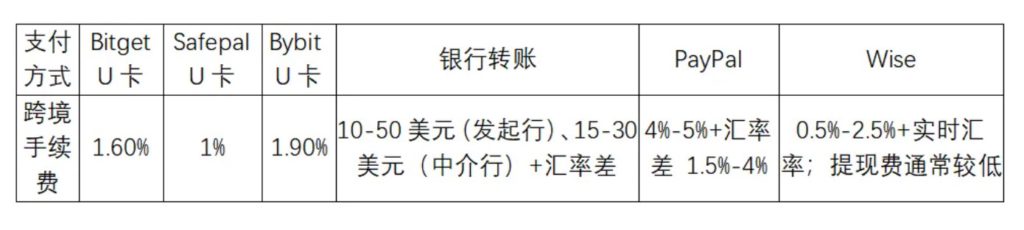
The transaction fees of U Cards are often significantly lower than traditional payment channels, especially in the case of cross-border payments. The following compares the cross-border transaction fees of various payment methods:
3. Potential Risks of U Card
3.1 Tax Risks
Due to the support for anonymity or less stringent real-name requirements, some users hope to avoid taxes through U Cards, such as using U Cards to conceal the source of income and reduce their tax liabilities. However, this tax avoidance behavior through U Cards is actually not feasible. First, although U Cards have a certain degree of anonymity, most U Cards still rely on international payment networks (such as Visa, Mastercard, etc.). These payment networks will meticulously record the details of each transaction, including the transaction amount, merchant information, transaction time, etc. Therefore, tax authorities can still track the flow of relevant funds through these transaction records.
Secondly, for cross-border transactions, tax authorities can also track the cross-border flow of funds through foreign exchange monitoring systems, bank information exchange, and other means.
Many countries have signed the Common Reporting Standard (CRS) for the automatic exchange of tax information, making cross-border capital flows more transparent. In this way, tax authorities can also obtain transaction information related to U cards. Finally, in actual use, payment platforms may also conduct strict real-name authentication reviews for large transactions. If users are involved in frequent large-scale capital flows, the platform may require proof of the legality of the source of funds and other additional information. Therefore, the behavior of tax avoidance through U cards is actually not feasible and may also result in tax audits and penalties.
3.2 Legal Risks
Using U cards also requires attention to certain legal risks. For example, in some countries with strict foreign exchange management, although U cards do not set personal access limits to U, capital outflows exceeding the foreign exchange quota will also trigger foreign exchange management regulations. If discovered by the foreign exchange management agency, administrative fines will be imposed, and even criminal involvement may occur.
Additionally, the legal status of cryptocurrencies is still unclear in some countries, and some countries completely prohibit the use of cryptocurrencies. In this case, using cryptocurrency U cards for transactions may also be considered illegal. Therefore, before using U cards, users should understand the basic compliance requirements of the country and region. Furthermore, users should not use U cards as a tool for illegal and criminal activities. For example, if users use U cards for high-frequency, large-amount transactions, or assist others in cashing out, they will also be identified as illegal operations or money laundering activities, facing criminal penalties.
4. Conclusion
In summary, U cards, with their strong privacy, convenient payment, and low handling fees, provide an excellent off-chain payment solution for cryptocurrency investors, winning the favor of many. However, U cards are not perfect, and U card users still face potential tax risks and legal risks that must be treated with caution, otherwise the consequences will be disastrous.