Everything has a traceable origin. Among Musk's friends in Silicon Valley, many understand that his acquisition of Twitter is to prepare for a greater cause. "The current atmosphere is that people hope Musk can do the same thing to the US government," an informed source told Time magazine in November. Senior officials from Trump's first administration had also devised their plan long before the election and published a 900-page report called "Project 2025". One of the main authors of the project, Russell Vought, said in a speech two years ago that he hoped the civil servants would be "traumatically impacted" by the envisioned purge, "We want their funding to be cut off," he said. "We want to traumatize them."
During the campaign, Trump swore he was not involved with the plan, "It's inappropriate for them to have put out a file like that," he told Time magazine in November. "There are some things I strongly object to." But once in office, he chose Vought to head the White House Office of Management and Budget, which is now closely collaborating with Musk to implement key parts of Project 2025. So far, according to Time magazine's analysis, Trump's frenzied initial actions during his presidency have nearly achieved two-thirds of its provisions.
Musk has never hidden his intentions. Two weeks after the election, he co-wrote an article in The Wall Street Journal, promising that his team would help Trump "hire a lean team of small-government crusaders" who would work to "drastically reduce the number of federal bureaucrats". The recruitment drive began shortly after the election, recruiting from Musk's followers in Silicon Valley, some of whom had just graduated from college and were ready to be dispersed across Washington.
The DOGE personnel manager appointed by Musk is aerospace engineer Steve Davis, who previously led Musk's cost-cutting efforts at Twitter. In late December, as the presidential transition unfolded in the White House, Davis attended a series of meetings with members of the Biden administration. Democratic staffers noticed he was very interested in an obscure branch of the White House, the US Digital Service (USDS). Davis wanted to know how it operates, who it reports to, and what it can access.
The US Digital Service was established in 2014 to work with federal agencies to improve computer systems and databases. It has a map of the government's technology infrastructure and a touchpoint with the tech officials of almost every federal agency. This makes it the perfect venue to host Musk's team. By controlling the USDS, Musk's team can access the federal government's critical systems and implement massive layoffs and budget cuts, like "poison" flowing through the "veins" to gradually weaken the entire government's operations.
The power of the US Digital Service began on Inauguration Day. One of Trump's earliest executive orders renamed it the "Musk US Service", cleverly retaining the office's acronym. The order also ensured the new entity would report directly to the White House Chief of Staff. Since then, the office has set up outposts at the State Department and Treasury. It has begun accessing personnel computer systems, firing contractors, and blocking payments to them.
Musk also sent a team to the Office of Personnel Management. The office has records of 2.1 million workers, nearly every federal employee's email address, and tracks $59 billion in annual federal healthcare premiums and $88 billion in annual federal pension payments. According to a source familiar with these actions, the move to issue "mass buyout offers" to government employees originated from Musk's team within the Office of Personnel Management. (Both the Musk team and the White House declined to comment.)
Next, the Musk team began cutting funding to the Office of Personnel Management itself. Brian Birdwell, who recently served as vice president of human resources at Musk's aerospace company, told the Office of Personnel Management's career executives that the goal is to cut 70% of its staff, which would weaken its healthcare benefits and retirement plan teams, a current OPM official said.
Some senior OPM leaders have been locked out of critical databases, the official said, with political appointees able to access systems including corporate human resources integration without the standard safeguard protocols intended to protect such private information. The system includes data such as pay grades, years of service, Social Security numbers, birth dates, and home addresses.
Within days of Trump taking office, the White House ordered a freeze on federal spending — from foreign aid to public health programs, and everything in between. The government said the freeze would only be lifted when agencies aligned with the president's agenda: cracking down on immigration, ending diversity efforts, and halting investments to reduce the environmental impact of fossil fuels. Facing lawsuits, the White House rescinded the order.
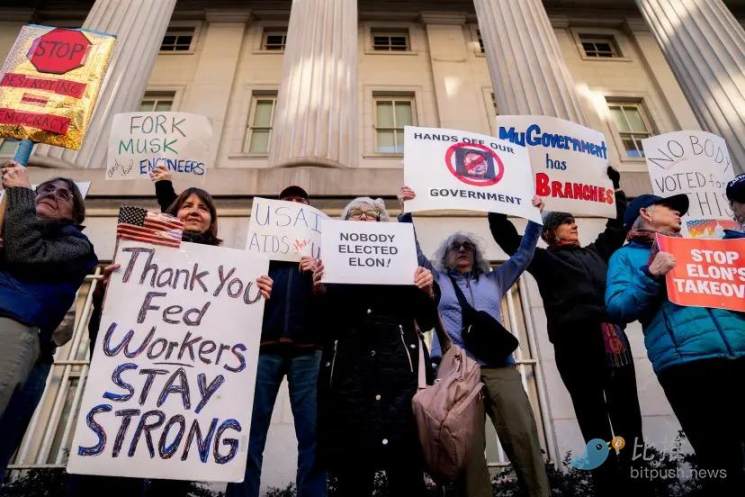
Protest outside the US Treasury Department building in Washington, DC on February 4.
Musk's layoff actions continue, with Trump continuing to give him his blessings. "Musk can't do anything without our approval — and he won't do anything," Trump told reporters in the Oval Office on February 4. "We'll give him approval at the right time," he added. "In the wrong places, we won't."
Here is the English translation, with the content inside <> retained and not translated:Some believe that Trump may restrain Musk's actions to prevent him from being too radical, but the civil servants are not waiting for this to happen. In northern Virginia, where tens of thousands of federal government employees and military personnel live, the typical town hall meeting in the town of Leesburg, Virginia attracted dozens of people, and hundreds gathered on the night Musk shut down the U.S. Agency for International Development (USAID). "We've heard some strange stories," said local Democratic Congressman Suhash Subramanyam, who spoke at the event. Due to the large number of workers flooding his office, describing the Musk team's takeover actions, he instructed his staff to document these testimonies and assist the whistleblowers. Subramanyam told Time magazine that most of what they witnessed was "simply illegal." "We're almost being tested, and being goaded into suing or investigating."
Some lawsuits have indeed worked. The White House has complied with a court order to block its attempt to freeze billions of dollars in federal spending. A judge in a February 6 ruling delayed the final deadline for the government's offer to employees. Union representatives have sued the federal workers on behalf of the Musk team. Even Musk's usual worshipers have warned that he has gone too far. A February 4 Wall Street Journal editorial noted that "lawsuits are piling up," and "if Mr. Musk isn't careful, the courts will disrupt his project before it even gets off the ground."
On Capitol Hill, Musk's attack on the bureaucracy has sparked a battle between him and the Democrats that could determine the future of the government and the balance of power within it. On the afternoon of February 3, Maryland Democrat Jamie Raskin told a crowd outside USAID, "We don't have a fourth branch of government called Elon Musk." At the same time, Musk's team (DOGE) was trying to forcibly implement their plans inside USAID.
Jamie Raskin is right. But the agency employees listening to him on Pennsylvania Avenue are unsure whether they can keep their jobs, unable to judge how much power Musk has gained and whether he will make other government agencies submit to his will. One employee seemed particularly doubtful. Yes, she told Time magazine, the Constitution gives Congress the power of the purse. But Musk has already shown the power to deprive it of that power.
"There's only so much the Democrats can do," she said, unwilling to reveal her name for fear of drawing more attention from DOGE. Her official email account has been shut down, and she can no longer access her office desk. Like thousands of her colleagues and millions of Americans, she can only watch helplessly as Musk's actions unfold, wondering how far he will go, and what - if anything - can stop him?