Editor's Note: Jupiter announced a series of major initiatives at the Catstanbul conference, including acquisitions, AI funding, token buybacks and burns, as well as the launch of the cross-chain network Jupnet, demonstrating its ambition for vertical integration. This article analyzes its business strategy and explores how brand, community, and user experience determine value capture in a permissionless crypto environment, revealing the inevitable trend towards application integration.
The following is the original content (edited for easier reading):
Last month, Jupiter made a series of major announcements at its flagship Catstanbul conference. In summary - it was a lot of information. There were Burning Cats, acquisition announcements, and most importantly: Jupiter openly acknowledged that its ambitions go beyond its current ecosystem. In today's article, we will unpack Jupiter's latest business strategy and discuss why, given enough time, every crypto application that controls user access will ultimately choose vertical integration to maximize value capture. Let's dive in.
TL;DR
Acquisitions
Jupiter acquired a majority stake in the popular mobile trading app Moonshot, which generated $35 million in fee revenue after the Trump MEME coin frenzy. Jupiter also completed the full acquisition of the Solana DeFi asset management tool Sonar Watch.
Funding
Jupiter is collaborating with Shaw of ElizaOS to allocate $10 million to support AI developers launching through the Jupiter Launchpad.
Token Buybacks
50% of the Jupiter protocol's trading fees will be used to buy back JUP tokens.
Token Burns
3 billion JUP tokens (around $360 million) have been burned to reduce supply and lower the protocol's fully diluted valuation (FDV).
Jupnet
Jupiter plans to launch Jupnet, a cross-chain interoperability network, aiming to integrate the entire crypto ecosystem into a single decentralized ledger, maximizing user and developer experience.
Honestly, this is one of the most impressive product roadmaps and announcements I've seen in the past few quarters. The execution of the Jupiter team is top-notch, from their extremely detailed communication (Meow is basically tweeting long-form essays daily) to the high level of transparency they maintain with the community.
As a typical example:
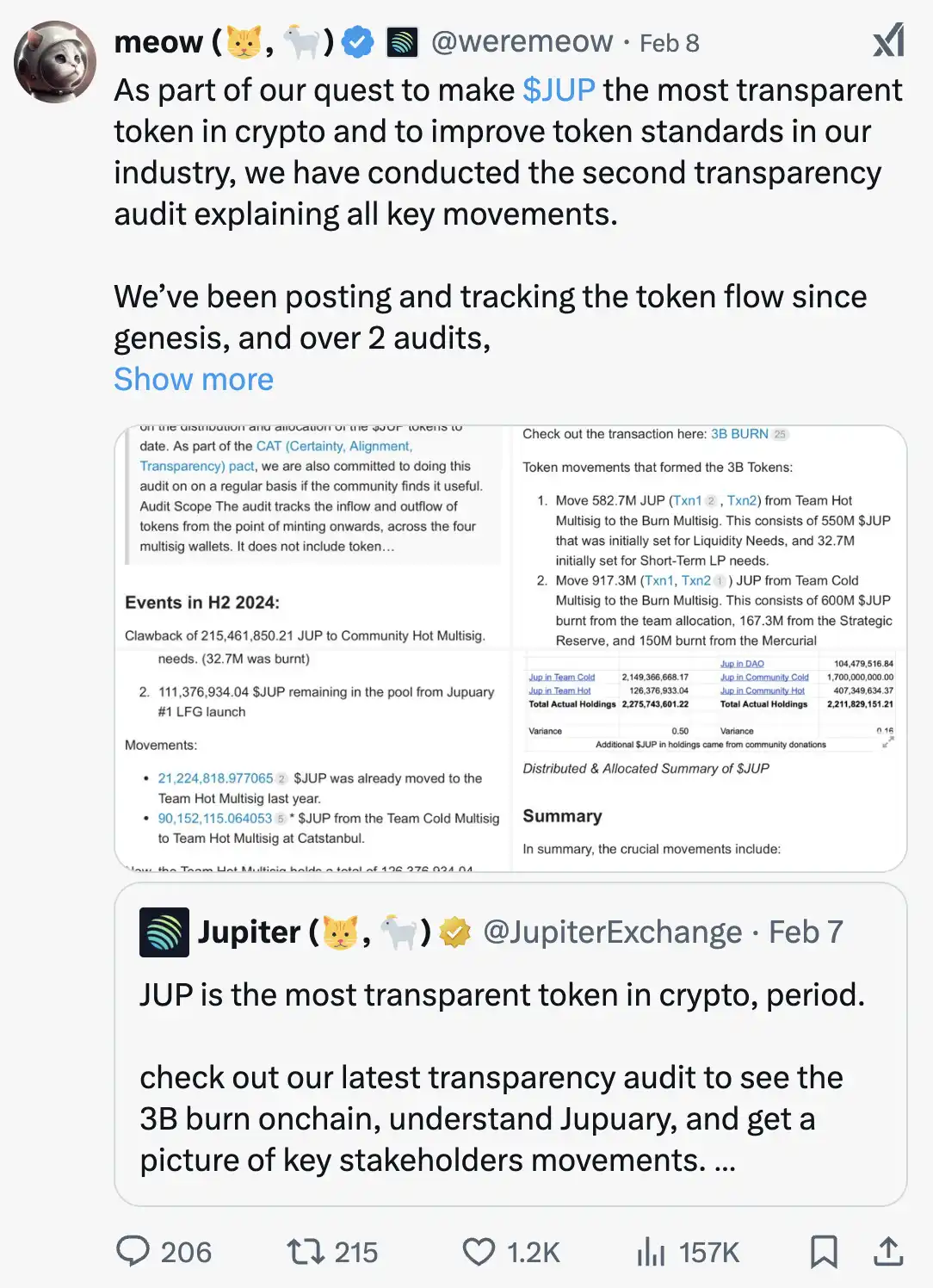
BlockBeats recently published a transparency audit report, detailing the team's key fund flows. "We have been publicly tracking token movements since genesis, and through two audits, have accounted for all token flows (except for 1 JUP), and have consolidated the tokens into verified wallets."
Read that last sentence again. For any crypto protocol that has completed a TGE, it is crucial to track the ownership of every single token to the best of their ability. Similarly, public companies maintain clear records of their stock ownership structure. In the crypto realm, where blockchains are permissionless, tracking ownership is relatively more challenging, but there are still tools that can help teams achieve a high degree of traceability.
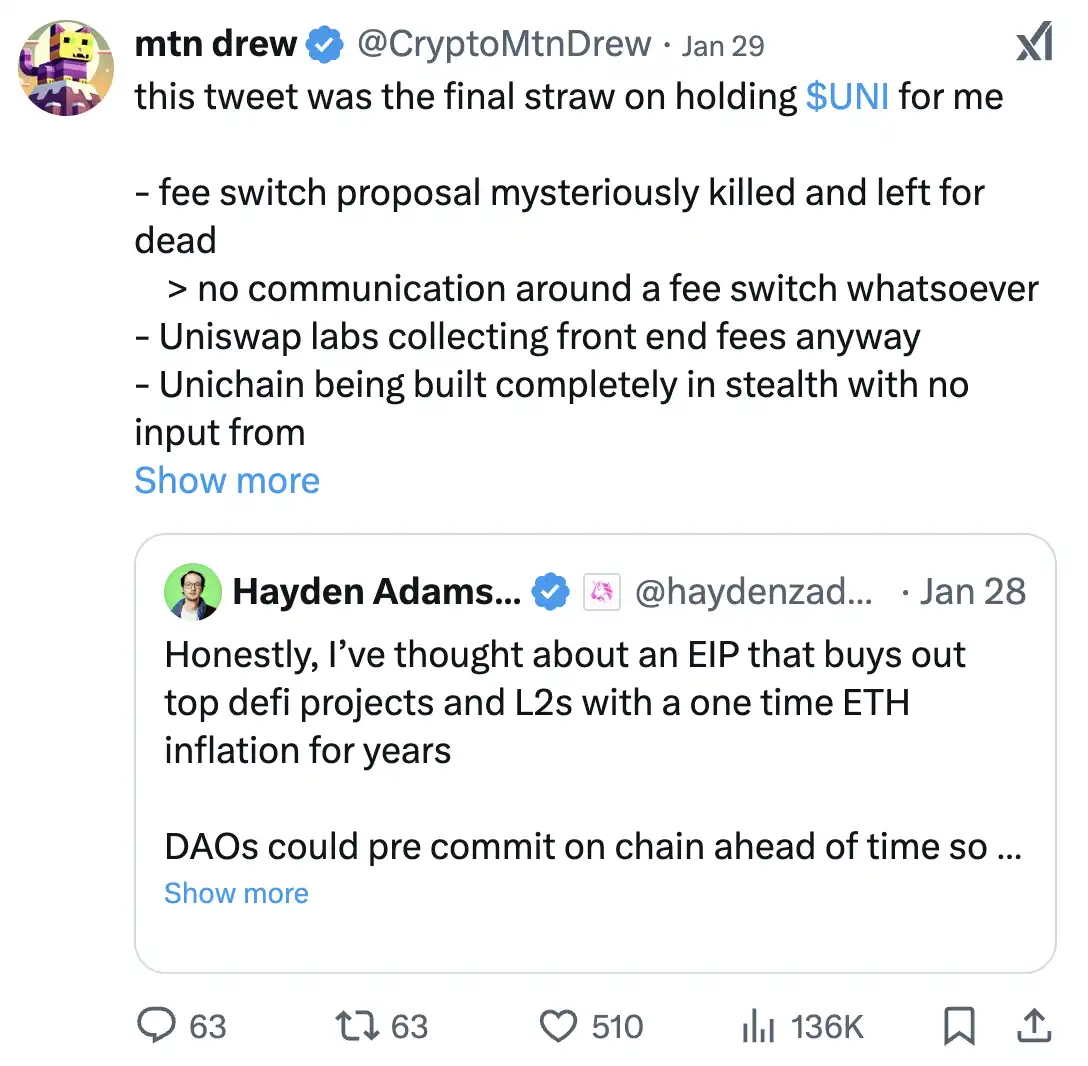
Meanwhile, Uniswap...
Every Application Will Vertically Integrate Given Enough Time
The core thesis of this article is that the business strategies in the crypto world fundamentally differ from traditional, permissioned environments.
Outside of the crypto industry, enterprises typically build "moats" through regulatory barriers, long-term B2B contracts, and proprietary innovations.
However, in the crypto industry, these "moats" largely do not exist, as the permissionless nature of blockchains allows anyone to build on top of existing products, and users can almost always choose alternatives.
Therefore, what truly matters are brand, user experience, and community, as the industry matures, we will see more experienced entrepreneurs entering the crypto space, building on top of existing infrastructure and launching vampire attacks on industry incumbents.
Ironically, this is exactly what Deepseek is currently doing to OpenAI.
Ultimately, in the crypto realm, the "moats" will evolve into the following three points:
· Brand → Users trust you
· Genuine Community → Users want to be part of your organization and have real ownership (through revenue sharing)
· User Experience → Users love your product
Aggregation Strategy is Wise in a Permissionless Environment
Prior to Jupiter's success, many were skeptical of the aggregation model, especially in the EVM ecosystem, where the market performance was not impressive. For example, 1inch failed to surpass Uniswap's market cap, as most users still preferred to use Uniswap directly (too lazy to switch) or other MEV-friendly DEXes like CoW Swap.
However, in the Solana ecosystem, Jupiter managed to convince users that it provided the best trading experience, successfully aggregating traffic and capturing value.
Honestly, I'm not sure when this shift happened. I remember using Orca and Raydium during the 2020-2021 DeFi Summer, and also trying Jupiter's early version. If my memory serves me right, by the end of DeFi Summer, the user experience of Orca and Raydium had become quite poor, due to factors like:
· Lack of unified token standards (e.g., multiple bridged USDC versions)
· UI performance issues
This poor user experience was still visible even a year later.

Jupiter used to show the optimal trade paths to demonstrate its superior exchange rates. In hindsight, this was a very smart move, as there was no clear DEX market leader in the Solana ecosystem at the time. Even though Raydium had the highest market share, its market dominance was far from the level of Uniswap on Ethereum.
Excellent Business Strategy and Operations
In essence, Jupiter executed better on the core business - providing the optimal token swap experience for Solana users. Many protocols have attempted similar strategies in the EVM ecosystem, but with limited success. Additionally, the Jupiter team was initially formed by Meow, who led the Racoon Dev group, meaning they could maintain operations with a small number of engineers at low cost during the bear market, minimizing capital consumption.
Not all successful startups need a "sexy startup angle." Many successful crypto entrepreneurs started as simply running a development studio. This "traditional service business" can teach extremely efficient cost management skills and help founders identify market opportunities in a targeted manner.
By 2024, this savvy business acumen was fully demonstrated in the Jupiter team.
Within just 12 months, Jupiter acquired 5 teams:
· Moonshot: Acquired the mobile-first MEME trading platform
· SonarWatch: Acquired the on-chain asset management tool
· Ultimate Wallet: Acquired the self-custody wallet
· Coinhall: Acquired the decentralized trading terminal
· SolanaFM: Acquired the blockchain explorer

Pardon my bluntness, but this is a genius-level move. Some of the acquired projects were facing fierce competition and market challenges, making them excellent acquisition targets. And without any inside information, I wouldn't be surprised if these acquisitions were primarily done through JUP tokens. Given the current JUP FDV, the Jupiter team has undoubtedly expanded their footprint at a low cost and onboarded a talented pool of developers.
Conclusion
This line of thinking is not new. Nascent's Dan Elitzer wrote an article in 2022 titled "The Inevitability of UNIchain," with the core thesis being: "As applications reach a certain scale, control over block space becomes increasingly important... The solution is to build a dedicated chain or Rollup, managed by validators who care about the success of the application."
My view is similar but more direct - this is a manifestation of human nature in the capitalist business society: optimizing value capture, vertical integration.
The crypto industry is still operated by humans, and we still cannot escape the innate desire to control the value chain. Let's be realistic.
Welcome to join the official BlockBeats community:
Telegram subscription group: https://t.me/theblockbeats
Telegram discussion group: https://t.me/BlockBeats_App
Twitter official account: https://twitter.com/BlockBeatsAsia