Image source: Generated by Boundless AI
Following the Xiaomi SU7, Lei Jun's next blockbuster product, the Xiaomi AI glasses, is about to arrive.
In 2024, the AI glasses market was almost monopolized by Ray-Ban Meta, but with the collective efforts of Chinese manufacturers and their influx, 2025 will see a concentrated explosion of AI glasses products.
Among these Chinese manufacturers, "Xiaomi" is undoubtedly the most eye-catching. Whether it's Xiaomi's brand positioning, its massive user base, its well-developed market channels, or its experience in AI + hardware implementation, Xiaomi's AI glasses launch is expected to propel the Chinese AI glasses market to the next level.
The release of Xiaomi's AI glasses is imminent, and a "legacy account" has sparked a market frenzy
The release of Xiaomi's AI glasses is imminent, and market news is constantly emerging.
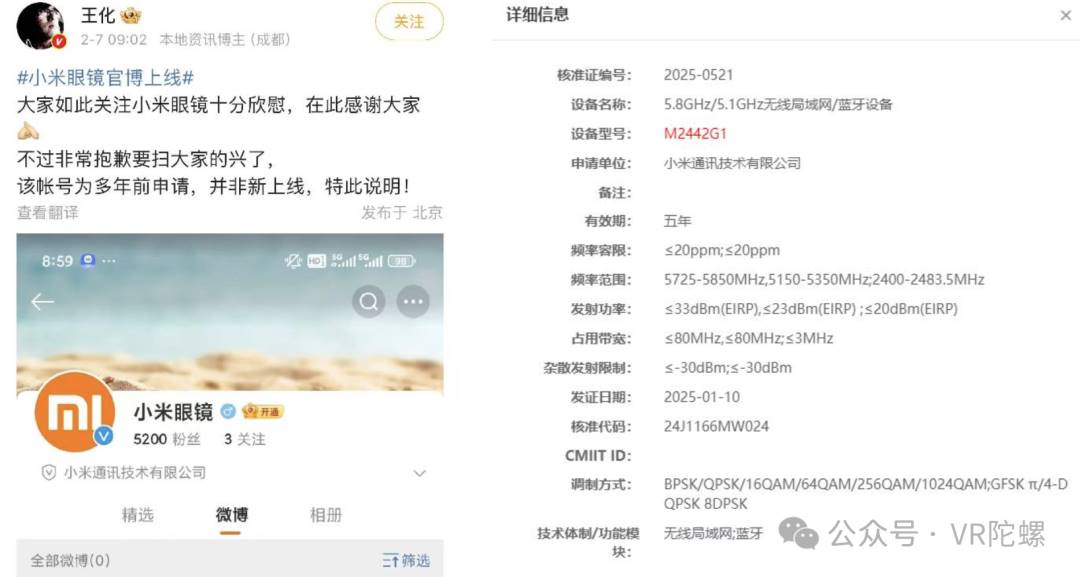
Although Xiaomi Group's Public Relations General Manager Wang Hua recently urgently refuted the rumors, stating that "Xiaomi's glasses official account was registered years ago and is not a new launch," this response has left the market with even more room for imagination. It is not difficult to see from his very official rhetoric that Wang Hua did not directly deny the possibility of a product launch, but only emphasized that the account is not new, hinting that the relevant progress may still be in progress.
Additionally, during this period, the news that Xiaomi's AI glasses have obtained network access permission (model M2442G1) from the Ministry of Industry and Information Technology has also been widely circulated. However, Wang Hua did not respond to this, which seems to have quietly indicated everything.
In fact, as early as November 2024, the industry had heard rumors that Xiaomi was collaborating with Goertek to develop a new generation of AI glasses, with plans to launch them during the Xiaomi Fan Festival in the second quarter of 2025. Lei Jun expects the annual sales of Xiaomi's AI glasses to exceed 300,000 units.
Last year, Gyroscope learned from supply chain sources that Xiaomi's AI glasses may be divided into two versions: one with a camera module, and a basic version (or an early test version) with pure audio interaction, targeting the mass market.
Additionally, there will be some innovations in the design of the glasses to enhance the battery life of the AI glasses. This strategy basically continues Xiaomi's existing "extreme cost-effectiveness" gene in 3C products, while also directly competing with Ray-Ban Meta in terms of product strength.
Why have AI glasses become Xiaomi's next growth option?
Xiaomi has entered the AI glasses market, seeking new market growth.
Since its establishment in 2010, Xiaomi, which started as an internet mobile phone company, has developed rapidly. Its latest data shows that its market value has exceeded one trillion, officially entering the global top 100 companies, surpassing giants like Huawei, Panasonic, and LG.
Behind Xiaomi Group's continuous growth, on the one hand, it is inseparable from the R&D investment in various technologies and ecosystems centered on mobile phones. On the other hand, it is also inseparable from the "Xiaomi Grocery Store." The "Xiaomi Grocery Store" covers a rich variety of IoT and consumer lifestyle products, which occupy an important position in Xiaomi Group's revenue, as can be seen from Xiaomi Group's Q3 2024 financial report data.
Xiaomi Group's Q3 2024 financial report shows that its IoT and consumer lifestyle product revenue reached 26.1 billion yuan, a year-on-year increase of 26.3%, with a gross profit margin of 20.8%, up 3.5 percentage points year-on-year. In contrast, although smartphone revenue reached 47.5 billion yuan, the gross profit margin has dropped to 11.7%, down 4.9 percentage points year-on-year. In addition, the newly launched smart electric vehicle business is also very prominent, with revenue reaching 9.7 billion yuan, a quarter-on-quarter increase of 52.3%.
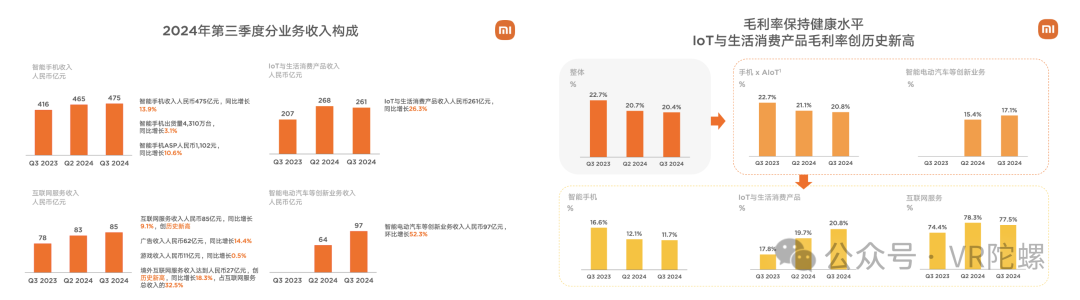
Therefore, in the face of the plateau in the smartphone market and the continuous decline in gross profit margins, continuously expanding the "Xiaomi Grocery Store" centered on the Xiaomi ecosystem, and increasing revenue and profits, has become a must-choose option for Xiaomi's continued growth.
AI glasses meet Xiaomi's strategic needs for business growth and the expansion of scenarios centered on mobile phones. On the one hand, as a wearable device closest to the human senses, glasses have natural advantages in first-person information collection and AI voice interaction. Based on mobile phone computing power and AI cloud interaction, they can expand a variety of diversified AI scenarios such as real-time translation, image recognition, smart search, and personal assistants.
On the other hand, Ray-Ban Meta's sales exceeded one million units in 2024, verifying the market's potential demand for "lightweight AI glasses." Currently, the Chinese AI glasses market is still in its infancy and has a large growth space. Research firm IDC predicts that the global AI glasses market shipments will reach 12.8 million units in 2025, a year-on-year increase of 26%. Among them, China's AI glasses market shipments are expected to reach 2.8 million units in 2025, a year-on-year increase of as high as 107%.
From "AR Exploration Version" to "AI Glasses" Landing, Xiaomi Has Been Preparing for a Long Time
In fact, like Meta, Xiaomi has been laying the groundwork in next-generation computing platform AR technology for a long time (excluding Mijia ecosystem products). As early as 2021, Xiaomi released a Micro-LED+diffractive waveguide AR glasses concept product; in 2023, Xiaomi also officially announced the Xiaomi Wireless AR Glasses Exploration Edition, based on Micro-OLED+free-form optics.
In terms of technical maturity, the AR glasses products released by Xiaomi in the past few years have already had a high degree of landing capability, and similar products from startups can also be found on the market. However, Xiaomi did not rush to commercialize, and for large companies, the opportunity cost of taking risks in an industry without a blockbuster product may be too high.
Until the AIGC boom and the explosion of Ray-Ban Meta, Xiaomi became more convinced of this track. Although the AI glasses to be launched in 2025 are the "simplified version" of the previous AR glasses, with the support of generative AI, they can already bring many practical scenarios through voice and camera sensors. More importantly, AI glasses are the consumer-oriented products that Xiaomi believes can be fully commercialized.
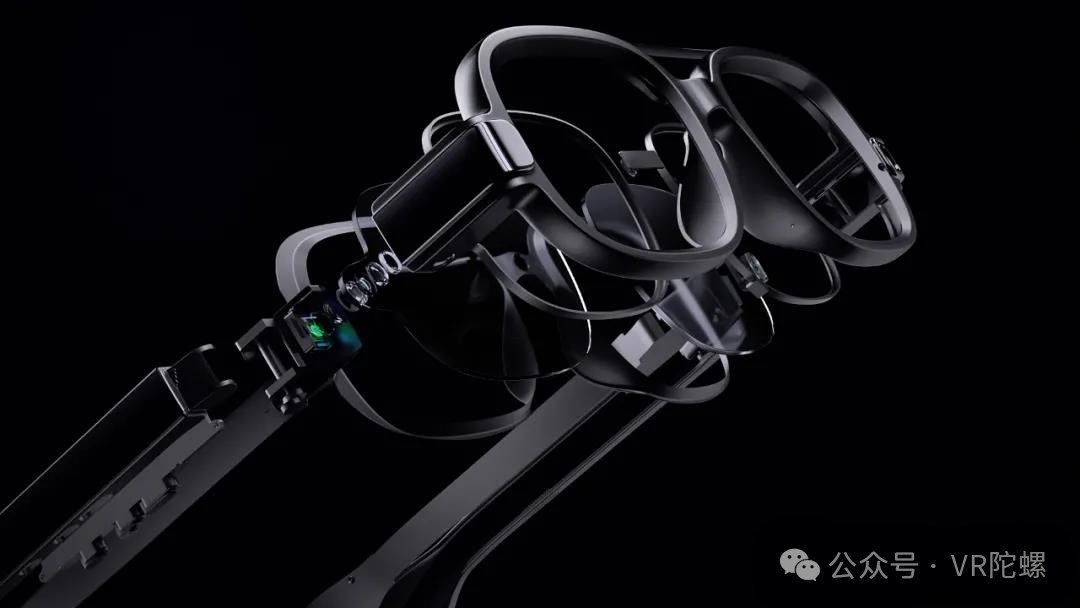
Xiaomi monocular AR glasses
In addition, it is worth noting that compared to ordinary startups, mobile phone manufacturers have certain technical advantages in making AI glasses. In last year's article 《AI Glasses | Easy to Enter the Supply Chain, Difficult to Achieve High-Quality Products》, Gyroscope has already emphasized that for Ray-Ban Meta-like AI glasses, "audio" and "imaging" are the most core modules, and also the two most difficult parts of the glasses to make.
A simple "voice interaction" will involve the combination of multi-Mic external acquisition, noise reduction recording and a series of audio algorithms and hardware. "Image shooting" is directly related to the reputation and market sales of a pair of glasses, which cannot be ignored. Due to the lack of manual focus like a mobile phone, AI glasses need to achieve full automatic focus, automatic color, and photosensitivity optimization adjustment. For start-ups, the pressure is not small. Among them, the choice of chips and the balance of costs are also very important.
Noise reduction algorithms, pickup algorithms, image algorithms, and AI voice interaction, which Xiaomi and other mobile phone giants have already achieved technical precipitation and exploration on TWS headphones, smart speakers, and smartphones. Compared with start-up companies, they need to make up for fewer debugging modules, and at the software ecosystem level, they can also achieve system-level permissions, fully call the mobile phone ecosystem, and have stronger technical advantages. In this way, we are also more looking forward to what kind of technical differentiation Xiaomi's AI glasses will make.
Xiaomi AI Glasses, the Fuse of the Breakthrough of China's AI Glasses?
By 2025, the AI glasses track has been crowded with giants: Meta plans to launch 6 AI wearable devices within the year, and manufacturers such as Samsung, Huawei, OPPO, Rouyu Innovation, Meizu, Baidu, and Rokid are also eyeing it. Facing the "hundred-mirror war" in the global market, the release of Xiaomi AI glasses may trigger a catfish effect in the Chinese market.
From the market pattern, the current sales volume of China's AI glasses market is far lower than overseas, but the industry is boiling. From a marketing perspective, the domestic market has always lacked a phenomenon-level blockbuster like Ray-Ban Meta to enhance consumer awareness and increase users' desire to buy AI glasses.
Xiaomi's own brand advantage is not to be underestimated. Over the years, Xiaomi has created a legendary image in consumers' minds with its high-cost-effective products and rich ecosystem, and its huge user base also provides natural soil for the promotion of Xiaomi AI glasses.
Against this market background, the entry of Xiaomi AI glasses will undoubtedly further expand the market capacity of China's AI glasses industry and bring a larger incremental market.