When it comes to DeFi, crypto users who have been in the industry for more than a year may know that the first public chain Ethereum is the headquarters of the DeFi ecosystem, and many popular projects like Uniswap, Aave, and Lido have risen from Ethereum. Naturally, DeFi projects in other public chain ecosystems may not be well understood.
However, as the bull market narrative shifts towards meme coins, not only has it made Solana the current hottest public chain, but it has also made the DeFi ecosystem, which is closest to on-chain users, a major focus of attention besides meme coins. Furthermore, as the functionality of the Solana DeFi ecosystem gradually improves, the same user experience has also made the high gas fees of Ethereum DeFi's shortcomings more apparent.
While the Solana DeFi ecosystem is experiencing multiple outbreaks along with the meme hype, the Solana lending protocol Kamino has also recently launched a variety of products and functions, attracting the attention of DeFi players.
What is Kamino Finance?
Kamino Finance, established in 2022, is currently the largest DeFi lending protocol in the Solana ecosystem, with a TVL of over $2.3 billion. The protocol's products include a lending market (Borrow/Lend), a multiplier market (Multiply), a leveraged long/short market (Long/Short), a liquidity market (Liquidity), and a swap trading function currently in beta testing.
It is worth mentioning that Kamino Lend V2 will also be launched in the near future, which is based on Kamino Lend V1 and adds more customizable functions in the core language, including diversified open-source modules and customizable Vault configurations. In addition, Lend V2 will also upgrade product functions on the original basis, and add two new products: "spot leverage" and "lending order book".
While comprehensive functionality is certainly important, users won't easily buy in without competitive interest income. To this end, Kamino has also recently launched two JLP-USDT investment tools, trying to attract users with yields that outperform the market.
Can stablecoin APY reach as high as 116%?
In the crypto market, users who want to seek stable returns often lend out stablecoins like USDT for investment, and centralized exchanges (CEXs) and decentralized lending have become the only two choices for users to lend.
From the CEX perspective, the base APY of USDT on the three major exchanges (Binance, OKX, and Bybit) is around 2%, while Bitget is 3.5%, and the highest APY with platform subsidies can reach 11.5%, but these subsidies have limited deposit amounts (500-1000 USDT), so centralized exchange lending is not very suitable for large depositors.
From the perspective of decentralized lending protocols:
- The largest Ethereum lending protocol AAVE currently has a base APY of 5.08% for USDT deposits, and Mopho APY is 5.28%.
- The largest Solana lending protocol Kamino has a base APY of 5.2% for USDT deposits in the "Main Market".
- The largest BSC lending protocol Venus has a base APY of 7.11% for USDT.
- The largest TRON lending protocol Justlend has a base APY of 3.5% for USDT.
From the above-mentioned well-known Lending protocols, 3-8% APY is a relatively reasonable interest rate range for USDT, and from the historical DeFi stablecoin interest rates, below 10% is considered a normal APY.
Kamino's newly launched JLP market USDT lending product has a base APY of 5.87% today (2/10) (APY will fluctuate with the lending utilization rate), and the 30-day annualized return rate reaches 6.78%. The daily APY outperforms the other protocols except Venus.
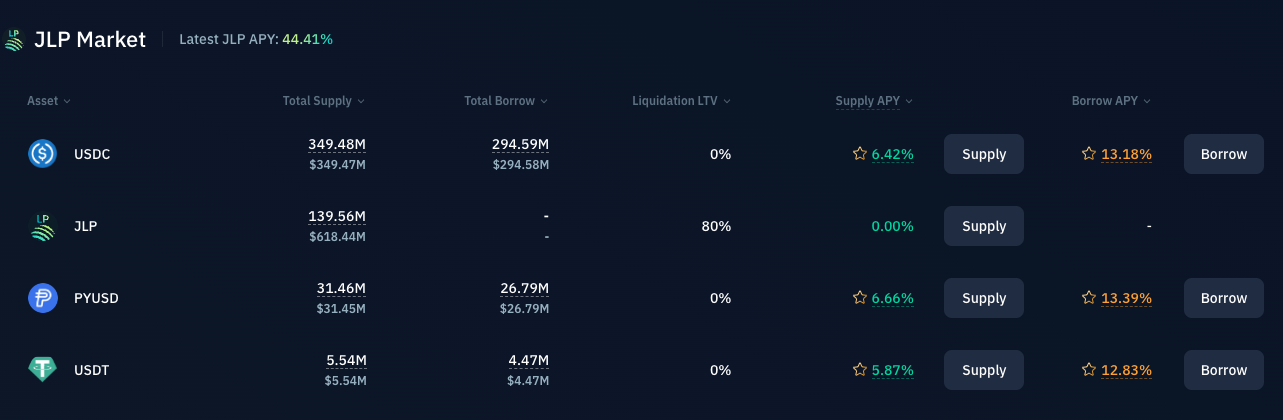
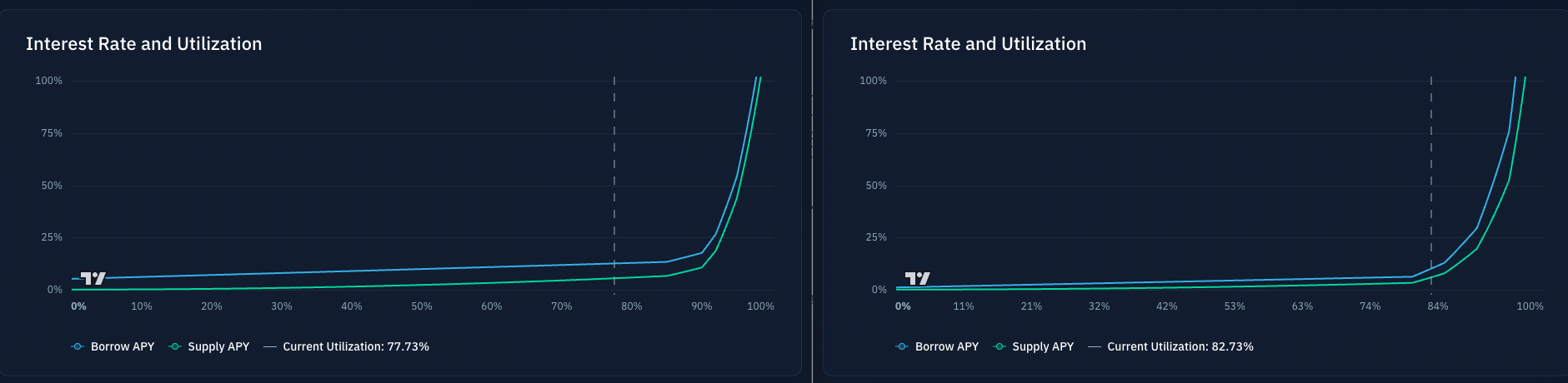
As for the high 5.87% APY of the JLP market USDT, it is actually quite simple - just like other lending protocols, it is determined by the USDT borrowing utilization rate.
Some may wonder, Kamino has both a "JLP Market" and a "Main Market" for USDT lending, what's the difference between the two? If you observe carefully, you can find that the USDT borrowing utilization rate in the JLP market generates a higher APY than the Main Market before 84-86%, and after that, the APY in the Main Market is higher than the JLP market.
In addition, the deposit caps for the two are also different, with the JLP market being $10 million and the Main Market being $100 million. This means that small deposits can be placed in the JLP market, and large deposits can be placed in the Main Market, so that the borrowing utilization rate will not be too far apart, causing the interest rate to drop.
In the current bull market context, products with high APY are more likely to attract players' attention. To this end, Kamino also launched another product JLP-USDT Multiply in January this year, with a maximum APY of 116% (floating rate).
However, where does such a high APY come from? This needs to be explored through the underlying mechanism of Multiply.
The operating principle of JLP Multiply is simple - it uses flash loans and eMode (allowing the LTV of pegged assets to be increased) to perform circular lending (borrowing and re-pledging) of USDT and JLP, thereby achieving leverage amplification of the held position. Under a maximum leverage of 3.2x, the APY of JLP Multiply can reach 116.1%.
For example, the process may involve the following steps:
- The user deposits USDT and selects the leverage multiple
- The protocol automatically converts the deposited USDT into JLP
- Next, to amplify the utilization efficiency, the protocol will borrow USDT through a flash loan
- The borrowed USDT is converted into JLP
- These JLPs are deposited into the protocol's lending platform, and USDT is lent out
- The lent USDT is used to repay the previous flash loan
Throughout the lending process, as long as the JLP staking APY is greater than the USDT lending rate, the user can generate net staking income, for example, the JLP staking APY is 44.41%, minus the USDT lending APY of 12.74%, the net APY is 31.67%.
However, high returns inevitably come with high risks. JLP is not a price-stable product, and with the leverage exposure of Multiply, if the market suddenly encounters a significant fluctuation, the user's position is very likely to drop to the liquidation price and be forcibly liquidated.

Although the JLP Multiply can achieve a staggering 116.1% APY, the staking APY of JLP itself is as high as 44.41%, which also makes one curious about the source of its earnings.
In fact, the JLP APY launched by Kamoni comes from the popular Solana product JLP Pool, which combines 5 mainstream tokens, with a total locked-in value of $1.8 billion, plus a mechanism similar to GMX's counterparty, which gives the JLP Pool three sources of income:
- The JLP Pool asset portfolio includes SOL (47%), ETH (10%), WBTC (11%), USDC (28%), and USDT (4%), which can be lent to traders
- Additionally, the JLP Pool is the counterparty for Jupiter's perpetual contract traders, and this market-making model has a higher probability of long-term stable profits (traders have a higher probability of long-term losses)
- Most importantly, the JLP Pool's APY is calculated based on 75% of the opening and closing fees, price impact, lending fees, and trading fees generated by the pool. This means that the more active Jupiter's perpetual contract trading is, the more fees it generates, the higher the JLP Pool's APY will be.
Furthermore, due to the diversified investment and long-term stable earnings mechanism, JLP has continued to rise steadily during this bull market, and even if the market encounters a deep correction, JLP can mitigate the decline through its diversified holding characteristics.

How are Kamino's other USDT products performing?
On the other hand, in addition to the newly launched JLP USDT product, what other USDT products does Kamino have for users to manage their finances?
In addition to the aforementioned lending market, Kamino's liquidity mining pools also have stable coin trading pairs for dual-token mining, with the following products:
- PYUSD-USDT: 7-day average APY 8.8%
- USDT-USDC: 7-day average APY 2.73% (DEX: Meteora)
- USDT-USDC: 7-day average APY 2.05% (DEX: Raydium)
- USDT-USDC: 7-day average APY 1.96% (DEX: Orca)
- USDT-USDH: 7-day average APY 0.99%
- FDUSD-USDT: 7-day average APY 0.6%
It can be seen that except for PYUSD-USDT, the APYs of the other trading pairs are not high, but a closer observation reveals that the TVLs of most liquidity mining trading pairs are relatively low. Among them, although the average APY of FDUSD-USDT is only 0.6%, its TVL is the highest, indicating that the product has a relatively mature degree.

In addition, although not a USDT product, by observing the basic interest rates of other stable coins in Kamino's lending market, their APYs are within the industry's reasonable range: USDC (6.2%), PYUSD (6.5%), USDS (3.6%), FDUSD (3.25%), which shows that Kamino's product interest rates are not arbitrarily set.
KMNO credit holders have additional earnings potential
Furthermore, Kamino has been holding KMNO credit activities since last year, and the third season is currently underway. Users can earn credits by using the protocol's products, and at the end of the season, they can receive potential airdrops of the governance token KMNO.
According to the official website, using the protocol's lending market (1 credit per $1 per day), liquidity (1 credit per $1 per day), Multiply (3 credits per $1 of net value per day), and long/short leverage function can all earn credits.
Using the JLP-USDT product can also earn corresponding credits and credit multipliers: (1) Lending JLP market USDT products can earn a 2x credit multiplier; (2) JLP Multiply can earn up to an 8x credit multiplier based on the leverage multiple.
Based on the airdrop performance in the first two seasons, the airdropped $KMNO can additionally contribute 0.3% to 1.5% of the principal earnings rate for users, but the token price will also affect the airdrop earnings rate, which users can view as an additional bonus.
However, the official has not yet released the airdrop standards and quotas for the third season, and the actual earnings rate will be known after the protocol distributes the airdrop.
Conclusion
Since Solana emerged from the FTX debacle in 2023, the Solana DeFi ecosystem has been constantly building and waiting, and it happened to coincide with the meme season explosion in 2024. With a large influx of users and capital, Solana DeFi has gradually gained the momentum to catch up with Ethereum.
In contrast, the Ethereum DeFi ecosystem has been constrained by high gas fees on the chain, which has become the theme of "speed" in this bull market. Many users cannot afford the frequent switching costs to seek better returns, leading to an exodus of on-chain users and a decline in capital flow. Additionally, the lending rates also reflect Ethereum's predicament, with the USDT deposit base APY of the Ethereum lending protocol AAVE at 5.08%, while the USDT base APY of Kamino's JLP lending market is 5.87%.
With both interest rates and gas fees advantages being occupied by Solana, Ethereum may only have the title of "veteran DeFi" left to boast about.
Furthermore, we can see that the airdrop distribution of Ethereum protocols is often a one-time event, allowing users to receive the airdrop and then leave, which is very unfavorable for user retention.
In contrast, Solana ecosystem protocols have learned from this lesson and are using long-term airdrops to attract loyal users, such as Kamino Finance's three-season credit airdrop activity and the ASR and Jupuary airdrops of the Solana DeFi aggregator Jupiter. This effect will also gradually make users realize that there is still a lot of meat to be eaten in the Solana ecosystem, and they will remain active within the Solana ecosystem.
As for the continuous inflow of users and funds, as well as the product iteration of Solana DeFi, whether this can create the next DeFi Summer is worth our continued attention.