Consensus Hong Kong 2025 is back, and I have reviewed the content of the on-site speeches, feeling a bit disappointed. Fortunately, I had the opportunity to interview several heads of major exchanges and public chains, which was very fruitful, and I would like to share it here.
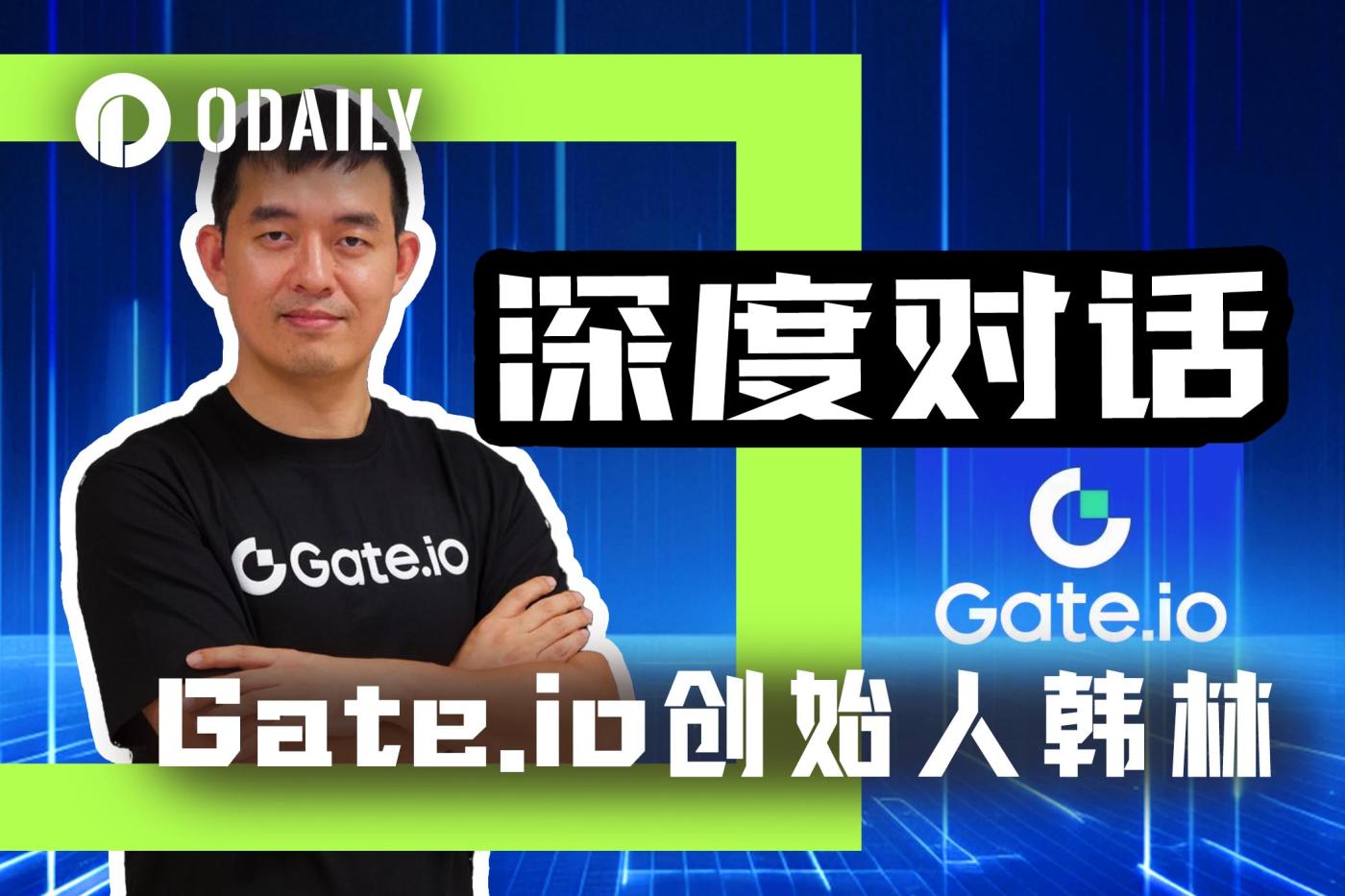
As the market direction is not very clear recently, with hot spots quickly rotating but unable to continue, Odaily interviewed Gate.io founder and CEO Han Lin on topics such as the current stage of the crypto market and vertical industry trends. Through the perspective of this 12-year industry veteran, he provided guidance, shared experiences, instilled confidence, and warned of risks for the broad participants; based on his years of experience in operating large trading platforms, Han Lin also elaborated on Gate.io's focus and progress in various business lines, the listing process and behind-the-scenes work details, the value support of the platform token GT, and the origin of sponsoring the F1 Red Bull racing team.
To present the interview clearly, Odaily has summarized the Q&A as follows, enjoy~
Odaily: With Trump taking office and favorable policies being steadily implemented, there is no news stimulus in the short term, nor new capital inflows, and the market has entered a period of stagnation. How do you assess the market stage going forward? Will there be a second bull market in 2025? What indicators can be used as a basis and reference for trading decisions?
Han Lin: In my view, the market is actually still doing well.
In the very short term, it will be a bit worse on weekends and holidays. But it will start to turn better around November 2023, and 2024 will have Meme-driven performance, which will be good throughout the year. This year, after Trump launches his coin, celebrities will follow suit.
The blockchain concept itself is dry and difficult for ordinary people to accept, but coins, especially Memes with huge price increases, will attract new entrants with interest, who will then easily discover mainstream assets like Bitcoin. When risk appetite returns and shifts to long-term thinking, some of the capital brought in by Memes will eventually flow back to more value-preserving mainstream coins.
As for the future market trend, it is very difficult to predict. I believe that with the mainstreaming of virtual assets, they will be greatly influenced by macroeconomic and financial events.
However, being in an exchange, we can clearly perceive the market sentiment - in the 2023 bear market, it seemed that no matter what activities or promotions we did, it was difficult to elicit user response, and the industry-wide traffic declined sharply, while after the wave ignited by Memecoin at the end of 2023 and into the 2024 bull market, the sentiment was clearly high.
Now, many financial operations are shifting on-chain, and data is easier to monitor externally, such as just looking at the daily issuance volume, which is very large. This is consistent with the data trend of the CEX.
Odaily: Many veteran traders and holders are looking forward to the rise of Altcoins, but the broader view is that the Altcoin downturn is obvious. What's your take on this?
Han Lin: Gate.io has been around since 2013. At that time, the definition of Altcoins was copy coins, such as the earliest Meme coin DOGE and some forked coins that copied the code. Looking at the long term, only a few top ones have survived, with very poor value preservation. Especially Memes, which rely on hot spots and community consensus, have rapid ups and downs. In contrast, mainstream coins have seen big ups and downs, but the overall trend is upward.
Therefore, we do not particularly recommend that novice users participate in Altcoin projects. In addition to selecting targets, they can also try wealth management and other income methods suitable for non-professional users to reduce risks. For users with a lot of financial experience, they can also make good use of various financial instruments such as contract products on Gate.io.
Odaily: Speaking of Memes, it has been a source of capital flow since the second half of last year. But with Trump launching his coin, Memes have entered the next stage. Do you think most retail investors still have ways and opportunities to participate in Memes?
Han Lin: It depends on the long and short term.
In the long run, they can participate in mainstream coins through methods like dollar-cost averaging and wealth management to generate income.
In the short term, I have to emphasize that trading requires a lot of professional skills, such as being a contract trader.
For Memes, I don't recommend novices to blindly rush in, as the probability of them becoming top mainstream ones is very small.
Odaily: At the end of 2024, all institutions predict that 2025 will be the year of Web3×AI, but the AI Agent sector has dropped more than 80% from its high point. What products or events could lead to a reversal in this field?
Han Lin: The Web3 field has never lacked concepts and hype, the most important thing is to look at the real demand and the degree of integration between products and actual solutions (to the demand).
Gate.io is actually using AI to process some actual work, such as data analysis, including market data as well as platform operational data.
Some very professional quantitative institutions and traditional financial companies are using neural algorithms in traditional finance to assist in selecting trading directions. But to reach the point of being able to assist ordinary users in trading decisions, there is still a long way to go.
Odaily: What personal investments have you made recently, and what niche areas or directions will you focus on? What advice do you have for CEX users?
Han Lin: My personal investment efforts are limited, and most of the time I'm considering how to provide better services on the platform.
But our venture capital department, Gate Ventures, will focus on ecosystem-related projects, looking at a large number of targets, such as L2 (to solve scalability issues), zk+chips, crypto payments, wallets and other infrastructure and technology-driven projects in the past.
Gate.io will provide funding support for Gate Ventures, and Ventures will independently execute the investment decision process. In terms of linkage, if the invested projects can meet the listing standards, the due diligence and other work results previously done by Ventures can also be reused.
Odaily: The next question is about Gate.io. What are the overall business goals for Gate.io in 2025?
Han Lin: Gate.io's strength is the early launch and comprehensiveness of product functions - we supported dozens of coins as early as 2013, which was very rare for platforms at the time, and we maintain this advantage - continuously providing users with high-quality spot trading opportunities for assets.
In terms of contracts, Gate.io has been making efforts since last year. This will be the focus business in 2025.
The Web3 industry follows the path of traditional finance, with contract trading volume starting low but quickly surpassing spot; and the development of crypto finance is faster. Compared to traditional finance, a contract trading volume 5-6 times that of spot is normal. Gate.io started with a 2% market share in contract business last year, and has now reached 5-6%, with a target of 10% by the end of 2025.
In addition, Gate.io is also actively developing ETF and options businesses, but more oriented towards professional investors.
Odaily: In users' impression, Gate.io is very sensitive to hot spots and the listing speed is also fast. What are the judgment and risk control processes of various departments before, during and after the decision to list a coin? What is the team size and division of labor? If it's a spot listing, how to quickly accumulate a large amount of capital to support liquidity? Will you communicate with the team and market makers?
Han Lin: The listing department is divided into two teams, one for finding quality projects and due diligence, each with dozens of people. The listing process is also divided into two categories:
One is for more traditional teams, where the due diligence team will focus on and cross-examine the team background, investor situation, token distribution rules, business model, risk control measures, etc., to confirm the long-term sustainability of the project;
The other is for community-driven projects, which may have already been listed on DEXes, the listing department will also evaluate community heat, user acceptance, on-chain data, dispersion of holdings, etc., and will also provide risk warnings to users.
As for the initial liquidity, the tokens are usually already in circulation externally, with pre-prepared quantities; there are also some first-launch projects where tokens have been airdropped to users, so the community already holds enough.
In addition, Gate.io has hundreds of partner market makers, and although we don't directly interface with projects, if a project needs it, we can also make introductions.
Odaily: In addition to trading, what recent progress is worth users paying attention to in product lines such as wealth management, Startup, Launchpool, copy trading, crypto, wallets, etc.? From Gate.io's own perspective, which business line has the highest priority?
Han Lin: Gate.io's priority is to continuously provide users with high-quality asset spot trading opportunities. The contract business, which we have been focusing on since last year, will be the key business in 2025. We also actively develop ETF and options businesses, but more oriented towards professional investors. In addition, Gate Ventures, our venture capital department, focuses on investing in infrastructure and technology-driven projects in the ecosystem.
Han Lin: The industry has been developing very rapidly in this period, especially in DEX and wallets.
Gate.io has done a lot of work, and the wallet is also a product that started very early. We started to do multi-chain wallets in 2018, when the market had one coin and one wallet, and there were few mobile wallets. In the DeFi Summer of 2020, Gate.io began to build DEX-related platforms, and within a few years, gradually shifted the exchange functions (Meme trading, transfer, finance, etc.) to the wallet, while integrating the two product ends, following the industry trend of blurring the boundaries between DeFi and CeFi.
The Gate.io wallet also has a special feature, which maps the addresses of each chain in the backend to a unified one, so that even if users transfer to other chain addresses, they can still receive the coins.
Odaily: GT has hit new highs, benefiting from what empowering operations or fundamental improvements? How do you attribute it?
Han Lin: GT is both the platform token of Gate.io and the native token of GateChain.
In 2018, we wanted to build an innovative chain, not just another Altcoin, and chose the direction of "user asset protection", including anti-theft and retrievability, as well as EVM compatibility and support for DeFi applications. Last year, GateChain supported L2.
When users participate in the platform and ecosystem, they naturally have an understanding of the platform token. Once they hold it, they will receive daily airdrops and other benefits, and see that Gate.io is actually distributing profits to the holders, which gives them a good impression of GT, and they will increase their holdings and bind more deeply, forming a virtuous cycle of GT price stability and upward trend.
Of course, the market has ups and downs, and buying platform tokens also carries risks, so we provide risk warnings and let users judge for themselves.
Odaily: Gate.io's external cooperation includes the fintech industry as well as brand-oriented ones such as sports stars, such as the recent partnership as the official sponsor of the F1 Red Bull Racing team. How was this partnership facilitated, and can you share some interesting stories from the initial contact to the final agreement? What is the typical conversion rate for Web3 companies advertising on traditional channels?
Han Lin: I'm a technical background, and Gate.io's previous market style was relatively low-key. At the same time, Gate.io's products had gaps in the past few years, and we needed to fill them from scratch. You will notice that we have quickly launched pioneering features such as finance, quantification, dynamics, and live streaming, which have been recognized by our old users. There are also some dry but important behind-the-scenes work that users are not strongly aware of, such as the reserve fund proof we started in 2020, which allows users to judge whether the platform is misappropriating funds.
By 2024, as our product functions are gradually improved and new global users are entering, we have focused on brand cooperation. For example, we sponsored the Inter Milan football team in the first half of 2024, and the two sides shared the "pursuit of championships" philosophy. In the second half of the year, we contacted the F1 field and found that F1 has adopted a lot of the latest technologies, and there is some overlap between the crowds during events like Token 2049 in the UAE and Singapore. Racing + Crypto just represents the pursuit of technology and finance at the forefront.
Personally, I didn't know much about F1 before, and I thought some luxury car brands were more powerful, but later I learned that the Red Bull Racing team's drivers are ranked first in F1. Plus, Red Bull Racing has a Web3 department internally, so the communication and connection was very smooth and efficient. In early 2025, we reached a sponsorship agreement.
As for the conversion rate calculation, Crypto trading platforms are not like physical products such as clothes and beverages (which require 7 exposures to build customer trust), but more about the logo appearing on jerseys, race cars, and race tracks, leaving an impression on sports fans and athletes, so that when they develop an interest in Crypto, they can come to explore further.
Odaily: One last question, how do you view the active presence of exchange founders on social media platforms like X? This year, do you hope to increase or decrease your own voice, and does your team want to promote your personal IP, and what are the considerations behind it?
Han Lin: This is more about the personalities of different exchange founders. Some people are more outgoing, while I have a technical background and am more introverted. But in this position, I have a responsibility to promote the company and let users recognize and trust Gate.io. If I try to build a personal IP and force myself to be more extroverted, the effect may not be good. So I'll just go with the flow.
Supplementary Reading
The interview with Gate.io CBO Kevin Lee in November last year: In the bull market, how can exchanges become an important gateway to protect user rights?