The recent performance of Ethereum has been inconsistent, which has had a negative impact on public perception. Persistent price declines, governance issues, and high gas fees have led the crypto community to wonder whether these issues are temporary or indicative of deeper problems.
BeInCrypto interviewed industry leaders from Wirelex, Komodo Platform, Binance, KelpDAO, and RAAC to analyze the factors contributing to Ethereum's decline, its current market position, and potential strategies for improvement.
Market Performance...Investor Sentiment
Ethereum's 2025 started off unstable. After failing to break the $2,500 barrier, Ethereum retreated to $2,090. Meanwhile, whale addresses sold 640,000 ETH, worth $1.5 billion, pushing the "Altcoin King" further from its target.
The recent Bybit hack, which resulted in the theft of around $1.4 billion worth of Ethereum, did not help either. Subsequently, the network recorded its highest weekly outflow, amounting to $300 million.
Additionally, the wave of bearish sentiment and decreased investor confidence led to a 30-day high of $94.27 million in ETH spot ETF outflows. This was the third-largest increase in 2025, indicating that investors clearly retreated after Ethereum's price fell to $2,251.
"Compared to Bitcoin, Ethereum's performance has been disappointing, with over 90% gains for Bitcoin this year. Many holders are wondering when it will recover to new all-time highs." - Vivien Lin, Chief Product Officer at Binance
Considering this situation, multiple factors need to be taken into account to understand Ethereum's recent decline.
External and Internal Factors Impacting Ethereum
The recent price volatility in the crypto sector has sparked speculation about the start of a bear market. The market briefly recovered after President Trump's announcement of a U.S. crypto strategic reserve, but the long-term impact of this recovery is uncertain.
Other factors have also contributed to the major cryptocurrency price declines. Trump's recent tariffs on Canada, Mexico, and China have caused prices to plummet.
Meanwhile, the crypto market has started to feel the impact of inflation in the U.S. economy. As a result, traders are increasingly concerned that the Federal Reserve will raise interest rates. All of these factors have impacted Ethereum's performance.
"The broader market is very sensitive to macroeconomic factors such as tariffs, potential rate hikes, and geopolitical tensions, all of which have added to the price uncertainty of ETH." - Lin
While these factors provide insight into the current market volatility, they do not fully explain the price performance of individual cryptocurrencies. Carlos Buyas, a graduate trading analyst at Wirelex, provided a general overview of the challenges Ethereum is currently facing:
"Ethereum's price difficulties may stem from internal issues such as governance problems, inefficient resource allocation, and a decline in market dominance. Critics have pointed to the Ethereum Foundation's large budget and unused finances as slowing innovation. Developer discontent has also played a role, and Ethereum's lack of political engagement compared to Solana and XRP has put it in a disadvantageous position. Leadership divisions have added to the uncertainty, and Ethereum has lost ground in DeFi while maintaining high fees, keeping its price below $3,500 since January 7, 2025." - Shared with BeInCrypto
Exploring these internal issues in more depth is crucial to truly understanding the causes of Ethereum's stagnation.
Ethereum's DeFi Dominance and Challenges
Ethereum's success has largely depended on its pioneering leadership in decentralized finance (DeFi), infrastructure, and developer ecosystem. Compared to competitors, Ethereum is perceived as more decentralized.
The network currently dominates the DeFi space, with a Total Value Locked (TVL) exceeding $48 billion. The runner-up, Solana, lags behind with over $7 billion in TVL.
"58% of DeFi liquidity is on Ethereum, and it dominates the stablecoin market, liquid staking, restaking, and various other DeFi sectors. Overall, Ethereum has been the most suitable chain for DeFi innovation, and most successful DeFi protocols are on Ethereum and Layer 2." - Amitay Gazaleh, Co-founder of KelpDAO, told BeInCrypto.
While Ethereum is dominant in DeFi, high gas fees and slow transaction speeds have hindered users' continuous interaction with the network.
"Ethereum is particularly lagging behind Solana in DeFi due to high transaction fees and governance issues. On-chain activity has decreased by 38%, and major protocols like Uniswap have experienced significant declines. Meanwhile, Solana's low fees and fast transactions have attracted liquidity, further strengthened by the launch of Trump's meme coin in January 2025." - Buyas said.
Overall, Ethereum has seen a decrease in user activity. According to Glassnode data, the number of active Ethereum addresses has been particularly volatile in recent months.
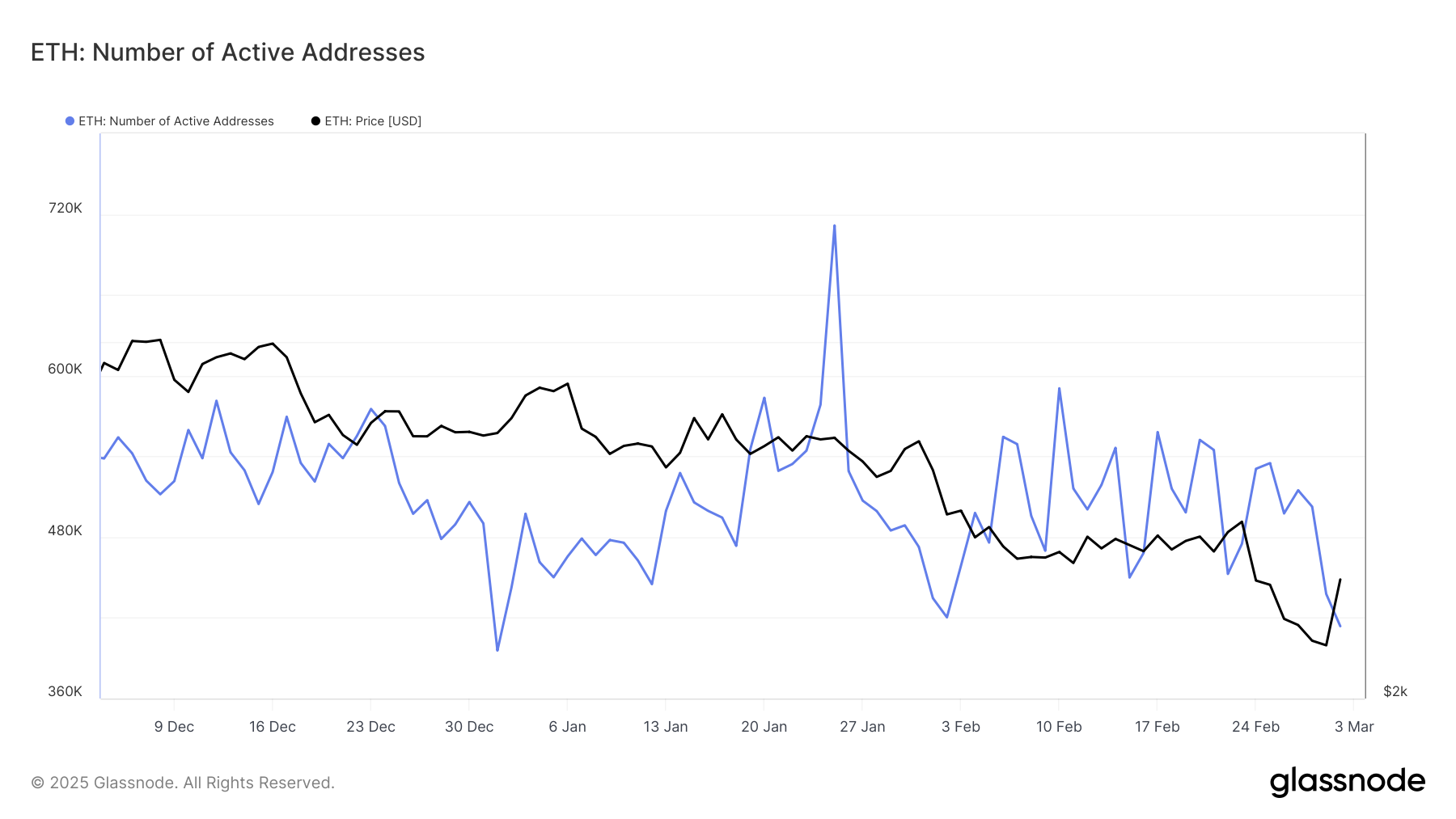
The recent peak for Ethereum was on January 25th, with the network recording 711,578 active addresses. This number decreased to 413,754 on March 2nd, representing a 53% decline.
Scalability Issues and Layer2 Solutions
The limited transaction capacity within Ethereum's network architecture has caused scalability issues, leading to congestion and high transaction fees. As user demand increases, transaction times slow down, and the fees paid by users interacting with dApps rise.
Over the years, Ethereum has introduced several reforms to reduce the scope of these problems.
"The scalability issues remain, including Ethereum's architectural changes and the transition from Proof-of-Work to Proof-of-Stake, which has led to a crisis of trust in Ethereum among cryptocurrency investors." - Cardan Stadelmann, Chief Technology Officer at the Komodo Platform, told BeInCrypto.
When these changes were deemed insufficient, Ethereum also introduced a Layer2 ecosystem. These protocols process transactions outside the main Ethereum network, providing short-term scalability improvements. However, this solution has faced criticism.
"The proliferation of Layer2 technologies has failed to make Ethereum scalable enough for the numerous dApps and DeFi applications built on the network. They have their own tokens, reducing the demand for Ethereum's mainnet. For example, Polygon is a Layer2 network, but its token has surpassed ETH, increasing Ethereum's scalability while also competing with it. Furthermore, Layer2 protocols like Optimism and Arbitrum introduce centralization into networks that promised decentralization." - Stadelmann added.
Over time, these issues have increased the competition from other networks.
Competition... Ethereum Foundation's Response
As networks like Solana began challenging Ethereum's DeFi dominance, Ethereum sought other DeFi solutions to maintain its position.
"Ethereum is losing ground, primarily to Solana. Solana was designed with scalability in mind, allowing large-scale DeFi projects to be launched on the network. Solana's success in DeFi is evidenced by the fact that former U.S. President Donald J. Trump launched his digital collectibles on Solana, not Ethereum." - Stadelmann
Days after Trump launched his meme coin on Solana, the Ethereum Foundation transferred 50,000 ETH to a multi-signature wallet to support DeFi protocols.
This move came in response to public criticism of the Foundation's financial management. Providing ETH to these protocols can generate yield on the deposited assets, increasing the value of the assets without having to sell them.
Some community members praised the move.
"The Ethereum Foundation's efforts to positively improve its reputation within the space and increase the price of Ethereum are an important step in the right direction. As DeFi competition increases, everyone is working to create better products than before. So this was a good decision. Within hours of the deployment, Ethereum's Relative Strength Index (RSI) rose from 65 to 72, indicating increased buying pressure." - Lin, told BeInCrypto.
Gajjala agreed, adding:
"This is a very positive move from the Foundation. It signals trust in DeFi protocols and also signals trust and credibility to a wider market, especially institutions." - he said.
However, others criticized the time it took the Ethereum Foundation to take this action.
"It's good that this happened, but it's too late. The primary value driver for ETH is DeFi and its financial applications. For some reason, the Ethereum Foundation has overlooked this and sold tokens to cover Foundation expenses. The optimal solution would have been to borrow from protocols like AAVE. The idea behind this move was to support the 'niche' that drives most of the value of ETH. After greatly overlooking DeFi, it's good that it's being recognized by the Ethereum Foundation. It was successful, but the lateness of this move has left a bad impression on some developers." - Kevin Rusher, founder of the real-world asset platform RAAC, told BeInCrypto.
On that point, Bujas argued:
"This move may have provided temporary liquidity support, but it does not fully address deeper concerns such as high fees, competition, and governance issues. The long-term impact depends on whether it can drive sustained engagement in DeFi. However, without fundamental improvements, this capital injection alone cannot reverse Ethereum's downward trend." - he said.
This event highlighted the divergent views within the Ethereum community on the Foundation's management of the network's future.
Leadership Change... Community Reaction
Over the past year, the Ethereum Foundation has faced increased criticism from community members over concerns about passivity and spending and operational priorities. The current efforts aim to strengthen the Foundation's ties within the Ethereum ecosystem and rebuild trust.
The Ethereum Foundation's transfer of 35,000 ETH to Kraken was revealed by Lookonchain and criticized by the community for a lack of transparency. The Foundation cited budgetary needs and regulatory constraints, but the community remained divided on how financial decisions are handled.
Here is the English translation of the text, with the specified terms retained and not translated:Several other issues have also divided the community over the Foundation's influence in the Ethereum ecosystem. The criticism includes the Foundation's leadership responsibility for the relatively poor performance of Ether compared to other cryptocurrencies. Additionally, the Ethereum network has seen a decrease in new developer inflows, and Solana has surpassed Ethereum's developer growth.
Some within the Ethereum community demanded the resignation of then-CEO Aya Miyaguchi. They held her responsible for Ethereum's issues.
"There were criticisms that Miyaguchi was not handling general operational issues well. This resulted in some team members leaving. There were also efforts to create a more balanced leadership structure through a dual-leader system. This is about taking more control away from one individual. On the other hand, some are satisfied with her leadership and the Foundation's roadmap. Satisfying all participants in the ecosystem is really difficult. Therefore, there have been leadership changes and discussions for long-term success," Lin explained.
Ethereum co-founder Vitalik Buterin announced on January 18 that the Ethereum Foundation was undergoing a major leadership change, but these changes were only announced last week.
After serving as CEO for 7 years, Miyaguchi became the chairperson on February 25. Shortly after, the Ethereum Foundation established a 15-member Silviculture Society to address leadership issues and maintain core values.
Yesterday, the Foundation appointed Xiao-Wei Wang and Thomas Stanzak as co-CEOs. The community's views on the new leadership remain divided, but Gazzal emphasized that time is needed for these changes to take effect.
"Change management will take time. It will take time to implement some of these changes, so I urge the community to be patient," he said.
Anticipating a new chapter in Ethereum's leadership, industry experts have highlighted priority areas for improvement.
Experts Recommend for Ethereum's Future
Stadelman and Buyyas agreed that Ethereum needs to improve its scalability to maintain competitiveness against other networks.
"The perceived obstacles to the scalability of the Ethereum network have led to a decrease in Ethereum's dominance in the cryptocurrency market. In the past, there was discussion of a 'flippening' between Ethereum and Bitcoin, but today there is discussion of Solana flipping Ethereum. Solana, primarily driven by memecoins, has recently surpassed Ethereum in terms of market share. Solana's average daily trading volume has far exceeded Ethereum's. This is a shocking criticism of Ethereum's lack of growth," Stadelman said.
If Ethereum does not solve this issue now, it will face a snowball effect in the future.
"Ethereum may benefit from the general growth of the cryptocurrency market, but issues related to fees, governance, and innovation could limit its future upside potential. The ETH/BTC price has shown weakness since 2022, and Ethereum is lagging behind Bitcoin, challenging its growth potential. As Ethereum's competitors improve their networks and capitalize on political opportunities, Ethereum will need to evolve to maintain its position," Buyyas said.
Meanwhile, other leaders have optimistically declared that Ethereum has the resources and resilience to firmly maintain its position as the second-largest cryptocurrency.
"We only need to look at the explosive growth of stablecoins on ETH and World Mobile Token massively buying ETH to understand Ethereum's critical role and undeniable value. Other examples include BlackRock launching stablecoins and collaborating with Aave to utilize Curve Finance as infrastructure. Of course, Ethereum's competitors will erode some market share. This is a sign of a healthy, non-monopolistic market. But look at the liquidity and where the major players are. It's in Ethereum's ETH. Ethereum is a decentralized, trustworthy, neutral network. This is something many chains cannot claim." - Rusher
The network's continued success largely depends on how the Ethereum Foundation manages its leadership during this period of fierce competition in the cryptocurrency sector and whether it can maintain investor confidence.