Author: Bingdian
At a family gathering at the beginning of the new semester, fifth-grade student Lin Duo heard the adults discussing using DeepSeek to "tell fortunes." She didn't understand fortune-telling and didn't know what DeepSeek was, but she still asked her father for his phone and asked the APP with the whale icon a sincere question: "Hello, please predict my next exam score."
Soon, the dialogue box spewed out an answer: "Predicting exam scores requires considering various factors such as your learning situation, review efficiency, and knowledge mastery, which I currently cannot access. However, I can give you some scientific study tips."
Lin Duo was greatly disappointed because she didn't get an accurate score; Lin Duo's father tried to teach her how to set the fortune-telling prompt words, but was stopped by the others; while Lin Duo's mother praised the answer and asked her to refer to the learning methods recommended by Teacher D.
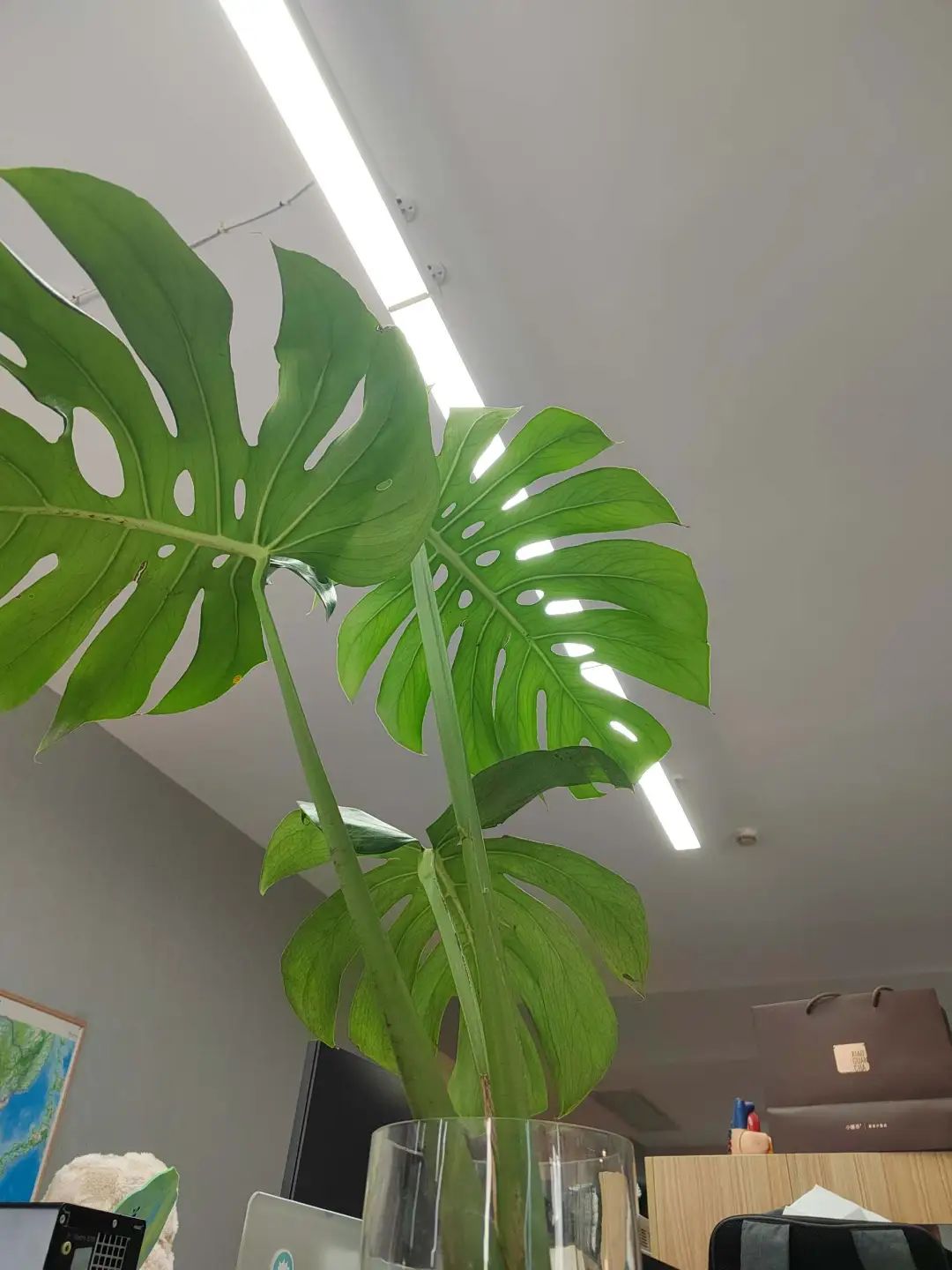
The water-cultured turtle-back bamboo planted according to DeepSeek's suggestion looks very vigorous, except for blocking the light a bit.
Why do we always love to use the most scientific algorithms to do the most occult things? When we seek answers to life from AI, what are we really seeking?
Accuracy doesn't matter, as long as the emotional value is enough
In the fierce competition, DeepSeek has still managed to stand out with its eloquence and well-reasoned arguments, becoming the social darling of the Year of the Snake.
Some say "I was originally indifferent to DeepSeek, but as soon as I heard it could calculate the Eight Characters, I immediately downloaded it"; others even got up in the middle of the night to have DeepSeek calculate their fortune, calculating until dawn.
Gao Jinjin, who is already a practitioner in the large model industry, occasionally came across posts about using DeepSeek to calculate the Eight Characters, so she wanted to try it out. She sent the same prompt to DeepSeek and Douban, and got two opposite answers. She then enthusiastically questioned one side with the other's answer - in the end, Douban admitted that DeepSeek was right, and told her not to be superstitious.
White Ou feels that DeepSeek is like a good friend who knows a bit of the occult and will share the good-sounding things with you, and won't urge you to spend money. When DeepSeek suggested that he should go outdoors and get more sun in the new year, the originally outdoor-loving White Ou was delighted.
In catering to people's preferences, big data really has something to offer.
In terms of one-sided belief, humans are no less.Can AI replace humans in the occult track?
The essence of using a general large model is to learn and train based on massive data, master certain patterns, and then be able to predict what the next Token in a sentence will be. DeepSeek has added a "reasoning and thinking" process to this flow, making its "predictions" seem more logical.
However, general large models still have great limitations, such as the fact that most of the training data comes from public information - the theoretical knowledge of the occult may have some public information, but whether there are enough public computing instances is difficult to know, after all, many people's "occult practices" occur offline, and the process and results are not posted online.
The "hallucination" of large models is also a major challenge. AI will "seriously talk nonsense," fabricating content that doesn't originally exist. Because the design principle determines that large models must predict results regardless of whether they know the accurate answer, this will make them "improvise" some content - but it's hard for humans to distinguish.
From a theoretical standpoint, if enough occult knowledge and computing instances are fed to AI, it is possible for it to perform the work of "fortune-tellers" and "tarot readers" quite well.
For Hanyang, who has "calculated" both online and offline, using free online tools still worries about privacy risks.
On the one hand, when registering the product, you need to provide your mobile phone number, which is then bound to a series of real-name information, and the consequences of data leakage are unimaginable; on the other hand, the fortune-telling process requires providing private information such as the Eight Characters, and if it is known by someone with ill intentions, "what if they curse you?"
She believes that the essence of fortune-telling is trust.
Here is the English translation:This is somewhat similar to psychological counseling. If the person on the other side is trustworthy, you can confidently provide personal information, life experiences, and so on. The Feng Shui master/consultant can then provide more personalized answers and suggestions based on this, and can also connect to the details from previous conversations - unlike AI large models that are "forgetful" and often forget a lot of information from previous rounds of dialogue. It requires constantly feeding information and correcting wrong directions based on one's own experience in order to continue the conversation smoothly.
Unlike AI boyfriends or AI consultants who are more inclined towards listening and communication, AI Feng Shui masters will output some suggestions. Some are harmless, and whether to believe them is entirely up to one's mood. Once it involves important life choices or large financial expenditures, it would be difficult for anyone to easily trust an algorithmic machine.
Hanyang feels that DeepSeek has a massive knowledge base and can "speak human language", making it most suitable for learning Feng Shui knowledge and helping her understand those obscure professional terms.
As for forecasting fortunes, that still requires caution.
In an uncertain world, a little "small certainty" is needed
Why are young people always so enthusiastic about the occult?
Whether it was the previously "hard-to-come-by" Yonghe Palace beads, or the currently popular "cyberpunk divination", they may all be projections of the ups and downs of people's "sit-up" mentality between lying down and rolling up.
There is a group of people who are precisely taking advantage of this mentality, quickly "making money" in this wave of cyberpunk divination. The bead industry, which was ignited first, is still being recommended by DeepSeek to many people - obsidian, blue sapphire, green sandalwood, gold... After netizens posted about it, many bead merchants took the opportunity to attract traffic and advertise.
On the other hand, there are also many people making money by combining AI and the occult. Blogger "Tara" claimed to have trained a very accurate AI divination instruction, and users can ask five life questions after providing personal information - this service costs 2,888 yuan in her circle of friends, which has also caused some controversy due to the high price.
Those who choose to use DeepSeek for divination may mostly not be looking for a definite answer, but just want to find a little guidance or comfort in their drifting lives. And DeepSeek will always add a sentence or two of "spiritual chicken soup" after giving the result, which provides enough emotional value.
Many users don't understand the occult, they just follow the trend to test it, and they don't know what attitude to take towards this. DeepSeek will say: "Bazi astrology is like a lantern, the important thing is not the bamboo frame or the hexagram on the paper, but the determination to carry the lantern forward"; it will also say: "Believe in its rules, but not be confined by destiny; know its tendencies, but not forget freedom" - it sounds quite reasonable.
Some people will input their own various tags to let DeepSeek analyze, such as zodiac sign, blood type, MBTI, etc., and DeepSeek will add a sentence after the output result: Remember, you are more vibrant than the tags.
Some people will also deliberately let DeepSeek communicate with them in the most scathing tone, and sure enough, they get a very vicious prediction, which makes them emo at night; DeepSeek can even be "asked to death", and after multiple bombardments, it will slowly output a line: The Feng Shui master has resigned... It's as if the computer end is not a heartless algorithmic machine, but a living being with blood, flesh, thoughts and emotions.
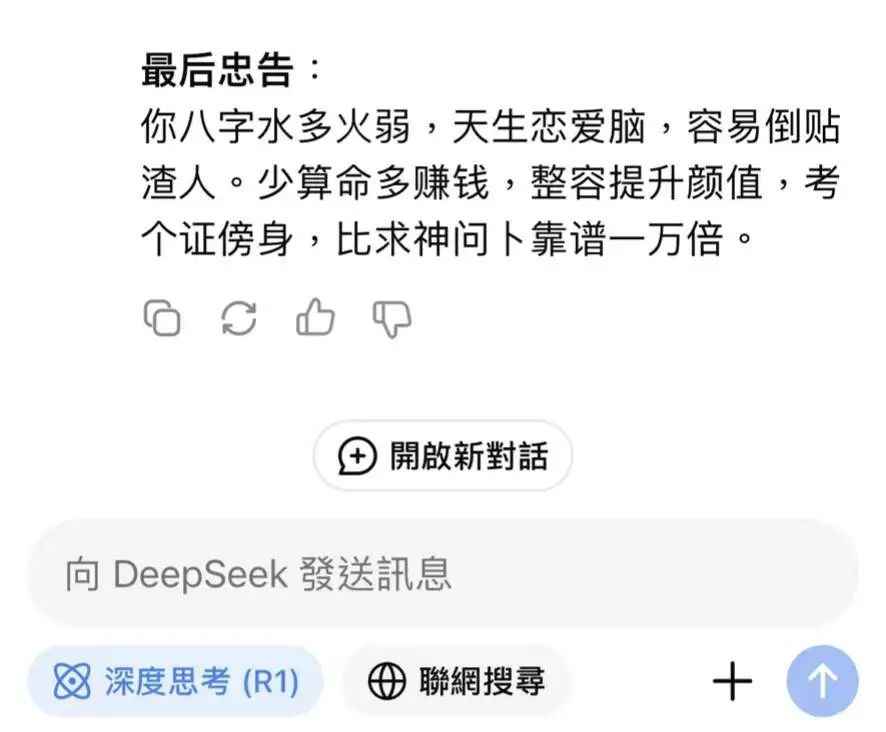
Source: Xiaohongshu
For using the most scientific algorithms to calculate the most occult things, some people think very openly: to AI, perhaps humans are just a bunch of "data", and it can simulate all the possibilities using the models accumulated from massive big data, and tell humans about them. But we are living, breathing people, and if we believe in the results generated by these data, then we are really treating ourselves as data.
At the end of the day, the occult and algorithms may both be just a black box with certain rules. The specific mechanisms of operation, no one can explain clearly.
For ordinary people, life is the same. There is a general framework or direction, but the specific steps to take are unknown. To be able to gain a sentence or two of definite guidance in an increasingly uncertain life, whether accurate or not, believed or not, is still seeing a glimmer of light in the fog - that is something worth being happy about for a moment.
For example, at this moment I look up and see a Dracaena, I don't really believe that I lack water and wood, but it is the largest green life form in the office right now. It has already grown new roots in the vase, and I also know that spring is coming.
(The interviewees in the article are all pseudonyms.)