Author: Joseph
The content of this article does not represent the views of Wu Blockchain
In the wave of the rise of Web3 and crypto economy, DePIN (decentralized physical infrastructure network) is becoming the core bridge connecting the real world off-chain and the crypto world on-chain. As a leader in this field, Roam combines WiFi hotspot sharing, eSIM communication, AI algorithms and community incentives to build a decentralized communication network covering more than 190 countries around the world. At present, Roam has more than 2.3 million registered users and nodes, especially in Southeast Asia and other regions where the crypto industry is booming, with a broad user base. This article will analyze Roam's innovation logic and ecological value.
Roam's core products and services include the following:
(1) Roam APP
Users download the Roam APP and earn Roam points by sharing mobile network performance data (such as signal strength, speed and coverage), adding WiFi nodes, signing in and inviting friends, etc. These points can be exchanged for ROAM tokens, airline miles, call credits, etc., to encourage users to continue to participate.
In addition, the App also provides the function of seamlessly connecting to Roam WiFi hotspots to enhance the user experience.
(2) Hardware products
Hardware products mainly include Roam Miner (such as Rainier MAX60 and Baker MAX30 routers).
Users can purchase WiFi routers to deploy and expand Roam's decentralized network while earning more points rewards. Devices such as Rainier MAX60 routers are priced on par with similar consumer products. Users can even obtain hardware with a 30% down payment through the Roam Loan Program, with the remaining costs offset by mining revenue.
(3) Roam eSIM
Roam eSIM is a virtual eSIM card launched by Roam, but it has all the advantages of eSIM card. It can be used without replacing the physical card or the original eSMI card. It has covered more than 180 countries and supports USDT, cash and credit card payments.
(4) Telecom Data Layer
Roam's telecommunications data layer creates a decentralized data network by collecting user network performance data, providing reliable data for AI model training.
According to Roam Explorer, as of March 4, Roam had 2.384 million registered users, 2.16 million self-built nodes worldwide, and completed 186 million check-ins.
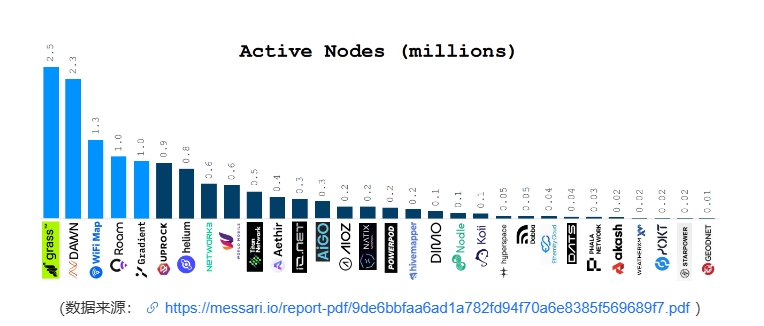
According to the 2024 DePIN Annual Report released by Messari, in 2024, more than 13 million devices worldwide contribute to DePIN every day, among which Roam ranks fourth among the top projects with more than one million active nodes, and is highly praised in terms of technical practicality, user scale and ecological value. In addition, Roam has been ranked first in the DePIN Scan hardware node list since December 2024, and its technical framework has been promoted by Solana as an excellent industry case, demonstrating its benchmarking position in the field of Web3 infrastructure.
Technological moat: OpenRoaming and DID, ensuring security and privacy
The rapid rise of Roam and its leading role in wireless network innovation worldwide is inseparable from the support of a series of hard-core technologies behind it. Its technological moat stems from two core capabilities: OpenRoaming technology integration and DID and VC technologies.
As the only Web3 identity provider in the OpenRoaming program of the Global Wireless Broadband Alliance, Roam deeply combines enterprise-level wireless roaming protocols with decentralized architecture. Its network supports automatic and seamless switching at the cellular level, and user devices can jump seamlessly between different WiFi hotspots. The communication process is fully encrypted, and the security is comparable to that of 5G private networks. This technology solves the pain points of cumbersome and low-security access to traditional public WiFi, making the Roam network the preferred communication solution for business travelers around the world. Roam already has more than 4.5 million OpenRoaming™ available WiFi hotspots in more than 190 countries around the world, and the coverage will continue to expand.
At the same time, Roam has built a decentralized user identity system through distributed identity (DID) and verifiable credential (VC) technology. Through the DID mechanism, users can create digital identities controlled by themselves, and complete identity authentication without repeatedly providing personal sensitive information when connecting to the network. Behind each DID is a user's own key, which is used to cryptographically prove their identity, thereby avoiding the intrusion of traditional centralized authentication on privacy. VC technology can provide verifiable digital credentials for identities and nodes in the network, ensuring that only trusted devices and users can participate in the connection and collaboration of the Roam network.
In general, the ownership of user data belongs entirely to the individual, and network contribution behaviors (such as bandwidth sharing and data uploading) are verified on the chain to generate tamper-proof contribution certificates, ensuring the transparency and fairness of incentive distribution. This technical architecture not only provides a high-quality, traceable telecommunications data layer for AI training, but also greatly reduces the entry threshold for Web2 users through the free business model of "mining while using" - users can enjoy global roaming services without prepaying costs, and the behavioral data generated by network use is desensitized and fed back to AI model training, forming a sustainable data economy closed loop. Users not only enjoy convenience, but also benefit from contributing to the network, thereby spontaneously growing the Roam community. This community-driven, free Internet access plus incentive strategy is one of the important reasons why Roam has rapidly accumulated user and node resources.
OpenRoaming WiFi + eSIM Top-Up: Dual-engine drive
At the specific product level, Roam uses the dual-engine solution of OpenRoaming WiFi + eSIM Top-Up to create a seamless connection experience for global users anytime, anywhere. Simply put, Roam combines open WiFi access and cellular data services on the same platform: when the user is in a covered area, the Roam application will automatically connect to the nearby OpenRoaming™ WiFi hotspot; when there is no WiFi coverage, Roam seamlessly switches to the eSIM cellular data service it provides to ensure that the user is always online. This intelligent switching solution allows users to enjoy smooth network access wherever they are, without having to manually change SIM cards or repeatedly enter login information. For people who travel frequently, Roam's solution greatly facilitates cross-border communications and truly realizes the experience of "one network" for the global network.
Roam eSIM has covered more than 190 countries and regions. When users arrive at any destination, their mobile devices can automatically switch to the local data network without incurring roaming charges. The entire process does not require the replacement of physical SIM cards or cumbersome procedures, and is completely completed by the Roam application in the background.
New users can get 50MB of free data when they apply for Roam eSIM for the first time. After that, they can continue to get up to 5GB of free eSIM data rewards by signing in to WiFi hotspots and completing tasks in the Roam App. Roam has also launched a continuous sign-in activity for eSIM. If users stick to the sign-in for 7 days, they can accumulate nearly 1GB of additional free data to encourage users to use it for a long time. When users have greater data needs, they can also pay to recharge eSIM data packages directly in the app. It is worth mentioning that the tariff of Roam eSIM is quite favorable: compared with the roaming packages of traditional operators, Roam's communication costs can be reduced by about 30% to 80%. For example, users can get a data quota worth $65 for the first recharge of $50, and enjoy an additional gift of about $15. In addition, the purchased data is deducted according to actual use, and there is no problem of expiration, which is far more flexible than traditional operator packages. This cost-effective strategy makes Roam eSIM very attractive to cross-border travelers and business people. At the Consensus Hong Kong 2025 conference in mid-to-late February this year, Roam provided free eSIM traffic to users from all over the world.
Value support in the DePIN era: Business prospects of combining telecom data layer with AI
In addition to providing connection services for individual users, Roam is built on a telecommunications data layer with profound commercial value. The numerous nodes in the Roam network will generate massive amounts of real-time data during operation, such as network connectivity and device access data at different geographic locations and times. After being collected and processed by Roam's decentralized architecture, these anonymous massive data will form a telecommunications-grade data resource pool. These network data from the real world can be used as valuable material sources for AI model training and optimization. The distributed data of the Roam network is more diverse and reliable, and can provide artificial intelligence with a training foundation that is closer to real-life scenarios. The open data base created by Roam will benefit any AI or IoT application that requires large-scale real-world network data in the future.
The rapid rise of Roam has also received great attention from the capital market. At the end of 2023, Roam completed a strategic financing of US$5 million, led by well-known institutions such as Anagram and Volt Capital, which provided support for its further development. Then, in April 2024, Samsung Next, a subsidiary of technology giant Samsung, also made a strategic investment in Roam. It is worth mentioning that this investment is the only investment made by Samsung Next in the DePIN field in 2024. The support of Samsung Next not only brings funds, but also represents the recognition of the Roam model by traditional large technology companies. At present, Roam has raised more than US$10 million in total, and resources are continuously invested in hardware research and development and regional market penetration.