Against the backdrop of the rapid development of AI technology, the centralization of computing resources and the high cost are still the main bottlenecks for innovation and popularization. Prime Intellect, as a decentralized peer-to-peer computing power and intelligent protocol, aims to provide a new path for open-source intelligence by aggregating global distributed computing resources and promoting collaborative AI model development.
This article will introduce this project from three dimensions: investment background, team background, and protocol operation.
Prime Intellect Team Background
Prime Intellect was founded in January 2024 by two co-founders, Vincent Weisser and Johannes Hagemann.
CEO Vincent Weisser has relatively rich experience in Web3, mainly focusing on the DeSci and AI fields. He is the co-founder of the DeSci projects Bio Protocol, VitaDAO, and CryoDAO, and previously served as the ecosystem and AI manager of DeSci Molecule. In addition, Vincent Weisser also helped create the experimental community Zuzalu.city in 2023.
CTO Johannes Hagemann mainly focuses on decentralized AI, semi-automation, energy optimization, clear technological optimism, brain-computer interfaces (BCIs), longevity, and other fields. He previously worked as an AI research engineer at the German AI system developer Aleph Alpha and served as a strategic advisor for VitaDAO from May 2021 to January 2023.
Financing Background: Heavyweight Figures in the AI Field Increase Their Investment
In April 2024, Prime Intellect completed a $5.5 million seed round of financing, co-led by Distributed Global and CoinFund, with participation from Compound, Collab+Currency, and Juan Benet, the founder of Protocol Labs. In addition, the seed round also attracted well-known angel investors such as Clem Delangue, the CEO of the machine learning construction tool Hugging Face.
In early 2025, Prime Intellect made further significant financing progress, completing a $15 million new round of financing, led by Founders Fund, with participation from Menlo Ventures. This round of financing attracted several heavyweight figures in the AI and Web3 fields, including Andrej Karpathy (EurekaAI, Tesla, OpenAI), Clem Delangue (Hugging Face CEO), Dylan Patel (SemiAnalysis), Tri Dao (Chief Scientist of the generative AI cloud platform Together.AI), Balaji Srinivasan (Network School), Emad Mostaque (co-founder of Stability AI), Jake Medwell (co-founder of 8VC), Brendan McCord (Cosmos Institute), and Sandeep Nailwal (co-founder of Polygon). After this round of financing, its total fundraising exceeded $20 million.
It is worth mentioning that Prime Intellect's investor Andrej Karpathy was one of the founding members of OpenAI and previously served as a research scientist at OpenAI and the director of AI at Tesla. Emad Mostaque was the CEO of Stability AI and later resigned to focus on decentralized artificial intelligence, and he is also an advisor to the decentralized GPU rendering solution provider Render.
How Does It Operate?
The official said that Prime Intellect is based on existing decentralized AI work, developing infrastructure and economic incentive measures to aggregate and coordinate global computing resources, and realize a truly sovereign open-source AI ecosystem. Currently, the protocol is running on an internal testnet and has been fully integrated and launched on SYNTHETIC-1. Prime Intellect has delivered several key works or products in the past year.
Compute Exchange: Aggregating, coordinating, and scheduling global GPU resources, integrating computing resources from data centers, cloud service providers, and even individual GPU owners into a unified resource pool. Users can choose the most cost-effective GPU resources based on chip type, quantity, and rental time. This not only reduces the computing cost of AI training but also promotes the democratization of AI technology through efficient supply and demand matching and improved resource utilization.
PRIME: A decentralized training framework that supports training large-scale models on globally distributed computing resources, enabling fault-tolerant training, and supports the dynamic activation/deactivation of computing resources, and optimizes communication and routing in the global distributed GPU network.
In October 2024, Prime Intellect launched the decentralized training of a 100 billion parameter model, INTELLECT-1. Leading open-source AI participants such as Hugging Face, SemiAnalysis, Arcee, Hyperbolic, Olas, Akash, and Schelling AI contributed computing power to this decentralized training.
GENESYS: A synthetic data generation framework that can easily extend open-source libraries for synthetic data generation and verification, as well as the invocation of crowdsourcing tasks and verifiers. In February 2025, Prime Intellect announced that it would use DeepSeek-R1 to create the verified mathematical, coding, and scientific reasoning trajectory open-source dataset SYNTHETIC-1.
TOPLOC: Prime Intellect introduced the verifiable reasoning method TOPLOC, which uses compact local-sensitive hashing (LSH) technology to accurately detect unauthorized modifications to models, prompts, or computational accuracy. When generating a response, a pre-filling of the input token is required, and then multiple decodes are performed for each new generated token. During verification, all tokens can be passed at once and only one pre-filling is required.
The Prime Intellect protocol forms a coordination layer, connecting all these components and providing economic incentives to attract the computing and capital needed to achieve scale.
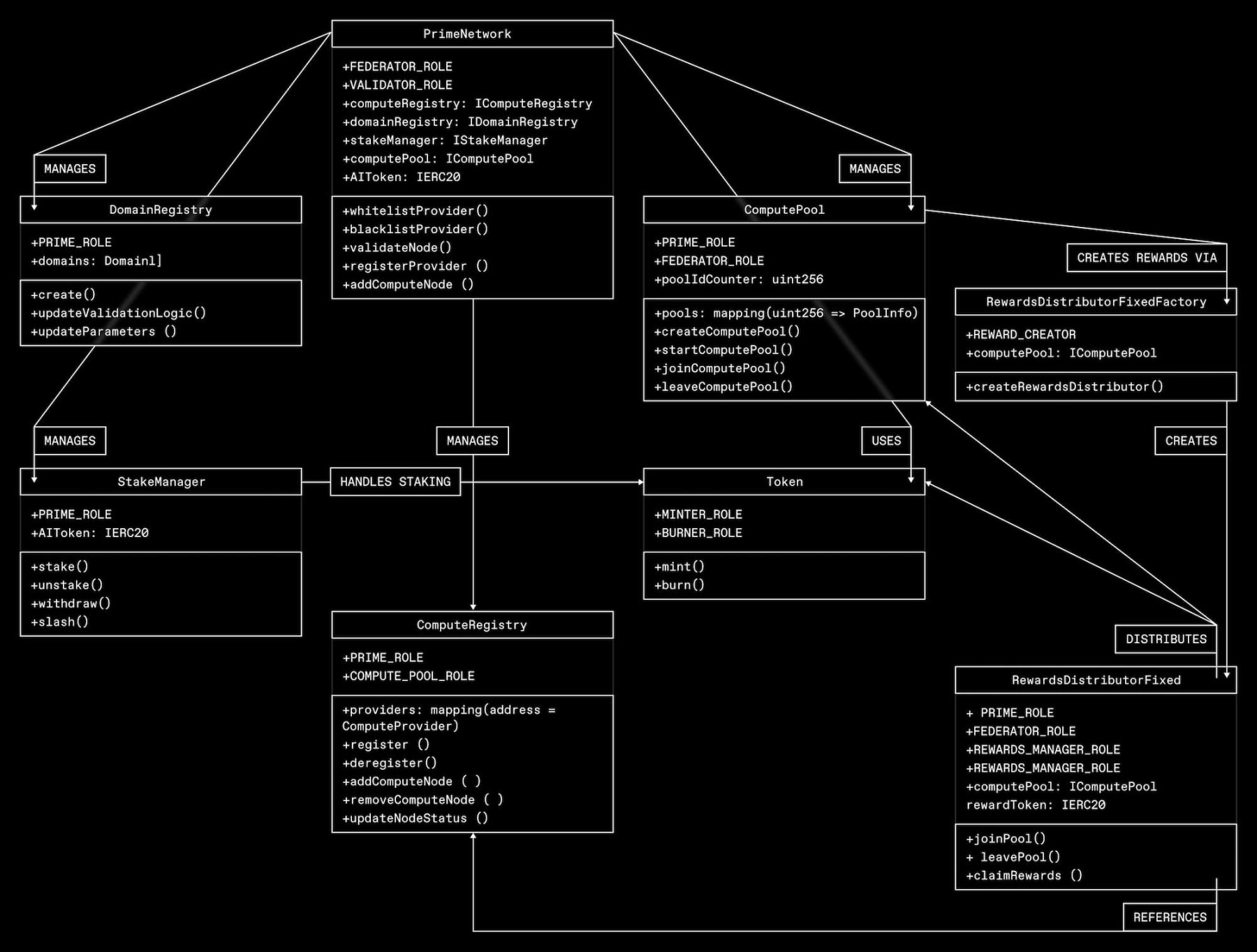
The main components of the Prime Intellect protocol include Workers (users running software to contribute computing resources), Verifiers, Orchestrators (pool creators who manage the workers in the pool and coordinate the current workload running on the servers), and smart contracts.
The Prime Intellect smart contracts are currently deployed on the Base Sepolia testnet, but Prime Intellect plans to migrate to its own chain later. The contract component RewardsDistributor describes that node rewards can be calculated based on the active time in the computing power pool and distributed accordingly.
This means that Prime Intellect may issue tokens when launching the Base mainnet or releasing its own chain. Prime Intellect plans to release a public testnet in the coming months, allowing anyone to contribute computing power and make contributions without permission.
Summary
Prime Intellect aims to build a sovereign open-source AI ecosystem by aggregating large-scale computing power, providing a global GPU resource scheduling market, and allowing anyone to create and contribute open models, agents, and datasets, collectively owning the results of their contributions. This model is expected to drive global participants to jointly build open-source AI models.
Prime Intellect also stated that it is exploring the collective ownership and programmable licensing of models and agents to reward contributors and provide new revenue sources for open-source AI.
As stated in its mission, Prime Intellect hopes to use the power of decentralization to massively popularize AI development, accelerate progress in high-impact areas such as science, agents, and code, and ultimately build an open, transparent, and increasingly beneficial intelligent ecosystem.