Looking back to the beginning of 2024, the Bitcoin ecosystem was greatly boosted by the rise of Ordinals and Runes, which temporarily caused congestion on the Bitcoin mainnet. While discussing the application of the Bitcoin ecosystem, many teams saw a new direction of development - "Bitcoin Layer 2".
Since the Bitcoin network does not natively support smart contracts, in order to further accelerate Bitcoin's entry into DeFi, GameFi, and NFT, the Bitcoin Layer2 protocol Bitlayer recently announced strategic partnerships with five blockchains including Base, Starknet, Sonic, and Plume Network, to jointly promote the BitVM Bridge cross-chain bridge and unlock the huge liquidity of BTCFi.
What is BitVM Bridge?
According to the official document, the cross-chain bridge BitVM Bridge is built by the Bitlayer team based on the BitVM smart contract, Fraud Proofs, and Zero-Knowledge Proofs (ZK Proofs) framework, and will be able to support multiple ecosystem environments.
The main function of this protocol is to bridge BTC into Peg-BTC, making it convenient to cross-chain to other blockchains. Initially, BitVM Bridge supports interaction with Bitlayer Rollup and Ethereum, and will gradually expand to other EVM-compatible chains (such as the aforementioned strategic partners), and even non-EVM ecosystems (such as Solana).

Why mint Peg-BTC?
Some readers who are not familiar with DeFi may not understand why BTC needs to be minted as Peg-BTC.
That's because the native token of the Bitcoin network cannot be directly used on another chain (such as Ethereum or Solana), so it is necessary to "lock the BTC on the mainnet" and "release the equivalent BTC on other blockchains" through a cross-chain bridge to allow users to participate in the rich DeFi protocols on other chains.
The Peg-BTC minted through the BitVM Bridge will be pegged to BTC at a 1:1 ratio, and its programmable nature allows users to flexibly participate in DeFi operations in various ecosystems, expanding more financial application scenarios. For example, after cross-chaining, users can stake, borrow, and perform other DeFi operations with Peg-BTC on Bitlayer.
How does BitVM Bridge significantly reduce the trust risk of cross-chain bridges?
However, in the decentralized Bitcoin mainnet, most BTC cross-chain bridges still rely on "trust assumptions", that is, these cross-chain funds are controlled by a "single" or "majority" entity, which also introduces additional trust risks in the process of BTC assets crossing chains, and this is also a major concern for some Bitcoin holders when using cross-chain bridges.
To address this, the following will explain how BitVM Bridge reduces the trust risk of cross-chain bridges through the evolution of three generations of BTC bridging technologies:
The first-generation BTC bridging technology relies on a centralized custodial model, where the bridged funds are locked in an address controlled by a single entity, such as wBTC. Additionally, BTC bridging solutions based on multi-party computation (MPC) require a pre-defined group to distribute control of the funds. Although these models have certain practicality, they still have centralization risks.

The second-generation bridging technology introduces a "distributed custodial mechanism" to try to solve the above problems, by randomly selecting multiple entities to jointly manage the funds, and combining incentive and penalty mechanisms to reduce the risk of collusion. However, even with the improvement of distributed custodianship, the bridging technology still relies on the "honest majority" assumption and does not completely eliminate the dependence on trust.
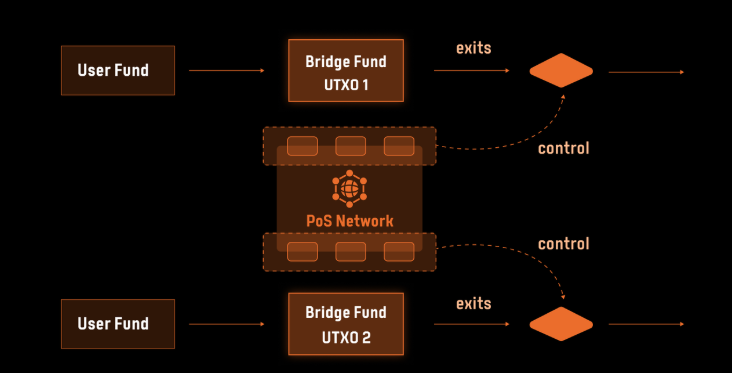
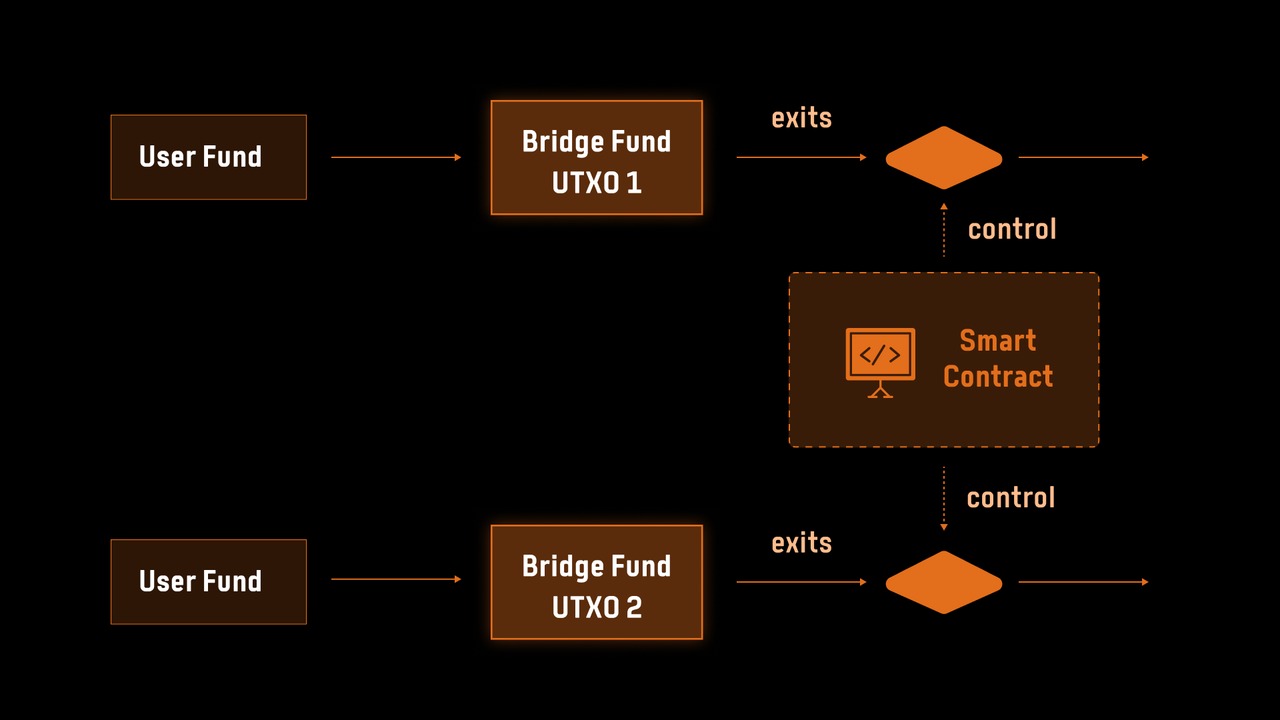
The third-generation bridging technology represented by BitVM Bridge, on the other hand, significantly reduces the trust assumption through "smart contract custodianship" that minimizes trust. In this model, the funds are locked in addresses controlled by the BitVM smart contract, and the system only needs to assume that at least one participant is honest, this "1-of-N" trust design significantly reduces the trust assumption required, making the cross-chain system more robust.
As for the fourth-generation bridging technology, it is currently still in the theoretical concept stage, and it is expected that after its realization, "trustless" smart contracts will become possible.
Constructing the BitVM Bridge Operation Framework with Three Major Processes
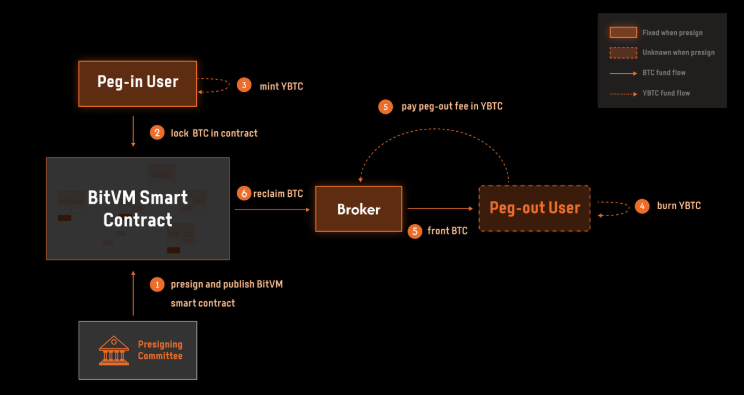
Additionally, let me explain the terminology: when using the BitVM Bridge to perform cross-chain operations, the complete operation framework is constructed using the three major processes of Peg-in, Peg-out, and Reclaim.
- Peg-in and Peg-out are responsible for providing users with cross-chain exchange of BTC and Peg-BTC
- Between the two, there is also a Broker (intermediary) providing short-term liquidity to prepay the fund exchange requests made by Peg-out.
- As for the Reclaim process, it uses the optimistic assumption (assuming the Broker is honest) to allow the Broker to recover the BTC it prepaid in the peg-out operation. However, in case of disputes, the fraud proof challenge mechanism (7-day challenge period) can be triggered.
Are There Any Benefits to Participating in the Testnet and Using Peg-BTC?
Currently, the BitVM Bridge testnet has been launched, and users can log in to the testnet to experience functions such as Mint, UnMint, and Reclaim. But will there be additional airdrop benefits for using Peg-BTC in the testnet operations? Based on the current announcements and documentation, the official has not explicitly mentioned this.
However, users can participate in the various ecosystem airdrop activities hosted by the Bitlayer mainnet and receive corresponding BTR token rewards for completing tasks. Although the Bitlayer native token BTR has not yet been launched, the value of these token credits is still unknown. But if the user already has Bitcoin spot, they may consider whether to release more value.
What Protocols Does Bitlayer Have?
Let's get to know the leading protocols in various tracks of Bitlayer:
- Redelegation Protocol Desyn Protocol, TVL $285 million
- Lending Protocol Avalon Finance, TVL $278 million
- Stablecoin Protocol BitSmiley, TVL $27.34 million
- Lending Protocol TRUSTIN Finance, TVL $7.61 million
- DEX bitCow, TVL $4.67 million
In addition to DeFi projects, the Launchpad protocol PumpPad, the AI infrastructure DeAgentAI, and the decentralized oracle APRO Oracle are also well-known protocols on Bitlayer.
Can BitVM Open Up the BTC Ecosystem Development?
With the adoption and development of BitVM smart contracts, including Bitlayer, many BTC ecosystem projects have already utilized BitVM as the development environment. As a result, the BitVM Alliance, which is dedicated to exploring the potential of BitVM, has emerged.
The alliance was founded by Robin Lukas and Lukas George, and currently has 6 Bitcoin protocols joined, including Bitlayer, Citrea, Element, Fiamma, Strata, and ZeroSync.
With the continuous efforts of BitVM technology and ecosystem in the near future, and the fact that Trump has recently signed an executive order to establish a US Bitcoin strategic reserve, the subsequent development of the BTC ecosystem is likely to be more prosperous. Whether the launch of the Bitlayer cross-chain bridge can bring a new wave of wealth effect is worth our attention.