Source: The Heart of the Metaverse
The global tech giant Google recently launched the Gemma 3 series of open-source AI models, which is the latest version of its open-source AI model family, aiming to set a new benchmark for the popularization of artificial intelligence technology.
As an upgraded version of the Gemini 2.0 model architecture, Gemma 3 has the characteristics of being lightweight, portable, and highly adaptable, allowing developers to use it to develop AI applications on various devices.
On the first anniversary of the launch of the Gemma model, its cumulative downloads have exceeded 100 million, and the community developers have derived more than 60,000 improved versions based on it. This ecosystem, known as the "Gemmaverse", is becoming a driving force in promoting the democratization of AI technology.
01. Key Highlights of Gemma 3
Gemma 3 provides a variety of model sizes - with parameters of 10 billion, 40 billion, 120 billion, and 270 billion, respectively - allowing developers to flexibly choose based on their hardware conditions and performance requirements. These models can run quickly on ordinary computing devices while ensuring that their functionality and accuracy are not affected.
Its core advantages include:
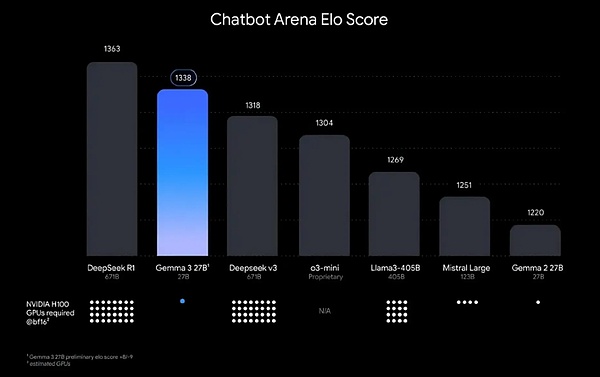
The performance king on a single card: Gemma 3 has set a new benchmark in the single-card model. In the Chatbot Arena benchmark test, it defeated competitors including Llama-405B, DeepSeek-V3, and o3-mini.
Supports more than 140 languages: To serve global users, Gemma 3 has built-in pre-training capabilities for more than 140 languages. Developers can create applications that are more suitable for users' native language communication, greatly expanding the global impact of their projects.
Advanced text and visual analysis: Leveraging its advanced text, image, and short video reasoning capabilities, developers can use Gemma 3 to develop highly interactive and intelligent applications, covering a variety of scenarios from content analysis to creative workflows.
Extremely large context window: Gemma 3 provides a context window of up to 128,000 tokens, allowing it to analyze and integrate large-scale datasets, making it very suitable for applications that require in-depth content understanding.
Automated workflow function calls: By supporting function calls, developers can easily implement process automation using structured outputs, creating intelligent agent systems.
Lightweight quantized models: Gemma 3 has launched an official quantized version, which significantly reduces the model size while maintaining output accuracy, which is particularly beneficial for optimizing mobile devices or resource-constrained environments.
The performance advantage of Gemma 3 is evident in the Chatbot Arena Elo ranking. With just one NVIDIA H100 GPU, its flagship 27 billion parameter model ranks among the top chatbots, with an Elo score of 1338. Many competitors require up to 32 GPUs to achieve similar performance.
Another major advantage of Gemma 3 is its seamless integration into developers' existing workflows. It can flexibly adapt to developers' existing workflows, making the development process smoother, including:
Compatible with multiple tools: Gemma 3 supports many mainstream AI libraries and tools, such as Hugging Face Transformers, JAX, PyTorch, and Google AI Edge. If optimization and deployment are needed, platforms like Vertex AI and Google Colab can help developers get started quickly, with almost no additional configuration required.
NVIDIA performance optimization: Whether users are using an entry-level Jetson Nano GPU or a top-of-the-line Blackwell chip, Gemma 3 can deliver optimal performance. Through the support of the NVIDIA API Catalog, the entire optimization process becomes simpler.
Broad hardware support: In addition to NVIDIA, Gemma 3 is also compatible with AMD GPUs through the ROCm technology stack, and can even run on CPUs using Gemma.cpp, demonstrating exceptional adaptability.
If developers want to try it out immediately, they can directly use the Gemma 3 model through platforms like Hugging Face or Kaggle, or quickly deploy it in the browser using Google AI Studio.
02. Promoting Responsible AI Development
Google stated: "We believe that open models require careful risk assessment, and our approach is to strike a balance between innovation and safety."
The Gemma 3 development team has adopted a strict management strategy, through meticulous tuning and robust benchmarking, to ensure the model's compliance with ethical standards.
Given the significant improvement in the model's capabilities in the STEM (Science, Technology, Engineering, and Mathematics) field, the team has conducted targeted assessments to mitigate the risk of misuse, such as the generation of harmful content.
Google calls on the industry to work together to build an appropriate safety framework for the increasingly powerful models.
To fulfill its own responsibility, Google has launched ShieldGemma 2, a 40 billion parameter image safety inspection tool developed based on the Gemma 3 architecture, which can generate safety labels for categories such as dangerous content, explicit materials, and violence. It not only provides an out-of-the-box solution, but developers can also customize the tool according to their specific security needs.
"Gemmaverse" is not only a technical ecosystem, but also a community-driven movement. Projects like AI Singapore's SEA-LION v3, INSAIT's BgGPT, and Nexa AI's OmniAudio demonstrate the tremendous collaborative power within this ecosystem.
To support academic research, Google has also launched the Gemma 3 Academic Program. Researchers can apply for $10,000 worth of Google Cloud credits to accelerate their AI-related projects. The application is open from today for four weeks.
With its ease of use, powerful functionality, and wide compatibility, Gemma 3 has the potential to become the cornerstone of the AI development community.