Followin' the period from March 8 to March 11, ETH declined by 13% as investors shifted to short-term fixed income and cash positions, seeking safety amid global tariff wars and growing concerns about economic recession.
VX: TZ7971
ETH price needs to rise 29% to return to $2,500.
Market concerns escalated after the US took retaliatory measures against Canada's electricity surcharge.
Typically, traders tend to overreact, increasing the likelihood of ETH rebounding faster than other assets as market sentiment improves. While some believe risk assets are driven by inflation and economic growth data, others think returns depend on stimulus measures and monetary expansion.
Regardless of the next bull market catalyst, ETH price must rise 29% from the current $1,940 level to return to $2,500. This move may require increased demand from leveraged buyers, whose activity is currently at a five-month low.
Traders hope for higher prices to offset longer settlement cycles, so in a neutral market, the annualized premium (basis rate) is expected to be 5% to 10%. When rates fall below this range (e.g., the current 4.5%), it indicates weak bullish sentiment.
Excessive optimism played a role in ETH's recent pullback, as $235 million in leveraged long positions were liquidated from March 10 to March 11.
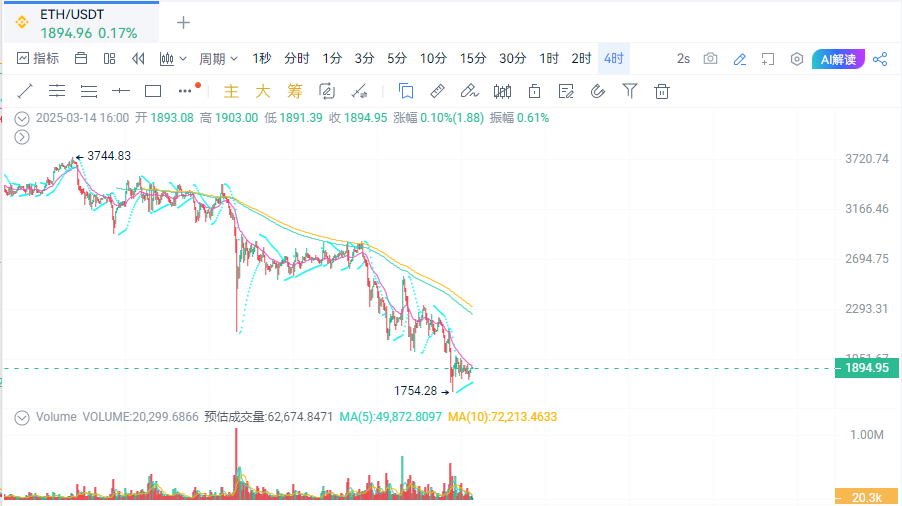
The panic sell-off pushed ETH to a low of $1,754, the lowest level since October 2023. However, some indicators suggest a potential recovery, as ETH derivatives and on-chain metrics show resilience.
Growth of ETH Layer-2 Networks
ETH's trading price is 60% lower than its $4,868 all-time high in November 2021. This decline is primarily due to increased competition in the smart contract space and weakening demand for applications like non-fungible tokens (NFTs), gaming, collectibles, metaverse projects, social networks, and Web3 infrastructure.
However, this view overlooks a key factor. In late 2021, average transaction fees exceeded $50, while the activity on the ETH Layer-2 ecosystem was 97% lower than today.
For reference, despite the growth in average daily operations, on March 11, the cost of token swaps on the ETH base layer was $1.70, highlighting the significant progress in network efficiency.
Even if bots generated 80% of the Layer-2 transactions, the remaining 20% of activity on Base, Arbitrum, Optimism, ZKsync, and Blast is still about three times that of the ETH base layer. However, critics have a valid point: while network activity has surged, the rewards earned by validators have decreased significantly compared to late 2021.
ETH Regains DEX Leadership, TVL Growth
ETH has consolidated its position as the second-most popular choice for traditional financial institution investors, with an $8.9 billion spot exchange-traded fund (ETF) backing it.
Meanwhile, competitors like Solana are still awaiting regulatory approval for similar ETF products. Even if they receive approval, they cannot match the first-mover advantage of the Grayscale Ethereum Trust, which began publicly trading in the over-the-counter market in June 2019.
Furthermore, ETH smart contract deposits (measured by total value locked, or TVL) reached their highest level since July 2022 on March 11, growing 10% in the past two weeks.
ETH's TVL reached 24 million ETH, driven by the growth of liquidity staking, lending, yield farming, and the tokenization of real-world assets. According to defillama data, the network recently regained its leading position in decentralized exchange (DEX) trading volume, reaching $20.5 billion in the past seven days, surpassing Solana's $13.9 billion.
This provides a bullish outlook for ETH's price, driven by the following factors: Layer-2 transaction volume nearing all-time highs, regaining the DEX trading volume leadership, and growth in TVL deposits.
Ultimately, ETH's trend reversal remains highly dependent on macroeconomic improvements, but once stabilized, ETH is fully capable of returning to $2,500 and establishing it as a key support level in the coming weeks.