A proposal suggesting that XRP is a strategic financial asset has been submitted to the US Securities and Exchange Commission (SEC). The SEC often receives unsolicited proposals from individuals or organizations, but these proposals do not automatically lead to action.
The document outlines how the US could use XRP to unlock liquidity and potentially secure a significant Bitcoin reserve.
XRP Proposed as the Primary Liquidity Asset for the US Crypto Reserve
The author of the proposal, Maximilian Staudinger, advocates for a structured approach to President Donald Trump's crypto reserve initiative. Staudinger's strategy places Bitcoin at the core of the US reserve while positioning Solana and Cardano for government applications.
He argues that while these blockchains enhance security and efficiency in government operations, XRP remains the key asset for financial transactions.
"Solana and Cardano should be integrated into the US digital infrastructure, but not included in the reserve strategy. Instead, they should enhance the efficiency and security of government applications, while XRP remains the key asset for financial transactions," Staudinger argues.
Considering this, Staudinger claims that integrating XRP into the traditional financial system will unlock capital trapped in Nostro accounts. These accounts support cross-border transactions and hold a combined total of $27 trillion globally.
He estimates that $5 trillion of this belongs to the US, with XRP potentially unlocking $1.5 trillion. This liquidity, he claims, could be redirected to purchase Bitcoin.
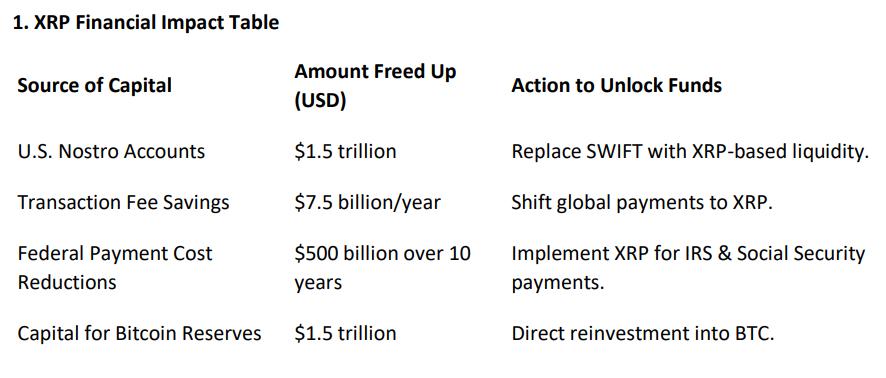 The financial impact of XRP as a strategic reserve asset. Source: Staudinger's proposal to the SEC
However, his proposal that the US could secure 25 million BTC at $60,000 per coin conflicts with Bitcoin's fixed supply limit of 21 million.
Beyond liquidity, the proposal claims that shifting financial transactions to XRP could generate up to $7.5 billion in annual savings from transaction fees. It also suggests that XRP could simplify government payments, including IRS tax refunds and Social Security distributions.
Regulatory Uncertainty Around XRP Poses Challenges
Despite its ambitious vision, the proposal acknowledges that the legal status of XRP remains a significant barrier.
Staudinger calls for the SEC to officially classify XRP as a payment asset rather than a security and urges the resolution of the agency's ongoing legal battle with Ripple.
He also proposes that the Department of Justice (DOJ) remove restrictions preventing banks from using XRP-based solutions. To accelerate adoption, he suggests a presidential executive order to overcome legal hurdles.
 The roadmap for deploying the strategic reserve asset XRP. Source: Staudinger's proposal to the SEC
Meanwhile, the document outlines two potential timelines: a standard deployment phase lasting two years and a fast-track plan from six to twelve months.
The latter plan would require immediate legal approval, accelerated government testing of XRP, and a mandate for banks to integrate XRP as a liquidity tool.
Importantly, independent proposals like Staudinger's typically carry little weight unless backed by strong industry support or policy interest.
If a proposal comes from a major financial institution, regulatory body, or industry group, it is more likely to be taken seriously.