Two days ago, Tether's CEO Paolo Ardoino announced their new plan: to promote solar kiosks in Africa. Currently, several hundred solar kiosks are already in operation, providing a monthly subscription service for high-performance batteries, with users able to pay using USDt and Bitcoin. Tether plans to expand this model to 100,000 solar kiosks, helping to electrify the African continent.
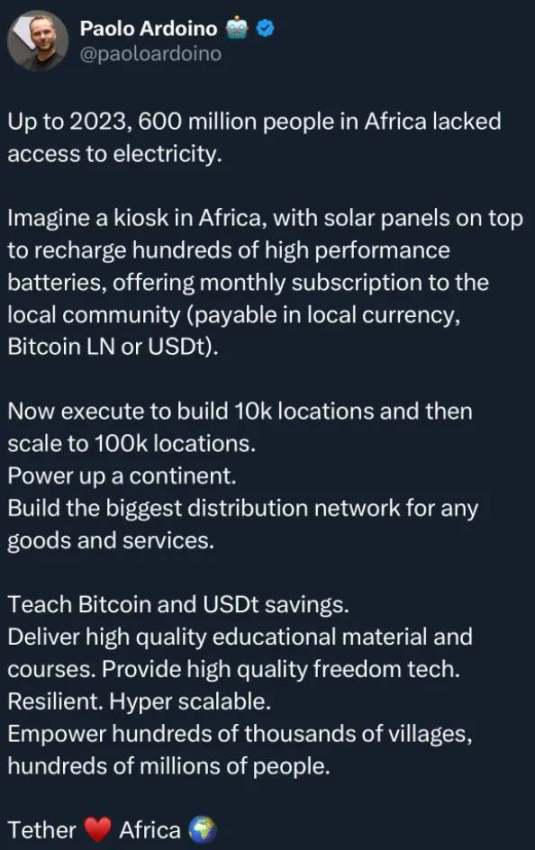
My initial reaction is that this is a very meaningful attempt. As I mentioned in a recent article on the off-grid energy potential in Africa, innovative energy solutions are key to driving Africa's development. The electrification of the African continent is not a zero-sum game, and there is no single solution that can completely solve the electrification problem in Africa. Currently, up to 600 million Africans lack access to electricity, accounting for 83% of the global unelectrified population. Therefore, exploring new off-grid energy models is the inevitable direction for the future.
I fully agree with Paolo's view that Tether is a once-in-a-century enterprise. In 2024 alone, Tether's profit reached $13.7 billion. Tether's usage continues to grow in the US, EU, and China, while the demand for USDt is also rapidly increasing in developing countries. As local currencies depreciate in some regions, people are increasingly inclined to use stablecoins (digital tokens pegged to fiat currencies like the US dollar) to hedge economic risks. For example, in Ethiopia (population about 123 million), the birr currency depreciated by about 30% in mid-2023. Now, Ethiopia has become the fastest-growing stablecoin market in Africa, with retail stablecoin trading volume growing 180% year-over-year. (Note: Due to the lack of detailed information currently available, the analysis of the Tether model in the text is based on speculation.)
Revisiting Africa's Solar Kiosks
Tether's plan in Africa combines off-grid solar kiosks with stablecoin-based financial services, the latter being a completely new highlight in this model. Before delving deeper, we need to understand the background in this field.
Over the past 15 years, Africa has seen the emergence of many solar kiosk projects provided by commercial companies and non-governmental organizations. The operating models and success/failure factors of these projects provide important references for evaluating Tether's plan. For example:
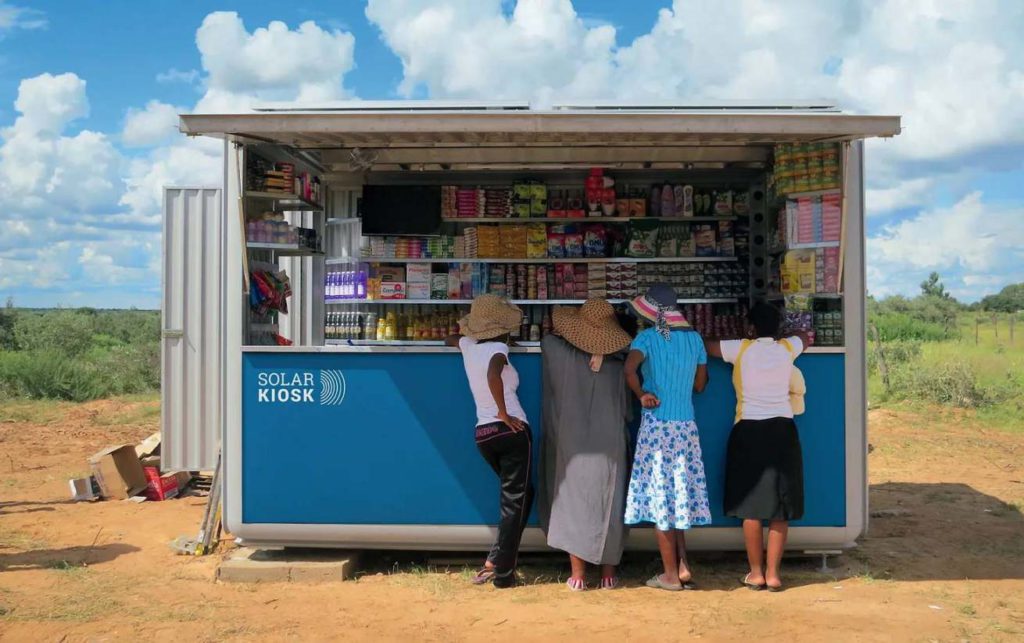
Solar Kiosk (2011-2019): Operated in Ethiopia, Kenya, Botswana, Tanzania, Rwanda, and Ghana, with a peak of 250 solar kiosks.
ARED 'Shiriki Hubs' (ongoing): Covering Uganda and Rwanda, currently with 60 solar kiosks.
Community Energy Kiosks: Part of the SOGERV project in Malawi, smaller in scale with only 4-10 solar kiosks.
Many solar kiosk projects in Africa have faced challenges in profitability and organic growth, often relying on grants or impact investors to fund their operations. Tether's business model is still uncertain. It is believed that Tether is more likely to adopt a franchising model. But regardless of the model Tether chooses, there are a few key points to pay attention to:
Funding Source Determines Success
Tether's plan is backed by a highly profitable commercial company, which lays a solid foundation for the project's success. In contrast, funding models relying on grants, especially in the "post-USAID era" in Africa, struggle to support long-term business expansion. Social impact investments can only provide initial help, but to achieve large-scale deployment, strong capital partners are still needed to invest substantial funds.
Providing More Community Services is Key
If solar kiosks are used solely as low-profit battery charging stations, local operators often struggle to generate sufficient profits. For solar kiosks to achieve sustainable operations, they often need to become community hubs, providing additional functions such as WiFi, mobile payment services, phone charging, and airtime sales. If the solar kiosks can also provide a venue for the village to watch football matches in the evenings, it can attract more traffic and further improve profitability.
Tether's solar kiosk plan has a good starting point: a stable funding source and secured growth financing. Moreover, since franchisees are typically already mobile payment agents, they only need to add USDt stablecoin as a payment option to smoothly implement the subscription service model. At the same time, the solar kiosks also come with built-in WiFi deployment capabilities, providing more added value to the community and further enhancing the project's attractiveness and practicality.
Here is the English translation of the text, with the specified terms translated as instructed:However, expanding the off-grid solar kit in the African rural market is not an easy task. The "last mile" market faces huge logistics and operational challenges, and the competition in the off-grid solar sector is also extremely fierce. The pay-as-you-go home solar financing model has been developing for 13 years, but many companies have failed due to underestimating the competitive environment and logistics complexity of the African market. In addition, the risks of theft and vandalism, as well as the difficulty of building brand trust in a low-trust society, are also key issues that cannot be ignored.
The Rise of African Stablecoins
In recent years, Africa has become a major growth region for cryptocurrency usage, with stablecoins being particularly popular. By mid-2024, about 43% of the total crypto transaction value in sub-Saharan Africa will come from stablecoins. The rapid growth of this proportion reflects people's concerns about the instability of local currencies. In fact, in Africa, stablecoins are even more popular than Bitcoin, becoming the main tool for value transfer. This trend indicates that stablecoins are becoming an important part of Africa's financial ecosystem.
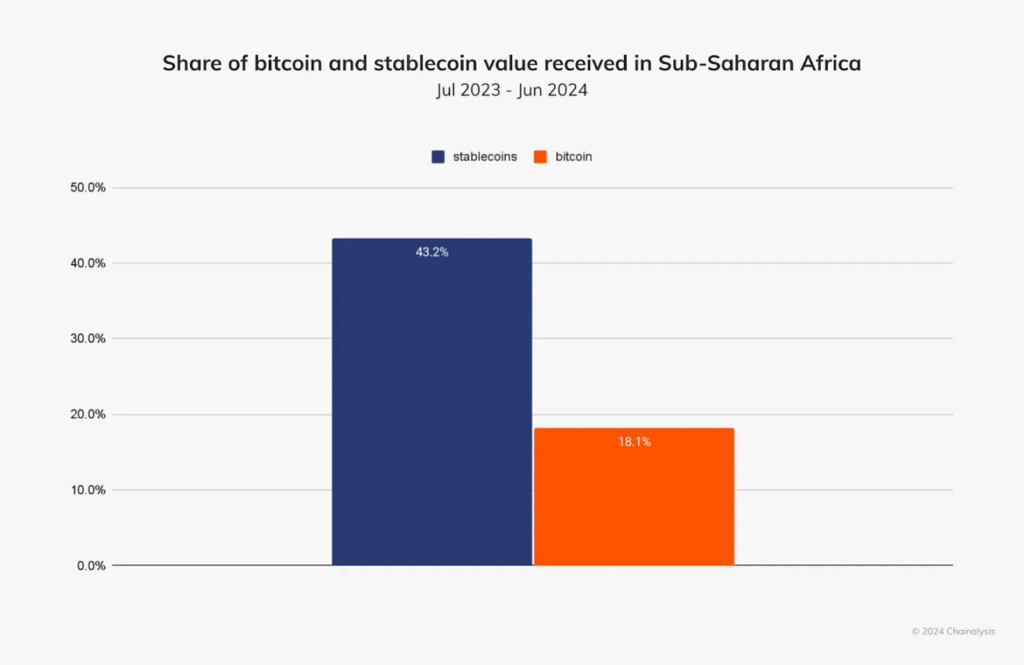
Stablecoins (such as USDT) have already shown very practical use cases in the African economy. A typical application scenario is cross-border trade and payments. Many SMEs choose to use stablecoins for cross-border payments due to the difficulty of obtaining US dollar accounts. These companies can convert their local currency to USDT, complete international transfers in a few minutes, and the recipient can quickly convert it back to hard currency. This greatly optimizes the traditional cross-border payment process. Compared to waiting weeks for high bank transfer fees or relying on the high-risk black market exchange, the use of USDT bypasses traditional intermediaries and high remittance fees, becoming an indispensable tool for many import and export companies. Stablecoins are changing the trade landscape in Africa. In addition, the practical use of stablecoins is also reflected in daily transactions such as paying for overseas tuition and purchasing inventory.
However, the widespread adoption of stablecoins also faces challenges from government regulatory authorities. Some countries are concerned that the large-scale use of USDT may lead to capital outflows and undermine the stability of local currencies. This is particularly evident in some countries, such as Malawi and Nigeria. Due to the severe depreciation of their currencies, many people prefer to choose USDT to meet their domestic and foreign payment needs, further reducing the attractiveness of local currencies. Currently, stablecoins in Africa are still in a "gray area": they are widely used informally, but have not yet received official recognition. This status poses obstacles to large-scale integration. Companies may be reluctant to use USDT openly due to concerns about future government penalties, while fintech startups need to face the challenge of a lack of clear regulatory framework.
We have reason to believe that Tether can perform well in the African market. Tether's strong financial strength has given it an advantageous position in the African market. This financial support has opened many doors of opportunity for it. In addition, Tether's strategy is to expand the use of stablecoins from urban traders to rural areas. For merchants who have extended their supply chains to rural areas, they have already been using USDT in their transactions with counterparts in China and other international markets, so replicating this model to the local market is a natural progression. In this way, Tether hopes to further promote the adoption of stablecoins in Africa, while providing convenient financial services to more users.
Tether's Solar Kiosk Project Holds Promise for Success
The most innovative part of Tether's plan is to integrate stablecoin payments and related financial services into the operation of solar kiosks. This model not only has the potential to change the industry landscape, but also faces certain challenges.
On the one hand, stablecoins have gradually become popular among grassroots users in Africa due to their ability to effectively solve real financial problems. If Tether can extend the application of stablecoins to physical solar kiosks in rural areas, this will further promote financial inclusion. Imagine a farmer who not only can charge their phone at a solar kiosk, but can also convert part of their cash income into a digital USDT balance. This balance not only helps the farmer fight against the hyperinflation of the local currency, but also provides them with a more stable store of value. They can use this balance to purchase agricultural supplies or receive remittances from overseas relatives in a matter of minutes.
In theory, these solar kiosks can not only be an energy supply center, but also become an "informal micro-bank" that supports those who cannot access traditional banking services. By combining energy supply and fintech, this model may significantly improve the overall development of the community - solving both the demand for electricity and providing a safer way to save and transact. Compared to traditional solar kiosk projects, Tether's innovation lies in the integration of financial services, rather than just providing energy and connectivity.
From a business perspective, this model has relatively strong sustainability and the potential to be profitable. However, the goal of this project may not be limited to pursuing profits. Tether's strategy also seems to include expanding the use of stablecoins and establishing brand influence and a good reputation in emerging markets. Against the backdrop of increasing regulatory pressure in the US and EU, Tether is turning its sights to the Southern Hemisphere to explore new growth opportunities. This strategy suggests that Tether may be willing to bear certain losses in the initial stage of the solar kiosk project in order to gradually build a complete ecosystem. This approach is similar to the development path of Mpesa in Kenya: through long-term investment and patient cultivation of the market, ultimately achieving widespread user acceptance and commercial success.
Comparing Tether's Model with Gridless' Model
As another company committed to providing innovative financing models, developing off-grid energy, and actually achieving profitability for Africa, Gridless has a significantly different model compared to Tether. Here is a comparison of the two models:
Tether's plan is to deploy solar kiosks to provide flexible payment options and educational services to African communities. Gridless, on the other hand, focuses on building low-cost hydroelectric power plants in areas with natural water resources, while using excess electricity for Bitcoin mining to provide stable financial support for the project.
Financing Approach
- Gridless mode: Obtain financing by using Bitcoin as collateral to drive project expansion.
- Tether mode: Directly invest in projects through its large reserve funds to achieve rapid growth.
Energy source
- Gridless mode: Utilize hydropower, leveraging the low cost and sustainability of water resources.
- Tether mode: Rely on solar power, fully utilizing abundant and low-cost solar energy resources.
Revenue source
- Gridless mode: Achieve profitability through Bitcoin mining and meeting the community's electricity demand.
- Tether mode: Profit from the payment function of USDT (or Bitcoin), and may also earn income from managing floating funds or attracting users to use other financial services provided by Tether.
Growth potential
Gridless mode: Although limited by the geographical conditions of hydropower, it can provide a more localized and stable energy solution for the community, while achieving financial sustainability through Bitcoin mining.
Tether mode: Leveraging its strong financial resources and standardized solar kiosk design, it can expand the kiosk market more quickly. However, this model may face regulatory barriers related to cryptocurrencies, and there is also a certain complexity in managing a large number of physical sites.
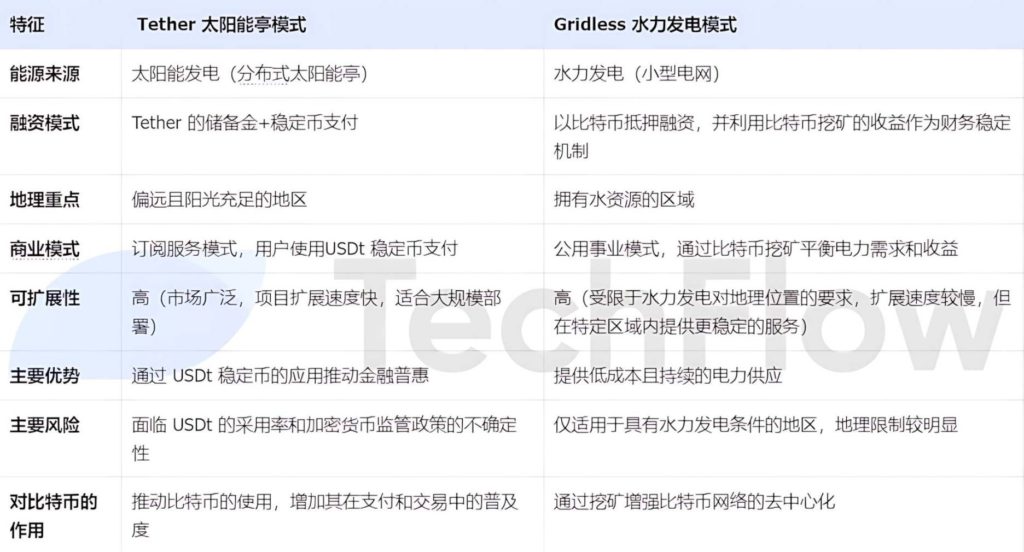
As can be seen, these two models have shown strong innovation in combining renewable energy and cryptocurrencies, but their application scenarios are slightly different. Tether's solar kiosks can quickly cover underserved areas, particularly suitable for regions with abundant solar energy resources but limited traditional grid expansion. While Gridless' hydropower model has a longer deployment cycle, it provides a solution that focuses more on infrastructure construction. This model can provide the community with a lasting and stable power supply, better supporting the long-term development and economic growth of the community.
Ideally, a hybrid model can be adopted. For example, deploy solar kiosks in areas where hydropower is not feasible to fill the energy supply gap. In this way, the overall impact of off-grid electrification in Africa can be maximized, providing reliable energy support to more communities while achieving sustainable development goals.
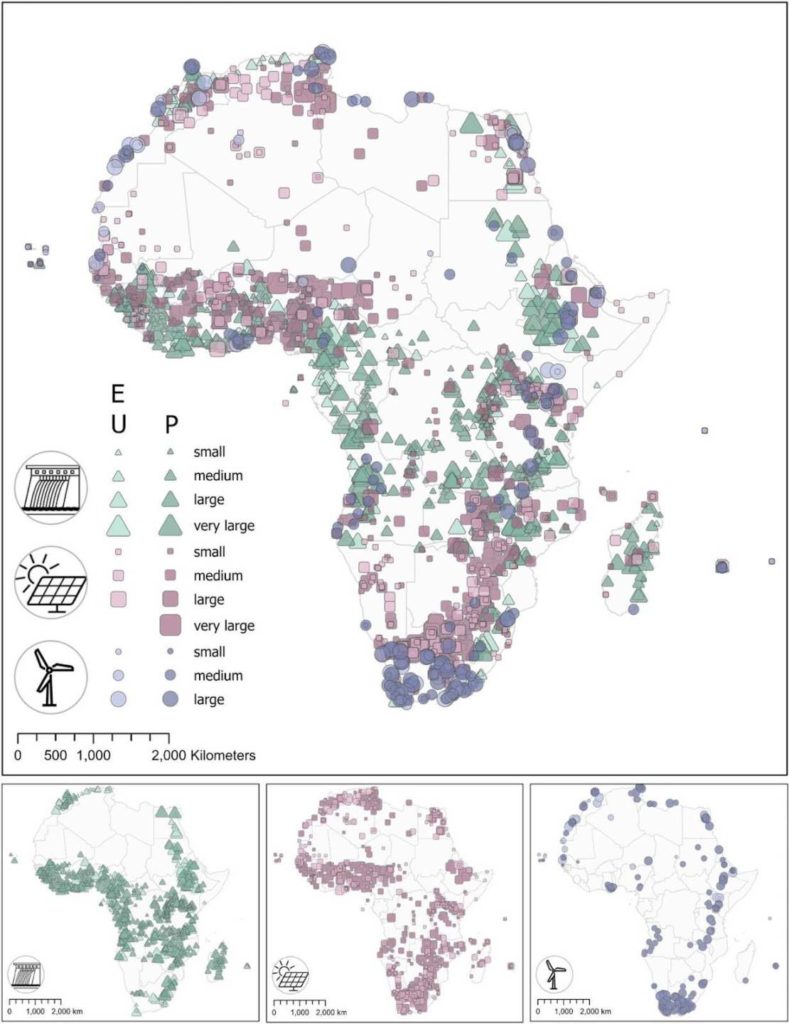
Distribution of hydropower, solar power and wind power in Africa
As shown in the above image, although solar and hydropower have some overlapping regions, there are also large areas more suitable for one type of energy. Tether's solar kiosks are mainly aimed at regions with abundant sunshine but lack of grid, such as the Sahel region and the Horn of Africa. These regions are characterized by high solar radiation intensity and limited hydropower potential, making them very suitable for modular and rapidly deployable solar kiosks. These kiosks can not only provide electricity, but also internet access and financial services for local residents. Gridless, on the other hand, focuses on East Africa and Southern Africa where water resources are abundant, building small hydropower stations. The rivers in these regions have stable flow, which can support 24-hour uninterrupted power supply.