A practical guide to funding rate arbitrage in perpetual contracts.
Author: HangukQuant
Compiled by: Luffy, Foresight News
About a year ago, we first had the idea of using perpetual contracts to conduct funding rate arbitrage idea. Since then, we have published several articles exploring this trading method and related derivative topics, including one article that discussed the value proposition and sources of returns for this strategy. We have also developed a fully systematized perpetual contract arbitrage bot to put the idea into practice.
Today, we want to discuss some of the details and extensions of implementing this trading strategy.
Stacking Expected Value
Let's assume everyone is familiar with funding rate differentials and the strategy of profiting from positive funding rates. If not, please refer to our previous articles. The following discussion applies to both systematic and manual trading.
We start with a table like this. The leftmost column is the asset, and the horizontal columns are n exchanges. We use 'fr'X'' to represent the standardized funding rate, taking into account different time intervals. We focus on combinations with large differentials (the difference between the maximum and minimum values), in which we go long at the exchange with the minimum value and go short at the exchange with the maximum value.
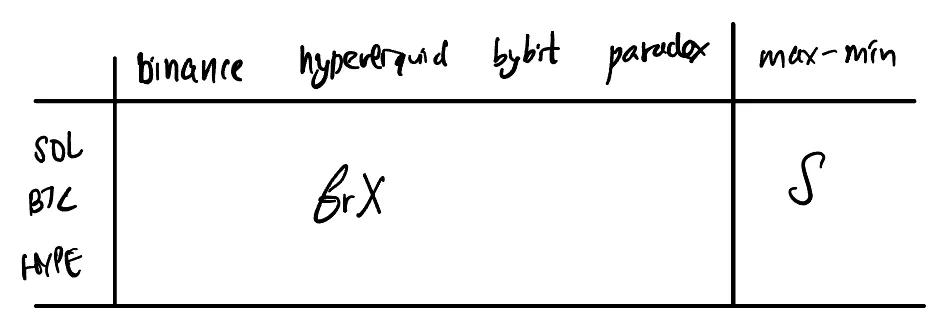
There are some extensions to consider here. Usually, an exchange can provide different quote assets, such as the US dollar stablecoins USDC, USDT, USDE, etc. If we choose to arbitrage a combination that is not priced in the same quote asset, we are actually performing a form of implicit triangular arbitrage. This is generally a good choice. For example, you can compare the following trading pairs:
BTC/USDT, BTC/USDC, USDC/USDT
And then find that their valuations are misaligned. These valuation discrepancies are usually not large enough to trade profitably on the same platform, but stacking them into cross-platform arbitrage can improve the yield. In this case, you will need a price oracle to help you convert the valuations. For example, on Binance, you need the USDC/USDT price information; on Paradex, you need the USDC/USD price information, and so on.
My view is that you can stack funding arbitrage, triangular arbitrage, and price arbitrage in the same trade. However, in manual trading, it's best to stick to combinations with the same quote asset, as humans tend to perform poorly in high-dimensional decision-making.
By the way, although you can stack multiple independent strategies related to funding rates, the funding rate itself is usually a key feature of the market-making business in perpetual contracts (it will stack with other factors).
Break-Even
From these combination options, you should already have the combination you want to arbitrage. Let's say we're interested in going long REQ/USDT on Binance and going long REQ on Hyperliquid.
You'll need a table with the trading fees, which can vary depending on the individual (VIP level) and the exchange. The funding rate differential is the source of the positive cash flow. But we still need to execute the actual trades to establish the positions.
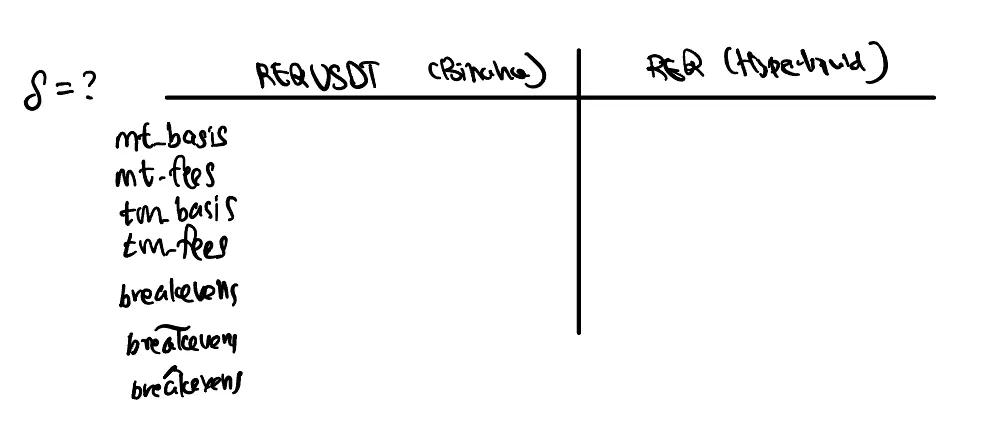
Due to the exchange's incentive mechanism, the total of the maker (limit order) fee and the taker (market order) fee is not symmetric. This creates a bias that affects where you submit your orders. Additionally, the order book liquidity is also asymmetric. Depending on where you execute the trades, you may get a better price basis. The combined effect of these two factors is your entry cost.
Generally, you will be compensated for providing liquidity, so you may choose to place limit orders where liquidity is lower and take orders where liquidity is higher.
The break-even is the duration or cash flow interval (e.g., 8-hour settlement at some exchanges) required to cover the entry cost.
This is an important data point, and it's necessary to have multiple estimation methods, as you are obtaining future funding rate differential earnings. I use '~' to represent the break-even point estimated from historical data, and '^' to represent the break-even point predicted by a regression model.
So far, we've identified the trading combination and where to submit the orders. How do we execute the trades?
Trade Execution
If you're using systematic trading, you can leverage computational power to calculate some basic data based on real-time market data. When liquidity is abnormal, you can even use this to capture pure price arbitrage opportunities. In most cases, your target is structural arbitrage opportunities that can last at least a few minutes. Your task is to ensure that the arbitrage conditions still hold within the few seconds to a few minutes it takes to establish the positions.
The core concept is Stacked EV, which is also the source of our profits. The formula is Profit minus Cost, and the break-even point can simplify the problem, which is particularly important when we're doing manual trading.
These are all details, and iterating on them can make our trading strategy more rigorous. Similar rules apply whether you're using systematic trading or not.
In the ideal case, if we have a target position and can start a market maker engine to acquire the position, we're all set. Generally, we'll use a combination of limit orders and market orders. If it's automated trading, we can dynamically choose to be the maker; otherwise, the usual rules of thumb can be useful.
We need to determine:
- Target position size
- Maximum order size
- Minimum order size
- Dynamic order size rules
For each point, we'll have some relevant points to make. The target position size depends on risk appetite, leverage cost, and available capital.
The maximum order size depends on the liquidity of the taker exchange. Once the limit order is filled, the market order hedge will have a (linear or quadratic) price impact. Setting a size limit is to reduce the impact on the execution price.
The minimum order size depends on the target position size, and it's the lower bound of the less aggressive accumulation pace.
The dynamic orders in between the maximum and minimum order sizes. If we're using a small amount of capital, we can choose the order size that has the minimum market impact (just take liquidity from the best bid/ask on the taker exchange). Another rule of thumb is that if it's manual trading, we can roughly divide the order size into several blocks.
If we want to be more aggressive, we can work backwards from a break-even point threshold. The forward explanation is easier to understand, so I'll explain it from that perspective. Suppose we've shorted a position worth $x and it's been filled, then we want to go long to hedge. The actual taker price is the nominal volume-weighted sum of the depth, which I've explained in a related article:
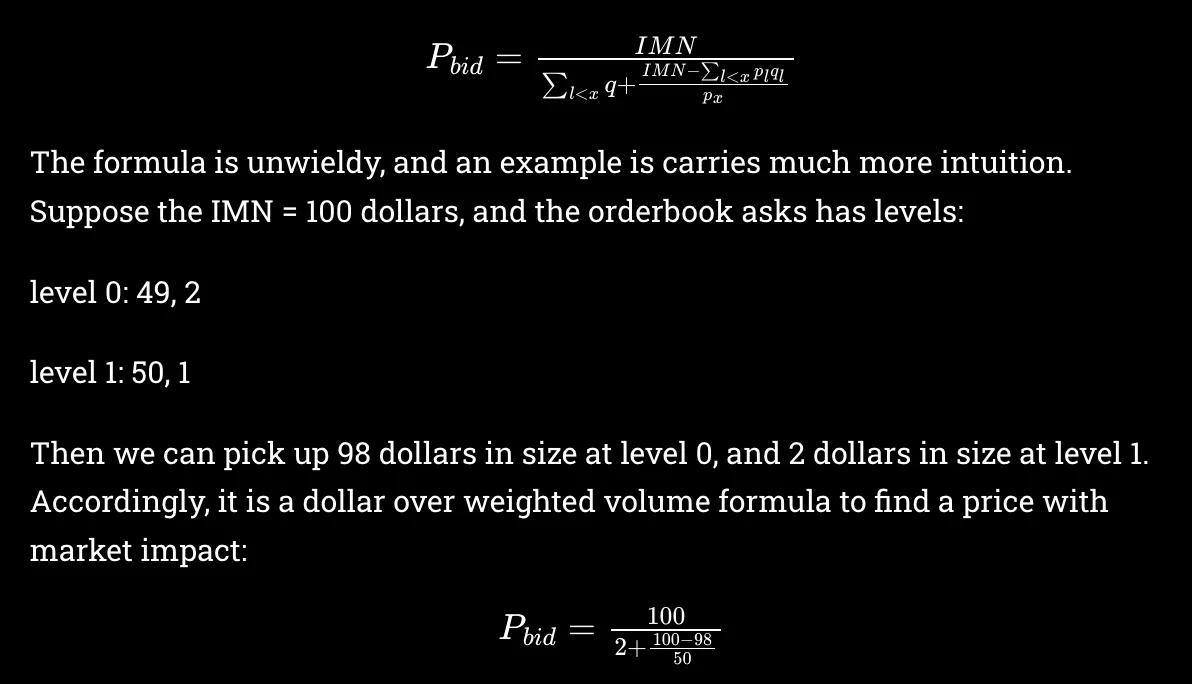
This affects the spread between the maker and taker, and thus the break-even point. We can work backwards from the break-even point to determine the desired level of aggressiveness.
To replace an existing trade with a new trade combination, the break-even point must consider the exit cost.
Risks
External risks include counterparty risk, hacking risk, and so on. There's not much to comment on these, as they are difficult to assess and are inherent characteristics of risk premium businesses. This is a feature, not a bug.
More worth focusing on are the internal risks, such as margin risk. These risks are mostly due to underestimating market volatility and overconfidence. Here, a Sharpe ratio greater than 10 is not uncommon, and the expensive part is the volatility.
High Sharpe ratio and expensive volatility (low capital efficiency) is the perfect combination to trigger over-trading. This is the simplest and most likely cause of trading failure. The collapse of Long-Term Capital Management, the subprime crisis, we always struggle to control ourselves. Human craziness often goes beyond the most sophisticated model predictions.
The main operational risk is the margin risk. It is a good idea to transfer the margin from the profitable exchange to the losing exchange, no matter what position we have established. However, this is still vulnerable to the risk factor of market collapse, because when we need to transfer the margin the most, network congestion may prevent the margin from being transferred smoothly.
One way to mitigate the risk of market collapse is to perform beta hedging. There are several options. Assume that the beta value is obtained from the single-factor risk model. One method is to select a trading portfolio so that the beta risk exposure of any exchange is roughly neutral.

When you have a large number of target exchanges, this will be easier to achieve, as there are more trading combinations available to meet this constraint. The cost is that the search space will be reduced.
Another method is to build an investment portfolio as usual, and then use mainstream assets for beta hedging to keep the beta value neutral. Since the hedging is done for each exchange, the hedging of the overall investment portfolio will also offset each other, maintaining delta neutrality. The cost is that additional funds are required.
There are also some other less conventional methods, such as trading combinations of Bitcoin and other assets with the goal of generating income. The cost is that delta risk will be taken.
If we operate properly, the risk of the investment portfolio is largely controllable. We can still use the worst-case risk engine to handle special risks. Individual positions can indeed disrupt market balance, especially in the cryptocurrency market.
When the margin reaches a certain threshold, we can preemptively close the position instead of waiting for forced liquidation. The advantage of doing this is that we can gradually close the position, while the exchange may not be so polite.
Related Arbitrage Strategies
Last but not least, there are other forms of funding rate arbitrage worth noting. We are particularly focused on perpetual contract arbitrage, and other forms include (excerpted from a tweet by 0xLightcycle):
- Same exchange - short perpetual contract, long spot
- Same exchange - short quarterly contract, long spot
- Same exchange - borrow/short spot, long perpetual contract
- Two exchanges - short perpetual contract on one exchange, long perpetual contract on another exchange
- Statistical arbitrage factor - short all high funding rate contracts, long low funding rate contracts
- Dynamic funding rate arbitrage
0xLightcycle has a rough comparison for each arbitrage method, so I won't repeat it here.
Another advantage of perpetual contract arbitrage is that there is no long-short restriction, which means its performance is less dependent on market conditions and more dependent on structural differences in capital flows between different trading venues. Spot and perpetual contract arbitrage is usually more profitable in a bull market, relying on leverage-long positions that are insensitive to price and provide liquidity compensation.
Regarding improving the profitability of arbitrage, I have two additional points.
Typically, exchanges offer yield-bearing collateral and margin methods. For example, you can hold USDE as trading collateral and earn yield on Bybit. Yield-bearing synthetic collateral is also about to be launched on the Paradex exchange.
Finally, spot and perpetual contract arbitrage is often combined with spot collateralization to increase the yield. I think this is similar to Resolv's approach. For example, you can buy spot HYPE, short the perpetual contract HYPE to earn the funding rate, while collateralizing the spot to earn the collateral yield.