The introduction of decentralized exchange (DEX) features by centralized exchanges (CEX) to create hybrid platforms reflects the growing trend of combining centralized and decentralized approaches to attract both traditional users and DeFi enthusiasts.
With increasing regulatory pressure on CEX, such as KYC and AML requirements, decentralized exchanges (DEX) have become a more attractive option due to their anonymity and decentralized nature. Integrating DEX functionalities allows CEX to retain users while still complying with regulations.
Integrating CEX-DEX for Growth
CEX and DEX represent the two main exchange models in the cryptocurrency market. The boundaries between these two exchange types are becoming increasingly blurred in the evolving market. Both models are starting to adopt and integrate each other's strengths to meet the diverse and growing needs of users.
Recently, some centralized exchanges have launched hybrid platforms. For example, Binance introduced Binance Alpha 2.0 (another update of Binance Alpha), allowing CEX users to purchase DEX tokens without the need to withdraw funds, combining the convenience of CEX with access to decentralized tokens.
Similarly, MEXC launched DEX+, integrating on-chain and off-chain trading to provide a seamless experience. This reflects the trend of integrating centralized and decentralized approaches to attract both traditional users and DeFi participants.
"This is a great move. Allowing CEX users to directly buy any DEX token from the CEX, without the need to withdraw funds." Former Binance CEO CZ commented.
Interestingly, DEX started to gain prominence in 2020. They surpassed CEX slightly in on-chain trading volume in 2020, and reached a peak in 2021. The development of platforms like Solana contributed to this sudden growth. However, DEX gradually lost momentum in 2022 and 2023.
According to a report by OAK Research, by early 2024, DEX only accounted for 9.3% of trading volume market share compared to CEX. However, by January 2025, DEX has surpassed $320 billion in monthly trading volume as they captured over 20% of spot trading volume for the first time in crypto history.
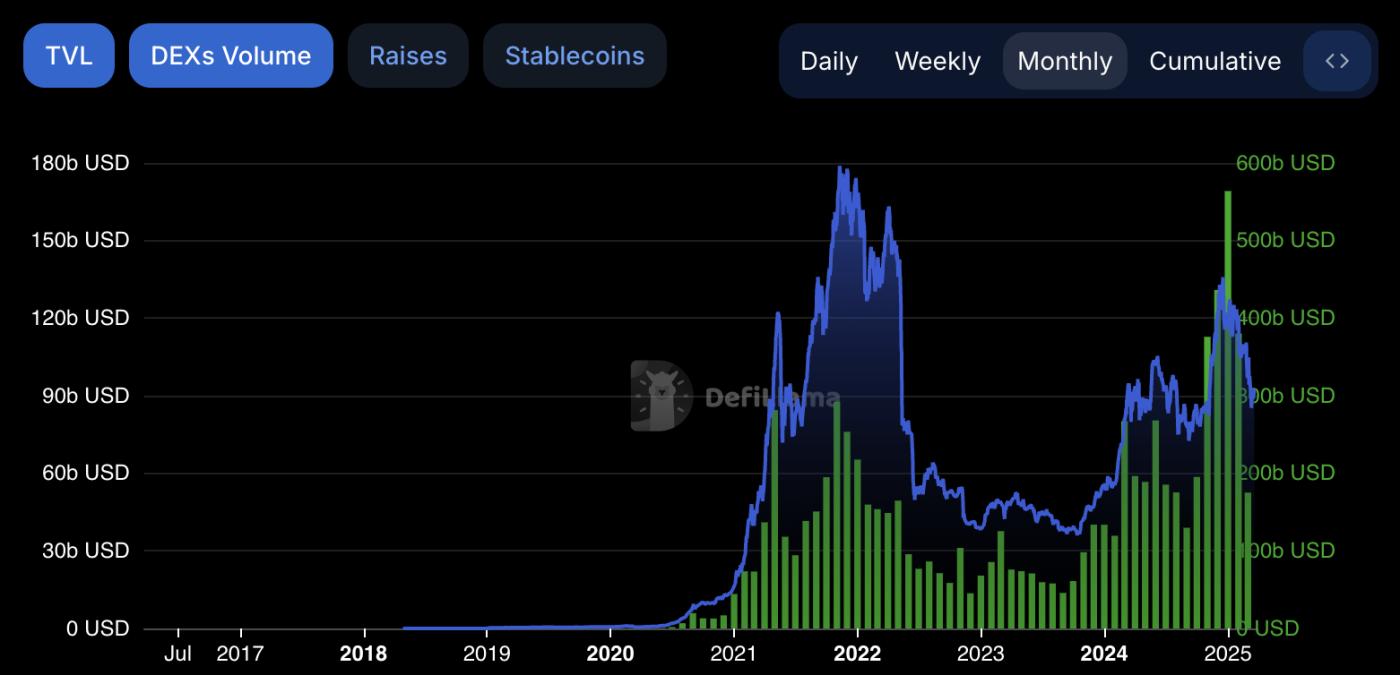 DEX Volume and TVL. Source: DefiLlama
Similarly, according to data from DeFiLlama, the Total Value Locked (TVL) in DEX was around $163.6 billion at the start of 2022. In 2023, the TVL dropped to around $52 billion and remained around this level for most of 2024.
However, by December 2024, this figure had surged to around $140 billion, marking a nearly 160% increase from the start of the year. This indicates the growing preference for DEX among cryptocurrency traders.
According to CoinGecko, there are around 959 active DEX platforms in 2025, compared to 217 CEX.
Benefits and Challenges of CEX-DEX Integration
The current differences between CEX and DEX create disadvantages for users. As a result, users seek to combine the strengths of both models: the speed and liquidity of CEX with the control and transparency of DEX. The launch of Binance Alpha 2.0 and MEXC DEX+ demonstrates how major exchanges are addressing this demand.
Furthermore, DEX has led innovation in the current cycle with AMMs and liquidity pools, forcing CEX to adapt to avoid falling behind.
With increasing regulatory pressure on CEX, the anonymity and decentralization of DEX make it more attractive. Integrating DEX allows CEX to retain users while navigating compliance.
However, creating hybrid platforms comes with challenges. Integrating on-chain and off-chain systems requires complex infrastructure, which can lead to errors or high gas fees for DEX users. Additionally, hybrid platforms may face stricter regulatory oversight, especially when combining fiat-to-crypto trading from CEX with decentralized tokens.
Despite these hurdles, with the benefits outlined, hybrid platforms like Binance Alpha 2.0 and MEXC DEX+ will continue to emerge.