Arcium: Solana / FHE / Dark Pool History
Fashion is a cycle, Crypto is a cycle, maybe the cycle will cease, but copycats will live forever.
Arcium, the encrypted supercomputing project on Solana, chose Coinlist for the community round, which instantly reminded me of the Coinlist quota script war from 2017 to 2021, and the novice village of scientists and money-grabbing parties.
The new generation is better than the old one, but Arcium has changed its name three times and is struggling to find a way out for itself. It luckily avoided the Solana Meme Season, and it is unknown whether it can realize its dream in the BSC Meme Season.
Previous life: The dark pool Elusiv that deleted the database and ran away
In three sentences, you can summarize why Elusiv transformed into Arcium:
You know Arcium is not my real last name, Elusiv is my real family name;
Data-based MPC encryption is a disguise, dark pools are the real deal;
Privacy 1.0 is about personal private status, while Avatar 2.0 emphasizes sharing and collaboration.
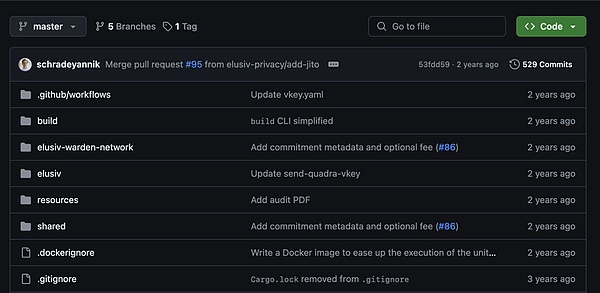
Elusiv originated from the Solana hackathon. In the early days, it was a Solana imitation of encrypted privacy such as Zcash, Monero, Tornado Cash, etc., focusing on ZK/FHE/MPC to build dark pool services.
Dark pool services are not complicated. Like the Dark Web, they refer to deep behaviors beyond the surface, giving a sense of the deep government. Dark pools are essentially anonymous over-the-counter transactions by traditional institutions or large individual traders to avoid fluctuations in the secondary market.
On the blockchain, the open and transparent ledger system makes all transactions public, which is also the source of MEV, so there are specific requirements for switching to anonymous transactions.
However, as mentioned earlier, Privacy 1.0 at this time is essentially no different from mixers, Monero, etc. After Tornado Cash was regulated, doing so would be a provocation to the US authorities, so Elusiv stopped updating its code two years ago.
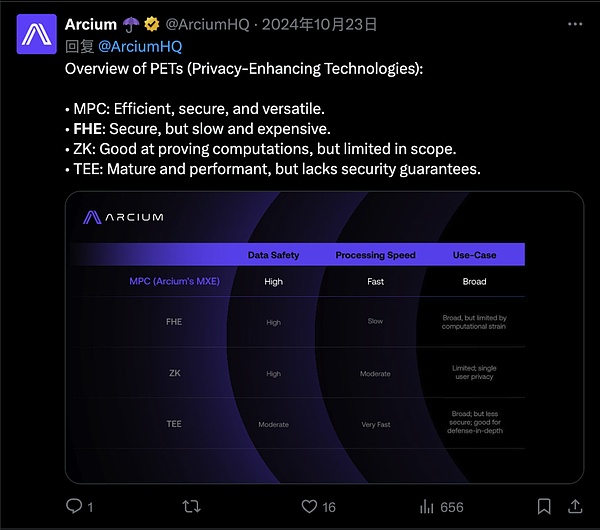
If you search for Dark Pool and FHE at @ArciumHQ, you’ll find that they focus on two things: talking about how MPC is better than FHE, mainly in terms of computational efficiency and cost, and secondly, being optimistic about Dark Pool in the long term, except that it was previously known as Elusiv and is now known as Arcium.
However, there is no absolute difference between technologies such as MPC/FHE/ZK/TEE. The difference is more in the application scenarios. MPC focuses on trusted computing between multiple subjects, FHE focuses on encrypted computing behavior, and ZK ensures the validity of data before encryption.
In fact, it can be said responsibly that all privacy technology-oriented projects are not doing well now. Why target each other? It is a more win-win choice to expand the market together. However, this is not the most effective show. After Tornado Cash ushered in a turnaround, Arcium began to promote Dark Pool again.
It is difficult to do a project, and it is even more difficult to do a famous project. You have to be able to be tempered by the market and still be like first love; it is difficult to be a retail investor, and it is even more difficult to be a profitable retail investor. You have to interpret every word in "Everyone in Huanglongjiang wears Bluetooth".
This life: Parallel FHE turns to encryption supercomputing
Arcium has its own ideas about data-based privacy.
Simply put, Arcium is considering how to combine the characteristics of blockchain and MPC. The answer is also simple. Since MPC requires multi-party computing and blockchain requires multi-node operation, combining the two is a multi-party execution environment (MXEs, Multi-Party eXecution Environments).
Based on this, combined with parallel execution technology and technical features such as FHE/ZK, we can create a fast and secure blockchain encryption system.
If you are interested in parallelization, you can read the old article that is not contradictory: Parallelism is not just about EVM, high-performance L1 (Sui) vs. Ethereum L2?
However, these are not particularly important. Just like Nillion, the core problem now is the lack of scenario support for privacy technology. Arcium has selected AI, DePIN and DeFi. The first two can be used as gimmicks for financing and issuing coins. Only dark pools and privacy transactions (mixed coins) in the DeFi field have real market demand at present.
Arcium’s claim of being 10,000 times faster than the FHE architecture is meaningless, because the blockchain’s demand for FHE is zero, so 10,000 times zero is also zero.
I am not denying Arcium or MPC/FHE technology, but their long-term demand is not clear, and the project parties, under the pressure of issuing coins, can only look for non-real demand, just like the repurchase of shit coin will still be shit coin.
Afterlife: Solana Privacy 2.0
But things will always turn around. Helius once contributed the most easy-to-understand technical article on Solana 2.0, and is now redefining the concept of Solana Privacy 2.0. Although I don’t believe this, it sounds reasonable.
The core is just one point: Privacy 2.0 is multi-party privacy, typically shared private state, in other words, MPC, more specifically, the concept of Arcium:
arxOS is a cryptographic operating system that aggregates the computing power of Arcium nodes;
MXE is a computational execution environment that allows secure computing to occur on Arcium;
Arcis is a programming language adapted from Rust, just like the relationship between Move language and Rust.
I really have to complain here. StarkNet, Move language, and Arcis are all adapted from Rust. Maybe the project owners think that they can maximize the full effectiveness of customized languages, but it will not have any practical effect except increasing the burden on developers.

Image caption: Differences between Privacy 1.0 and 2.0
In fact, privacy AI may not require technologies such as MPC/FHE. If LLM can be made small enough, MCP can become the de facto industry standard, which can directly meet the daily needs of individual users without excessive exposure of privacy.
If privacy or private AI refers to a company, entity or individual deploying LLM on their own, then the interaction delay and computing power consumption brought by MPC/FHE technology can be added inefficiently. MPC's cheapness is relative to FHE, and its own computing power consumption is not cheap.
Secondly, the main problem faced by dark pools and privacy transactions (anonymous small transfers, coin mixing) is regulation, followed by cost issues. Dark pools are reserved for large investors. The battle between dark pools in the traditional financial market and the SEC has been ongoing, and the same is true for coin mixers.
Although Trump is acting like he is willing to make money even if the world floods after his death, the on-chain dark pools are really on the rise. Will they follow the privacy model reported by RailGun and the authorities? In this case, the only ones who will be hurt by the peace between the big players are the retail investors.
The US government has officially given up its hunt for Tornado Cash, but after this battle, pure, classic true privacy solutions will no longer become the mainstream of the market. The active and passive compliance of TRM Labs and RailGun will allow regulators to control on-chain behavior.
The only real thing is anonymous small transfers in the market space, but ordinary users will not pay extra for privacy. You can treat it as a service, but it is difficult to use this to support the complete PMF logic.
Conclusion
Arcium's entry into the TGE process marks the end of the classic privacy project, which is even more classic than the reversal of Tornado Cash. From now on, the project party will actively set limits on itself and the boundaries will be established.