Written by: Mark Dewolf
Translated by: Plain Blockchain
After a 45% price drop in the first quarter, Ethereum (ETH) may be preparing for a revival. On May 7th, the highly anticipated Pectra upgrade is expected to pass final testing, paving the way for mainnet launch.
This network upgrade, formed by merging two improvement packages—Prague and Electra, collectively known as Pectra, includes 9 Ethereum Improvement Proposals (EIPs). These changes aim to simplify the entry process for new retail traders while making the world's second-largest blockchain more attractive to institutions.
Pectra will raise the validator staking cap from 32 ETH to 2048 ETH, reducing the need to run multiple validator nodes. By streamlining the staking process, Ethereum's managers hope to achieve stronger liquidity locking and even facilitate capital flow for large investors.
If user experience (UX) is improved and large investors can participate more easily, on-chain activity is expected to increase significantly. The Ethereum price trend after the Pectra upgrade will be a key indicator for the crypto market in the second quarter. Let's examine the details behind it.
What is the Ethereum Pectra Upgrade?
Pectra is an Ethereum blockchain upgrade aimed at improving staking efficiency, enhancing user experience, continuing the Rollup-centric expansion roadmap, and strengthening Ethereum's decentralization characteristics.
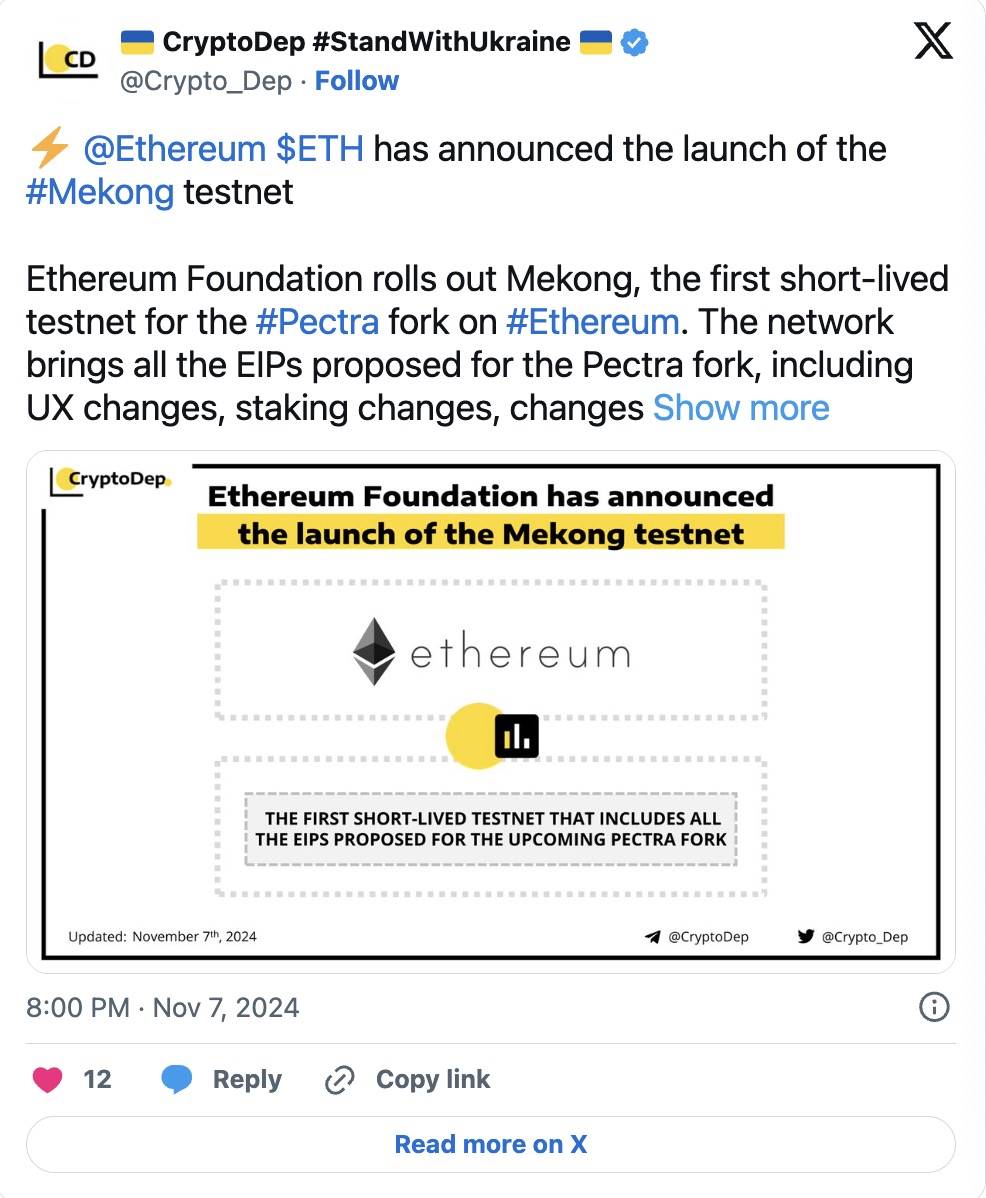
Before the merge, Prague focused on improvements to Ethereum's execution layer, while Electra concentrated on consensus layer upgrades.
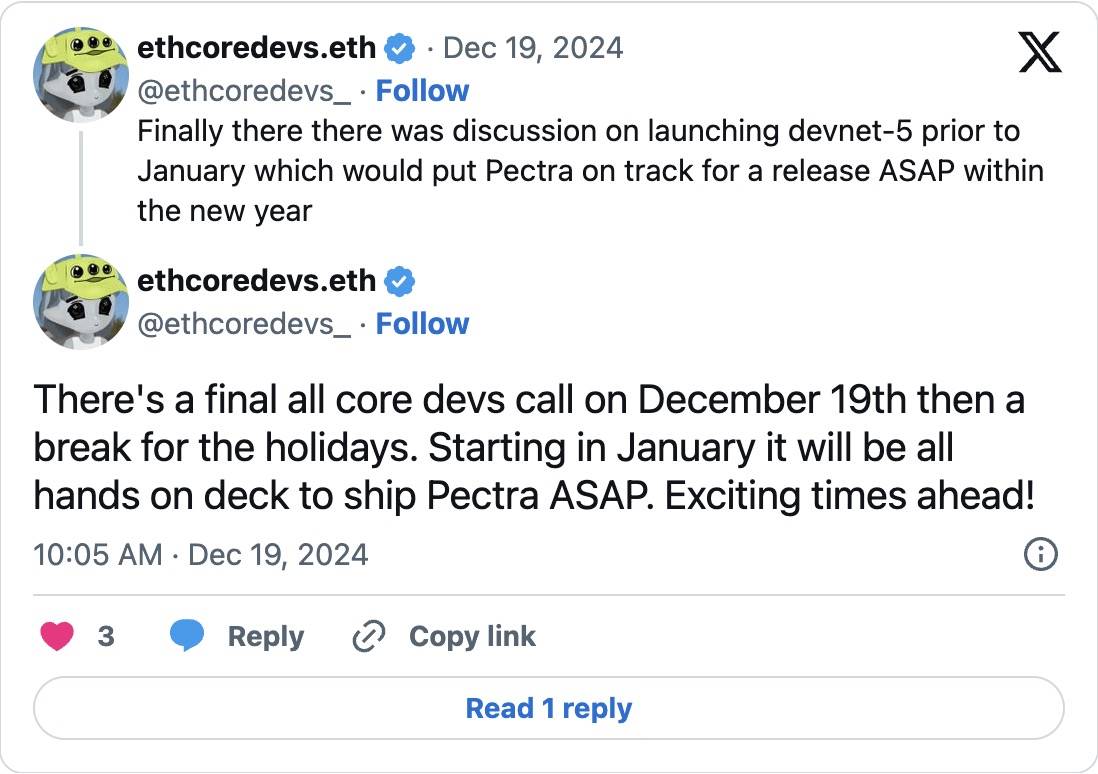
The Pectra upgrade has been anticipated for months, and now has an official launch date: May 7th, 2025. If everything goes as planned, this will be the largest update in Ethereum's history.
Pectra's Main Proposals
As of March 2025, the Pectra upgrade includes the following nine EIPs:
EIP-2537: New precompile, providing 120+ bit security operations, higher than the existing 80-bit security of BN254 precompile.
EIP-2935: Preserving historical block hashes to support stateless clients.
EIP-6110: Providing validator deposits on-chain.
EIP-7002: New mechanism allowing validators to trigger withdrawals and exits through the execution layer.
EIP-7251: Raising Ethereum validator's maximum staking limit from 32 ETH to 2048 ETH.
EIP-7549: Providing additional data availability for Ethereum Layer 2 (L2).
EIP-7685: Framework allowing validator smart contracts to execute specific operations.
EIP-7702: Experience improvements for Externally Owned Account (EOA) users.
EIP-7742: Decoupling Blob counts between consensus and execution layers.
Among these, EIP-6110, EIP-7002, EIP-7251, EIP-7549, and EIP-7742 will be applied to Ethereum's consensus layer; while EIP-2537, EIP-2935, EIP-6110, EIP-7685, EIP-7002, EIP-7702, and EIP-7742 will change Ethereum's execution layer.
Pectra's Key Features
More Efficient Staking
Currently, Ethereum limits single validator staking to 32 ETH. For larger transactions, this limitation requires transaction entities to run numerous validator nodes.
By introducing EIP-7251, the maximum staking limit per validator node will increase from 32 ETH to 2048 ETH. However, the minimum validator staking threshold remains at 32 ETH to not obstruct individual staking.
The increased maximum staking limit will allow large validators to consolidate and run fewer nodes, thereby reducing peer-to-peer messages and digital signatures.
Small validators can still increase staking without accumulating in 32 ETH multiples to run multiple validator nodes.
As of December 2nd, 2024, Ethereum has over 1.07 million daily active validators. The large number of validators may lead to high computational and bandwidth load on the network.
User Experience Improvements
The Pectra upgrade contains multiple EIPs aimed at improving user and developer experience on Ethereum.
EIP-7702 will introduce new transaction types allowing multiple operations for the same user in one transaction. This upgrade will also allow accounts to sponsor gas fees for another account. We have previously discussed this "gas abstraction".
"Permission downgrading" is a new feature introduced by EIP-7702, allowing users to authorize conditional expenditures. For example, authorizing spending of specific ERC-20 Tokens or 2% of total balance daily.
EIP-2537 will also introduce new functions used in zero-knowledge cryptography, while EIP-7002 makes Ethereum staking pool experience more trustless by introducing a mechanism for smart contracts to trigger validator exits.
Improved Rollup Expansion
Building on the data Blob introduced in the original Danksharding, the Pectra upgrade significantly reduces gas fees for Ethereum Layer 2 (L2).
EIP-7594 will introduce a new protocol called PeerDAS, allowing nodes to validate L2 Blob data availability by downloading only partial data.
How Might Pectra Affect ETH's Value?
In a research report released in October last year, Galaxy Research Vice President Christine Kim wrote that as Ethereum advances its Rollup-centric expansion roadmap, the impact of mainnet (L1) protocol upgrades on ETH value will gradually decrease.
She added that upgrades on Layer 2 (L2) might have the most significant impact on ETH value, as Ethereum's income may be primarily driven by user activity on L2 in the future.
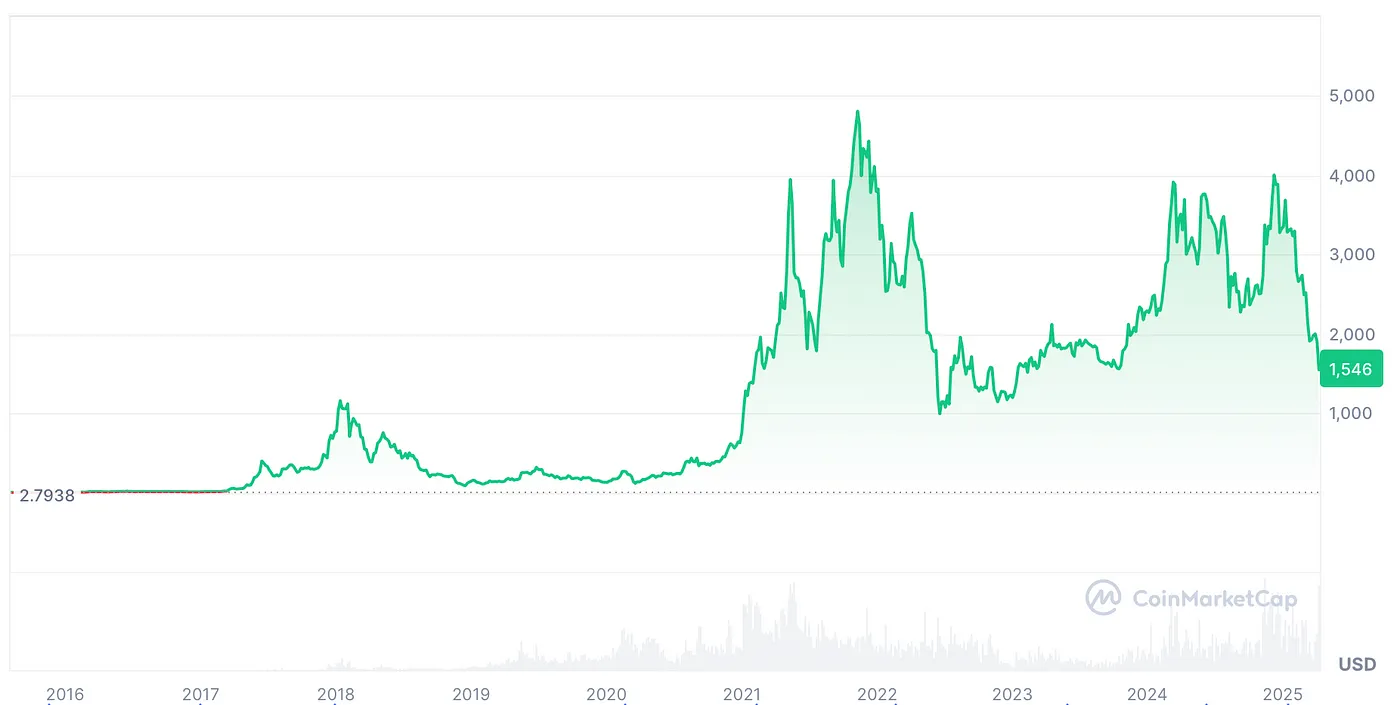
From $3 to $4000, then a decline: Ethereum's price history as of April 6th, 2025. Source: CoinMarketCap
Christine Kim noted: "Upgrades promoting user experience, interoperability, decentralization, and security on L2 are more important to Ethereum's value than optimizations and improvements at the base layer."
Summary
Ethereum's Rollup-centric expansion plan has sparked divergent opinions among analysts, and uncertainty may have influenced market valuation over the past year.
However, network upgrades like original Danksharding and Pectra demonstrate high levels of planning and effort. Ethereum—the pillar of decentralized applications (dApps), decentralized finance (DeFi), and many parts of the modern crypto market—will undoubtedly benefit from increased efficiency and flexibility.