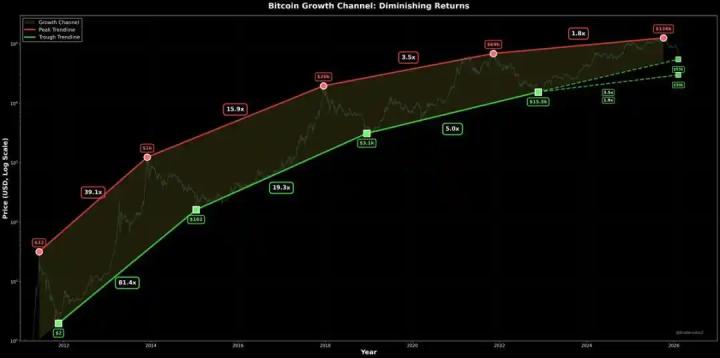
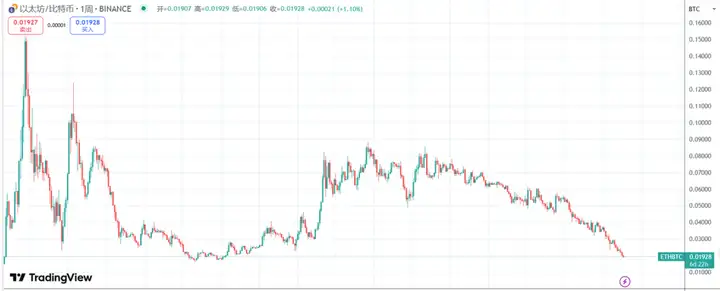
On April 14, the ETH/BTC exchange rate dropped to 0.01924, creating a new low since January 2020. As a mainstream asset in the previous bull market, Ethereum's performance in this cycle has led to dissatisfaction among many investors.
Facing Bitcoin's strong performance in this cycle, Ethereum seems to be experiencing a dual test of confidence and value. "OM plummeted 90%, but its performance this year still outperforms ETH." In the recent week, some whales deposited on the chain are also becoming restless. Does Ethereum still have a chance?
VX: TZ7971
On-chain Data: "Retreat" Signal Emerges
In the past week, some whales have been "pouring" into the market. According to Arkham data, an OG address group that initially purchased 100,000 ETH in 2015 has accumulated sales of 4,180 ETH on Kraken since April, valued at approximately $7.05 million.
Another 0x62A address sold 4,482 ETH at an average price of $1,572 on April 12, valued at $7.05 million. Such price decline triggered numerous on-chain liquidations. A whale sold 35,881 ETH at an average price of $1,562 on April 10, reduced leverage, and then sold the remaining 2,000 ETH at $1,575, currently holding 688 ETH.
Since Bitcoin's halving in 2024, Ethereum has dropped 40% relative to Bitcoin, marking the first time of sustained weakness within a year of halving. In comparison, the SOL/ETH exchange rate has increased by 49% this year, reaching 0.0817. This indicates that SOL's performance will continue to significantly outperform Ethereum in 2025.
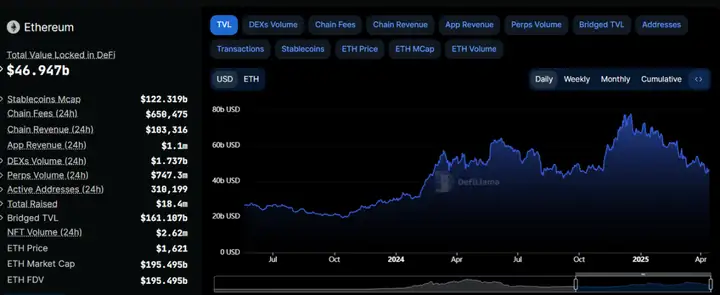
In the past 24 hours, Ethereum's DEX income was only $1.1 million, and its TVL has dropped from a high of nearly $80 billion to $46.9 billion, a decline of almost half. In the previous cycle, Ethereum successfully became the second-largest asset through multiple new assets (such as Non-Fungible Tokens and DeFi) and application advantages. However, now, with the MEME trading fever shifting to chains like Solana, its asset circulation has relatively slowed down.
On-chain Activity Indicators
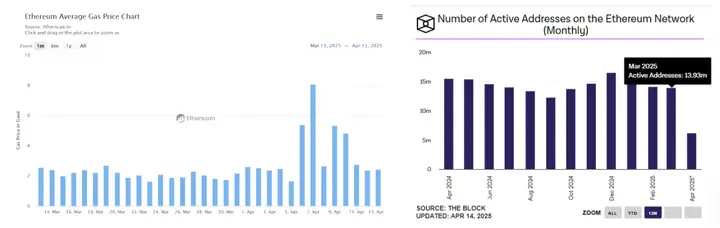
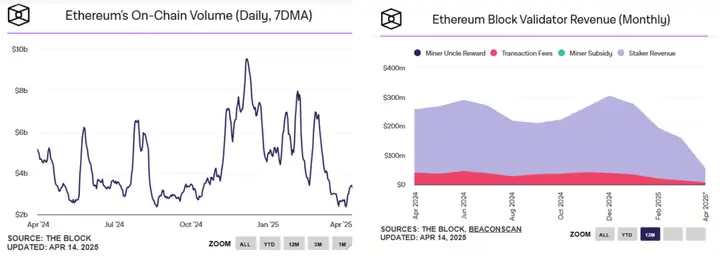
In the past month, except for the market crash on April 7, the mainnet Gas has long maintained a level of 2 Gwei, reflecting a decline in on-chain activity. Additionally, the monthly active addresses on the Ethereum mainnet have been in a fluctuating trend, with active addresses below 15 million in March.
The daily average transaction volume on the Ethereum chain is below $3 billion, and coupled with the coin price impact, the monthly income of mainnet validators in March dropped below $200 million. From an investor sentiment perspective, the lower on-chain opportunities have led some investors to adopt a wait-and-see attitude towards Ethereum's short-term growth potential.
CEX and ETF Data
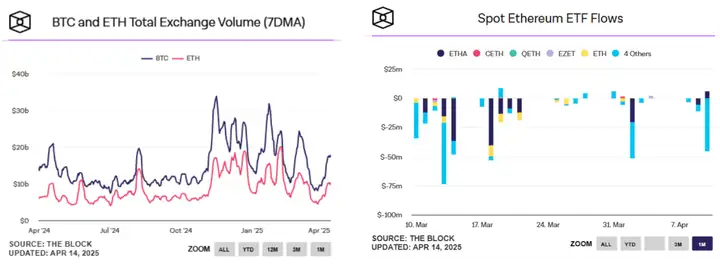
From exchange data, it can be seen that Bitcoin's peak trading volume is significantly larger and more volatile, indicating that market funds are more flowing into Bitcoin spot and derivatives trading. In ETF data, Ethereum spot ETF has recorded outflows in the past month, with the highest single-day outflow reaching $75 million. From the performance differences, it can be further seen that the current risk appetite for crypto assets shows significant differentiation characteristics. The capital withdrawal from Ethereum spot ETF exposes market concerns about the slowing pace of the crypto ecosystem, especially under the background of intensified Layer 2 competition and new public chain diverting developer resources, some institutional investors choose to shift.
Macro Environment: Bitcoin Dominates, Ethereum Awaits Opportunity
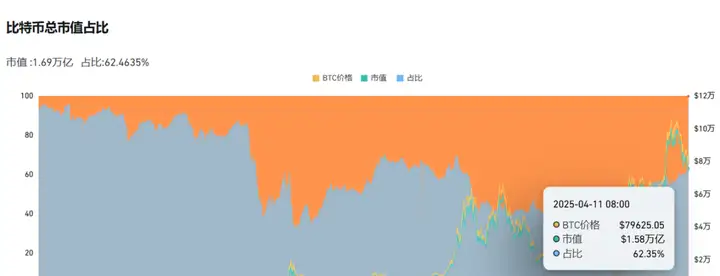
In the market environment where Bitcoin serves as the "Beta" of US stocks, Bitcoin's total market capitalization proportion is gradually exceeding 60%, reaching 62.46% today, indicating a clear "Bitcoin season" with high fund concentration and Altcoins performing weaker than Bitcoin. Additionally, the crypto fear and greed index remains in the "panic zone", reflecting investors' preference for "risk-averse" needs, with Bitcoin becoming the target. Moreover, in the future strategic reserve plans of the United States, most state proposals only include Bitcoin as a reference, which further promotes Bitcoin's status as the mainstream crypto asset. If the ETH/BTC exchange rate falls below 0.018 in Q2 2025, it may trigger more leverage position liquidations, further suppressing the price.
In the Ethereum ecosystem, the potential "Trump liquidity" is also a market focus. On March 25, the Trump family prominently launched a USD-pegged stablecoin USD 1 through "World Free Finance" (WLFI), with the first batch to be issued on Ethereum and Binance Smart Chain. As one of the stablecoins dedicated to institutional liquidity, this liquidity window is expected to provide sufficient inflow for Ethereum.
The current new low of the ETH/BTC exchange rate is a result of the market's weighing of short-term risks (halving siphoning, regulatory uncertainty) and long-term value (ecosystem innovation, market expectations). With Ethereum's upcoming Pectra upgrade and key progress in account abstraction, in the future where Vitalik shouts about building Ethereum L1 as the "world computer", this might be Ethereum's next turning point.