Written by: Li Xiaoyin, Wall Street Insight
Rumors of a Federal Reserve "leadership change" from the White House are circulating, and the Supreme Court's ruling may further shake Powell's position. Is the global financial market brewing the next storm?
On Monday local time, U.S. Treasury Secretary Scott Bessent stated in an interview that he and President Trump have been "considering" candidates for the next Federal Reserve chair and plan to start interviewing potential candidates in the fall.
Public information shows that the current Federal Reserve Chair Powell's term will end in May 2026, and Bessent's remarks have prematurely ignited market speculation about changes in Fed leadership.
Meanwhile, the Trump administration is targeting independent institutions, requesting the Supreme Court to dismiss relevant officials. Analysts believe this could open a legal pathway for Trump to remove Powell, challenging the Fed's long-standing independence norms.
In May, focus on this U.S. Supreme Court ruling
According to media reports, the Trump administration has urgently requested the U.S. Supreme Court to authorize the president to dismiss senior officials from two independent federal agencies (Gwynne Wilcox from the National Labor Relations Board and Cathy Harris from the Merit Systems Protection Board).
This aims to challenge the precedent established in the 1935 'Humphrey's Executor v. United States' case, which limited the president's power to arbitrarily remove heads of independent institutions, safeguarding the operational autonomy of internal government independent agencies.
According to compiled media information, the Trump administration argues that these restrictions contradict the executive powers granted to the president by Article II of the Constitution, asserting that agencies exercising significant administrative powers must be subject to complete presidential supervision.
Trump requests the Supreme Court allow him to immediately dismiss these two officials, without waiting for the appellate court's final ruling, and to conduct an immediate comprehensive review. The Trump administration suggests the Supreme Court should hold a special session in May to hear the case during the current judicial year (typically running from October to June or July of the following year).
Some analysts point out that the final ruling of this case is a test of "whether Trump has the right to dismiss Fed Chair Powell" - although current Federal Reserve Law stipulates that removing the Fed chair requires "just cause", if the Supreme Court overturns the 'Humphrey's Executor' case precedent, it would significantly weaken this protective barrier and open the door for presidential intervention in Fed operations.
Powell's "Slow Response" Irritates Trump
In fact, Trump has long been dissatisfied with Powell's monetary policy, especially interest rate decisions.
Under Powell's leadership, U.S. inflation is entering a cooling trajectory, but his anti-inflation efforts now face new threats from Trump's trade war. The market is focused on whether Powell will maintain a hawkish stance to ensure inflation does not resurge, or yield to market pressure and start rate cuts early.
The White House continues to pressure Powell. Media reports suggest Trump has been critical of the Fed's interest rate policy under Powell and has repeatedly pressured for significant rate cuts. He once publicly urged Powell to cut rates on social media:
"He's always 'a step behind', but now has a chance to turn his image around, and must act quickly."
Despite recent tariff impacts, the Fed has recently maintained interest rates. Powell also countered earlier this month, stating that tariff levels exceed expectations and could trigger "persistent" inflation beyond short-term price shocks.
Potential Bargaining Chip? Dollar Swap Lines May Influence US-European Negotiations
The impact of the Fed's potential loss of independence goes far beyond monetary policy prospects.
Some analysts suggest this potential power transfer could even affect international relations, especially in trade negotiations with Europe.
The view suggests that if Trump ultimately gains the power to dismiss the Fed chair and appoints a loyal "loyalist" to lead the Fed, European policymakers will have to worry that dollar swap lines, a key negotiation chip, might be revoked or used as a pressure tool.
The Fed-centered monetary swap network has gradually become an important tool for the U.S. to defend the dollar's international status during crises, serving as a critical liquidity safety net for the global financial system.
The Fed's official definition of monetary swaps is: To address severe pressures in global short-term dollar funding markets, the Fed can establish temporary central bank liquidity swap lines with foreign central banks, allowing foreign central banks to provide dollar liquidity to financial institutions in their jurisdictions.
If Trump gains the power to dismiss the Fed chair, the government could influence swap mechanism operations through personnel appointments and "moral suasion". Once this tool is selectively used for geopolitical gaming, the foundation of the global financial system could be shaken.
Taking Europe as an example, relevant data shows that the euro area banking system has a long-standing dollar shortage. Without swap line support, European financial institutions might face liquidity disruption, triggering chain reactions similar to Lehman Brothers. If the Fed uses swap line revocation as a bargaining chip, weaponizing this mechanism, Europe might be forced to compromise in trade, energy policies, and even affect US-European tariff negotiations.
Dollar "Nuclear Weapon" More Powerful Than Tariffs
Wall Street Insight previously mentioned that Deutsche Bank analysis considers the Fed's dollar swap mechanism a "nuclear weapon" more deterrent than tariffs.
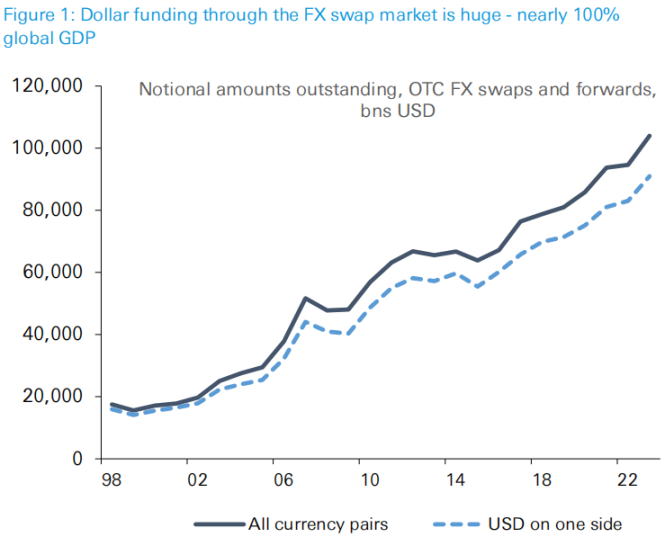
Deutsche Bank states that the Fed's dollar swap lines control approximately $97 trillion in foreign exchange swap markets, equivalent to global GDP total, and are a lifeline for non-U.S. institutions to obtain dollar liquidity during crises.
If Trump targets the Fed's dollar swap "nuclear button" - with the U.S. refusing to provide dollar liquidity at critical moments - it could trigger a severe global financial crisis.