Author: JE Labs
Compiled by: Glendon, Techub News
As the core region of the global cryptocurrency ecosystem, Asia accounts for 70% of global crypto liquidity and 60% of global crypto users. However, Asian countries exhibit significant differences in market environments, regulatory policies, and user behaviors, making it crucial to understand the characteristics of each country and region.
This article will provide an in-depth analysis of Asian market features, offering a strategic guide for ecosystem builders looking to expand their business in this region. The article covers the following core modules: Asian market overview, user behavior preferences, key market analysis, market entry strategies, specific country analyses, and how to successfully enter the Asian market.
Asian Market Overview
Market Structure Dominated by CEX
37.1% of global centralized exchange (CEX) traffic comes from Asia, ranking first worldwide; mainstream centralized exchanges like Binance, OKX, and Upbit constitute the core liquidity centers, with Asian users highly dependent on these exchanges for trading and discovering new projects.
Market Driving Factors
Financial Inclusion Needs: In regions with underdeveloped financial infrastructure like Indonesia and Vietnam, crypto assets have become key tools for achieving financial inclusion;
Young Investors and High-Yield Preference: Asian youth have higher risk tolerance, driving the growth of DeFi and meme coins;
Regulatory Difference Landscape: Different regulations create varied adoption rates, with mainland China and South Korea adopting strict regulations, while Hong Kong and Singapore implement crypto-friendly policies.
Future Trend Predictions
First, the compliance process will accelerate, with Hong Kong and Singapore becoming compliant crypto asset centers, undoubtedly promoting transparency in the entire Asian market. Second, clear regulations will attract traditional financial institutions, further driving DeFi and RWA (Real World Assets) tokenization. Additionally, growing demand for cross-border payments, digital payments, and value storage scenarios will promote widespread stablecoin use. In terms of DeFi, GameFi, and SocialFi expansion, DEX and lending protocol adoption rates are expected to continue rising, with Southeast Asia potentially becoming the fastest-growing region for Web3 games and social finance.
User Behavior Preferences
Airdrops: Asian User Behavior Analysis
After airdrops, most Asian traders tend to engage in short-term arbitrage, quickly selling tokens upon unlock, causing significant price volatility. Their airdrop information sources are primarily community-driven, concentrated in private domain groups like WeChat, Telegram, Discord, and X.
These traders' characteristics include frequent small-amount transactions and rapid selling. Before airdrops, traders use small funds to interact with multiple wallets to increase airdrop opportunities. Within hours of airdrop release, token trading volume surges, typically causing price drops. This can be verified by time zone effects, with GMT+8 (Asian) zone often experiencing the earliest selling pressure.
Meme Trading: Asian Users' Speculative Frenzy
As mentioned, Asian crypto traders heavily rely on KOLs and community-driven trends, easily influenced by FOMO emotions. When a meme coin goes viral, investors' funds quickly pour in, driving token prices up short-term. In this process, traders mostly employ highly speculative short-term strategies based on "buy low, sell high" principles, including early entry, quick profit-taking, and trend-following wave trading.
Data shows Asia is the largest market for GMGN (a Meme coin data dashboard and trading tool), with 19% of platform traffic from Chinese users, highlighting Chinese investors' strong interest in Solana meme coin trading.
Key Market Analysis
China: Highly Active but Regulatory-Limited Market
Despite strict policy restrictions, over 59 million Chinese users hold crypto assets; OTC trading remains active, with Hong Kong serving as a key portal for stablecoin fund flows. Chinese users show strong demand for high-yield products like Curve and Aave, with active DeFi and DEX ecosystems. In information dissemination, investors rely on private communities and crypto KOL recommendations, creating a herd effect.
South Korea: Strictly Regulated, Trading-Driven Market
South Korea's crypto trading volume ranks globally top-tier, once dubbed the "crypto trading nation", with Upbit exchange holding over 80% market share. Korean investors strongly prefer CEX trading, with low DEX participation but active NFT markets. Notably, meme coins and Altcoins are extremely popular, especially Solana meme coins attracting many Korean investors.
Regarding regulation, South Korea will pass its first crypto asset regulatory framework, the "Virtual Asset User Protection Act", in July 2024, imposing stricter requirements on digital asset exchanges.
Japan: Compliance-Driven, Long-Term Investment Market
Unlike South Korea, Japanese investors strongly prefer Bitcoin, NFT markets, and long-term investments. Strict regulations and institutional market dominance reduce speculative behaviors. Crypto KOLs and communities play crucial roles, with NFT culture deeply integrated into local traditional culture like anime.
Thailand: High Crypto Adoption and Regulatory-Friendly Market
Thailand's crypto penetration rate reaches 21.96%, ranking tenth globally. Investors show strong DeFi demand, primarily investing in Bitcoin and Ethereum. Local exchanges dominate, with Bitkub holding over 70% market share.
Regulatorily, Thailand adopts a supportive compliance approach, with the SEC legalizing USDT and USDC in March this year.
Malaysia: Institutional Investor-Oriented Market
Under strict regulatory laws, all crypto activities require official permission. High-net-worth and institutional investors dominate, preferring Bitcoin, stablecoins, and DeFi markets. Primary exchanges include Luno and Binance.
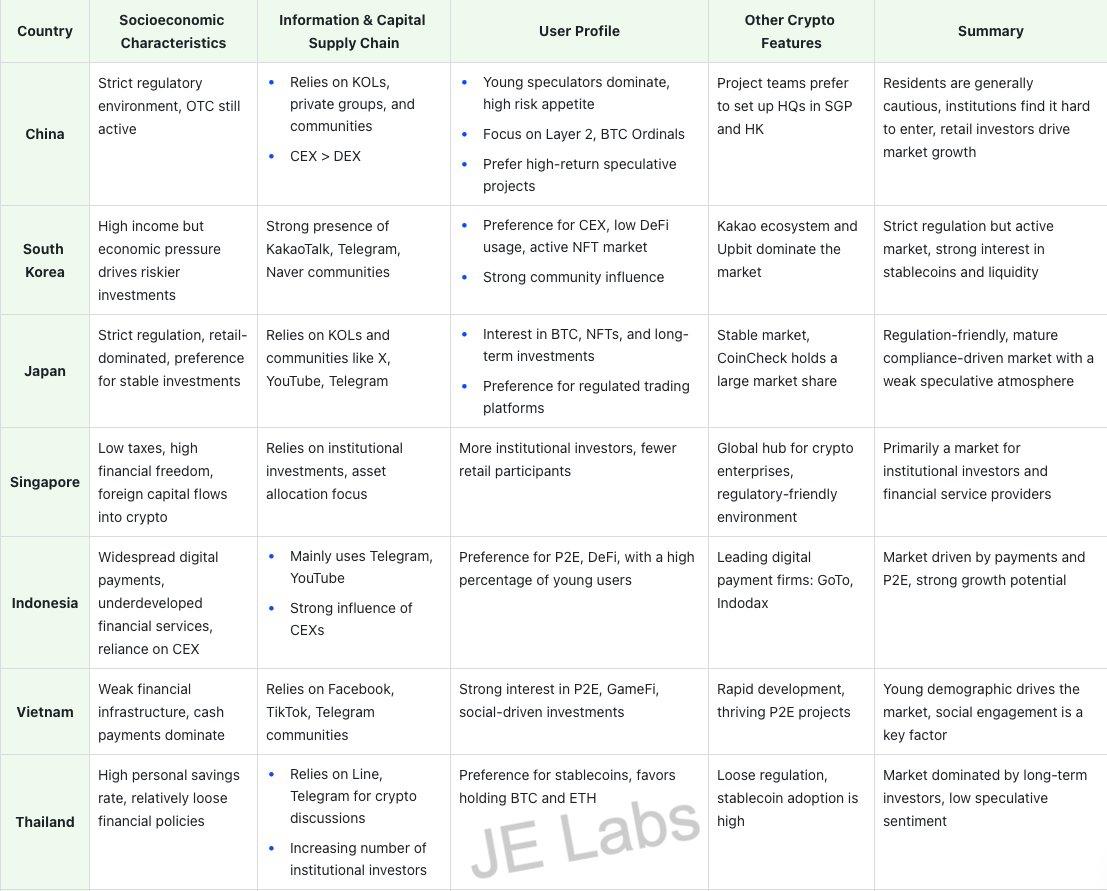
Asia Crypto Markets Comparison by JE Labs
Key GTM Strategies
GTM (Go-To-Market) method is a business strategy aimed at planning how a company will bring its products or services to market and attract customers. The key for project issuers to successfully promote Web3 projects in the Asian market lies in precise localization strategies and community penetration.
First, localization is the key to opening the Asian market. Since Asia is not a single market but a complex of multiple cultures, languages, and regulatory environments, market entry strategies need to be tailored to each country's cultural and regulatory context. For example, localize narratives using content that resonates with and is easily spread by local users. In terms of information dissemination, content localization is equally important, requiring precise translation and adjustment to suit local user habits. Social media channels vary by country: China (WeChat, Weibo), South Korea (KakaoTalk, Naver), Japan (Line, CoinPost), and Southeast Asia (TikTok).
Second, in terms of regional ecosystem integration, Southeast Asia, South Korea, and Japan have high acceptance of GameFi and Non-Fungible Token, making them ideal locations for game and Non-Fungible Token-related projects; China is very suitable for fintech and DeFi applications, while Hong Kong and Singapore can serve as compliance portals. Additionally, project issuers need to segment users, with different markets requiring different ICPs (Ideal Customer Profiles), such as institutional clients (B2B), retail investors (B2C), and developers (B2D).
Community-driven approach is the core method of gaining user trust, including community-driven trust-building and expanding market influence through KOLs:
Deep local integration: Regular contact, active community participation, and long-term trust building;
Early user incentives: Issuing Non-Fungible Token or airdrop rewards to maintain user stickiness and loyalty;
Continuous engagement: Organizing AMAs, continuously producing content, and maintaining high community activity.
Collaborating with KOLs: Local KOLs have enormous influence, and collaboration can enhance credibility, precisely targeting users through tweets, community marketing, and KOL partnerships.
Specific Asian Country Analysis and How to Enter Asian Markets
China: Precise Positioning and Private Traffic Growth
Leverage Hong Kong as a compliance portal to connect global and mainland markets;
Collaborate with KOLs to increase influence through WeChat community traffic.
South Korea: Transaction-Driven, CEX is Key
Listing on local CEX (especially Upbit) will be game-changing, directly impacting market trust;
Establish communities on KakaoTalk and Telegram, and collaborate with KOLs to increase project visibility;
Media exposure is more important than community management, as it can enhance credibility.
Japan: User Experience and Institutional Preference
High-net-worth users prioritize UX/UI experience and local Non-Fungible Token culture over airdrops;
Expand influence through prominent media like CoinDesk Japan and CoinPost;
Collaborate with Web3 institutions like Bitget Wallet to reach target users.
Southeast Asia: Huge Potential for DeFi and GameFi
Indonesia: P2E and airdrop-intensive viral growth strategies work best.
Vietnam: Developed Web3 game ecosystem, ideal for deep GameFi expansion.
Thailand: Transparent policies, rich DeFi opportunities, suitable for localized promotion.
Philippines: Token economy highly integrated with gaming and pop culture, leading to higher Non-Fungible Token adoption.
Malaysia: Continuous growth in DeFi adoption, huge potential in stablecoin and lending markets.
In conclusion, to develop the Asian market, project issuers must anchor the right target market and define ICP, with the key being precise localization strategies and community penetration, and a deep understanding of regulatory policy directions and communication channels. For instance, China, South Korea, Japan, and Thailand are primarily transaction-user-focused, while Southeast Asian countries like Philippines, Vietnam, and Malaysia are more suitable for DeFi, GameFi, and P2E growth strategies, with Hong Kong and Singapore serving as compliance portals and capital circulation channels. It's crucial to note that in the context of typically long Web3 project lifecycles, building long-term effective community relationships is far more effective in retaining users than short-term hype.