Author: JE Labs
"It takes 20 years to build a reputation and five minutes to ruin it" - Warren Buffett
Recently, the market seems to be in an amplifier of FUD emotions - even minor technical vulnerabilities or trivial internal community issues can quickly ferment into a "crisis" under the high transmission effect of social networks, and many industry partners have come to discuss with us how to "turn danger into safety".
In our view, effective crisis management has never been about blindly "explaining", but continuously conveying to the community at every stage: "We are taking responsibility."
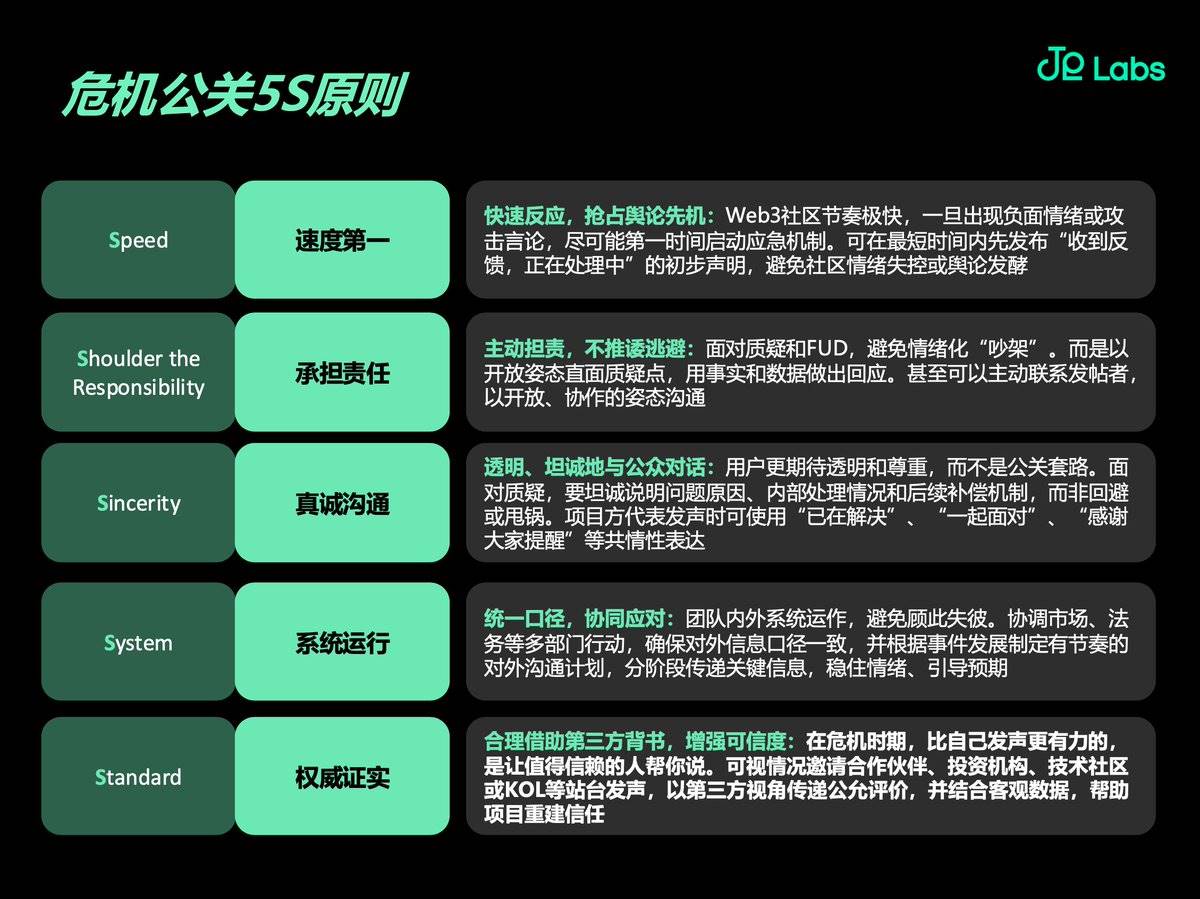
We have summarized the three types of crises common in Web3 projects and, combined with the 5S principles verified in our practice, we have customized response strategies for each type of crisis to help project parties maintain trust in uncertainty and turn pressure into opportunity. We hope these methods can help more Web3 builders become stronger in the face of challenges.
📖 Three Types of Crises and Response Strategies
1.1 Rumors and Misunderstandings: Trust Crisis Arising from Information Gaps Requires Efficient Clarification and Credible Communication Mechanisms
Many crisis outbreaks are not caused by project issues themselves, but by misunderstandings during fragmented information dissemination - such crises are often triggered by taking things out of context, edited screenshots, or rule misunderstandings, which, once spread, can label the project as "non-transparent" or even "running away".
1️⃣ Rapid Response, Seize the Narrative: When facing rumor-related public opinion, rhythm and attitude are most critical. The project should provide feedback at the first opportunity, even if it's just a concise sentence: "We have noticed the related discussion and are verifying." This can effectively curb further community emotional fermentation. Initial response doesn't need to provide all answers but must demonstrate "we are watching, we are acting" to show the project's attitude and actions.
2️⃣ Fact-Based Counterattack, Avoid Emotionalism: Responses must anchor to facts. Do not be led by attacks, and do not fall into arguments and accusations. Once the project's tone becomes confrontational or emotionally expressed, it can easily trigger secondary crises and make the situation more out of control. Only by speaking with facts and supporting with data can misunderstandings and panic truly be quelled.
3️⃣ Leverage Credible Third-Party Voices: When facing misunderstandings, the project is best not to fight alone. A word of recognition from technical partners, ecosystem partners, or KOLs who have long supported the project is often more convincing than the project's self-explanation. Reasonably mobilizing external endorsement resources helps quickly break through doubts and speculations. For technical misreadings, projects should proactively use diagrams, threads, and other forms to break down key information in an easy-to-understand, visualized way, "translating" professional content into "community language" to truly resolve misunderstandings and rebuild understanding.
[The translation continues in the same manner for the rest of the text, maintaining the original structure and meaning while translating to English.]Follow-up Feedback (3-7 days): Deliver transparent results, update future prevention mechanisms, and invite community supervision.
This framework helps the project stabilize emotions, win buffer time, and convey sincerity before emotional outbursts, effectively avoiding crisis escalation.
🔐Three-Tier Crisis Public Relations: Long-Term Mechanism from "Firefighting" to "Transformation"
Tactics can only solve temporary crises, but only by cultivating long-term mechanisms can a true moat be built, allowing projects to remain calm, respond quickly, and effectively solve problems when facing a crisis:
👀Preventive Level: Establish Public Opinion Early Warning Strategy
Web3's communication speed is extremely fast, and project parties must have the ability to "see the storm clouds". By setting keyword monitoring, regular community patrols, and emotional trend data analysis, a fixed detection mechanism is formed to achieve continuous public opinion perception on platforms like Discord, Twitter, and Telegram.
The goal is simple: prepare before the storm arrives.
✍️Response Level: Rapid Response + Multilingual Collaboration Mechanism
Once a crisis occurs, the project needs to immediately activate an operational mechanism. We recommend preparing a "modular text library" with templates for different scenarios written in advance by content, legal, and technical roles. Multilingual operations/partners/KOLs need to synchronize responses within 3 hours, covering mainstream language areas to prevent an "information vacuum" of silence.
📓Aftermath Level: Governance Mechanism + Narrative Reconstruction
True public relations is not about "extinguishing" a crisis, but "rebuilding" community confidence. After resolving an issue, the project can transform a crisis into a brand trust endorsement through improvement proposals, community governance voting, and transparent upgrade plans, potentially reshaping the project vision and guiding users from "doubters" to "co-builders".
🔍Crisis is a Magnifying Glass, Public Relations is a Firewall
Ultimately, each crisis is an amplified examination of a project's usual accumulation. Whether a project has a stable community atmosphere, long-term KOL relationships, and recognized brand trust cannot be remedied by temporary public relations.
JE Labs always believes that crisis management capability is not built on a single response's "eloquence", but on whether the project party is continuously establishing long-term trust and willing to take full responsibility. Before a crisis arrives, we must make "responsibility" part of the project culture and polish governance and multilingual response mechanisms into standard configurations.
As Mr. Churchill said: "Never waste a good crisis." If handled properly, the crisis itself can become a turning point for the project to strengthen awareness and enhance trust.