In less than 18 months, Ethena has established a core position in decentralized (DeFi) and centralized financial (CeFi) infrastructure, with its stablecoin USDe becoming the fastest USD asset to break through $5 billion in supply. Crypto venture capital firm ParaFi analyzes Ethena from three perspectives, revealing its price stability, yield strategy, and potential limitations.
🧵 1/ In less than 18 months, Ethena has become a bedrock across both DeFi and CeFi infrastructure.
Ethena's USDe has become the fastest USD asset to reach 5bn in supply. With Ethena's rapid growth, the ParaFi team wanted to do a deep dive into the protocol's mechanics. We… pic.twitter.com/vC5SDWqaqp
— ParaFi Capital (@paraficapital) April 17, 2025
Table of Contents
ToggleStablecoin USDe Maintains Strong Peg
First, ParaFi discovered that Ethena's USDe stablecoin demonstrates high resilience in extreme market volatility. Over the past year, even when Bitcoin experienced eight intraday drops of over 10%, and even during the largest hacking event in crypto history, USDe maintained a deviation of no more than 0.5% from its $1 peg.
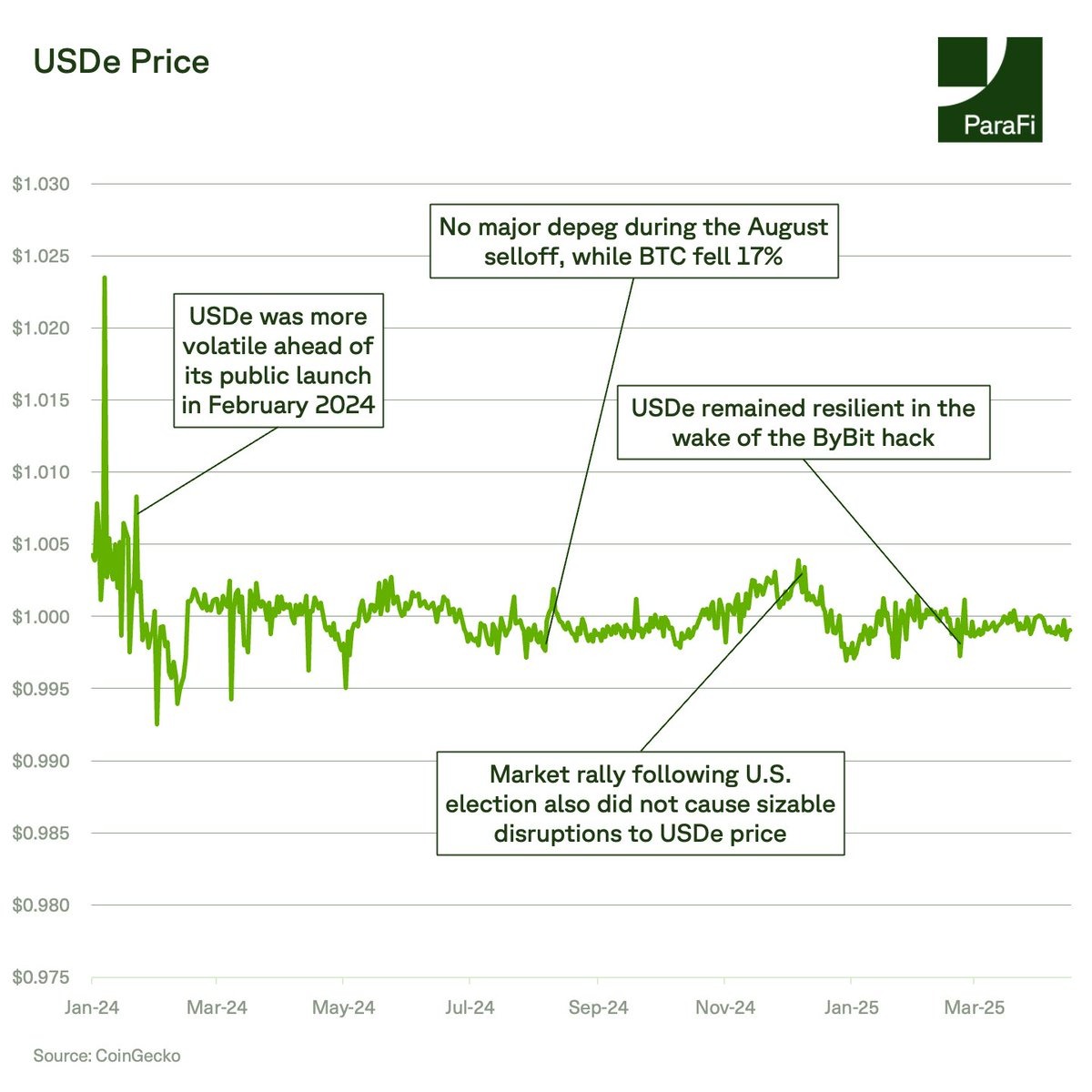
Since its launch, the protocol has processed up to $3.3 billion in redemptions, successfully handling $409 million in redemptions in just two weeks after the "Liberation Day" following Trump's tariffs, demonstrating its highly reliable clearing mechanism.
Impressive Yield Performance
sUSDe Becomes a DeFi Yield Indicator
As the staked version of USDe, sUSDe is rapidly becoming a key reference point for "measuring market risk appetite and yield capacity" in the DeFi field. sUSDe's average annual percentage yield (APY) over the past six months reached 12.3%, significantly outperforming MakerDAO's 8.8% and Bitcoin's 9.2%.
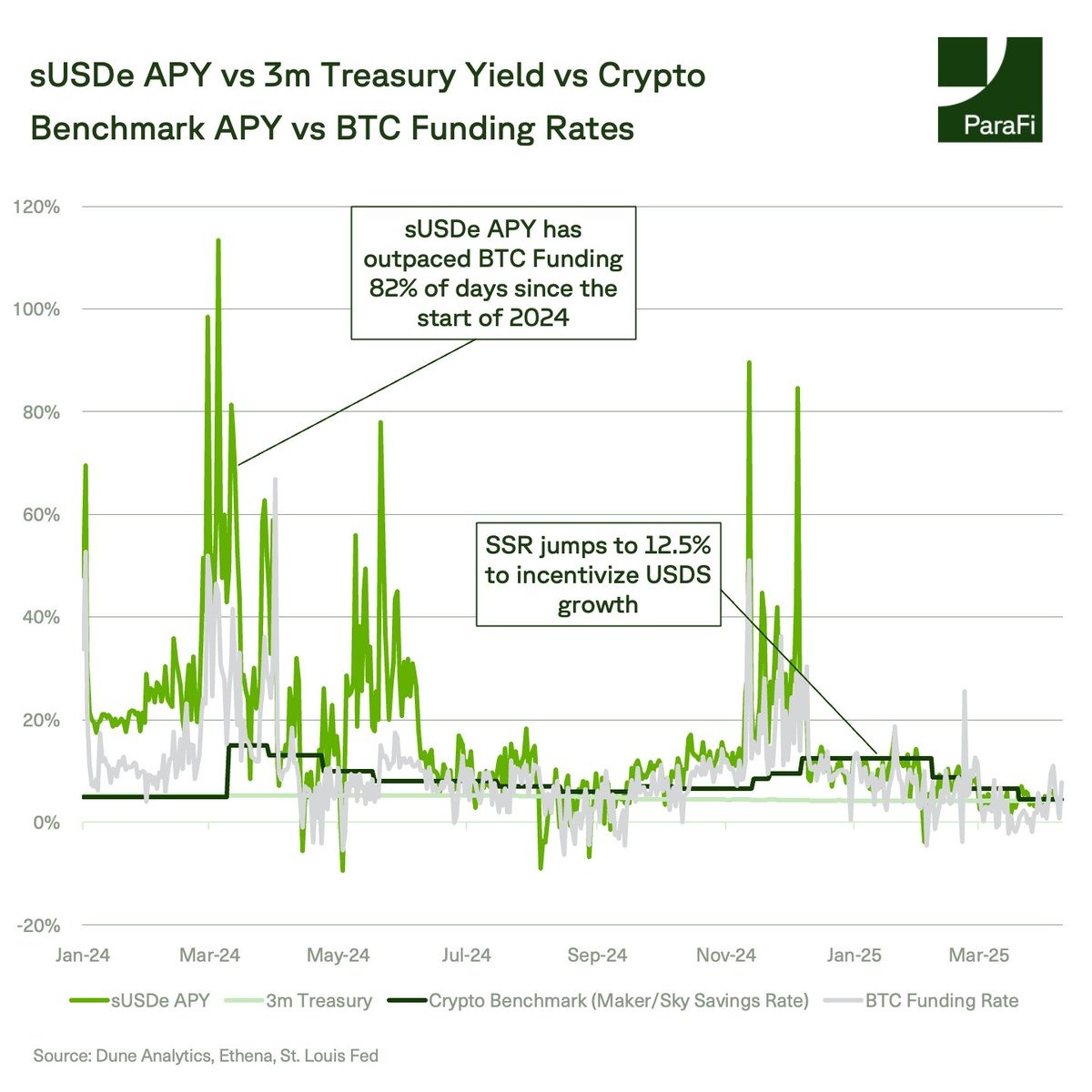
This yield primarily comes from the "basis trade" strategy, with positive funding rates on 93% of trading days. Additionally, since only 43% of USDe is staked, yields are concentrated among a smaller group of holders, while enhancing capital efficiency through the "cross-margin" mechanism of the custody framework.
Flexible Asset Allocation Strategy
Simultaneously, Ethena dynamically manages its collateral, adjusting strategies based on market conditions, covering "funding rate arbitrage, stablecoin yields, and Treasury rate yields". In December 2024, it introduced the USDtb stablecoin issued by the BlackRock-supported BUIDL product, with a supply now exceeding $1.4 billion.
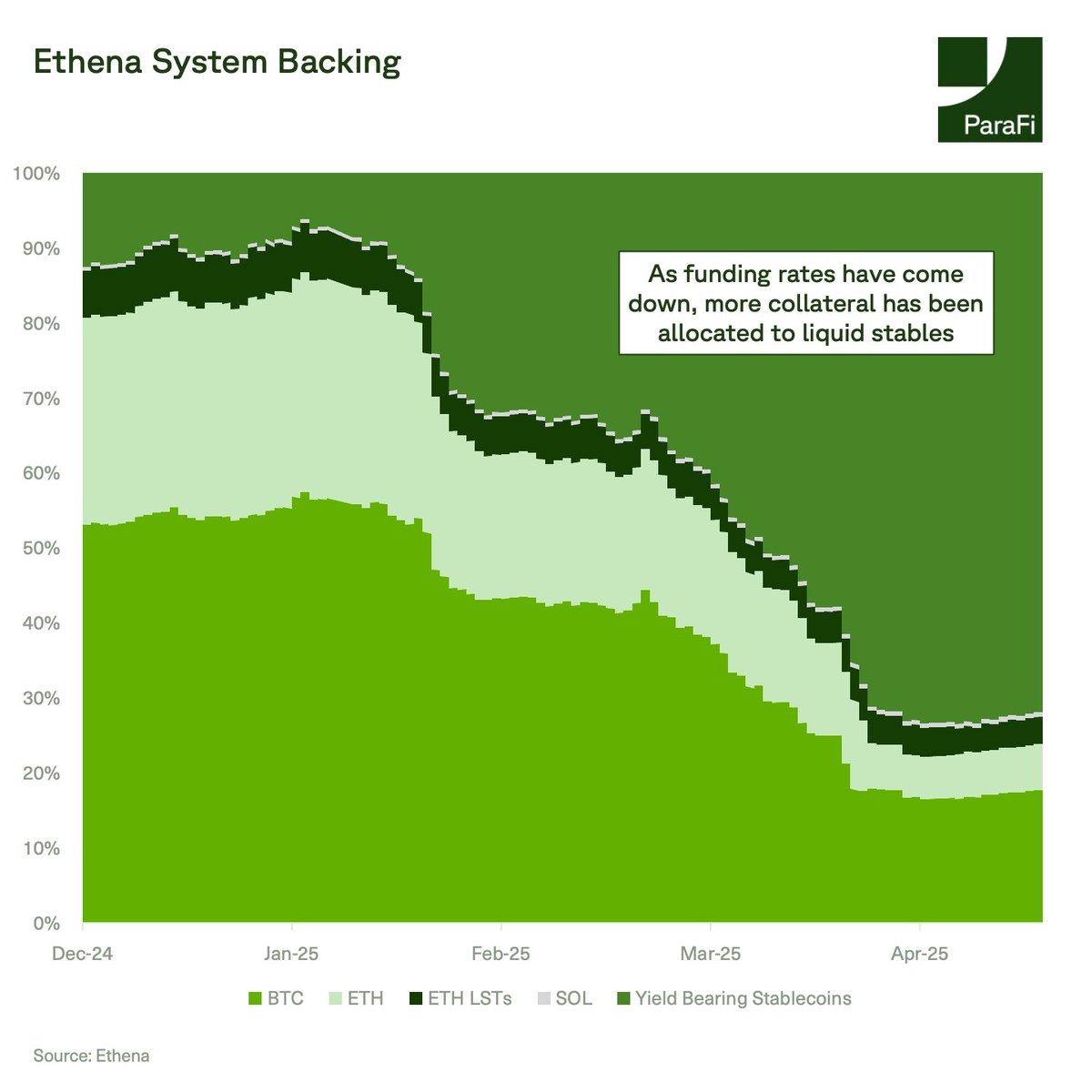
Currently, 72% of the protocol's collateral consists of highly liquid stablecoins, compared to BTC and ETH each accounting for 53% and 28% at the end of 2024, demonstrating a clear shift towards stable yield assets in response to market conditions.
TVL Growth Still Has Room, Not Yet Reaching Ceiling
Despite USDe's supply reaching $5 billion, Ethena's Total Value Locked (TVL) only represents 12% of the total open interest in BTC, ETH, and Solana perpetual contracts. Even during the market's rapid expansion at the end of 2024, its supply proportion only reached 14%, indicating that it is far from reaching market capacity limits.
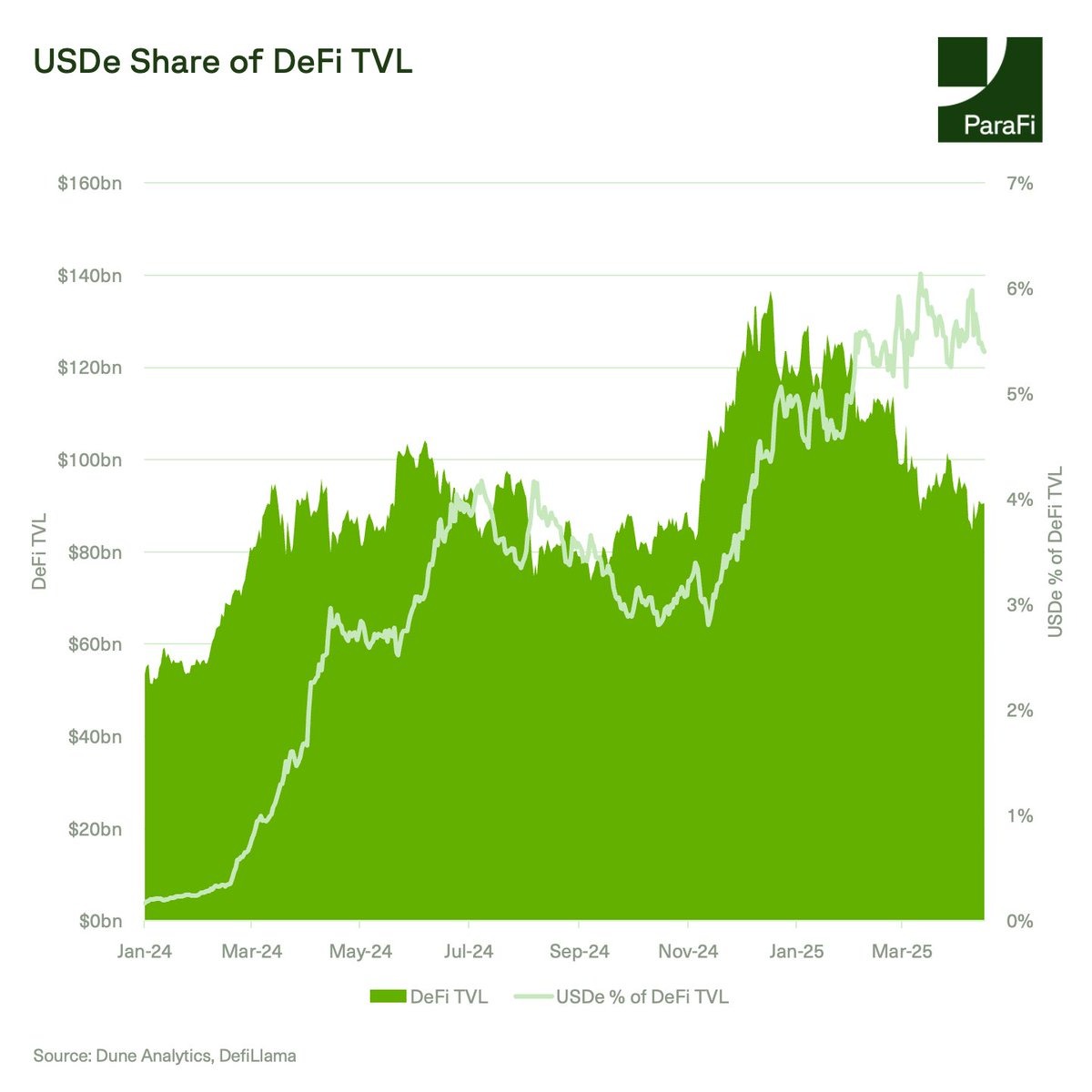
Moreover, Ethena's products are deeply embedded in multiple DeFi protocols: USDe accounts for about 60% of Pendle's TVL and about 12% of Morpho's TVL. Even though DeFi's overall TVL has declined by 23% since 2025, USDe has only slightly dropped by 17%, demonstrating relatively robust market performance.
ParaFi finally pointed out the following risks and opportunities to watch:
Opportunities
USDtb Expansion and Integration: Whether USDtb can expand integration with more DeFi protocols or yield sources will directly impact Ethena's protocol stability and yield performance.
Institutional Adoption Potential of iUSDe: If it gains favor from financial institutions, it will enhance market trust, bring new funding sources for Ethena, and become an important milestone in its expansion into mainstream markets.
Upcoming Converge Network: Further expand the Ethena ecosystem, starting with simplifying user experience, providing more tokenized asset yield opportunities for institutions.
USDe Application Scenarios: Currently, USDe is mainly used for staking yields in DeFi. If developed into a daily payment or commercial transaction stablecoin, it will significantly enhance its liquidity and market demand.
(Converge 2025 Roadmap: High-Speed, Secure, Low-Cost Connecting RWA and DeFi Future)
Risks
USDe Supply Performance Under Negative Funding Rates: Negative funding rates will compress Ethena's revenue sources, thereby affecting USDe's issuance momentum and overall supply growth.
Exchange Operation Risks: Ethena's hedging and funding rate arbitrage strategies rely on CEX operations. If system failures or cybersecurity risks occur, they may jeopardize protocol stability.
Dark Horse Establishing Foundation, Ethena Moves Towards Next Growth Stage
In less than 18 months since its launch, Ethena has become not just a dark horse in the crypto field, but is gradually becoming a key infrastructure for stablecoin and yield markets. By combining innovative yield models, flexible asset allocation, and stable pegging performance, its diverse products have gained substantial market share in DeFi.
However, as ParaFi Capital pointed out, Ethena's future development will depend on its ability to respond to market changes. If it can establish a firm footing, it may become an indispensable part of the crypto financial system.
Risk Warning
Cryptocurrency investment carries high risks, and prices may fluctuate dramatically. You may lose all your principal. Please carefully assess the risks.